

Divided state Supreme Court says judges cannot review discipline of judicial workers
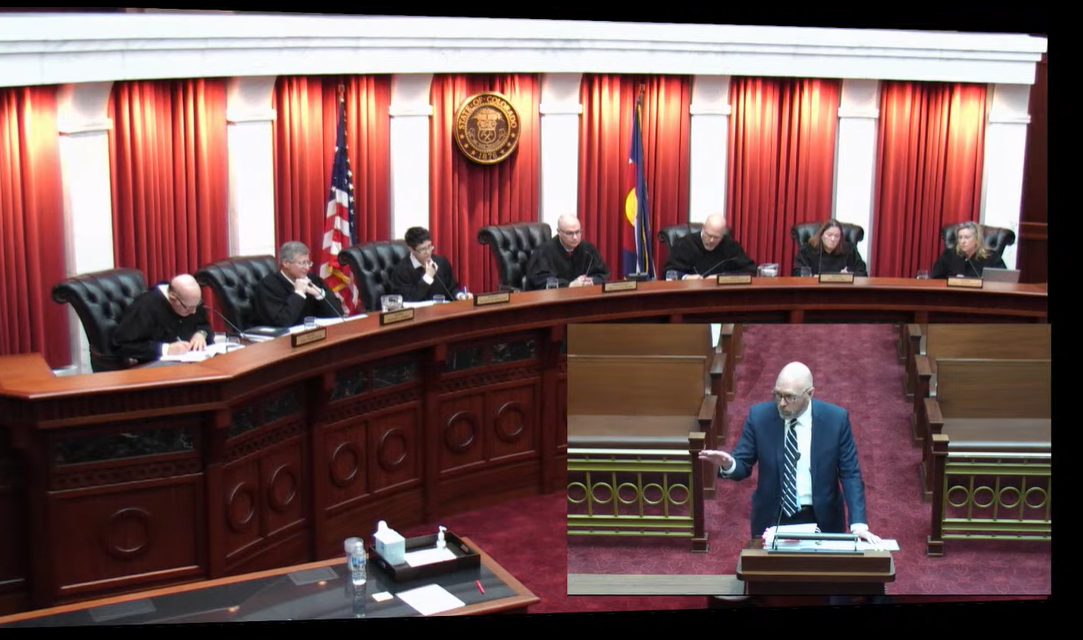
In an extraordinary decision pitting one part of the state’s judicial branch against another part, the Colorado Supreme Court decided on Monday, by 4-3, that trial judges are not permitted to hear disciplinary appeals involving judicial employees – an option afforded to other government workers.
The majority of justices believed the court system’s personnel rules made the judicial branch’s own appeal board the final stop for disciplinary disputes. Moreover, the Colorado Judicial Department’s Personnel Board of Review contained far more procedural safeguards than the process for non-judicial public employees.
“We are aware that the Personnel Rules are not identical to the rules governing personnel matters in the executive and legislative departments,” wrote Justice Carlos A. Samour Jr. in the Nov. 7 majority opinion. However, there is “no statutory requirement that our employees be treated in exactly the same manner as employees in the executive and legislative departments.”
Justice Monica M. Márquez disputed that conclusion. Writing for herself, Chief Justice Brian D. Boatright and Justice Melissa Hart, Márquez took aim at a key argument of the majority: that trial judges should not be allowed to review the disciplinary decisions made by the department’s personnel board because its members include appellate judges or justices.
“I see no reason to think that a district court judge would have any difficulty reviewing the Board’s decision,” she retorted. “I trust my colleagues serving on the district courts to adjudicate such matters fairly and impartially – as they do with all matters.”
The case that prompted the divided ruling originated out of the 18th Judicial District, which encompasses Arapahoe, Douglas, Elbert and Lincoln counties. In December 2018, probation officer Abbey Dickerson, an employee of the judicial branch, disclosed personal information about a client on her Facebook page. She did not, however, identify the man by name.
The chief probation officer for the judicial district terminated her months later, writing that Dickerson had broken departmental policies and failed to take responsibility for her actions. Dickerson appealed that decision, following the procedures in the court system’s personnel rules.
Dickerson received a hearing in front of a retired Court of Appeals judge who served as the hearing officer. The retired judge heard from witnesses, reviewed evidence and issued a decision that found the chief probation officer had acted arbitrarily in firing Dickerson. He reinstated her with a 90-day unpaid suspension.
The 18th Judicial District, in turn, appealed to the personnel board, which voted by 5-3 to uphold the hearing officer’s decision. Among the board’s members were three judges, including an appellate judge. The personnel rules label such decisions as “final, and there is no further right to appeal.”
Nevertheless, the 18th Judicial District turned to the Denver District Court, asking a trial judge to find that the board had abused its discretion. The district cited the procedural rule that allows for judges to analyze the final decisions of “any governmental body” or “lower judicial body.”
But the trial judge believed he did not have jurisdiction to hear the case, and a Court of Appeals panel agreed the Colorado constitution granted the Supreme Court the power to establish personnel rules. The rules did not allow for judicial review, so there was no path forward for the appeal.
During oral arguments before the Supreme Court in September, Dickerson’s attorney suggested that the extreme length of time it has taken for the 18th Judicial District’s appeal to work its way through the system should illustrate how judicial review is not meant to play a role in the disciplinary process.
“This is the worst possible way to operate a personnel system, where Ms. Dickerson or her counterpart would have to wait years before knowing whether or not they’re gonna be reinstated,” said Barry D. Roseman.
The justices grappled with the competing forces at play. On the one hand, if the personnel board’s decisions were unappealable, judicial employees would not have the same path available to them as other government employees to challenge their discipline. On the other hand, the unavailability of judicial review was advantageous to Dickerson under the current scenario, in which the personnel board imposed a less severe sanction on her.
“If we say there’s no review, there’s no review in either situation,” observed Hart.
The court’s majority determined the language of the personnel rules clearly prohibits judicial review of disciplinary decisions. But the majority went further in its reasoning, defending the process the court system had set up for itself.
“Given the extensive similarities between a trial and an appeal in a civil case,” Samour wrote, “it is not surprising that we conclude today that an employee who is disciplined enjoys substantial procedural rights under the Personnel Rules.”
He further boasted that there was “no decision-making system that’s as robust as the one our employees enjoy.” Then, Samour pointed out it would turn the “judicial world as we know it upside down” if a trial judge had the power to review and reverse a decision of the personnel board, which has other trial judges and an appellate judge as its members.
Samour argued the Supreme Court never intended to allow for such “perverse scenarios.”
“Superimposing district court review on this review process would be duplicative, not to mention ill-advised,” he concluded. “They’re our rules; there’s nothing stopping us from kickstarting the process to revise them.”
The dissenting justices disagreed broadly with Samour’s assessment of the issue. The personnel board fit under the definition of “any governmental body,” Márquez noted, meaning its decisions were fair game for judicial review under the procedural rules.
Further, she did not view the trial-like procedures for disciplinary actions as proof the courts were following a different system than other governmental entities. Instead, the disciplinary protocols had the hallmarks – including public hearings and decisions based on evidence – of other types of decisions subject to judicial review.
“I am concerned that the majority’s decision to preclude review in this context results in treating Judicial Department employees differently than all other state employees,” Márquez warned.
A spokesperson for the Judicial Department said the Office of the State Court Administrator is reviewing the decision, but could otherwise not speak to whether the Supreme Court intends to revise its personnel rules.
In another case implicating judicial review, the Supreme Court recently accepted an appeal to scrutinize the State Board of Education’s final authority over certain charter school denials. The justices will similarly consider if judicial review exists for that category of state board actions, or whether, like the Judicial Department’s personnel board, there is nowhere to turn after a final decision.
The case is Colorado Judicial Department v. Colorado Judicial Department Personnel Board of Review.

Colorado judge blasts state forensics lab in dismissing child sex case
Jenny Deam
jenny.deam@gazette.com
Updated 31 minutes ago
In a potentially widely consequential action, a Weld County district judge dismissed a child sexual assault case, citing the ongoing scandal at the Colorado Bureau of Investigation’s forensic lab that “has left a dark mark on the history of Colorado...
10th Circuit sympathetic to Colorado consumer protection law governing interest rates
Michael Karlik
michael.karlik@coloradopolitics.com
Updated 23 hours ago
Members of the Denver-based federal appeals court appeared sympathetic on Tuesday to Colorado’s assertion that it can lawfully require certain out-of-state banks to abide by the state’s own ceilings on interest rates when they lend to consumers in Colorado. The...
Colorado justices to decide insurance companies’ obligation to disclose relevant policies
Michael Karlik
michael.karlik@coloradopolitics.com
Updated 29 minutes ago
The Colorado Supreme Court announced on Monday that it will decide whether an insurance company violated state law by withholding an at-fault driver’s policy for nearly a year when there was no dispute that the policy was not in effect...

Judicial performance evaluations released, Montezuma County judge disciplined | COURT CRAWL
Michael Karlik
michael.karlik@coloradopolitics.com
Updated 2 days ago
Welcome to Court Crawl, Colorado Politics’ roundup of news from the third branch of government. Colorado’s citizen-led judicial performance commissions released their voter narratives for the judges standing for retention in November, plus a disciplinary panel imposed consequences on a...

DA justifies CSPD officers in fatally shooting man at McDonald’s
Cleo Westin
cleo-westin@coloradopolitics.com
Updated 1 day ago
The deadly shooting of a man by Colorado Springs police officers at a McDonald’s was ruled justified by the 4th Judicial District Attorney’s Office on Monday, the office announced in a news release. The ruling determined officers Daniel White, Mitchell...
Federal judge holds off on dismissing formerly bankrupt medical contractor from Jeffco jail death lawsuit
Michael Karlik
michael.karlik@coloradopolitics.com
Updated 21 hours ago
A federal judge declined on Monday to dismiss the formerly bankrupt medical contractor from a lawsuit over a detainee’s death in Jefferson County jail, but indicated she would do so if the plaintiffs’ attorneys go through the process to ensure...
Castle Rock caregiver sentenced after stealing more than $110,000 in jewelry from family
Nicholas Fogleman
nicholas.fogleman@denvergazette.com
Updated 1 day ago
A judge sentenced a Castle Rock caregiver to 90 days in jail after she pleaded guilty to stealing more than $110,000 worth of jewelry from the family of a disabled son under her care. Elsa Montejo-Fuentes, 32, had worked for...
Federal judge green-lights excessive force, retaliation claims for trial against Fort Collins officers
Michael Karlik
michael.karlik@coloradopolitics.com
Updated 4 days ago
A federal judge green-lit a jury trial last week against multiple Fort Collins police officers on claims that they used excessive force on one man who was standing unarmed in his underwear, and retaliated against another man for exercising his...
10th Circuit revives wage violation lawsuit against Papa John’s operator
Michael Karlik
michael.karlik@coloradopolitics.com
Updated 5 days ago
The Denver-based federal appeals court on Tuesday reinstated a former Papa John’s delivery driver’s lawsuit alleging violations of federal and state wage law. Steve Mighell worked for one month at a Denver Papa John’s location in summer 2023. He alleged...
Colorado appeals judge’s delays in releasing opinions noted by performance commission
Michael Karlik
michael.karlik@coloradopolitics.com
Updated 4 days ago
The citizen-led performance commission that provides guidance to voters about whether to retain members of Colorado’s second-highest court raised concerns by judges and attorneys that Judge Elizabeth L. Harris sometimes struggles with releasing opinions promptly. Harris, who joined the Court...
PREV
PREVIOUS

ELECTION 2022 | The 'unrealized potential’ of Latino voters in Colorado elections
From Spanish-language campaign ads to pleas to Latino voters during debates, Latino Coloradans took center stage in this year’s election – and for good reason. In 2020, 21.9% of Colorado’s population identified as Hispanic or Latino, according to Census results – the highest share since the 1870s. In the last decade, the Latino population of Fort […]

Despite parents, child leaving state, Supreme Court rules Colorado kept jurisdiction in welfare case
Even though the parents and the child at the center of a welfare case had all left Colorado at the time of the decision, the state Supreme Court on Monday agreed that an El Paso County judge retained the ability to terminate the parents’ legal rights over their daughter. The justices concluded that based on […]