

No constitutional right to challenge functionality receipt of breathalyzer, Court of Appeals rules

A person facing a drunk driving charge does not have the constitutional right to challenge the certificate of functionality that a breathalyzer device issues when taking measurements, the Colorado Court of Appeals ruled on Thursday.
The defendant “has not cited, nor have we found, any case from any jurisdiction holding that certificates similar to the I-9000 working order certificate are testimonial and subject to the Confrontation Clause,” wrote Judge Rebecca R. Freyre for the three-member panel.
Deputy Corey Dilka pulled over a vehicle with an inoperative tail light and noticed that the driver, William Edward Ambrose, had glassy eyes and smelled like alcohol. Ambrose consented to a sobriety check and a breath test, which revealed his blood alcohol content was 0.063.
Prosecutors charged him with driving while ability impaired and a jury for the Rio Blanco County District Court subsequently convicted him. Because Ambrose had prior convictions for driving under the influence of alcohol, the court elevated his charge to a felony and sentenced him to three years in community corrections.
Before the trial, Ambrose had asked the court to determine the reliability of the Intoxilyzer 9000 used in his breath test. In addition to giving a BAC readout and the machine’s serial number, the I-9000 issues a document certifying that it is working properly during a certain time period.
A New York Times investigation in 2019 found that courts had thrown out tens of thousands of BAC tests due to improper calibration, use of stale chemical solutions, or – in one instance – rats nesting inside a machine. The Times provided a Gilpin County District Court order from 2017 rejecting an I-9000 functionality certificate because the signature on the document came from a state health department employee who had left her job prior to the device’s approval. The judge found the health department knew about the incorrect signature, which was “not present for the sake of appearance” alone.
In Ambrose’s case, Judge Anne K. Norrdin found the Gilpin court’s order was “interesting and instructive,” but “I do find that the breath tests in the Intoxilyzer are not a new or novel science, such that the Court needs to hold an evidentiary hearing to address the reliability of the science.”
She added that Ambrose could present other evidence, but the I-9000 in his case was in compliance with the Colorado Department of Public Health and Environment’s regulations.
The Court of Appeals acknowledged that expert testimony must undergo an analysis for its reliability and the witness’s qualifications – preventing “junk” science from influencing a verdict. The panel found no problems with the machine itself or the deputy’s testimony.
The certification from the machine lacked a signature required by state law, which the defense argued made the test results inadmissible. Without discussing the legality of the signature, Freyre wrote that “any such deficiency goes to the weight of the evidence and not its admissibility.” The panel went on to conclude that the certificate from the I-9000 did not constitute testimony and was not subject to Ambrose’s Sixth Amendment right to confront the witnesses against him.
Charles L. Fife, a managing partner at Fife Luneau, P.C., whose firm was involved with the Gilpin County I-9000 case, called the court’s decision “intellectual gymnastics in order to get breath tests into evidence cheap and easily.”
He said the purpose of the certificate was to avoid the need for prosecutors to call technicians in for every case to attest to the devices’ functionality. “It shifts the burden of proof, because the only thing the prosecution has to do is bring in this document that has the state seal on it – that is not attested to, as required by statute,” he added.
A 2009 U.S. Supreme Court decision deemed that laboratory test results are testimonial, meaning they establish material facts about the trial and defendants therefore have a right to confront the preparers of such reports.
Freyre pointed out, though, that “neither our supreme court nor the United States Supreme Court has decided whether a certificate used to establish that an intoxilyzer machine complies with state rules and regulations is testimonial and subject to the Confrontation Clause.” The appellate opinion also explained the certificates did not contain information about the impairment and were not prepared as scientific trial evidence – plus, no other court had taken Ambrose’s side on the issue.
Karen Steinhauser, a former prosecutor-turned criminal defense attorney, emphasized that a defendant can still call witnesses to challenge the reliability of an I-9000’s results under the ruling – after the certificate is admitted.
“They were differentiating the certificate from the result that comes out of it,” she said. “The defense could argue that all you have is this certificate. There’s no testimony saying this machine is working.”
Fife called the result of the ruling “trial by breath box,” and that the I-9000 receipts are getting around the state requirement that the executive director of the health department or their deputy sign off on the certification.
“This decision is not about transparency. It’s about efficiency,” he said.
Ambrose further challenged the constitutionality of Dilka’s investigative stop, which is permissible as long as law enforcement has reasonable suspicion that a crime has been or is about to be committed. The court agreed that the absence of a tail light and the illumination of Ambrose’s white backup light constituted a violation of the law and were an appropriate basis to pull Ambrose over.
The judges also dismissed Ambrose’s claim that a juror was biased against him because she raised her hand when his attorney asked if any prospective jurors believed it was “never okay” to have a beer before driving. The court found that Ambrose’s attorneys failed to follow up with the juror about her ability to decide fairly.
The case is People v. Ambrose.


Flesh-eating cattle parasite spreads beyond Texas as new screwworm cases found | OUT WEST ROUNDUP
The Associated Press
the-associated-press@coloradopolitics.com
Updated 4 days ago
NEW MEXICO Screwworm spreads beyond Texas Three more cases of the New World screwworm have been confirmed, including one found in a dog in New Mexico, outside the main cluster in Texas, demonstrating the difficulty of stopping a resurgent pest...
Michael Dougherty is literally running for attorney general in Colorado Democrat’s 1st TV ad
Ernest Luning
ernest.luning@coloradopolitics.com
Updated 2 days ago
Democratic attorney general candidate Michael Dougherty, the Boulder County district attorney, runs laps around the judicial complex in Denver that houses the office he’s seeking in a TV ad released Friday that includes a subtle dig at one of his...

Group aims to add right to hunt and fish to Colorado Constitution
Marissa Ventrelli
marissa.ventrelli@coloradopolitics.com
Updated 2 days ago
A group is seeking to make Colorado the 25th state in the nation with an established constitutional right to hunting and fishing through a proposed ballot initiative. Backed by the International Order of T. Roosevelt, a group dedicated to preserving...

Colorado Politics Calendar June 15-21
Rachael Wright, Special to Colorado Politics
rachael.wright@coloradopolitics.com
Updated 5 days ago
CoPo’s weekly political calendar helps you find political and public policy events throughout Colorado. It includes candidate and issue campaign events, public policy meetings, court hearings, state and local party conventions, assemblies, debates, rallies, parades, speaking engagements, traveling dignitary appearances,...

A primary brings out primal instincts | SONDERMANN
Eric Sondermann
eric-sondermann@coloradopolitics.com
Updated 4 days ago
There are no Stanley Cup finals or NBA title showdowns involving local teams this June. In their place, we are inundated with primary election campaign ads. Coloradans can be excused for missing the diversion and alternate programming. But life can...
Dem-GOP tension dominates 1,000-bill legislative session | A LOOK BACK
Rachael Wright, Special to Colorado Politics
rachael.wright@coloradopolitics.com
Updated 4 days ago
Forty-Five Years Ago This Week: “I can honestly say that until now, we got along well with the governor’s office,” said House Minority Leader Federico Peña, D-Denver. “We visited frequently with the staff. And you didn’t see certain legislators speaking...

Hickenlooper lands endorsements from Elizabeth Warren, Ministerial Alliance in US Senate primary
Ernest Luning
ernest.luning@coloradopolitics.com
Updated 3 days ago
U.S. Sen. John Hickenlooper won endorsements this week from a progressive Democratic colleague and a coalition of metro-area African American faith leaders as voting began in Colorado’s primary election. U.S. Sen. Elizabeth Warren of Massachusetts and the Greater Metro Denver...
Colorado justices say insurers may access policyholders’ medical info in denied-benefits litigation
Michael Karlik
michael.karlik@coloradopolitics.com
Updated 18 hours ago
The Colorado Supreme Court declined on Monday to expand its narrow prohibition on insurance companies accessing policyholders’ medical information, clarifying that a dispute over an insurer’s bad-faith decision to deny benefits is the only situation where a company is limited...

House District 14: Businesswoman, consultant square off in GOP primary
Mary Shinn
mary-shinn@coloradopolitics.com
Updated 3 days ago
Firearms training company owner Ava Flanell will face Troy Vanderhule, the chief fundraising officer for Dobson Philanthropic, in the June 30 Republican primary for state House District 14, an area in northern Colorado Springs. Flanell was appointed to the seat...
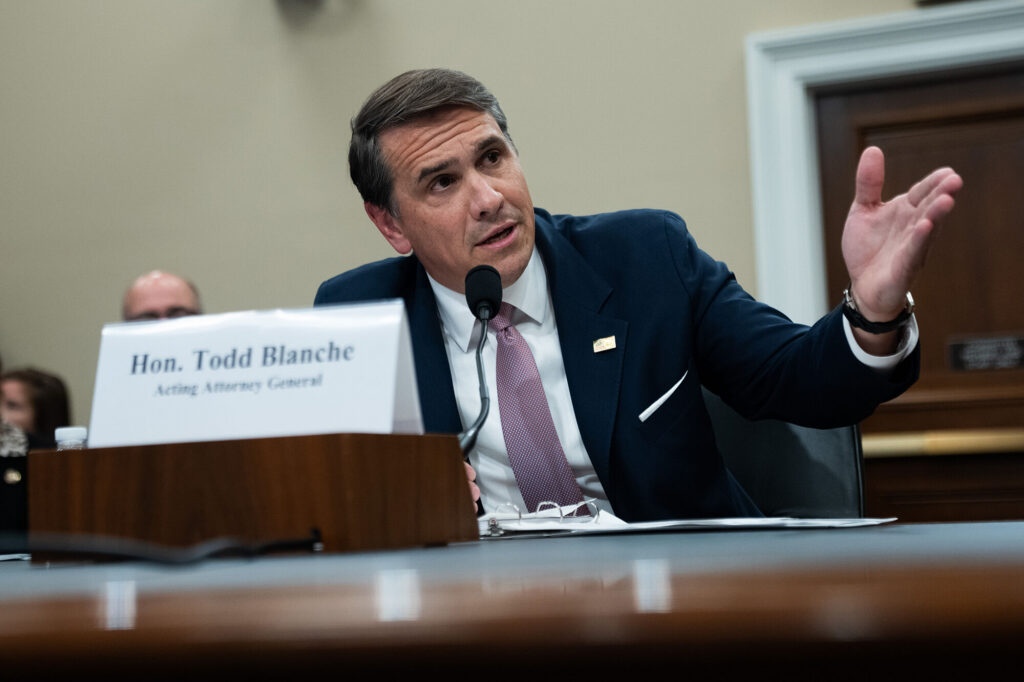
Federal judge wants Todd Blanche to swear in writing anti-weaponization fund won’t be revived
Jack Birle, Washington Examiner
jack.birle.washington.examiner@gazetteedit.wpenginepowered.com
Updated 3 days ago
A federal judge maintained a block on the Department of Justice’s $1.776 billion anti-weaponization fund Friday, despite the DOJ claiming they have abandoned the planned fund aimed at compensating allies of President Donald Trump and others who say they were politically targeted by...
PREV
PREVIOUS
U.S. Space Command responds to another Russian anti-satellite test
Russia is conducting another test of an anti-satellite weapon, which could threaten American military systems in orbit, U.S. Space Command announced Thursday. The weapon is a highly-maneuverable satellite similar to one launched in April, the command, headquartered at Peterson Air Force Base, said in a news release. RELATED: Major road construction could help secure U.S. […]

New analysis highlights Colorado's lagging interstate system
Congestion, deterioration and fatalities on Colorado’s interstate highways is among the highest in the nation, according to a new report Thursday by the national transportation research nonprofit TRIP. From 2000 to 2018, vehicle travel increased 17 times faster than the corresponding rate at which new lane capacity has been added, according to the analysis. Colorado’s […]