

Cory Gardner wants to go to Mars
U.S. Sen. Cory Gardner wants to explore Mars.
Maybe not in person, but the Republican authored an amendment to the National Aeronautics and Space Administration Transition Authorization Act, a bill sponsored by Texas U.S. Sen. Ted Cruz and passed by the full Senate Friday, Feb. 17, that indicates an interest. Gardner’s amendment calls on the space agency to develop a plan to reach Mars with specific timelines and benchmarks, so Congress can hold the agency accountable and provide oversight.
Gardner, a member of the Senate Commerce, Science and Transportation Committee, had a second amendment, authorizing NASA to consider satellite servicing options for future programs, added to the act as well. That amendment encourages NASA to look at servicing and refurbishing existing satellites to extend their lifespan and capabilities.
“Aerospace plays a major role in Colorado’s economy, and this legislation will benefit the thousands of aerospace jobs in Colorado,” Gardner said in a statement. “Supporting a manned mission to Mars by requiring NASA to develop timelines and milestones is an important component in ensuring we see a successful mission.”
Since entering the Senate and serving on the Senate committee, Gardner has worked to support Colorado’s space industry. In June 2016, the Senate approved S.2943, the National Defense Authorization Act for Fiscal Year 2017, which included language Gardner authored that allows the Department of Defense to purchase rockets from any certified launch provider through Dec. 31, 2022, so long as the provider offers the best value.
That amendment promotes competition, protects U.S. national security and “paves the way for assured access to space, which is critical to detect missiles, transmitting secure communication, and gathering intelligence,” according to a news release from Gardner’s office. It is estimated the amendment could potentially save the Defense department as much as $5 billion.
Gardner also authored the Space Weather Research and Forecasting Act, bipartisan legislation introduced with Sen. Gary Peters, D-Mich., and Sen. Cory Booker, D-N.J., to improve efforts to predict and mitigate the effects of space weather events, which can have significant economic and security implications on Earth and in space.
The legislation was designed to strengthen space weather research and response by defining clear roles and responsibilities to the agencies that study and predict space weather events, including NASA, the National Oceanic and Atmospheric Administration, the National Science Foundation and the Department of Defense.

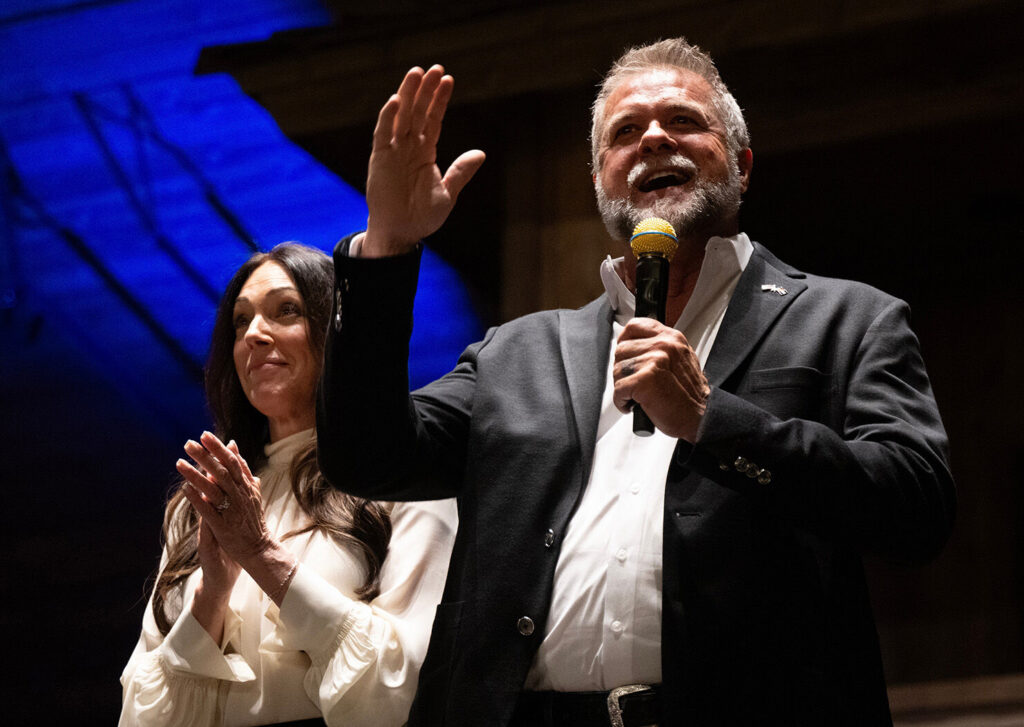
Victor Marx says he’ll only debate Phil Weiser once in Colorado governor’s race — without a moderator
Ernest Luning
ernest.luning@coloradopolitics.com
Updated 11 hours ago
Colorado Republican gubernatorial nominee Victor Marx said on Tuesday that he will participate in only one debate with Attorney General Phil Weiser before the November election — and he challenged the Democratic nominee to hold the event without a moderator....
10th Circuit finds no fair housing violation by Littleton landlord for worker’s alleged rape of tenant
Michael Karlik
michael.karlik@coloradopolitics.com
Updated 13 hours ago
The Denver-based federal appeals court concluded on Monday that Littleton’s housing authority could not be held liable for a maintenance worker’s alleged rape of a tenant, as the worker’s employment did not provide any special access to the victim. A...

Fauci’s Fifth Amendment answers may test Biden pardon as GOP eyes contempt
Kaelan Deese
kaelan-deese@coloradopolitics.com
Updated 12 hours ago
Dr. Anthony Fauci invoked his Fifth Amendment right against self-incrimination more than 100 times on Wednesday, a move legal experts described as strategically sound despite the politically damaging optics. Sen. Rand Paul (R-KY), chairman of the U.S. Senate Committee on...

Democrats must win 57 out of 77 competitive House seats to take majority: Cook Political Report
Hailey Bullis
hailey-bullis@coloradopolitics.com
Updated 14 hours ago
Democrats’ path to retaking the House in November has significantly slimmed as a result of the mid-decade redistricting war this cycle, a new analysis found. The nonpartisan Cook Political Report found that under the newly drawn maps across 10 states,...

Denver labor acknowledgment proposal faces council committee questions
Deborah Grigsby
deborah.smith@denvergazette.com
Updated 18 hours ago
A proposal to add a labor acknowledgment to Denver City Council proceedings has been delayed by the Finance and Business Committee after members raised questions about its wording, intentions and place in the council’s opening proceedings. The proposal, put forth...
Fauci invokes the Fifth Amendment and declines to testify in GOP-led Senate panel’s COVID-19 hearing
The Associated Press
the-associated-press@coloradopolitics.com
Updated 20 hours ago
WASHINGTON (AP) — Dr. Anthony Fauci on Wednesday invoked the Fifth Amendment and declined to answer questions from senators in a Republican-led committee hearing about his handling of the COVID-19 pandemic. The move injects new drama into the lingering tensions...

Colorado residents rush to buy guns ahead of new restrictions, breaking sales records for several stores
By Debbie Kelley
by-debbie-kelley@coloradopolitics.com
Updated 19 hours ago
Colorado residents are lining up to buy guns ahead of the latest weapons restrictions set to take effect this Saturday. The new law mandates individuals seeking to purchase semiautomatic firearms with detachable magazines to first complete a firearm safety course...

Crime continues to decline in Aurora, police chief says
Kyla Pearce
kyla.pearce@gazette.com
Updated 19 hours ago
Crime in Aurora continued to decline in the first half of 2026, according to Aurora Police Department officials. Crime overall in the city has been on a downward trend since 2024, according to APD. Between Jan. 1 and June 30,...

El Paso County rejects multi-family zoning request near Monument Academy
Savannah Eller
savannah-eller@coloradopolitics.com
Updated 18 hours ago
The El Paso County Board of Commissioners narrowly rejected a developer’s bid to convert land from low- to high-density residential zoning. The request, made by MA Infrastructure, LLC, would have allowed 12 units per acre on half of a 14-acre...

Atop taxes, here’s how much each Colorado resident pays in fees
Marissa Ventrelli
marissa.ventrelli@coloradopolitics.com
Updated 1 day ago
Each Colorado resident paid nearly $5,000 in state-sanctioned fees last year, according to a report by a policy think tank. The report, which analyzed how fees have affected Colorado’s economy, found that fee revenue has more than tripled since 2008...