Federal judge hears arguments about Colorado’s 3-day gun purchase waiting period

A federal judge heard arguments on Monday about the constitutionality of a 2023 Colorado law that generally imposes a three-day waiting period on firearm purchases after the initiation of a background check.
The test that the U.S. Supreme Court created in 2022 for assessing firearm regulations’ compliance with the Second Amendment occurs in two phases. First, judges must determine if the constitutional text applies to the regulation at issue, and then the government must show that the policy is consistent with similar regulations throughout the country’s history — in particular, around the time of the Second Amendment’s adoption.
“The first ‘cooling off’-style waiting period did not come into existence until the 1990s. Thirty years ago. Hardly a tradition,” said attorney Michael D. McCoy for the law’s challengers. “There should not be a further delay, whether it be three days or seven days, imposed on that person. That is unconstitutional.”
Assistant Solicitor General Joseph G. Michaels countered that the plaintiffs sought to recognize a constitutional right to “immediate” acquisition of firearms, which would not have been practical at the founding and is a window that is already built into federal law for conducting background checks.
“Whether it’s under a federal background check or whether it’s under Colorado’s waiting period law, three days is constitutionally acceptable,” said Michaels.
However, in advance of the hearing, U.S. District Court Senior Judge John L. Kane raised another issue for the parties. Before wading through the historical record and the constitutional arguments, he will need to decide whether two appellate judges from Colorado recently created irreconcilable legal precedent for Second Amendment challenges over the warnings of their colleagues.
In 2024, a three-judge panel of the U.S. Court of Appeals for the 10th Circuit issued a precedent-setting opinion in Rocky Mountain Gun Owners v. Polis, in which the challengers sought an injunction against Colorado legislation raising the gun purchasing age from 18 to 21. The panel, consisting of three Democratic appointees, rejected the challengers’ request, albeit with one judge employing different reasoning.
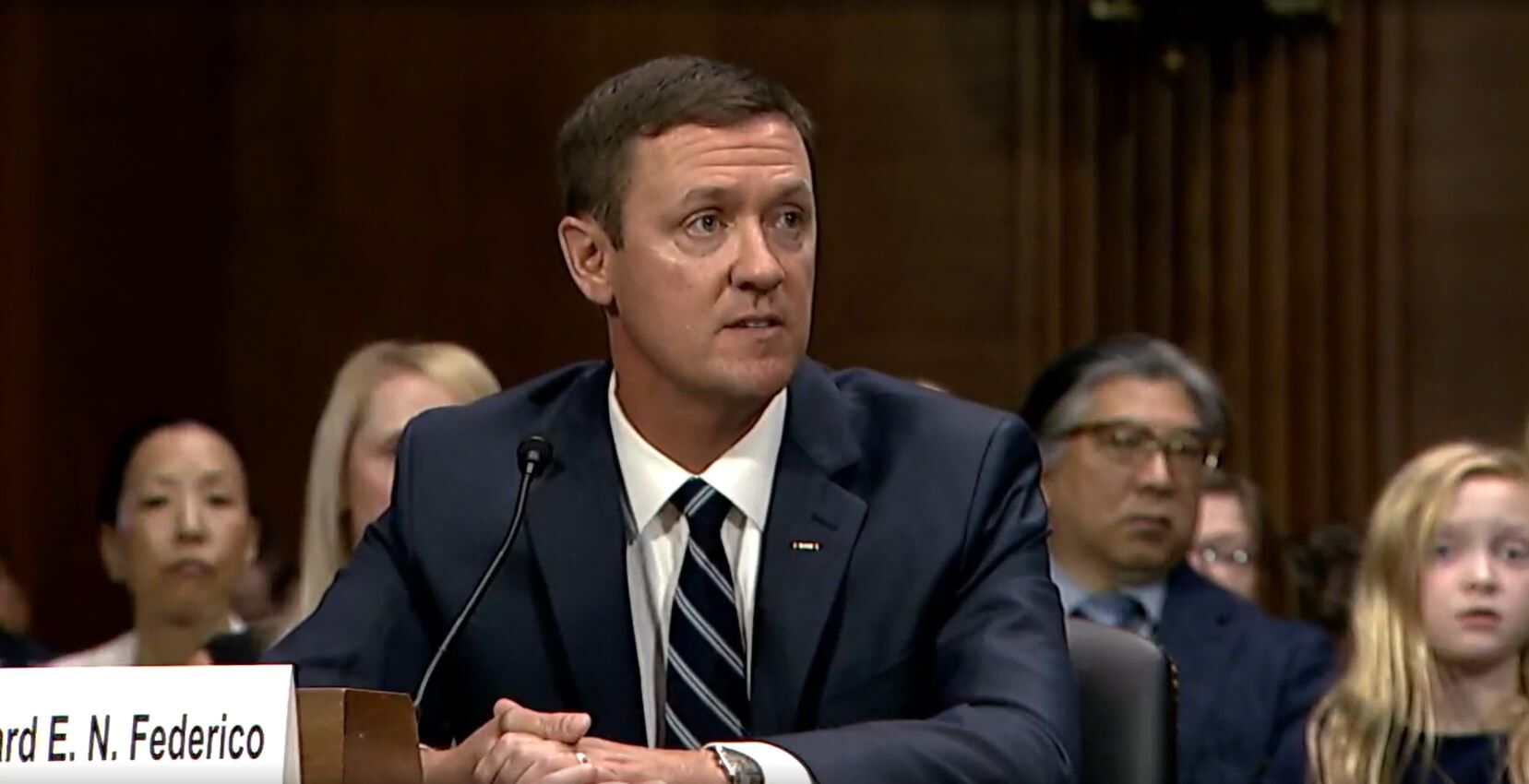
Judge Richard E.N. Federico, a Joe Biden appointee, concluded in the majority opinion that an age-related condition on gun purchases did not fall under the Second Amendment’s “keep and bear arms” guarantee. Specifically, Federico pointed to a 2008 Supreme Court decision on gun rights, which cautioned that “nothing in our opinion should be taken to cast doubt” on, among other things, “laws imposing conditions and qualifications on the commercial sale of arms.”
Nearly one year later, a different 10th Circuit panel addressed the constitutionality of a New Mexico law imposing a seven-day waiting period for firearm sales, possibly extending to 20 days if there is a delay in the background check. The panel recognized that New Mexico’s purpose was to “reduce impulsive gun violence or suicides” and to respond to the federal law that allows firearms dealers to deliver a gun if a background check takes longer than three days to complete.
Unlike Colorado’s state appellate court, precedent-setting decisions of the 10th Circuit are binding on the court itself. However, by 2-1, the majority in Ortega v. Lujan Grisham disagreed that a waiting period was a “condition and qualification” on commercial gun sales that fell outside of the Second Amendment. Instead, in its own precedent-setting decision, the majority found New Mexico’s waiting period law to be likely unconstitutional.
“Our decision today accords with RMGO,” wrote Judge Timothy M. Tymkovich, a George W. Bush appointee, for himself and Judge Allison H. Eid, a first-term appointee of President Donald Trump — both of whom are from Colorado.
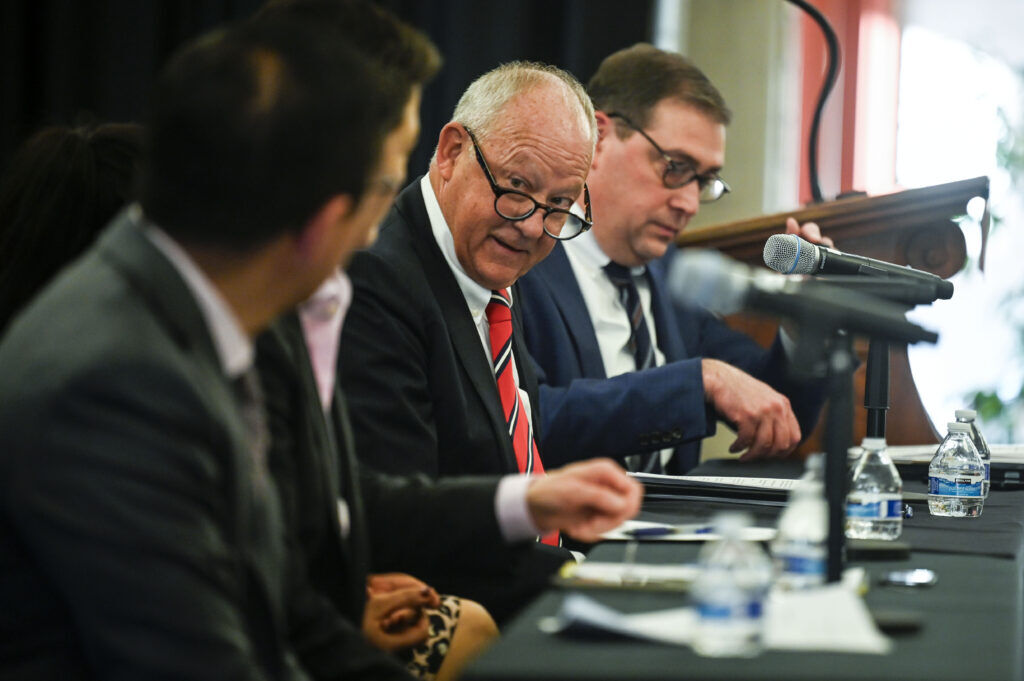
Writing in dissent, Judge Scott M. Matheson Jr., a Barack Obama appointee, argued the RMGO decision already established that the waiting period law did not implicate the challengers’ Second Amendment rights and the majority’s conclusion was at odds with the court’s own precedent.
New Mexico, with support from Colorado, asked the 10th Circuit to invoke the little-used procedural tool allowing the entire court to hear the Ortega case and potentially overrule its precedent. By 10-2, the full-time judges declined to reconsider the case.
Federico, who authored the RMGO decision, supported full-court review because of the “tension” between the two Second Amendment cases. Joined by Judge Nancy L. Moritz, an Obama appointee, Federico argued the majority in Ortega employed the opposite reasoning of what he said in RMGO.
“Indeed, if anything, the Colorado law imposed a far more burdensome waiting period — up to three years — for adults who wished to purchase a firearm,” he wrote, referring to the increase in the age threshold from 18 to 21. Now, there is “an open question whether Ortega casts doubt on the constitutionality of all these laws, notwithstanding our prior opinion in RMGO.”
Federico added that the seeming conflict “invites the perception — fair or not — that the Second Amendment rights of Americans might rise or fall depending on the district court where they file or the panel of appellate judges they draw.”
While the 10th Circuit mulled the Ortega case, the plaintiffs challenging Colorado’s three-day waiting period moved to end the case in their favor without a trial, as did the state. Rocky Mountain Gun Owners, which was also the plaintiff in the waiting period case, along with firearms instructor and social media personality Alicia Garcia, argued there was no historical parallel to Colorado’s law.
Kane, a Jimmy Carter appointee, instructed the parties before the hearing to address the potential problem the 10th Circuit created with dueling precedents on the subject of gun purchases. He also reiterated his own apprehension about the practicality of the Supreme Court’s historical test for Second Amendment cases.
“I previously expressed my concern that such an independent analysis could lead to inconsistent holdings, as the parties could craft distinct records and present varying arguments in different cases,” Kane wrote.
Michaels, representing the state, argued New Mexico’s law was different in important ways from Colorado’s waiting period law. While Colorado was also concerned about reducing gun homicides and suicides, its three-day waiting period coincided with the window in federal law for the processing of background checks. The majority in Ortega noted that the federal three-day period “is more consistent with historical traditions surrounding background checks and licensing laws.”
“A criminal defendant has the right to a speedy trial, but not to an immediate trial,” Michaels said. “There are many situations where a constitutional right isn’t subject to an immediate absence of delay.”
McCoy, for the challengers, countered that Ortega dictated the outcome of the case.
“How does Colorado’s firearms waiting period law now survive?” he said. “It doesn’t. It simply can’t.”
Kane will issue a written decision.
The case is Rocky Mountain Gun Owners et al. v. Polis.

Colorado Supreme Court intervenes in Weld County prosecution dismissed due to Missy Woods misconduct
Michael Karlik
michael.karlik@coloradopolitics.com
Updated 3 hours ago
The Colorado Supreme Court ordered a Weld County trial judge last week to respond to the district attorney’s claim that he improperly dismissed a criminal case because of “outrageous” conduct by the Colorado Bureau of Investigation. Daniel Lee Eatinger stood...
Schoolchildren’s presence at child sex-related trial did not harm Arapahoe County defendant, appeals court says
Michael Karlik
michael.karlik@coloradopolitics.com
Updated 2 days ago
Colorado’s second-highest court decided on Thursday that the presence of a group of schoolchildren on the first day of a child sexual exploitation trial did not violate an Arapahoe County defendant’s constitutional right to a fair trial. Prosecutors charged Jerry...
Appeals court cites week-old Colorado law to reinstate child neglect case at child, father’s request
Michael Karlik
michael.karlik@coloradopolitics.com
Updated 2 days ago
Colorado’s second-highest court invoked a new state law for the first time on Thursday and reinstated a child neglect case that both the child and her father wished to reopen. House Bill 1227 took effect on Aug. 12, reversing a...
Colorado Supreme Court names William Hood as next chief justice
Michael Karlik
michael.karlik@coloradopolitics.com
Updated 3 days ago
The Colorado Supreme Court has selected Justice William W. Hood III to be the next chief justice, the judicial branch announced on Friday. Hood will succeed Chief Justice Monica M. Márquez, who took over the role in July 2024. “I...

Family of slain Lakewood teacher releases statement as murder suspect makes first court appearance
Matt Kyle
matt.kyle@denvergazette.com
Updated 10 hours ago
Patrick Theodore Barnett, the Lakewood man accused of killing his wife, a Jeffco Public Schools art teacher, made his first court appearance Friday morning as his wife’s family looked on. The status conference hearing was held before District Court Judge...

Appeals court upholds Park County trophy hunting conviction
Michael Karlik
michael.karlik@coloradopolitics.com
Updated 3 days ago
Colorado’s second-highest court clarified on Thursday that a defendant may stand convicted under the state’s trophy hunting laws if he abandons a bear carcass but returns later to remove the meat. Under Colorado law, it is a felony to detach...

Judge grants partial injunction to GEO in fight against state health inspection law
Kyla Pearce
kyla.pearce@gazette.com
Updated 4 days ago
A judge ruled Thursday that The GEO Group does not have to follow parts of a new state law requiring more frequent health and safety inspections at the U.S. Immigration and Customs Enforcement processing center in Aurora. Under the order...

Parker man faces 20 years to life for serial sexual assaults
Nicholas Fogleman
nicholas.fogleman@denvergazette.com
Updated 4 days ago
A 25-year-old Parker man who sexually assaulted three women in 2025 pleaded guilty Wednesday and will serve 20 years to life in prison. Javier Rodriguez-Andrade pleaded guilty to charges stemming from three sexual assaults involving women ages 19 to 24. ...
Divided appeals court upholds warrantless DNA collection in Colorado cold case, cautions of government overreach
Michael Karlik
michael.karlik@coloradopolitics.com
Updated 4 days ago
Colorado’s second-highest court upheld the warrantless collection of a suspect’s DNA from a discarded soda can as constitutional on Thursday, while warning about potential abuse of DNA privacy in the absence of further guardrails. By 2-1, a three-judge Court of...
Man charged in Northglenn homicide of wife
Matt Kyle
matt.kyle@denvergazette.com
Updated 4 days ago
A man has been formally charged with murder and burglary relating to a homicide last week in Northglenn. Alexei Munive-Rodriguez, 48, was arrested Sunday after he was at large following the homicide, which occurred Friday. Police were dispatched around 10:30...