

The relevance of Watergate more than a half-century later | SONDERMANN
It was the scandal for which all other scandals are now named.
In June 1972, a small group of Cuban burglars with high-level connections broke into the headquarters of the Democratic National Committee. Those headquarters were located in the Watergate complex of offices, residences and a hotel.
Hence, the name of the scandal that dominated American politics for years. Out of that grew an endless list of cases of stupidity or illegality or sometimes just bad form all carrying the suffix of “gate” and combining to tell much of the tale of the last half century.
The political world produced Billygate, Contragate, Nannygate, Debategate, Troopergate, Koreagate, Pardongate, Emailgate, Russiagate, Pizzagate, Sharpiegate and Signalgate. Those are for starters.
From the sports arena, we have endured Bountygate, Deflategate, FIFA-gate and Tailgate. The entertainment realm brought us Nipplegate, Slapgate and Coldplaygate.
Four separate scandals across the world fall under the heading of Spygate. Nutellagate refers to an investigation by the Columbia University student newspaper that showed students stealing over $5,000 worth of the hazelnut spread from dining halls every week.
Scandal is commonplace across the world and “gate” soon entered the international lexicon. If you, dear reader, recognize more than half the episodes cited above, you will ace any test of cultural literacy.
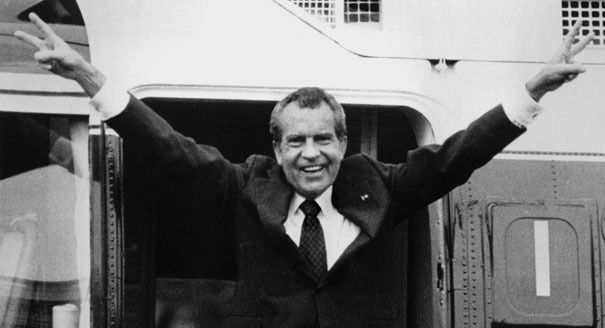
But back to the thumbnail history of Watergate: The story soon moved from the police blotter to front pages around the country. Led by the Washington Post and its reporters, Bob Woodward and Carl Bernstein, a conspiracy and political espionage operation directed by the Nixon White House was revealed.
The President’s team hunkered down and Richard Nixon won a landslide reelection victory that fall. But the Washington Post’s investigation alongside the 1973 trial of the burglars and their handlers began to bear fruit.
The Senate Watergate hearings provided high drama. A special prosecutor was appointed. An aide revealed the existence of a system for the audio taping of all Oval Office conversations. After an extended legal battle, the U.S. Supreme Court unanimously ordered that all subpoenaed recordings be turned over. The House Judiciary Committee undertook weeks of hearings and ultimately approved three articles of impeachment.
48 people, including most of Nixon’s inner circle, served prison time for Watergate crimes. Facing certain impeachment by the full House and likely conviction in the Senate, Nixon resigned on Aug. 9, 1974, 52 years ago this week. He remains the only person to willingly, even if not all that voluntarily, walk away from the office.
The lesson of Watergate years later is best captured in the phrase coming out of that scandal, “It’s not the crime; it’s the cover-up.” Despite it being often both.
Fast-forwarding to the current tense, Vice President JD Vance recently commented, “If Watergate happened tomorrow, it would be like a 12-hour news story. The idea that it would have taken down a presidency is crazy,”
Vance might be off by a few days on the brevity of the news coverage. But he is not necessarily wrong on how the criminality would have played out as just so much political noise and one more partisan battle.
The fact that Vance’s assessment may bear truth does not speak well for the health of our body politic.
Were such a scandal to occur today, the modern-day Woodwards and Bernsteins digging deep would be immediately accused of partisan motives.
The White House and its partisan media echo chamber would present their “alternative facts.” Those fawning media types would holler “witch hunt” on an hourly basis. The president and his team would treat it as just one more story to endure and ride out, counting on the nation’s short attention span.
Recent court rulings could make it easier for the president to simply fire investigating authorities. Recall that one of Nixon’s final, desperate acts was to discharge special prosecutor Archibald Cox while accepting the resignations of the attorney general and deputy attorney general who refused to carry out the deed.
Moreover, how would our evermore polarized legislative bodies treat such serious, even proven allegations? Does any line of legality or propriety exist today that would separate Democrats from a corrupt Democratic president? Or Republicans from one of their own?
On that latter score, we have recent evidence and it is not encouraging. A mere seven of 50 Republican senators voted to convict Donald Trump following his impeachment for the insurrectionist outrage of January 6th.
Nixon’s end came soon after the Republican leaders of the House and Senate, along with senior GOP statesman Barry Goldwater, came to the Oval Office to tell him that his support within the party had hemorrhaged and the gig was up. Try imagining such a scenario in the current moment.
Beyond party politics, perhaps it is that our societal standards, expectations and ethics have slackened as well. Would we still consider a conspiracy such as Watergate to be entirely out of bounds or would we treat it as just an unfortunate part of an unsavory game?
As “gate” has expanded as shorthand for all manner of scandal, what we regard as contemptible and deplorable across the gaping divide has shrunk and shrunk again.
Eric Sondermann is a Colorado-based independent political commentator. He writes regularly for ColoradoPolitics and the Gazette newspapers. Reach him at EWS@EricSondermann.com; follow him at @EricSondermann


Were the primaries a preview for consequential general election? | Paula Noonan
Paula Noonan
paula-noonan@coloradopolitics.com
Updated 2 days ago
Colorado’s political future will go the way of this election. Historically, the state has not had both chambers controlled by a supermajority. This election may change that. The primaries suggest how the general election may play out. Democrats had solid...

Courageous Colorado bucks Trump’s federal stupidity | Miller Hudson
Miller Hudson
miller-hudson@coloradopolitics.com
Updated 5 days ago
There are several theories regarding the rhythm of American politics. The most frequently cited is the pendulum hypothesis — positing that episodes of liberal dominance are then interrupted by spans of conservative control. Since Ronald Reagan’s presidential election in 1980,...

A historic moment during another major drought | Rachel Gabel
Rachel Gabel
rachel-gabel@coloradopolitics.com
Updated 1 week ago
Gustav Sumnick emigrated from Germany, traveled to Oklahoma and decided rather than be a Sooner, he wanted to be a farmer. He moved north to Nebraska and married an Irish immigrant farmer’s daughter. They farmed near Fremont, Nebraska, where the...

Colorado can’t forget the lessons of COVID | Jon Caldara
Jon Caldara
jon-caldara@coloradopolitics.com
Updated 5 days ago
We are finally getting a clearer picture of what happened during COVID. Not because the people who locked us up, masked our faces and forced unproven chemicals into our bodies have suddenly become transparent, but because Anthony Fauci’s COVID-era diary...
Historic preservation supporters organize to oppose Trump changes | Bob Loevy
Tom Cronin
tom-cronin@coloradopolitics.com
Updated 1 week ago
Historic preservation organizations in Colorado Springs, the remainder of Colorado and across the nation are organizing to resist a recent effort to relax and weaken historic preservation laws in the United States. In Washington, D.C., the Advisory Council on Historic...
The primary political reform and precondition for all others | SONDERMANN
Eric Sondermann
eric-sondermann@coloradopolitics.com
Updated 1 week ago
In its current state, the American political system has no end of ailments. Far too many factors accelerate polarization and work against moderation and narrowing the differences. Media, and the way so many citizens limit themselves to agreeable, reinforcing sources,...
Pueblo mayor, council concoct Trumpian Texas Two-Step | Dennis Maes
Dennis Maes
dennis-maes@coloradopolitics.com
Updated 1 week ago
Several weeks ago, an article was published positing Pueblo Mayor Heather Graham is a disciple of the calamitous Donald Trump school of governance — specifically as it related to questionable ethical practices and the misuse of public funds. Recently, Graham...
As education conflicts abound across Colorado, who puts the kids first? | Paula Noonan
Paula Noonan
paula-noonan@coloradopolitics.com
Updated 1 week ago
Elected school boards and the Colorado Department of Education (CDE) have hit the headlines with fired superintendents, superintendent resignations, failures of oversight, and misdirected dollars. Cherry Creek School District’s superintendent was fired. Jefferson County Schools’ superintendent found a less stressful...
The outrages mount | Hal Bidlack
Hal Bidlack
hal-bidlack@coloradopolitics.com
Updated 2 weeks ago
My kindly and forgiving editors understand that, from time to time, I can’t help myself from leaping atop my rickety soapbox to vent. And, like many other political commentators have already done, I could easily fill this entire missive with...
Weiser’s leadership crucial for rural win-win | Rachel Gabel
Rachel Gabel
rachel-gabel@coloradopolitics.com
Updated 2 weeks ago
Attorney General Phil Weiser is going to win the gubernatorial election. That said, Colorado agriculture and rural communities have a 30-year track record of finding the win-win be it for species or industries or habitat. Former Governor Roy Romer possessed...
PREV
PREVIOUS

Democratic group aims Spanish-language TV ad at Gabe Evans in Colorado’s battleground 8th CD
A national group tied to House Democratic leadership launched a six-figure Spanish-language TV ad in Colorado this week targeting Republican U.S. Rep. Gabe Evans and the GOP’s signature budget legislation. The 30-second spot is part of $15 million in new TV and digital ad reservations announced earlier this week by House Majority Forward, a nonprofit […]

Wirth downplays Social Security disaster talk | A LOOK BACK
Forty-five years ago this week: “As time goes on,” said Democratic U.S. Rep. Tim Wirth, of the 2nd Congressional District, “we are finding that the safety net, which was proposed earlier this year, has some very large holes in it,” referring to a recently debated Social Security policy change. Wirth had joined with the majority […]