

Colorado Supreme Court upholds child abuse convictions despite faulty jury instruction
The Colorado Supreme Court decided on Monday that a San Miguel County jury properly convicted a defendant of child abuse resulting in death, even though the instructions potentially allowed jurors to avoid finding that the child abuse resulted in death.
The court agreed unanimously that the jury instructions for finding Madani Ceus guilty of a felony failed to track Colorado law. However, by 6-1, the majority believed the error did not warrant reversal of Ceus’ convictions because the evidence overwhelmingly established the cause of the two victims’ deaths was their isolation in a vehicle without food or water.
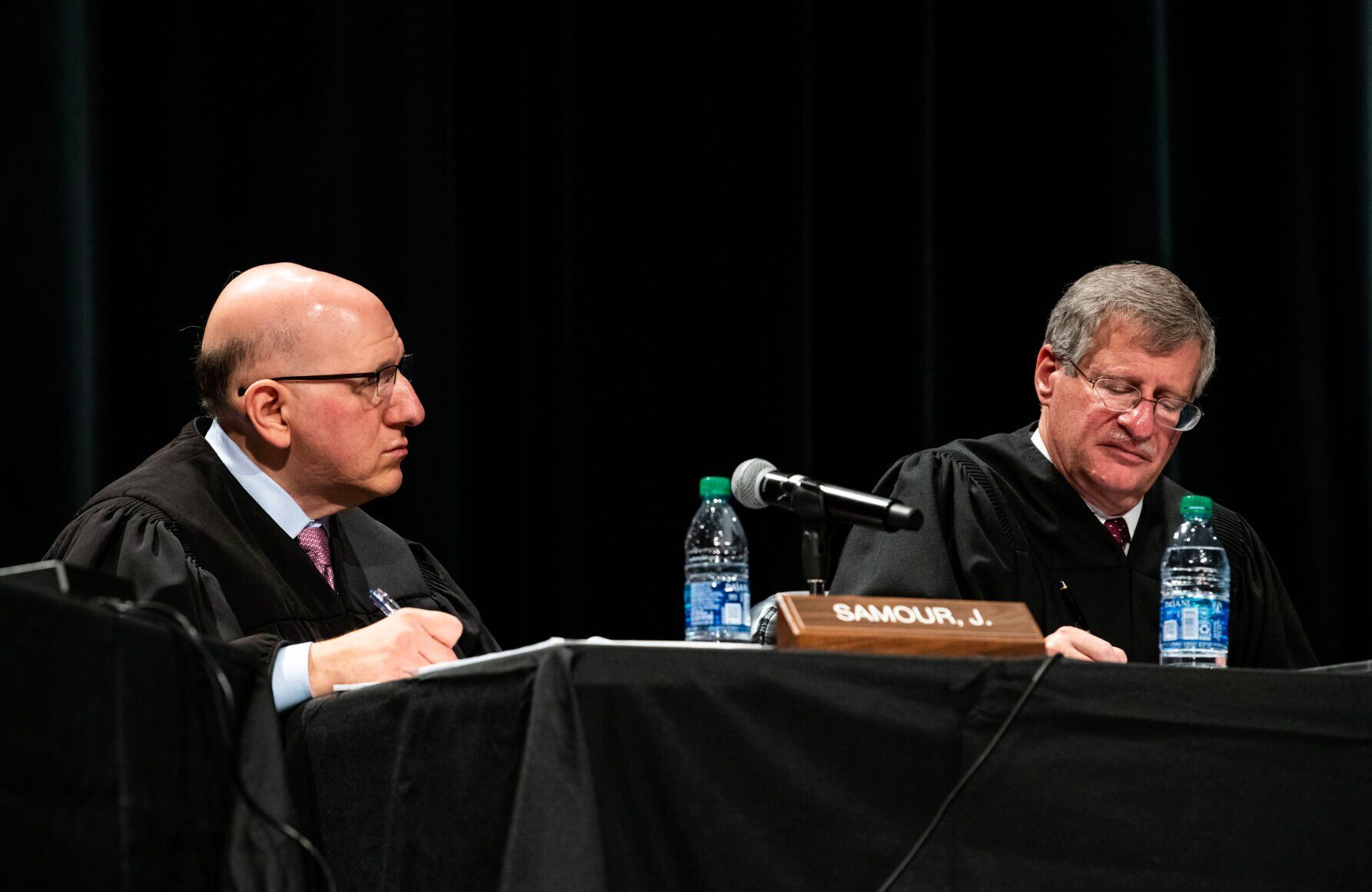
“We are hard-pressed to treat the trial court’s instructional error as reversible when the question (of) whether the confinement in the car resulted in the girls’ deaths was not meaningfully contested at trial,” wrote Justice Carlos A. Samour Jr. in the June 29 opinion.
Justice Richard L. Gabriel dissented, arguing that jurors might have decided Ceus’ actions did not cause the victims’ deaths in light of other evidence suggesting culpability belonged to the children’s mother. Yet, the instruction did not ask the jury to make the connection for Ceus.
“Here, substantial evidence at trial, which the majority largely ignores, raised a legitimate question as to whether Ceus’s alleged abusive conduct (as opposed to that of the victims’ mother, who was convicted of first degree murder in the victims’ deaths) was the cause,” he wrote.

Hannah Marshall, 8, and Makayla Roberts, 10, were discovered dead and decomposing in a vehicle located on Frederick “Alec” Blair’s Norwood farm in 2017. A forensic examiner was unable to conclusively state the cause of death because of the condition of the girls’ bodies, but evidence suggested starvation, dehydration, and hyperthermia were factors.
Jurors heard that Ceus was the spiritual leader of the group of itinerant adults and children living on the farm. At some point, the victims were left to live in a car with no food. Ceus directed that no one contact them, and she physically distanced her family from the victims.
Jurors convicted the children’s mother of murder and Ceus’ husband of child abuse resulting in death. Blair also received a 12-year prison sentence for his involvement.
Following her own convictions and 64-year prison sentence, Ceus contended the trial judge incorrectly instructed the jury about the charges. Child abuse becomes a felony if a person acts knowingly or recklessly and the child abuse results in death. Colorado’s template jury instructions contain a special form asking jurors, if they find a person committed child abuse, “Did the child abuse result in death?”
Instead, District Court Judge Keri A. Yoder gave jurors an instruction that deviated from the template. Ceus argued on appeal that it only required a finding of death for one possible method of child abuse, not for the other methods described in state law. A three-judge panel for the Court of Appeals agreed the defect meant Ceus only stood convicted of misdemeanor child abuse.
“Without an instruction requiring the jury to find beyond a reasonable doubt that Ceus’s abuse resulted in the children’s death, we are unable to conclude the instructional error was harmless,” wrote Judge Stephanie Dunn.

The Colorado Attorney General’s Office argued it was inconceivable that jurors would have convicted Ceus without finding that the child abuse resulted in death.
“From the moment the jury arrived and filled out questionnaires, it was clear that this case always was about death,” First Assistant Attorney General Erin K. Grundy told the justices.
The majority agreed. Samour wrote that the defense did not “meaningfully” dispute at trial whether the victims’ confinement in the car caused their deaths. Instead, the question was whether Ceus was responsible for their life-threatening conditions.
“The girls died after being confined in the car without food or water during the intense summer heat for an extended period. There was no evidence suggesting any other cause of death,” wrote Samour. “Here, the jury found that Ceus was responsible for the girls being confined in the car without food or water during the intense summer heat for an extended period.”
Gabriel argued in dissent that the majority deviated from the court’s precedent and had minimized the need to link Ceus’ conduct with the victims’ deaths. He would have reversed her convictions and allowed Ceus to remain convicted of misdemeanor child abuse or permitted prosecutors to retry her again for a felony.
The court returned the case to the Court of Appeals to resolve Ceus’ other arguments on appeal.
The case is People v. Ceus.

Federal judge green-lights excessive force, retaliation claims for trial against Fort Collins officers
Michael Karlik
michael.karlik@coloradopolitics.com
Updated 8 hours ago
A federal judge green-lit a jury trial last week against multiple Fort Collins police officers on claims that they used excessive force on one man who was standing unarmed in his underwear, and retaliated against another man for exercising his...
10th Circuit revives wage violation lawsuit against Papa John’s operator
Michael Karlik
michael.karlik@coloradopolitics.com
Updated 4 hours ago
The Denver-based federal appeals court on Tuesday reinstated a former Papa John’s delivery driver’s lawsuit alleging violations of federal and state wage law. Steve Mighell worked for one month at a Denver Papa John’s location in summer 2023. He alleged...
Colorado appeals judge’s delays in releasing opinions noted by performance commission
Michael Karlik
michael.karlik@coloradopolitics.com
Updated 19 hours ago
The citizen-led performance commission that provides guidance to voters about whether to retain members of Colorado’s second-highest court raised concerns by judges and attorneys that Judge Elizabeth L. Harris sometimes struggles with releasing opinions promptly. Harris, who joined the Court...

Colorado judge explores sanctions against DOJ, ICE for rearresting man 4 days after release on bond
Michael Karlik
michael.karlik@coloradopolitics.com
Updated 8 hours ago
A federal judge in Colorado is considering sanctions against the government after immigration agents rearrested a man four days after an immigration judge found him suitable for release on bond. On July 28, U.S. Magistrate Judge N. Reid Neureiter ordered...

Divided disciplinary panel censures Montezuma County judge after agreement reached
Michael Karlik
michael.karlik@coloradopolitics.com
Updated 7 hours ago
A disciplinary panel formally imposed a public censure, suspension, and further training on Montezuma County Court Judge Ian J. MacLaren on Tuesday by a 2-1 vote. Under constitutional Amendment H, which voters adopted in November 2024, MacLaren was set to...

Colorado’s Western Slope magistrate judges describe unique role in federal judiciary
Michael Karlik
michael.karlik@coloradopolitics.com
Updated 2 days ago
Two of Colorado’s federal judges stationed on the Western Slope spoke to lawyers on Wednesday about their unique roles, the ways their workloads differ, and the need for more criminal defense lawyers to take cases outside the Front Range. “Here...

Denver sues Philip Morris, other tobacco companies over cigarette butt litter
Deborah Grigsby
deborah.smith@denvergazette.com
Updated 15 hours ago
Denver is demanding that some of the biggest tobacco companies in the world pay for the cleanup of discarded cigarette butts on its streets, following a similar campaign that cities in other states have pursued. Denver’s lawsuit, filed this week...

Federal judge rules that request for bond hearing not necessary to challenge immigration detention
Michael Karlik
michael.karlik@coloradopolitics.com
Updated 7 hours ago
A federal judge in Colorado ruled last week that it is not mandatory for a person to seek a bond hearing with an immigration judge before they challenge the lawfulness of their detention in federal court. For the past year,...

Boulder Valley School District introduces new policies following antisemitism lawsuit
Marissa Ventrelli
marissa.ventrelli@coloradopolitics.com
Updated 8 hours ago
The chief of Boulder Valley School unveiled new policies for the 2026-2027 school year following a lawsuit filed on behalf of a student alleging antisemitic harassment. In June, the Anti-Defamation League filed a federal civil rights complaint against the school...

Colorado NRA chapter seeks injunction against new gun‑training requirement
Marissa Ventrelli
marissa.ventrelli@coloradopolitics.com
Updated 2 days ago
The Colorado chapter of the National Rifle Association is seeking an injunction to stop the state from enforcing a new law that took effect earlier this month. The new law requires anyone buying or selling certain firearms to first complete...
PREV
PREVIOUS

Gov. Polis asks residents not to use fireworks as wildfires burn
While Gov. Jared Polis said he will not issue a statewide fire ban, Colorado’s top political leader urged residents against using fireworks as the country heads into the July 4 weekend. “We are encouraging the people of Colorado to exercise personal responsibility and not do anything that could cause fires — from off-roading to shooting […]

Energy secretary says U.S. must grow capacity, lower price during Colorado visit
As a heatwave in the U.S. and Europe punctuated widespread calls for recommitments to solar and other “renewable” sources, U.S. Secretary of Energy Chris Wright doubled down on America’s current policy, telling a Thornton crowd on Monday that energy goals would be fixed on increasing the nation’s capacity — no matter what the source. “I […]