Colorado judge explores sanctions against DOJ, ICE for rearresting man 4 days after release on bond
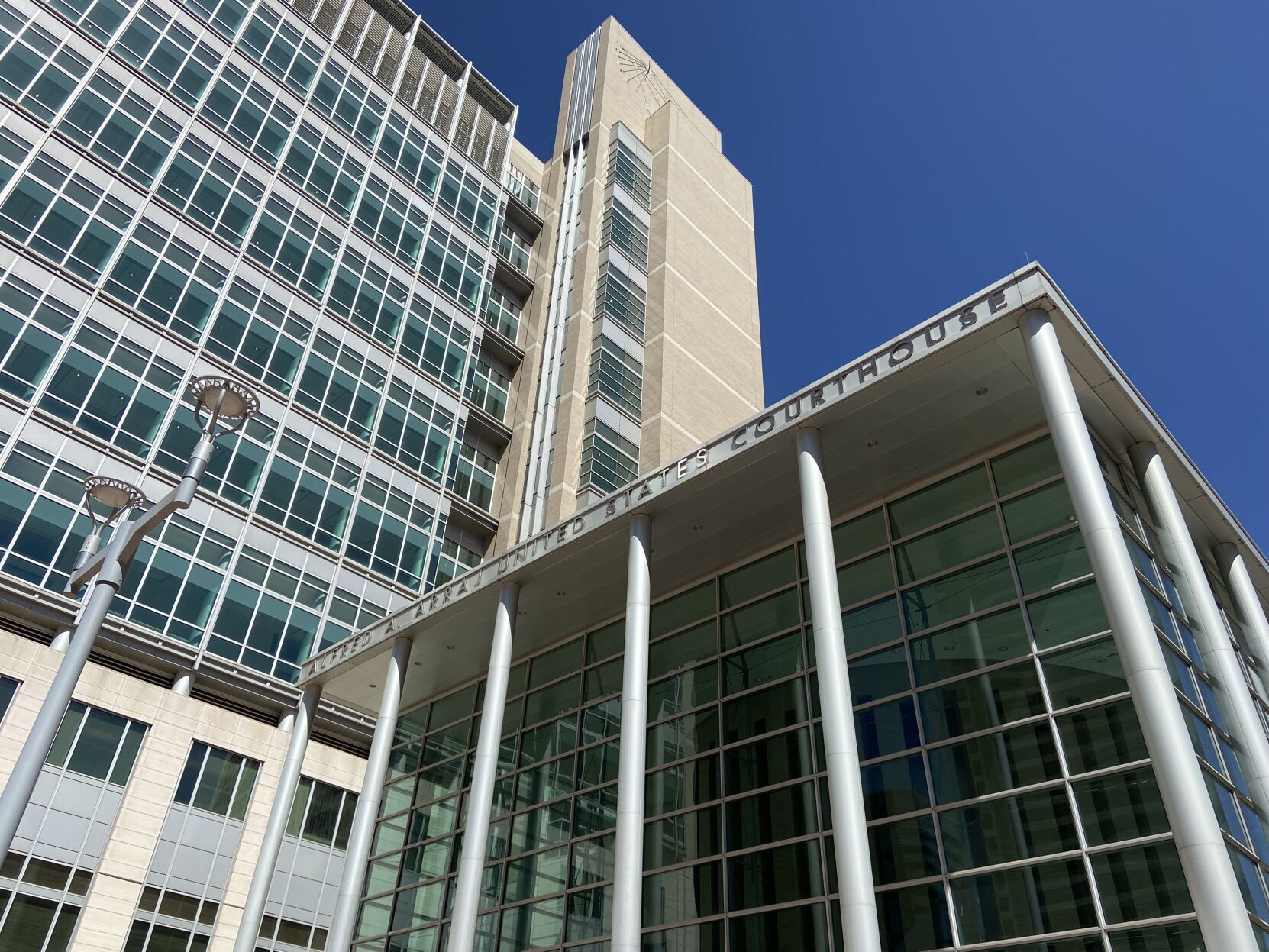
A federal judge in Colorado is considering sanctions against the government after immigration agents rearrested a man four days after an immigration judge found him suitable for release on bond.
On July 28, U.S. Magistrate Judge N. Reid Neureiter ordered the release of Feliciano Paulino Soares after U.S. Immigration and Customs Enforcement arrested him in Utah and transported him to the privately run detention center in Aurora. At the time, Soares was driving home to the East Coast because an immigration judge granted his release.
The U.S. Department of Justice, U.S. Department of Homeland Security, and ICE must show why “they should not be sanctioned for unlawfully detaining on April 25, 2026 an individual who had been released on bond — and thus someone who was not a flight risk or a danger to the community — on April 21, 2026,” wrote Neureiter. “Respondents shall also explain what steps or safeguards are being put in place to ensure that persons released on bond by an immigration judge are not re-detained over and over again.”
Federal judges throughout the country have weighed penalties in recent months after ICE failed to comply with a court order to produce documents, ignored judges’ deadlines, and withheld key information. In Colorado, judges’ actions have typically been limited to ordering the immediate release of “habeas corpus” petitioners as a consequence of immigration judges violating the terms of their orders.
Soares, a Brazilian citizen, came to the United States in 2021. After four months in detention, the government released him under the “alternatives to detention” program, which ICE recognizes as less costly than detention and effective at increasing appearances in court.
In August 2025, while living in Connecticut, Soares was a passenger in a car when ICE arrested him. The government transferred him to California and he filed a habeas petition in February seeking release. A federal judge sided with Soares in April and an immigration judge ordered his release on bond.
Four days after his release, Utah police stopped Soares for speeding on his way home. ICE then took him from the jail and transported him to Aurora, where he remained until he filed another habeas petition in Colorado.

Attorney Sara Vuong wrote that Soares had a “strong liberty interest in his freedom,” given that an immigration judge had just found him suitable for release.
“There is no indication that Mr. Soares received any evaluation of a material change in circumstances,” she wrote. “While the government has an interest in ensuring Mr. Soares’s appearance at his removal proceeding and protecting the community, the government cannot plausibly justify its position when a district court recently held that he is not subject to mandatory detention, and an immigration judge had determined that he was neither a flight risk or a danger to the community and granted him bond just four days before.”
The U.S. Attorney’s Office for Colorado, as is its general practice, declined to submit an argument in opposition to Soares’ petition. Assistant U.S. Attorney Kaitlyn Schaeffer asked that if Neureiter granted relief to Soares, he give the government seven days to hold another bond hearing.
“No further bond hearing is necessary, and Petitioner is entitled to immediate release,” wrote Neureiter, citing the immigration judge’s conclusion about Soares’ suitability for release.
After Neureiter ordered the government to explain why he should not impose sanctions for its treatment of Soares, ICE lawyer and Special Assistant U.S. Attorney Anh Weinberg asked for additional time to explain what happened.
“This case appears to present issues for which fulsome briefing is appropriate, and Respondents require additional time to draft their response and assemble supporting evidence, including, but is not limited to, obtaining multiple declarations from the appropriate deportation officers,” wrote Weinberg. “This will then allow Respondents’ counsel to present the Court with legal and factual bases for Petitioner’s re-detention, ensuring that the Court has all the relevant information it requested.”
Neureiter extended the government’s deadline to Aug. 27.
The case is Soares v. Baltazar et al.

Divided disciplinary panel censures Montezuma County judge after agreement reached
Michael Karlik
michael.karlik@coloradopolitics.com
Updated 3 hours ago
A disciplinary panel formally imposed a public censure, suspension, and further training on Montezuma County Court Judge Ian J. MacLaren on Tuesday by a 2-1 vote. Under constitutional Amendment H, which voters adopted in November 2024, MacLaren was set to...
Colorado’s Western Slope magistrate judges describe unique role in federal judiciary
Michael Karlik
michael.karlik@coloradopolitics.com
Updated 18 hours ago
Two of Colorado’s federal judges stationed on the Western Slope spoke to lawyers on Wednesday about their unique roles, the ways their workloads differ, and the need for more criminal defense lawyers to take cases outside the Front Range. “Here...
Federal judge rules that request for bond hearing not necessary to challenge immigration detention
Michael Karlik
michael.karlik@coloradopolitics.com
Updated 18 hours ago
A federal judge in Colorado ruled last week that it is not mandatory for a person to seek a bond hearing with an immigration judge before they challenge the lawfulness of their detention in federal court. For the past year,...

Boulder Valley School District introduces new policies following antisemitism lawsuit
Marissa Ventrelli
marissa.ventrelli@coloradopolitics.com
Updated 20 hours ago
The chief of Boulder Valley School unveiled new policies for the 2026-2027 school year following a lawsuit filed on behalf of a student alleging antisemitic harassment. In June, the Anti-Defamation League filed a federal civil rights complaint against the school...

Colorado NRA chapter seeks injunction against new gun‑training requirement
Marissa Ventrelli
marissa.ventrelli@coloradopolitics.com
Updated 2 hours ago
The Colorado chapter of the National Rifle Association is seeking an injunction to stop the state from enforcing a new law that took effect earlier this month. The new law requires anyone buying or selling certain firearms to first complete...
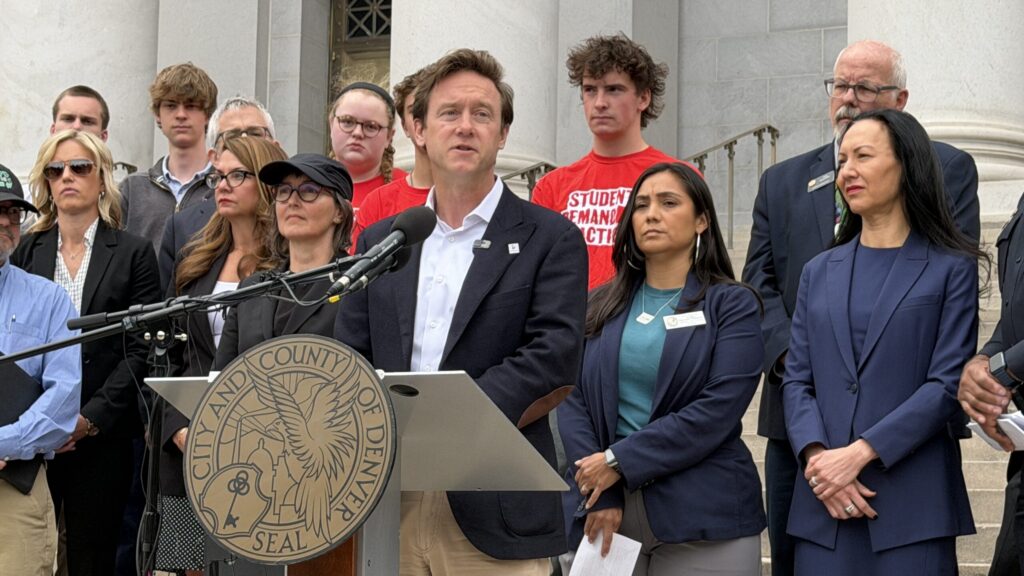
Denver moves to dismiss Trump challenge to ‘assault-style’ weapons ban
Deborah Grigsby
deborah.smith@denvergazette.com
Updated 19 hours ago
Denver has filed a motion to dismiss a lawsuit brought by the Trump administration challenging the city’s ban on “assault-style” weapons and magazines exceeding a 15-round capacity. The U.S. Department of Justice filed a suit in federal court in May,...
Federal judge dismisses ex-Colorado judicial discipline director’s conspiracy lawsuit
Michael Karlik
michael.karlik@coloradopolitics.com
Updated 2 days ago
A federal judge dismissed a lawsuit from Colorado’s former judicial discipline director on Tuesday, finding that he failed to adequately state claims for conspiracy or constitutional violations. Christopher S.P. Gregory, who served as the executive director of the Colorado Commission on Judicial...
Federal judge allows retaliation claims to proceed against prison officials
Michael Karlik
michael.karlik@coloradopolitics.com
Updated 19 hours ago
A federal judge agreed last week that a man incarcerated at Sterling Correctional Facility had credibly alleged that employees retaliated against him for filing grievances, including by taking away his disability accommodations and turning off his electricity. Louis Peoples Jr.,...

U.S. Rep. Lauren Boebert’s son arrested, faces charges of sexual exploitation of minor
Matt Kyle
matt.kyle@denvergazette.com
Updated 3 days ago
U.S. Rep. Lauren Boebert’s son Tyler Jay Boebert has been arrested and accused of recording and sharing a video depicting himself having intercourse with a minor, according to court records. The case originated in Garfield County in Western Colorado and...
Adams County water district may proceed with cost-recovery lawsuit against Denver for contamination
Michael Karlik
michael.karlik@coloradopolitics.com
Updated 2 days ago
A federal judge rejected Denver’s arguments last week for pausing or dismissing a lawsuit brought by an Adams County special district seeking to recover its costs for addressing water contamination as a result of Denver firefighting activities. In January, the...