

Federal judge rules that request for bond hearing not necessary to challenge immigration detention

A federal judge in Colorado ruled last week that it is not mandatory for a person to seek a bond hearing with an immigration judge before they challenge the lawfulness of their detention in federal court.
For the past year, Colorado’s U.S. District Court has faced a flood of “habeas corpus” petitions from those in immigration detention. The most common allegation is that the government is improperly denying bond hearings to people who are eligible by law to be released while their immigration proceedings unfold. Colorado’s judges have largely agreed with that argument, and the Denver-based federal appeals court recently handed down a binding interpretation of the law confirming that view.
But is a request for a bond hearing required in order to file a habeas case?
Luis Vásquez Noguera, representing himself from Aurora’s privately operated detention center, is a Costa Rican citizen who an immigration judge released on bond in September 2024. Nearly one year later, U.S. Immigration and Customs Enforcement arrested him and an immigration judge ordered him deported in October. He appealed the decision and the case remains pending.
On April 27, Vásquez Noguera filed a habeas petition seeking release or a bond hearing at which the government must justify his continued detention based on safety or flight risk.
The government argued that a federal judge should not entertain Vásquez Noguera’s petition because he never requested a bond hearing with an immigration judge prior to his habeas challenge.
“The Court should not permit Petitioner to circumvent the clear statutory requirements,” wrote Assistant U.S. Attorney Andrew M. Soler. “Petitioner should not be permitted to use the Petition to circumvent IJ review, or as a substitute for direct appeal to the (Board of Immigration Appeals).”

In an Aug. 6 order, Judge Gordon P. Gallagher disagreed that the law required someone in Vásquez Noguera’s position to go through an immigration judge and the Board of Immigration Appeals before challenging the lawfulness of their detention.
“Petitioner claims that his continued detention violates the Fifth Amendment’s due process guarantee,” wrote Gallagher, a Joe Biden appointee. “The IJ/BIA cannot adjudicate constitutional due process challenges to the legality of prolonged detention itself, rendering the suggested request for a bond hearing before an immigration court an inadequate forum.”
He added that the government’s envisioned process would be lengthy, as evidenced by Vásquez Noguera’s underlying immigration appeal remaining undecided after nine months.
“Each step takes time, and every day is another day of the confinement Petitioner contends is already unconstitutional,” Gallagher wrote. “Where the harm alleged is the detention itself, an additional administrative step requiring months of further detention before a court may hear the claim defeats the purpose it purports to serve.”
He ordered the government to give Vásquez Noguera a bond hearing or otherwise release him.
Previously, Judge Philip A. Brimmer reached the same conclusion in a 2023 habeas case, but did not analyze the issue at length because the government did not pursue the argument. Although Gallagher cited a 2024 order from Judge Regina M. Rodriguez, who found that a petitioner did not need to appeal an immigration judge’s denial of bond before filing a habeas case, Gallagher’s decision appeared to be the first in Colorado to address in detail the need to seek a bond hearing in immigration court.
Such a requirement “would be futile and irrelevant because those courts can’t address the core issues that are at play in these cases,” said immigration attorney Hans Meyer.
The case is Vásquez Noguera v. Baltazar et al.


Colorado judge explores sanctions against DOJ, ICE for rearresting man 4 days after release on bond
Michael Karlik
michael.karlik@coloradopolitics.com
Updated 1 hour ago
A federal judge in Colorado is considering sanctions against the government after immigration agents rearrested a man four days after an immigration judge found him suitable for release on bond. On July 28, U.S. Magistrate Judge N. Reid Neureiter ordered...

Divided disciplinary panel censures Montezuma County judge after agreement reached
Michael Karlik
michael.karlik@coloradopolitics.com
Updated 8 hours ago
A disciplinary panel formally imposed a public censure, suspension, and further training on Montezuma County Court Judge Ian J. MacLaren on Tuesday by a 2-1 vote. Under constitutional Amendment H, which voters adopted in November 2024, MacLaren was set to...

Colorado’s Western Slope magistrate judges describe unique role in federal judiciary
Michael Karlik
michael.karlik@coloradopolitics.com
Updated 22 hours ago
Two of Colorado’s federal judges stationed on the Western Slope spoke to lawyers on Wednesday about their unique roles, the ways their workloads differ, and the need for more criminal defense lawyers to take cases outside the Front Range. “Here...

Denver sues Philip Morris, other tobacco companies over cigarette butt litter
Deborah Grigsby
deborah.smith@denvergazette.com
Updated 4 hours ago
Denver is demanding that some of the biggest tobacco companies in the world pay for the cleanup of discarded cigarette butts on its streets, following a similar campaign that cities in other states have pursued. Denver’s lawsuit, filed this week...

Boulder Valley School District introduces new policies following antisemitism lawsuit
Marissa Ventrelli
marissa.ventrelli@coloradopolitics.com
Updated 2 hours ago
The chief of Boulder Valley School unveiled new policies for the 2026-2027 school year following a lawsuit filed on behalf of a student alleging antisemitic harassment. In June, the Anti-Defamation League filed a federal civil rights complaint against the school...

Colorado NRA chapter seeks injunction against new gun‑training requirement
Marissa Ventrelli
marissa.ventrelli@coloradopolitics.com
Updated 6 hours ago
The Colorado chapter of the National Rifle Association is seeking an injunction to stop the state from enforcing a new law that took effect earlier this month. The new law requires anyone buying or selling certain firearms to first complete...
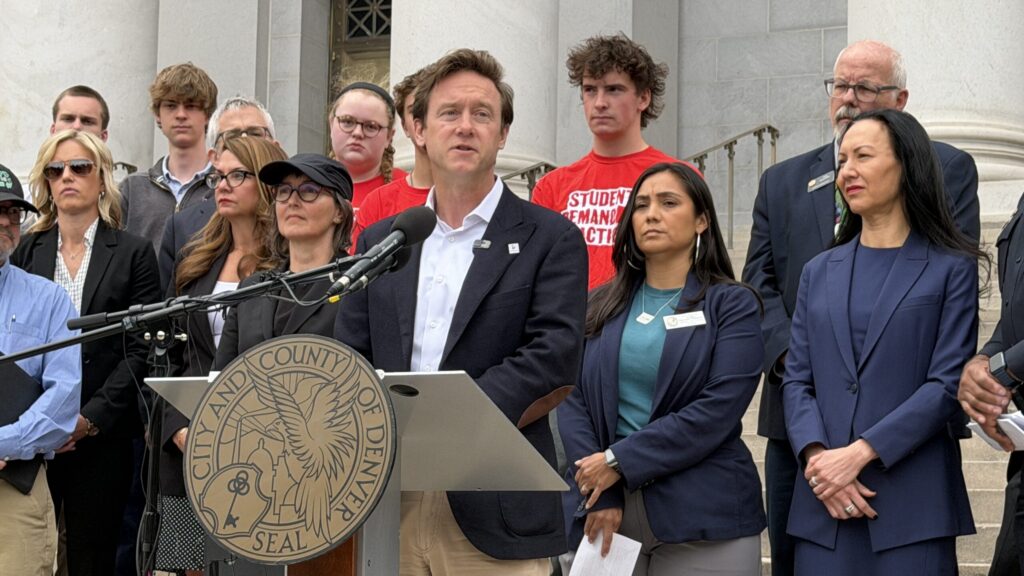
Denver moves to dismiss Trump challenge to ‘assault-style’ weapons ban
Deborah Grigsby
deborah.smith@denvergazette.com
Updated 2 minutes ago
Denver has filed a motion to dismiss a lawsuit brought by the Trump administration challenging the city’s ban on “assault-style” weapons and magazines exceeding a 15-round capacity. The U.S. Department of Justice filed a suit in federal court in May,...
Federal judge dismisses ex-Colorado judicial discipline director’s conspiracy lawsuit
Michael Karlik
michael.karlik@coloradopolitics.com
Updated 2 days ago
A federal judge dismissed a lawsuit from Colorado’s former judicial discipline director on Tuesday, finding that he failed to adequately state claims for conspiracy or constitutional violations. Christopher S.P. Gregory, who served as the executive director of the Colorado Commission on Judicial...
Federal judge allows retaliation claims to proceed against prison officials
Michael Karlik
michael.karlik@coloradopolitics.com
Updated 24 hours ago
A federal judge agreed last week that a man incarcerated at Sterling Correctional Facility had credibly alleged that employees retaliated against him for filing grievances, including by taking away his disability accommodations and turning off his electricity. Louis Peoples Jr.,...

U.S. Rep. Lauren Boebert’s son arrested, faces charges of sexual exploitation of minor
Matt Kyle
matt.kyle@denvergazette.com
Updated 3 days ago
U.S. Rep. Lauren Boebert’s son Tyler Jay Boebert has been arrested and accused of recording and sharing a video depicting himself having intercourse with a minor, according to court records. The case originated in Garfield County in Western Colorado and...
PREV
PREVIOUS

Colorado shifts vaccine authority to state as Trump administration revises childhood framework
As the Trump administration rolls out a revised childhood vaccine framework, Colorado’s law allowing the state to set its own immunization schedule has now taken effect. Issued Monday, President Donald Trump’s executive order separates childhood and adolescent vaccines into three categories: those recommended for all children, certain high-risk groups and “based on shared clinical decision-making.” […]

Denver sues Philip Morris, other tobacco companies over cigarette butt litter
Denver is demanding that some of the biggest tobacco companies in the world pay for the cleanup of discarded cigarette butts on its streets, following a similar campaign that cities in other states have pursued. Denver’s lawsuit, filed this week in a district court, claimed that taxpayers should not have to bear the financial burden […]