

Troubled waters: An uncertain rafting season gets underway in Colorado
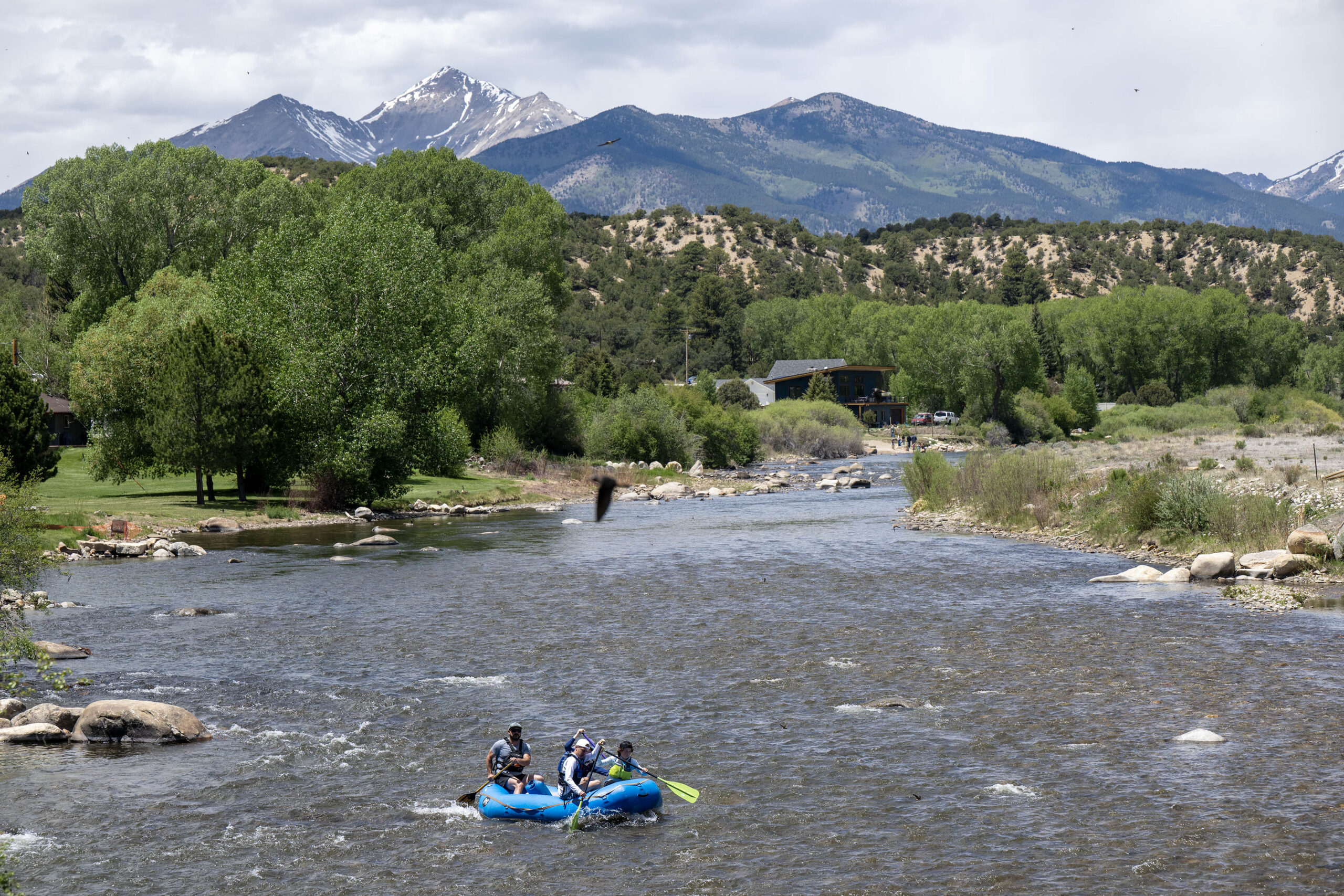
On the last day of May, along the Arkansas River that he has been paddling for 30-plus years, Mike Harvey found himself in a kayak he would not typically use this time of year: his racing boat, which is longer, narrower and lighter. It was better suited for this very atypical start to summer.
The goal that Sunday on the river was “to try to find enjoyment in the challenge of lacing lines through rocks,” Harvey said. “The lines are so much skinnier.”
That’s because the water on the Arkansas is so much lower ー as it is all across Colorado’s rivers and creeks.
Heading into June, Harvey was tracking flows around 350 cubic feet per second along go-to stretches near his home in Salida. He has come to anticipate flows closer to 3,000 cfs around Memorial Day, when snow is melting from the mountains and rushing into the river.
But following the hottest March ever recorded in Colorado, much of the state saw an astonishingly early peak runoff. It was a meager runoff coupled with historically low snowpack following the state’s “winter that never was.”
Winter and summer are inextricably linked, Bob Walker knows. Since 1992 in Pueblo, he has sold and rented gear for the slopes and whitewater at The Edge Ski, Paddle and Pack.
“We’ve been through this enough times to know one season affects the other, and it’s gonna be a rough go,” he said.
But May snow and more recent rains boosted the spirits of enthusiasts, including Harvey. And so there he was in his odd boat heading into June, enjoying himself however he could, like others he saw on the Arkansas River that day.
“It was the sort of flows you’d expect in October,” Harvey said. “But people were like, ‘Hey, it’s up a little bit! Even though it was only up like 30 cfs or something.”
As ever, it’s a similarly hopeful tone coming out of Colorado’s rafting industry.
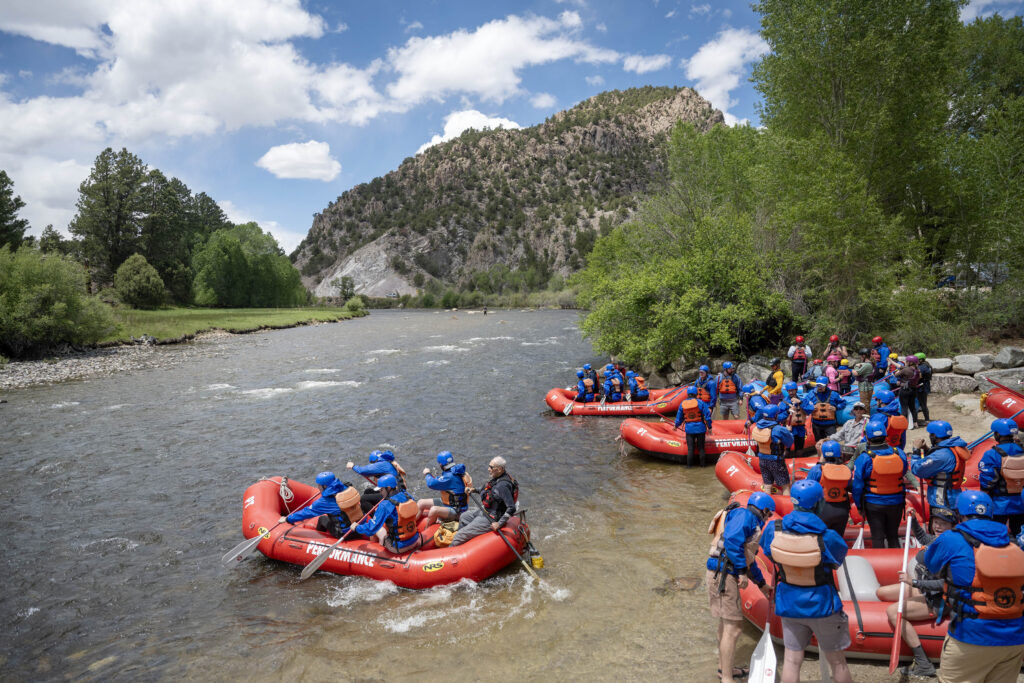
The industry has tracked between 500,000 and 600,000 customers in recent years. The majority of them come from out of state, spelling an annual economic impact exceeding $200 million across small, dependent economies like those in the Arkansas River Valley, America’s most rafted destination.
Would vacationers still come for low water?
Andy Neinas, the owner of Echo Canyon River Expeditions in Cañon City entering his 40th straight summer on the Arkansas, echoed fellow outfitters everywhere: “We dance to this music all the time.”
Maybe not all the time; for comparable drought years, Neinas pointed to 2002, 2012 and 2018. He described 2002 as especially pivotal.
“The industry went into that year with a lot of question marks, and we emerged from that year with a lot of answers,” he said. “2002 was the year the industry figured out how to manage a new flow regime on the rivers in Colorado.”
Outfitters would reroute trips to more favorable, less rocky sections of rivers. Maybe sections would be shorter in length, but due to slower water, trips would be marketed at similar durations. Anticipating more in-demand and clustered “pinch points,” as Neinas called them, guides across outfitters would coordinate. And outfitters would sell other services: cabin overnights and food and drink like Neinas’s business, or more land- and air-based attractions like adventure parks and ziplines.
Also when the water is lower and less intimidating, “inflatable kayaks become a really great option for people who are looking for more adventure,” said Alex Mickel, the longtime owner of Durango-based Mild to Wild Rafting. “They get a chance to really experience the river in a more one-on-one way, of course under our direction and instruction. It certainly ups the thrill level.”
Many vacationers aren’t necessarily looking for the thrill of high water, Mickel added.
“The vast majority of our clients are families, and they’re just wanting to come out and enjoy nature and connect with each other,” he said. “And a lot of times the river can be too high this time of year for them.”
High or low, water is not the only consideration for outfitters contemplating the summer of business.
The latest posted report on Colorado’s commercial rafting, from 2024, emphasizes “overall economic conditions” as a factor for declines in user days across rivers. Colorado River Outfitters Association reported 496,999 user days statewide in 2024, down 8.4% from the previous year and continuing a downward trend since record activity following the COVID-19 pandemic. Other than the shutdown of 2020, statewide rafting numbers from 2024 were the lowest since 2013.
“There continues to be pressure on rafting companies to raise prices because costs such as gasoline for vehicles, payroll, insurance and everyday supplies keep rising. Higher prices tend to reduce bookings,” Colorado River Outfitters Association reported.
“Additionally, during economically challenging times, groups and families tend to make their reservations more last-minute, making staffing and logistics planning a challenge. This also results in frequent situations where there are no openings for a day at the last minute.”
Economic challenges persist, impacting Colorado tourism beyond the whitewater sector.
“Yes, we have the added variable of water,” Neinas said, “but guests are having a great time.”
Would water last to grant such a time through the summer? It’s a question at the start of the season, with flows a fraction of what might be expected at some popular stretches.
Along Clear Creek near his home in Golden, Nik White has tracked flows around 230 cfs.
“In a typical year, we’d see 700, 900, maybe 1,400, something like that,” he said. “Being at 230 at peak, yeah, that’s gonna be pretty darn low.”
White is a kayaking instructor who serves as the access and conservation director for nonprofit advocacy group Colorado Whitewater. He has heard several group members talk about taking river trips away from the state. White gets it.
But no, “I don’t think we’ll get to the point where there’s no whitewater industry in Colorado,” he said.
Though, higher up Clear Creek in Idaho Springs, a short season was the fear of two companies that notified the town they would not be operating this summer.
“I can’t think of a year where that’s ever happened,” said Chuck Harmon, the mayor and longtime resident.
The news was a blow to the man who knows how vital every rafting company is to his town’s overall well-being. “We really feel it,” Harmon said. “When rafting season starts, the cash registers start ringing.”
Ahead of Memorial Day, the season started with a party at a local brewery, where Harmon visited with business owners and guides. The mood was “cautiously optimistic,” he said. “Simply because it was looking horrific in the beginning of May.”
Some surprise snow and ensuing rains helped, to the delight of enthusiasts and business owners elsewhere in Colorado. That includes Harvey, the longtime Arkansas River kayaker. He’s also the visionary behind Salida’s surf wave and owner of Badfish Surf Shop.
Harvey is buoyed by a “super” El Nino predicted to continue a wet trend in Colorado, potentially fueling rivers longer.
Still, “there’s nothing like a magic bullet that’s gonna save us,” Harvey said. “You just can’t escape the very simple fact that it has to snow in the winter for there to be enough water in the summer.”
It is believed there is not enough to allow for a boost that boaters, outfitters and the Arkansas River Valley’s broader economy have counted on between July 1 and Aug. 15.
Since 1991, when the Voluntary Flow Management Program was established, regulators have released water from Twin Lakes down to Pueblo Reservoir for the sake of recreation. That is not expected this summer, with agricultural and municipal needs taking priority.
Harvey and other recreation types sound understanding.
“It’s kind of like, how many stages of grief, you know?” Harvey said. “We’re into whatever the acceptance part is. It just is what it is.”
Business is down at his surf shop, and he worries business will be down across his hometown. “Everyone’s coming out of a tough winter with less skier traffic, and now it’s gonna be a tough summer,” Harvey said.
But a summer tradition must go on in Salida: The annual FIBArk festival returns this month, a weekend of various races on the water. Harvey expects several will be adjusted or canceled.
But low water means the wave in town is much calmer, allowing for a new youth bodyboarding contest. Also new is the “duckie cross:” a sprint through the whitewater park.
People can still expect the familiar, joyous beach scene, Harvey said. “The music will still be happening. The party will still be happening.”



Fashion, food and fun combine to make this event a success | NONPROFIT REGISTER
Joanne Davidson Special to Colorado Politics
joanne-davidson-special-to-colorado-politics@coloradopolitics.com
Updated 13 hours ago
arc THRIFT STORES Denver News: “Let’s Celebrate” was the theme for arc Thrift Stores’ annual fundraiser, and it’s not a stretch to say that’s exactly what everyone did at this Sept. 3 gathering held at Denver Botanic Gardens. The crowd that filled the gigantic...

With its water source dry, a southeast Colorado town’s clock is ticking
Savannah Eller
savannah-eller@coloradopolitics.com
Updated 18 hours ago
The Cucharas is not a mighty river, but the people of La Veta knew they had a problem brewing when it ran dry at the beginning of June. “We’re getting by,” said La Veta Mayor Doug Brgoch. “It’s not great.”...

Ikon Pass company Alterra to move into former Denver Post building, create downtown ‘outdoor hub’
Bernadette Berdychowski
bernadette.berdychowski@denvergazette.com
Updated 6 days ago
What was once the home of two of Colorado’s longest-running daily newspapers could soon become a central location for the state’s ski resort and outdoor companies, city and state leaders said Thursday. Alterra Mountain Co. is moving its headquarters to...

‘Until Every Woman Thrives’ campaign receives a $10 million investment | NONPROFIT REGISTER
Joanne Davidson Special to Colorado Politics
joanne-davidson-special-to-colorado-politics@coloradopolitics.com
Updated 7 days ago
WOMEN’S FOUNDATION OF COLORADO COLORADO HEALTH FOUNDATION Denver News: A $10 million gift from the Colorado Health Foundation will enhance “Until Every Woman Thrives,” a comprehensive campaign launched by the Women’s Foundation of Colorado in 2024 to transform lives, deepen relationships and amplify the impact of various...

Voices of Our Youth Gala celebrated the impact a mentor can have | NONPROFIT REGISTER
Joanne Davidson Special to Colorado Politics
joanne-davidson-special-to-colorado-politics@coloradopolitics.com
Updated 4 days ago
BIG BROTHERS BIG SISTERS OF COLORADO Denver News: When chief executive officer Elycia Cook extended an invitation to the 2026 Big Little Gala, Voices of Our Youth, it came with a note advising that it would be an evening that was “Very...

Amazon buys 70 acres in Aurora
Bernadette Berdychowski
bernadette.berdychowski@denvergazette.com
Updated 1 week ago
Amazon purchased 70 acres of land in Aurora with plans to build a distribution center, according to city and county records. The e-commerce giant bought a parcel at 825 N. Lisbon St. from a company tied to Northpoint Development for...
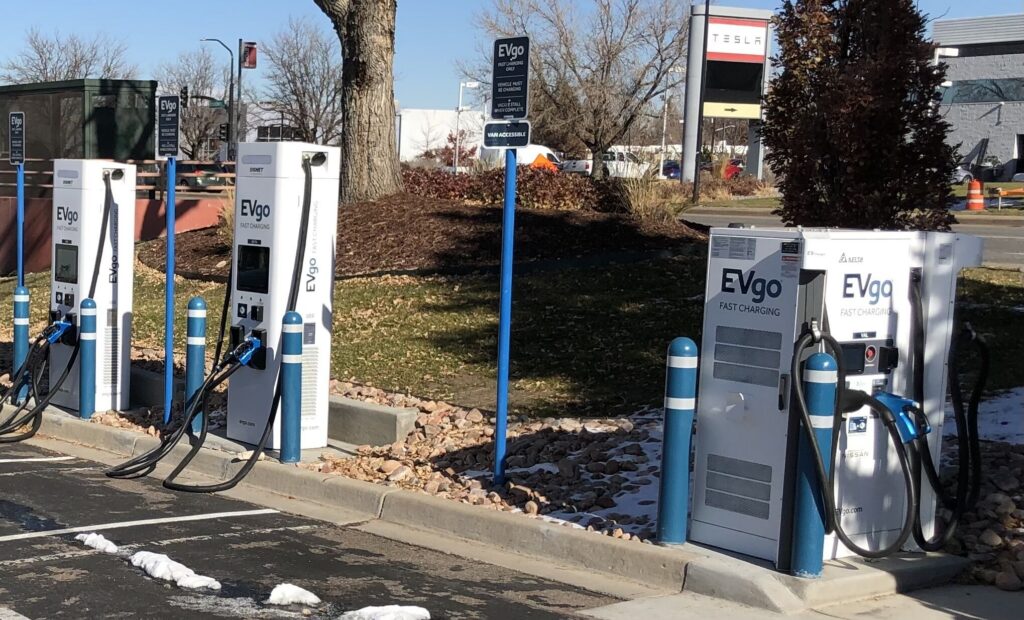
Colorado’s EV charging map nearly complete, state says
Scott Weiser
scott.weiser@gazette.com
Updated 3 days ago
Gov. Jared Polis and the Colorado Department of Transportation released a statement calling the state’s public fast-charging network nearly built out. The Aug. 27 news release reports there are now 486 DC fast-charging locations and 83% of the state highway...
PUC adds weekly comment after killing private talks
Scott Weiser
scott.weiser@gazette.com
Updated 2 weeks ago
The Colorado Public Utilities Commission will take public comment at the start of every commissioner’s weekly meeting beginning Sept. 9 as part of its new transparency mandate, the commission announced, expanding a slot previously limited to the second Wednesday of...

Healthcare Freefall: AI arms race hits rural healthcare as hospitals fight to keep up
Thelma Grimes
thelma.grimes@coloradopolitics.com
Updated 2 weeks ago
Editor’s Note: Colorado’s healthcare system is entering a period of accelerating instability — a “tsunami,” as multiple leaders describe it — driven by collapsing hospital finances, shrinking Medicaid reimbursements, disappearing services and a political fight over who is responsible for...
El Paso County upholds Buc-ee’s zoning appeal, clearing way for administrative approval
Savannah Eller
savannah-eller@coloradopolitics.com
Updated 2 weeks ago
A packed, daylong meeting on Thursday resulted in a win for the Texas travel center chain Buc-ee’s, with El Paso County commissioners voting 4-1 to approve the developer’s zoning appeal. “I think the burden of proof has been met here,”...
PREV
PREVIOUS

Using housing and cash, 'the program' exploits Colorado's homeless for Medicaid millions
Editor’s Note: This story is part of a series. Read about how home health in Colorado is a complex setup and about the group On Going HHC. They call it “the program.” For the past four years, dozens of homeless people in the Denver metro area have been recruited to live rent-free in suburban houses […]

Paramedics' convictions tossed in Elijah McClain's death
AURORA, Colo. — Two former Aurora Fire Rescue paramedics convicted in connection with the 2019 death of Elijah McClain will be retried following a ruling by the Colorado Court of Appeals. In September 2021, a statewide grand jury indicted Cooper and fellow paramedic Peter Cichuniec in McClain’s death. They went to trial together and were both convicted of […]