

Colorado Springs’ Auria showcases BORG training software meant to defend American space interests

Auria, a major space and defense company headquartered in Colorado Springs, showcased a flagship tool it has developed to keep satellite operators well trained. The tool fills a gap identified by a congressional committee as critical as the U.S. contends with increased competition and possible threats from China.
Space is a critical part of daily life, though many are unaware of this fact, said Auria CEO Damien DiPippa. Many aspects of the final frontier are vulnerable.
“Everybody from Walmart to Amazon cannot do what they do today, from a logistics standpoint, without space assets available,” he said.
This creates two considerations, one positive, the other negative, DiPippa added.
“The positive side is, it opens up so much opportunity across the board. … The downside is realizing how much at risk we are if we don’t protect those space assets,” he said.
People’s lives, finances and state power grids are all tied into the space ecosystem in some way, he said.
Overall, the Space Foundation estimates the space economy is worth about $613 billion, 7.8% more than in 2024. Much of it is vulnerable, however. This was made clear in 2007, when China launched an anti-satellite missile and destroyed one of their satellites.
In 2021 the International Space Station had to dodge a debris field created by the Chinese test. Chief of Space Operations Gen. Chance Saltzman identified the test as a “pivot point” in China’s space policy and the nation now views space as a war-fighting domain.
For China’s military, space superiority is important for establishing information dominance that “would allow it to control the battlespace and gain (an) operational advantage in wartime,” according to the 2025 annual report from the bipartisan U.S. China Economic and Security Review.
“China’s development and expansion of its space and counterspace strategies and capabilities reflect how the (People’s Liberation Army) may conduct multidomain precision warfare and target U.S. space assets as a means to deter and counter a U.S. military intervention during a regional military conflict,” the report said.
Because of the threats seen from China, the commission recommended the Department of Defense increase the Space Force’s “capacity to conduct space war gaming” and find ways to improve training for Guardians.
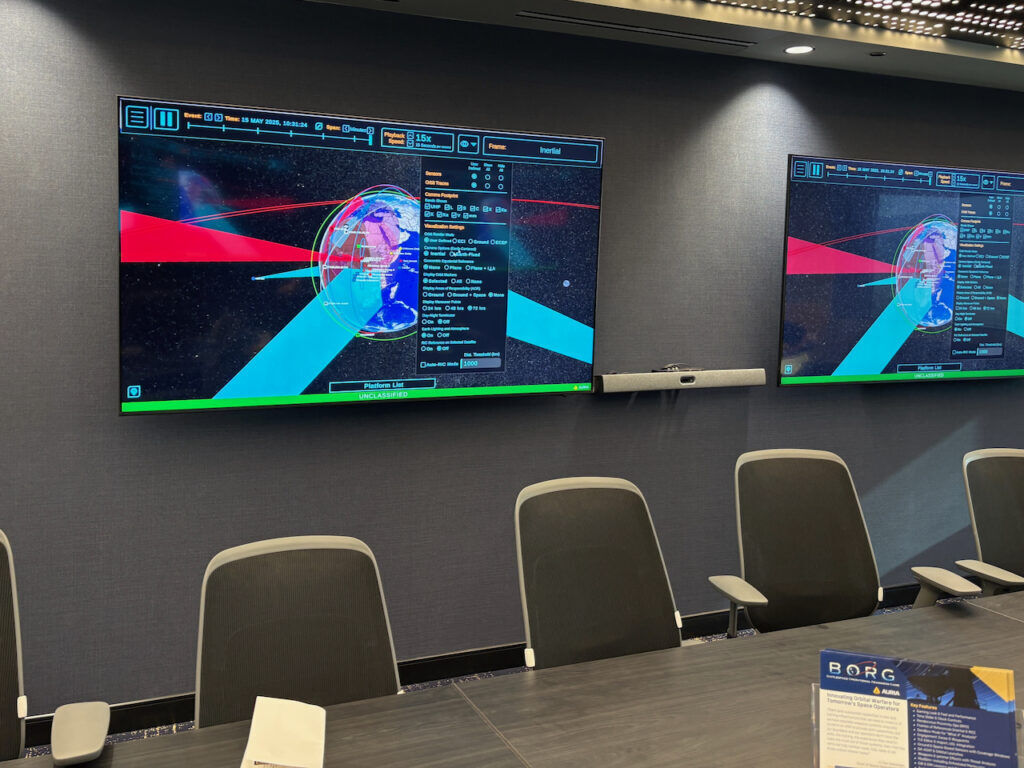
Auria has a collection of solutions. One is called the Battlespace Operational Readiness Game, which it demonstrated during a Thursday event that showcased several of the capabilities it has available to commercial and military partners. The company calls it BORG, and it is one of three gamified training platforms it created to improve satellite operators’ skills and decision-making, according to the company.
Auria’s BORG, and the larger ForgePoint training system, is “very familiar to our future space warfighters who grew up in a gaming environment,” DiPippa said. “Instead of the old days where you had these 300-page manuals, it’s very intuitive. They can pick it up, go through the menus, work the controllers (and) just operate the system.”

Colorado’s Ursa Major to go public in $2.3B deal as demand for missiles skyrockets
Bernadette Berdychowski
bernadette.berdychowski@denvergazette.com
Updated 3 days ago
Ursa Major Technologies, one of Colorado’s biggest aerospace and defense companies, is undergoing a period of major growth. Following on the heels of solidifying the creation of more than a thousand jobs for the state, Ursa Major now plans to...

Denver aerospace company Voyager sees rapid growth in latest earnings
Bernadette Berdychowski
bernadette.berdychowski@denvergazette.com
Updated 3 weeks ago
A fast-growing aerospace and defense company based in Denver saw record revenues and record bookings in the latest quarter. Voyager Technologies announced it generated $52.7 million in the second quarter, according to its latest earnings report released Monday. Revenues are...

Artemis II crew to speak at Red Rocks Amphitheatre
Dan Boniface
dan.boniface@denvergazette.com
Updated 2 months ago
An out-of-this-world event is landing in Colorado next month. The crew of Artemis II will be at Red Rocks Amphitheatre on Aug. 3 for an event that will celebrate the Rocky Mountain region’s contribution to their mission around the dark...

Business leaders see ‘cracks’ in Colorado, while governor insists state is ‘competitive’
Marianne Goodland
marianne.goodland@coloradopolitics.com
Updated 3 months ago
How does Colorado get back to the climate in the early 2000s, when there was collaboration between state government, companies and colleges and universities? That was the question posed to Gov. Jared Polis and a panel convened Tuesday by the...

Colorado space startup secures $650 million for expansion
alex-edwards
alex.edwards@gazette.com
Updated 4 months ago
The window to deliver space superiority for the U.S. is open but shrinking rapidly, according to defense startup True Anomaly. The Centennial-based company hit a milestone in its pursuit to help deliver that, announcing Tuesday that it raised $650 million...

Colorado Aeronautical Board greenlights millions in airport funding
Deborah Grigsby
deborah.smith@denvergazette.com
Updated 4 months ago
Many of Colorado’s public-use airports can now begin or complete key projects that enhance aviation safety and support the state’s transition to cleaner aviation fuels. Last week, the Colorado Aeronautical Board approved $7.3 million in grants from the Colorado Aviation...
Colorado company ready to build the lunar base, provide ‘lunar mobility’
alex-edwards
alex.edwards@gazette.com
Updated 4 months ago
Original concepts for a moon base ranged from believable to outlandish. Following the success of Artemis II, which launched four astronauts around the moon over the course of 10 days, NASA is looking ahead as it attempts to take another...

Colorado awards $26M in tax incentives to keep aerospace company in state
Bernadette Berdychowski
bernadette.berdychowski@denvergazette.com
Updated 5 months ago
A technology company in the aerospace and defense industry is looking to expand and could bring 1,250 jobs to Colorado if it chooses to continue growing in the state. The Colorado Economic Development Commission approved $26 million in job growth...

Universities sue to block dismantling of Boulder’s NCAR
Scott Weiser
scott.weiser@gazette.com
Updated 5 months ago
A consortium of universities filed a federal lawsuit Monday, alleging the Trump administration’s plan to dismantle the National Center for Atmospheric Research is unlawful retaliation against Colorado. The group also argued that the move violates federal law. The University Corporation...
Protecting satellites in space, on the ground a priority for Colorado companies
Alexander Edwards
alexander-edwards@coloradopolitics.com
Updated 6 months ago
As the Department of Defense moves toward utilizing more commercial partnerships, building a resilient space-based commercial field is contingent on several factors, according to industry leaders at the annual Warfare Symposium in Aurora. The symposium features businesses of all sizes...
PREV
PREVIOUS

$529M ICE contract will nearly double Colorado’s immigrant detention capacity
The federal government has signed a five-year contract with private prison company GEO Group that will effectively double Colorado’s immigration detention capacity to about 2,700 beds. Signed July 9, the contract comes a year after the Trump administration told Colorado’s congressional delegation it planned to reopen the shuttered Hudson Correctional Facility as an immigration detention […]

Designs for Front Range Passenger Rail trains released
The Front Range Passenger Rail District on Sunday unveiled the new brand identity and personality for its planned Colorado Connector intercity train service, known as CoCo. The district said the branding is intended to be welcoming, optimistic and distinctly Colorado while presenting a trustworthy and approachable identity for the service, according to a news release. […]