

Colorado company ready to build the lunar base, provide ‘lunar mobility’
Original concepts for a moon base ranged from believable to outlandish. Following the success of Artemis II, which launched four astronauts around the moon over the course of 10 days, NASA is looking ahead as it attempts to take another giant leap.
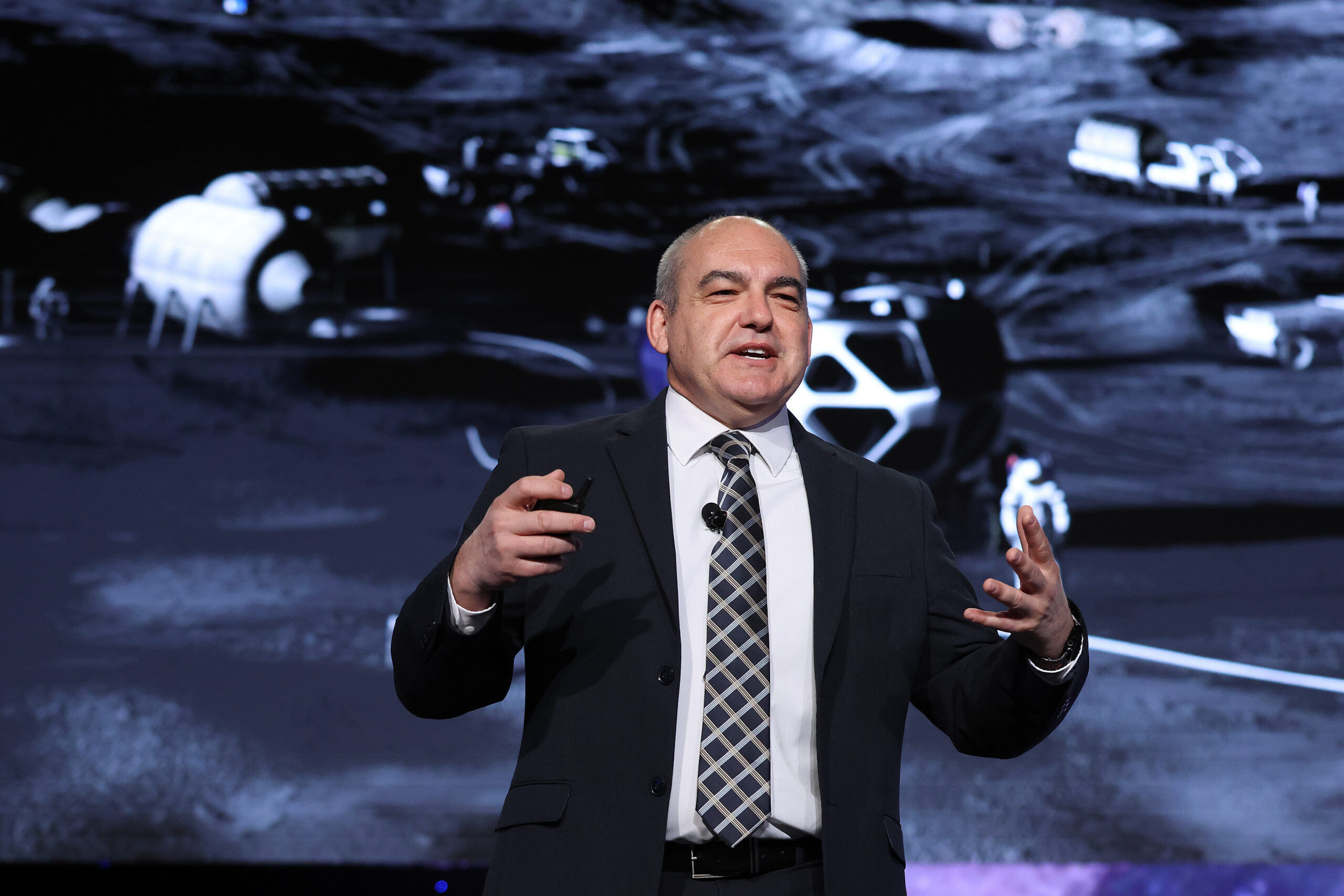
The goal? A permanent base on the moon. But what might that look like? Leaders within NASA and industry partners shared some details last week at the 41st Space Symposium, the annual international gathering of space industry companies, space agencies and space enthusiasts at The Broadmoor.
Some of the original concepts and pitches NASA got appeared to take inspiration from airports, said Carlos Garcia-Galan, NASA’s moon base program executive.
“What we envision is hundreds of square miles with assets that are serving different purposes,” he said. “It’s going to be an area where we have drones flying around cargo and human landers and habitation.”
The moon base won’t be built overnight, a point emphasized by both Garcia-Galan and NASA Administrator Jared Isaacman. During a presentation Thursday, Garcia-Galan outlined the agency’s three-phase approach to the moon base. Phase one, which is already underway having been announced during NASA’s ignition event roughly a month ago, will largely be about experimentation and assuring reliable access to the lunar surface.
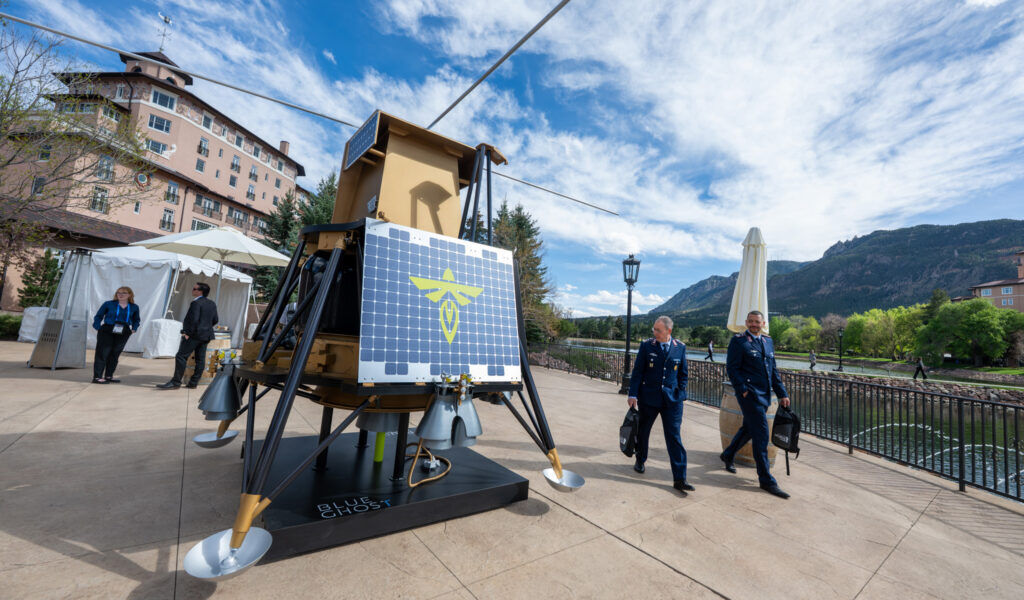
Isaacman is pushing NASA to land rovers, landers and experiments on the lunar surface at a rate of about one per month. Companies like Texas-based Firefly Aerospace, which successfully landed its Blue Ghost lunar lander last year, are ready to meet that goal. Firefly’s Blue Ghost Mission 2, with a plethora of experiments and a NASA-built telescope onboard, is set to launch later this year.
The second phase is all about landing and setting up permanent pieces of infrastructure while phase three will see permanent human habitation, Garcia-Galan said.
“We’re going to have over 10 missions next year and 12 the year after,” Garcia-Galan said, adding it will be all about sending “many assets.” This will include rovers to explore the terrain “so we can lay the groundwork to do technology and infrastructure later.”
Colorado company Lunar Outpost, headquartered in Golden, has been laser-focused on a sustained human presence on the moon since it was founded in 2017, said Mike Moreno, the company’s vice president of strategy. Lunar Outpost has accelerated some things, but it largely remains focused on current missions, Moreno said.
Lunar Outpost sees itself as a “lunar mobility” company, meaning it’s in the business of getting people, equipment and objects from one spot on the moon to another. The company has already tried to demonstrate that mobility, said Moreno.
The company had its “MAPP” — Mobile Autonomous Prospecting Platform — land on the surface of the moon aboard the Intuitive Machines IM-2 lander. The lander came to rest on its side, wedging the garage door of MAPP closed. Every indication prior to the landing showed that MAPP was ready to go, Moreno said.
“We have four more contracted missions with MAPP platforms in the next few years and that is the start of our lunar mobility,” he said.
And the company tests its large lunar vehicle right here in state. Outside of the southern Colorado towns of Rye and Colorado City are the proving grounds Lunar Outpost is using as it tests the rover it hopes will win a three-way competition.
Lunar Outpost employs at least 85 people in Colorado and about 150 nationwide, according to past coverage by the Gazette’s news partner KOAA. The company is currently hiring, with more than 20 positions available in Colorado, listed online at https://www.lunaroutpost.com/careers.
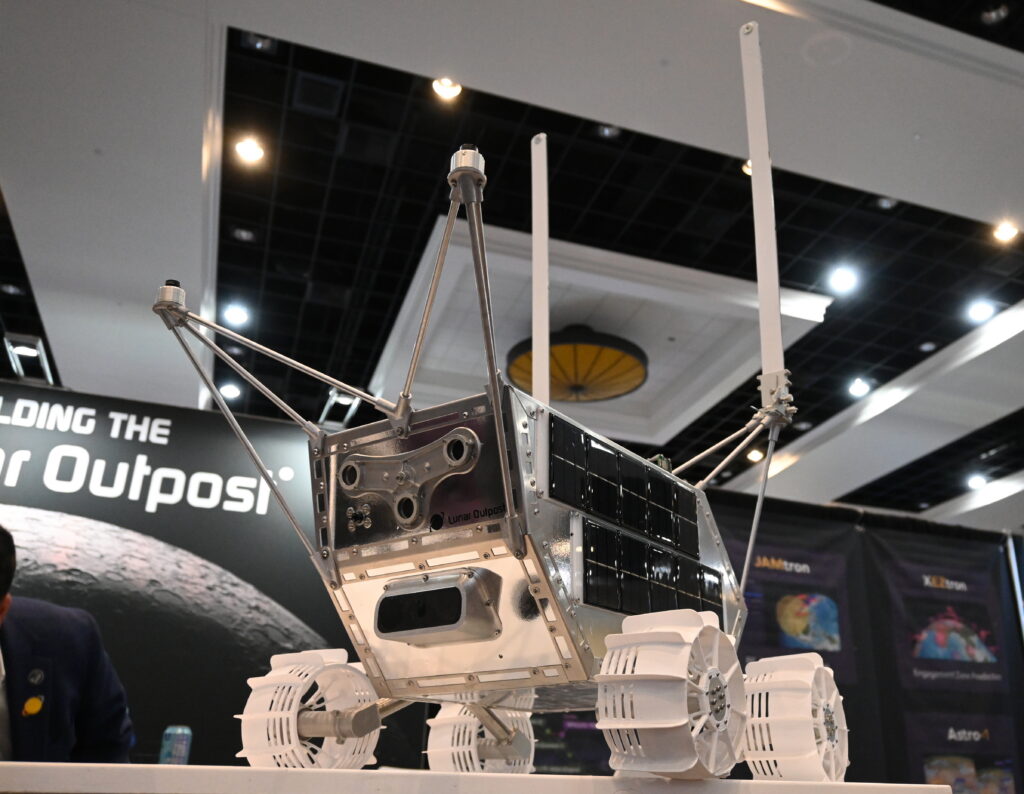
At last year’s Space Symposium, Lunar Outpost showcased a full-size mockup of its “Eagle” lunar terrain vehicle This year, Astrolab brought in a full-size rover which it calls FLEX, as well as its autonomous rover called FLIP. But Moreno wasn’t worried by Astrolab’s apparent flex.
“We really love the focus that NASA and the rest of the industry is placing on the moon,” he said.

Colorado quantum company gets another $20M from NASA to send tech to space
Bernadette Berdychowski
bernadette.berdychowski@denvergazette.com
Updated 1 week ago
NASA is ready to take the next step in sending a Colorado company’s quantum technology into space. The federal space agency awarded Infleqtion another $20 million to develop its Quantum Gravity Gradiometer Pathfinder, bringing the total to $40 million, Infleqtion...
Colorado’s Ursa Major to go public in $2.3B deal as demand for missiles skyrockets
Bernadette Berdychowski
bernadette.berdychowski@denvergazette.com
Updated 2 weeks ago
Ursa Major Technologies, one of Colorado’s biggest aerospace and defense companies, is undergoing a period of major growth. Following on the heels of solidifying the creation of more than a thousand jobs for the state, Ursa Major now plans to...

Denver aerospace company Voyager sees rapid growth in latest earnings
Bernadette Berdychowski
bernadette.berdychowski@denvergazette.com
Updated 1 month ago
A fast-growing aerospace and defense company based in Denver saw record revenues and record bookings in the latest quarter. Voyager Technologies announced it generated $52.7 million in the second quarter, according to its latest earnings report released Monday. Revenues are...

Artemis II crew to speak at Red Rocks Amphitheatre
Dan Boniface
dan.boniface@denvergazette.com
Updated 2 months ago
An out-of-this-world event is landing in Colorado next month. The crew of Artemis II will be at Red Rocks Amphitheatre on Aug. 3 for an event that will celebrate the Rocky Mountain region’s contribution to their mission around the dark...

Colorado Springs’ Auria showcases BORG training software meant to defend American space interests
alex-edwards
alex.edwards@gazette.com
Updated 2 months ago
Auria, a major space and defense company headquartered in Colorado Springs, showcased a flagship tool it has developed to keep satellite operators well trained. The tool fills a gap identified by a congressional committee as critical as the U.S. contends...

Business leaders see ‘cracks’ in Colorado, while governor insists state is ‘competitive’
Marianne Goodland
marianne.goodland@coloradopolitics.com
Updated 4 months ago
How does Colorado get back to the climate in the early 2000s, when there was collaboration between state government, companies and colleges and universities? That was the question posed to Gov. Jared Polis and a panel convened Tuesday by the...

Colorado space startup secures $650 million for expansion
alex-edwards
alex.edwards@gazette.com
Updated 4 months ago
The window to deliver space superiority for the U.S. is open but shrinking rapidly, according to defense startup True Anomaly. The Centennial-based company hit a milestone in its pursuit to help deliver that, announcing Tuesday that it raised $650 million...

Colorado Aeronautical Board greenlights millions in airport funding
Deborah Grigsby
deborah.smith@denvergazette.com
Updated 5 months ago
Many of Colorado’s public-use airports can now begin or complete key projects that enhance aviation safety and support the state’s transition to cleaner aviation fuels. Last week, the Colorado Aeronautical Board approved $7.3 million in grants from the Colorado Aviation...

Colorado awards $26M in tax incentives to keep aerospace company in state
Bernadette Berdychowski
bernadette.berdychowski@denvergazette.com
Updated 5 months ago
A technology company in the aerospace and defense industry is looking to expand and could bring 1,250 jobs to Colorado if it chooses to continue growing in the state. The Colorado Economic Development Commission approved $26 million in job growth...
Universities sue to block dismantling of Boulder’s NCAR
Scott Weiser
scott.weiser@gazette.com
Updated 6 months ago
A consortium of universities filed a federal lawsuit Monday, alleging the Trump administration’s plan to dismantle the National Center for Atmospheric Research is unlawful retaliation against Colorado. The group also argued that the move violates federal law. The University Corporation...
PREV
PREVIOUS

DougCo commissioners challenging open meetings violation
The Douglas County Board of Commissioners is challenging a recent court decision that found the board violated Colorado Open Meetings Law. County commissioners filed a petition Thursday seeking a rehearing from the Colorado Court of Appeals. On April 2, the appellate court ruled that a trial court erred in rejecting a preliminary injunction that would […]

U.S. Supreme Court will hear challenge from Colorado Catholic preschools on state funding exclusion
WASHINGTON (AP) — The Supreme Court will hear from Catholic preschools that say Colorado violated their religious rights by excluding them from a state-funded “universal” pre-kindergarten program over their admission policies. The court agreed on Monday to take up the appeal from St. Mary Catholic Parish in its challenge against a state program. That challenge […]