

‘Too many people are dying’: Motorcycle deaths continue to rise in Colorado, state agencies say
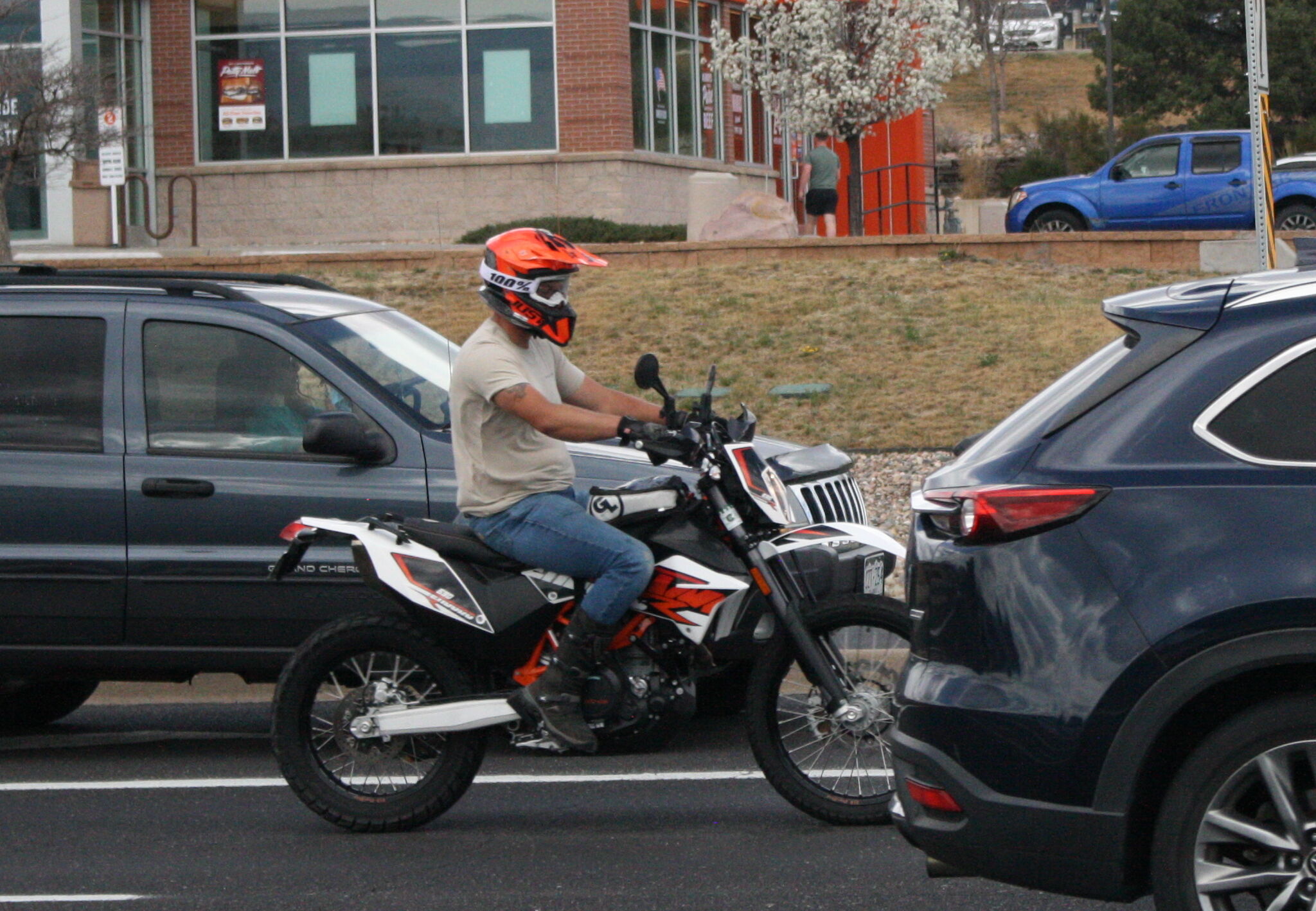
The first three months of 2026 were the deadliest opening quarter for Colorado motorcyclists in nearly a decade, according to the Colorado Department of Transportation.
Between Jan. 1 and March 31, 15 riders were killed in crashes, the deadliest start to a year in Colorado since 2017, the state agency said.
Six of those deaths were in Denver and Aurora, law enforcement officials said.
During that three-month span, Adams County had the highest number of motorcycle deaths with six, according to the Colorado State Patrol. El Paso County was second with five fatalities, followed by Jefferson and Larimer counties with four each and Boulder County with two.
This grim news comes as 2026 moves toward what is typically the deadliest period on U.S. roadways.
Road safety experts often refer to the span between Memorial Day and Labor Day as the “100 Deadliest Days of Summer,” a typically warm-weather period that has been particularly hazardous for motorcyclists.
Since 2015, about 58% of the state’s motorcycle fatalities have taken place between June and September, according to CDOT spokeswoman Tamara Rollison.
A possible factor in the recent spike in motorcycle deaths could be the unusually warm winter season, Rollison said.
“We have had an unseasonably warm winter and spring, which means that more motorcyclists and bicyclists will be out enjoying the wonderful weather,” she said. “If you have more motorcyclists out, an increase in crashes could follow.”
The increase is part of a steady, years-long increase in deadly crashes, CDOT officials said. Motorcycle fatalities have gone up by almost 90% over the past 15 years, CDOT officials said.
Last year, 148 riders were killed on Colorado roads and highways, accounting for 21% of all traffic deaths despite motorcycles comprising only 3% of vehicles on the road.
Several factors have contributed to the fatalities, but the most prevalent one is excessive speed, according to the CSP.
Alcohol impairment is a close second. In 2025, more than 26% of motorcycle deaths in Colorado involved impairment, CDOT data shows.
The most effective protection against fatal crashes is the use of a helmet. Over the past five years, 49% of all riders killed in Colorado were not wearing a helmet.
“Wearing a helmet is the best way for motorcyclists to protect themselves in the event of a crash,” Rollison said. “Without one, they may survive the crash, but chances are really good that they’ll have debilitating injuries to the point that they’ll never be able to get on a motorcycle again.”
Hanna Sturdivant, founder of Colorado-based nonprofit Riders for a Better Tomorrow, said just strapping on a helmet is not enough. When Sturdivant’s husband, Cody Ray, was killed in a motorcycle crash near 4th Street and Hancock Avenue in Colorado Springs in 2024, he lost his helmet upon impact, she said.
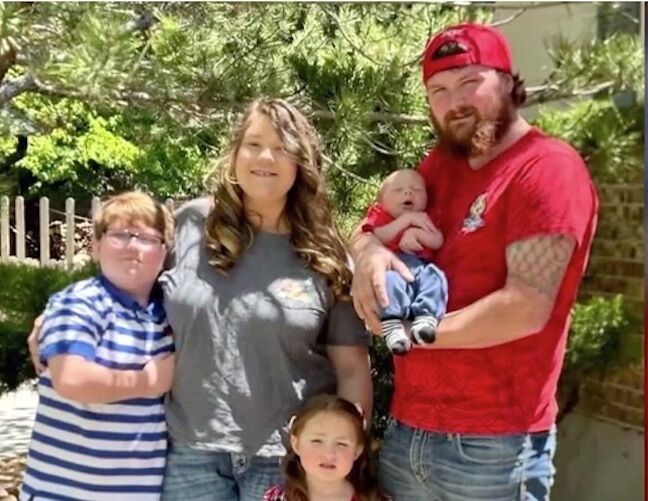
“It’s extremely important that your helmet fits well,” she said. “Also, you should replace your helmet every five years, and if you drop it from a significant height, you should check the memory foam inside. Not enough people are aware of that.”
Col. Matthew Packard, chief of the CSP, encourages riders to enroll in and pass an approved motorcycle safety course.
“Earning your motorcycle endorsement and wearing safety gear are responsibilities of every rider before hitting the road,” Packard said. “Safety is a shared responsibility on our roadways.”
Sturdivant agreed that riders and drivers share responsibility for avoiding crashes on Colorado roads.
Her awareness nonprofit, Riders for a Better Tomorrow, places a premium on rider safety, educating motorcyclists on the proper riding gear, and in some cases helping them pay for approved safety courses.
“It’s the rider’s responsibility to make sure that they’re going the speed limit, wearing a fitted helmet, and to make sure they know the law,” said Sturdivant, who has lost six friends and associates to motorcycle crashes in recent years.
“We share the road — motorists, truck drivers, motorcyclists,” Rollison said. “It’s a shared responsibility for all of us to watch out for each other and drive responsibly.”
Drivers are encouraged to keep an eye out for motorcycles, especially at intersections where many crashes occur.
“It’s incredibly important, when you’re in your car, to be mindful of your surroundings, and that includes potential motorcyclists,” Rollison said. “When you’re making a left turn at an intersection, you have a lot of protection around you. A motorcyclist does not. You need to be watchful.”
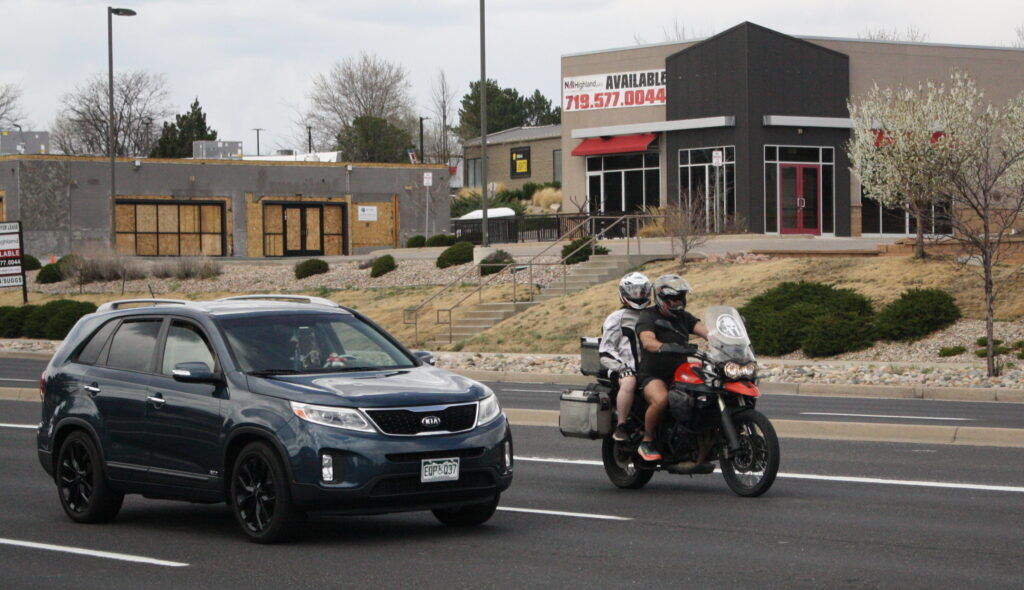
At the same time, riders need to follow the rules of the road, obey speed limits, avoid following vehicles too closely, and exercise caution when approaching intersections.
“Drivers need to look twice when they’re at an intersection,” Sturdivant said. “And riders need to slow down when they approach an intersection instead of speeding through it.”
Riders need to understand the difference between lane filtering, which is legal in Colorado, and lane splitting, which is not, Rollison said.
“Lane filtering allows bikes to pass between vehicles that have come to a complete stop, and the bike cannot pass faster than 15 mph,” she said. “Lane splitting, which is passing between moving vehicles, is extremely dangerous as well as illegal.”
May is Motorcycle Safety Awareness Month and the unofficial start of peak riding season, officials said.
State and local agencies are asking drivers and riders to help slow the upward trend in motorcycle deaths by observing all traffic laws, always driving or riding sober, avoiding distractions like cell phones, and maintaining awareness of each other.
“Crashes can happen easily if you’re speeding, driving distracted, or not following the laws of the road,” Rollison said. “They can happen in a flash of a second, and in that flash, your life can change drastically. We want everyone to get to their destinations safely, and that means we all share the road in a responsible way.”
Sturdivant, a 28-year-old widow with three young children, put it more succinctly.
“We all need to do better on the road,” she said. “Too many people are dying.”


Reagan’s PATCO Showdown ignited Colorado labor backlash | A LOOK BACK
Rachael Wright, Special to Colorado Politics
rachael.wright@coloradopolitics.com
Updated 3 days ago
Forty-five years ago this week: “It’s the old Nixon reaction as far as I’m concerned. He thinks he’s the Great God Almighty and can do no wrong … in the eyes of the public,” said Zelda Bransted, spokesman of the...

Jeff Crank, Jessica Killin set to face off in 2 debates in Colorado’s 5th Congressional District
Ernest Luning
ernest.luning@coloradopolitics.com
Updated 2 days ago
Republican U.S. Rep. Jeff Crank and Jessica Killin, his Democratic challenger, have agreed to debate twice in the weeks leading up to the general election in Colorado’s 5th Congressional District, their campaigns have said. Crank is seeking a second term...
Golden fire chief fired days after city manager as city investigates ‘racist incident’
Matt Kyle
matt.kyle@denvergazette.com
Updated 2 days ago
The City of Golden has terminated its fire chief days after terminating the city manager due to a “racist incident” earlier this year at a city fire station. City officials said that in March, a “Snoop on a Stoop” doll,...
Ikon Pass company cuts jobs in Denver and beyond amid several changes
Bernadette Berdychowski
bernadette.berdychowski@denvergazette.com
Updated 2 days ago
As the ski resort company behind the Ikon Pass and the operator of Steamboat Springs, Arapahoe Basin and Winter Park Resort is going through a phase of changes, the Denver-based company is now cutting jobs. Alterra Mountain Co. has laid...
Healthcare Freefall: Finger‑pointing intensifies as Colorado’s healthcare system strains under rising costs, shrinking coverage
Thelma Grimes
thelma.grimes@coloradopolitics.com
Updated 7 hours ago
Editor’s Note: Colorado’s healthcare system is entering a period of accelerating instability — a “tsunami,” as multiple leaders describe it — driven by collapsing hospital finances, shrinking Medicaid reimbursements, disappearing services and a political fight over who is responsible for...

DPS board sends $44 million tax increase to Denver voters
Nico Brambila
nico.brambila@denvergazette.com
Updated 3 days ago
The Denver Public Schools board on Thursday unanimously voted to place a mill levy override on the November ballot that — if approved by voters — would raise taxes by $43.9 million annually, largely to fund employee raises. The request...

General charged with Golden Dome raises alarm over future funding
Mary Shinn
mary-shinn@coloradopolitics.com
Updated 2 days ago
The general leading the efforts to develop the new Golden Dome missile defense system raised concerns this week that the next phase of funding might not come through. Gen. Mike Guetlein spoke about Golden Dome funding during the Space and...
Fort Carson garrison commander says staff cuts created ‘uncertainty and fear’
Mary Shinn
mary-shinn@coloradopolitics.com
Updated 3 days ago
The Fort Carson garrison commander departed Wednesday after what he described as a difficult 18 months for installation and garrison staff. “I know the last 18 months has been marked by profound uncertainty and fear, but you weathered the storm...

After a snowless winter, agents say summer is luring second-home buyers to the mountains
Mark Samuelson Special to The Denver Gazette
mark.samuelson@denvergazette.com
Updated 2 days ago
Last winter was a terrible growing season in Grand County for what arguably is its most important crop: snow. The county 60 miles west of Denver over the top of Berthoud Pass saw a record-low snowpack — poor enough that...
Aurora police officer resigns after taking narcotics found during traffic stop
Kyla Pearce
kyla.pearce@gazette.com
Updated 3 days ago
An Aurora Police Department officer resigned after investigators found that he took narcotics that were collected as evidence during a traffic stop. Michael Gallagher violated several agency policies, including substance abuse, tampering with evidence and lying in a criminal investigation,...
PREV
PREVIOUS

TABOR showdown: Senate moves bill forward, Advance Colorado prepares for legal action
Despite objections from legislative staff and Republican opposition, Senate Democrats on Friday moved forward with a proposal to reroute $306 million in taxpayer refunds. Already, critics are preparing to sue over the proposal that seeks to take $300 million in Taxpayer’s Bill of Rights refunds over the next two years to cover what Democratic lawmakers believe […]

Colorado needs a sane, viable opposition party | SONDERMANN
If you are upset with the increasing regulatory burden in Colorado, the exodus of too many large employers, accelerating property taxes, the condition of the roads, and all of the funding for transit schemes with low demand, of course, you can lay the blame on Democrats who control all levers of state government. The same […]