

Colorado governor signs $47 billion budget in which ‘nobody won’
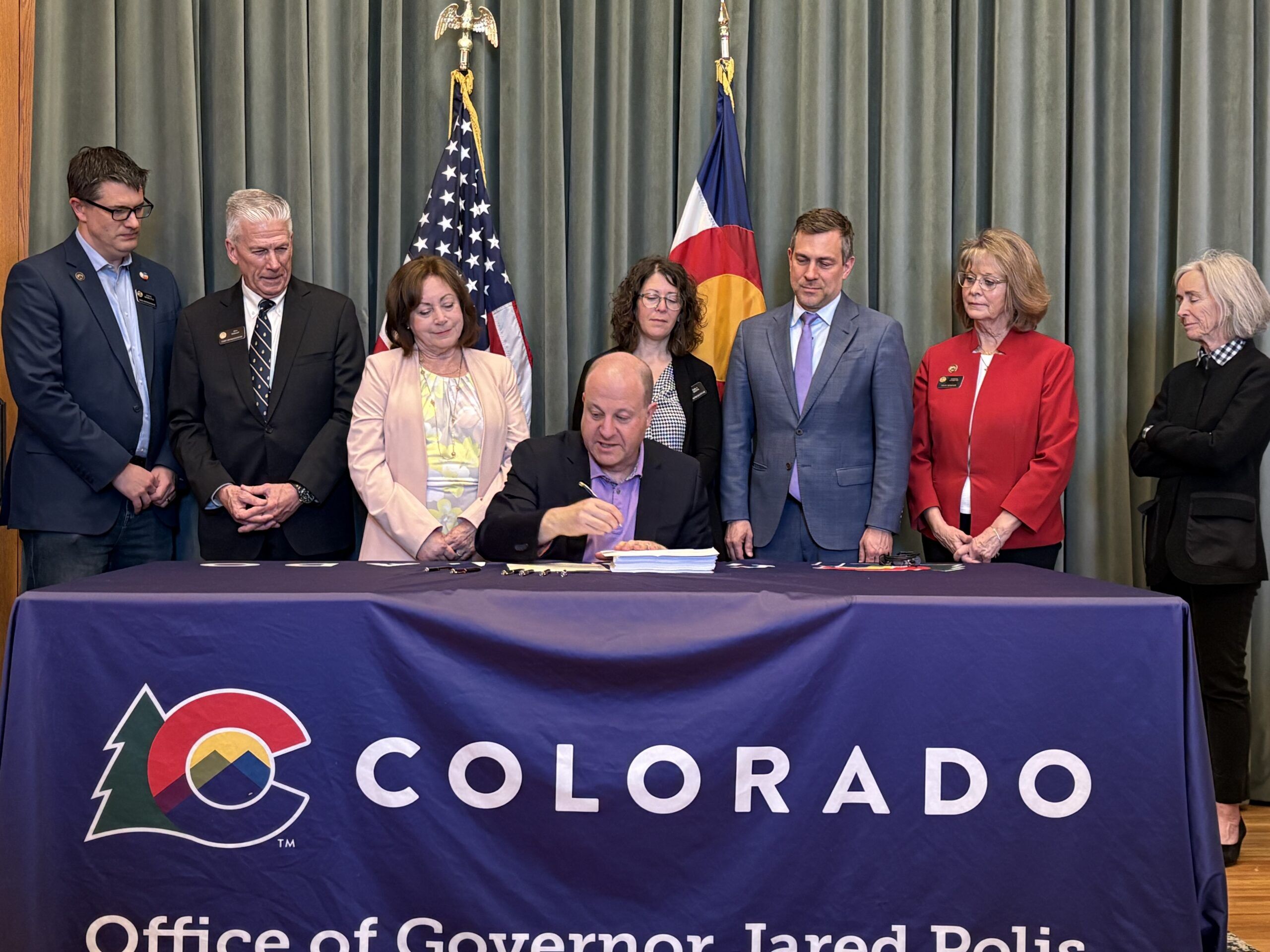
Gov. Jared Polis on Friday officially signed a $46.87 billion spending plan for the Colorado state government in the next fiscal year.
His signature is the culmination of months of work by legislators, who resorted to cuts, transfers and other mechanisms to balance the 2026-27 budget amid a deficit of more than $1 billion.
That spending plan is, in fact, larger than the current budget as approved by lawmakers a year ago. At the time, that budget stood at $43.9 billion. It had changed significantly since.
The new budget goes into effect on July 1.
The governor was flanked by members of the Joint Budget Committee, none of whom was happy about the spending plan, given the cuts to services for some of Colorado’s most vulnerable residents.
“Nobody won in this budget,” said Rep. Rick Taggart, R-Grand Junction.
Taggart recalled listening to testimony from families whose loved ones have intellectual and developmental disabilities. Caretaker pay for those families had been among the hardest hit in the budget.
Polis did not veto any line item appropriation. Nor did he veto any of the bill’s footnotes, which are directives from the legislature on how the dollars should be spent.
They sometimes earn a gubernatorial veto due to a separation of powers issue. The state Supreme Court has supported the governor’s authority on veto actions going back to the administration of Gov. Dick Lamm in 1978.
Polis directed agencies to comply with the footnotes — which notably included directives around the state’s wolf reintroduction program within Colorado Parks and Wildlife — “by the extent practicable and appropriate.”
He did not take questions after signing the budget.
Polis noted the difference between the federal and state budget, pointing out the former budget operates at a deficit at around $2 trillion dollars.
The state, on the other hand, must come up with a balanced budget every year, he said.
Democrats have blamed the congressional budget approved last July for Colorado’s fiscal woes. Republicans, on the other hand, said the state had overspent and the majority in charge of the government refused to make the hard decisions, even when they knew that large deficits loomed ahead.
Medicaid has been driving overspending both in the 2025-26 fiscal year and in next year’s state budget — the result of over-utilization of services. The state program that provides health coverage to low-income residents is beset by allegations of waste, fraud and abuse, while its leadership has been accused of mismanagement.
Congress is investigating the fraud allegations.
The governor said he was proud of the efforts by the Joint Budget Committee to come up with a balanced spending plan. He noted that legislators found a way to fully fund public education.
“We are not returning to the days of underfunding our schools and the budget stabilization factor,” the governor said, noting that the state is also moving forward with the second year of a new school finance formula.
As for the problems in health care, particularly with Medicaid, which was responsible for $1 billion in cost overruns in the past year, Polis said the costs cannot continue to go up by 10% or 11% per year.
“That’s ridiculous,” he said. “It’s not like health outcomes are getting better at 10%-11%. When health outcomes are the same, it’s just idiocy to spend more money.”
Joint Budget Committee Chair Rep. Emily Sirota, D-Denver, also noted that education funds had been spared.
“Even in the midst of making these billion-dollar reductions again and again, I think we can all be proud that we were able to preserve funding for K-12 education this year,” Sirota said.
The challenges will continue in the coming years, she said.
“The cuts that we had to make were unbelievably painful and they kept me up at night and they kept other members of the committee up at night,” added JBC Vice Chair Sen. Jeff Bridges, D-Greenwood Village.
He warned that, next year, policymakers will “probably be having the same kind of conversation about the cuts that we have made to get to a balanced budget.”
He said the committee has “done the least harm possible” through the cuts it made.
Sen. Barbara Kirkmeyer, R-Brighton, also lauded the efforts to fully fund K-12 education and maintain access to health care services throughout the state, not just for Medicaid.
“This is not a budget that we can love, but it’s a budget that got the job done,” Kirkmeyer said.
She noted the urgency of examining Medicaid — the JBC is sponsoring a bill to establish a commission to look at the program’s spending.
“It is tough because we’re still in the same spot we’ve been in for the last five years. We still have a structural deficit,” she said, adding the budget still relies on a lot of one-time spending.
“We protected and we did what we could with regard to education. We protected and did what we could with regard to health care access — and also to maintain public safety,” she said, noting these are the three top priorities for the state.
“This is the way government should work,” Taggart said — not, he added, at the “extremes,” where people are so set in their ideology that “we can’t reach out to one another.”
The governor still needs to decide on the 64 “orbital” bills that will help balance the budget through changes in statutes.


Democratic group aims Spanish-language TV ad at Gabe Evans in Colorado’s battleground 8th CD
Ernest Luning
ernest.luning@coloradopolitics.com
Updated 21 hours ago
A national group tied to House Democratic leadership launched a six-figure Spanish-language TV ad in Colorado this week targeting Republican U.S. Rep. Gabe Evans and the GOP’s signature budget legislation. The 30-second spot is part of $15 million in new...

Colorado School of Mines lands major share in Trump’s $100M mining-education plan
Thelma Grimes
thelma.grimes@coloradopolitics.com
Updated 22 hours ago
President Donald Trump on Friday named the Colorado School of Mines among roughly a dozen institutions that will share in a $100 million commitment “to train the next generation of American miners.” Paul Johnson, the university’s president, said he is...
Judge dismisses lawsuit seeking records from Colorado Democratic group
Marianne Goodland
marianne.goodland@coloradopolitics.com
Updated 23 hours ago
A lawsuit seeking to obtain records from Democratic lawmakers affiliated with a caucus has been thrown out by a Denver District Court judge. On July 17, Judge Ericka Englert dismissed the April lawsuit filed by progressive activist Derrick Blanton, who...

DOJ official decries ‘nonsense’ in Jeffco schools at fundraising gala
Matt Kyle
matt.kyle@denvergazette.com
Updated 7 hours ago
Amid a legal battle between Jeffco Public Schools and the federal government, a Department of Justice official spoke at a fundraising gala and decried “crazy stuff” and “nonsense” in the school district. The gala was for Jeffco Kids First, an...
Colorado Springs mother Deborah Nicholls’ murder conviction overturned
Nick Smith
nick-smith@coloradopolitics.com
Updated 2 days ago
A Colorado Springs mother convicted in 2008 of murdering her three children in a house fire might get a new trial after a judge ruled that prosecutors withheld key evidence that could have impacted the jury’s verdict. Deborah Nicholls, whose...

Aurora Community College student journalist accuses college of ‘unconstitutional gag order’
Kyla Pearce
kyla.pearce@gazette.com
Updated 1 day ago
An Aurora Community College student is accusing the college of putting an “unconstitutional gag order” on his student-run publication, saying the college banned it from publishing until students jumped through “countless bureaucratic hoops.” A college spokesperson said the college is...

Polis administration relaunches Colorado e-bike rebates with $3 million
Scott Weiser
scott.weiser@gazette.com
Updated 1 day ago
Gov. Jared Polis and the Colorado Energy Office announced Thursday the return of the state’s popular e-bike rebate program, with registration set to open later this month. The office plans to provide point-of-sale rebates totaling $3 million from the Community...
Appeals court rejects former DougCo commissioner’s legal fee claim
Nicholas Fogleman
nicholas.fogleman@denvergazette.com
Updated 1 day ago
The Colorado Court of Appeals rejected a former Douglas County commissioner’s bid for reimbursement of attorney fees she incurred while responding to multiple investigations into her conduct. The dispute stemmed from a 2019 anonymous letter sent to county officials alleging...

Right-to-natural-gas proposal in Colorado qualifies for ballot
Marissa Ventrelli
marissa.ventrelli@coloradopolitics.com
Updated 2 days ago
A citizen initiative that seeks to enshrine the right to natural gas has qualified for the November ballot, Colorado’s election office confirmed on Thursday. Petitions containing signatures for Initiative No. 177 were turned in to the Secretary of State’s Office for review...

Emerald ash borer confirmed in Colorado Springs, ‘pest is here to stay’
Brennen Kauffman
brennen-kauffman@coloradopolitics.com
Updated 2 days ago
Colorado Springs is asking residents to be on the lookout for an invasive beetle species that has jumped down the Front Range and into local ash trees. City officials said Wednesday that a confirmed emerald ash borer infestation had been...
PREV
PREVIOUS

Latest Pinnacol proposal shifts sponsors and cuts state benefits, triggers union standoff
Colorado’s long‑running bid to let Pinnacol Assurance break away from state control is suddenly in jeopardy, as a newly revised bill — stripped of the payouts and structural changes once central to the deal — has triggered fresh tensions among lawmakers, unions and the insurer itself. A draft obtained by Colorado Politics shows a very […]
TABOR showdown: Senate moves bill forward, Advance Colorado prepares for legal action
Despite objections from legislative staff and Republican opposition, Senate Democrats on Friday moved forward with a proposal to reroute $306 million in taxpayer refunds. Already, critics are preparing to sue over the proposal that seeks to take $300 million in Taxpayer’s Bill of Rights refunds over the next two years to cover what Democratic lawmakers believe […]