

Colorado justices concerned about blocking self-represented prisoners from pursuing claims due to lack of resources

When Jamale D. Townsell filed a petition from prison seeking postconviction relief, he argued his trial lawyer was constitutionally ineffective for failing to properly investigate DNA evidence that would have called his responsibility for a 2013 bank robbery into question.
The state’s Court of Appeals rejected his petition, reasoning Townsell had not shown how the uninvestigated DNA evidence would have changed the outcome of his criminal case, or if a DNA expert was “available and willing to testify.”
But during oral arguments to the Colorado Supreme Court on Tuesday, multiple justices expressed the same concern: Why should an incarcerated, self-represented defendant be turned away from the courthouse for failing to perform an investigation he could not possibly undertake himself?
“What would have been enough? What should Mr. Townsell have said here?” asked Justice Richard L. Gabriel.
“For somebody from prison, how do they do that?” added Justice Brian D. Boatright. “That’s where I’m concerned.”

In contrast with direct appeals of criminal convictions, defendants can also seek postconviction relief directly from the trial courts. That pathway, however, is only available for specific reasons, like ineffective assistance of counsel or newly discovered evidence — assertions that would require some investigation.
When a self-represented, or “pro se,” defendant files a petition, the Supreme Court has previously explained that trial judges must deny the request outright if the defendant is not entitled to relief. But if there is at least one claim with “arguable merit,” the judge must forward the petition to the public defender’s office so that an attorney can investigate and potentially refine the defendant’s assertions. After all of that happens, there is an opportunity for the defendant to receive a hearing.
An Arapahoe County jury convicted Townsell of entering a bank in June 2013 wearing a mask, demanding money at gunpoint and fleeing with $1,100 in cash in less than 30 seconds. He is serving 32 years in prison.
After the Court of Appeals upheld his convictions, Townsell filed a petition on his own arguing his defense lawyer failed to diligently investigate the possibility that DNA evidence would exonerate Townsell and point to an alternate suspect.
A three-judge panel for the Court of Appeals sided against Townsell by 2-1. The majority concluded a trial judge was not obligated to appoint counsel to represent Townsell because even if he had credibly alleged his original lawyer was ineffective, he failed to show the lack of DNA investigation harmed him.
“Townsell also does not specify how further investigation by defense counsel of the DNA evidence would have changed ‘the result of the proceeding,’ or allege that a DNA expert would even have been available and willing to testify consistent with his allegations that his DNA may not have been on the other items recovered by the police,” wrote Judge Sueanna P. Johnson for herself and Judge Jerry N. Jones.
Judge Timothy J. Schutz disagreed with the majority’s conclusion that Townsell neglected to explain how his attorney’s actions compromised his defense. Schutz believed Townsell had sufficiently done so under the circumstances. Specifically, he argued it is unreasonable to expect an incarcerated person to essentially perform the DNA investigation their trial lawyer allegedly failed to do.
“Townsell is, by all appearances, indigent, and he is in prison,” Schutz wrote. “The net effect of such reasoning is to deprive a defendant of an evidentiary hearing because of the failure to present the evidence that he claims trial counsel failed to procure in the first instance.”

To the Supreme Court, Townsell maintained Schutz’s assessment was correct.
“The minute you start rationing (appointments of postconviction counsel) based on what the defendant can write on the paper, you’re screening out cases that may have incredible arguable merit, like this one,” said Hollis A. Whitson, representing Townsell.
In support of Townsell, Ramsey Lama, a former trial judge who now specializes in postconviction work, submitted a brief arguing that wealthy defendants who can hire their own lawyers will always have a better chance of success, while people like Townsell are “forced to fend for themselves.”
However, the justices asked Whitson repeatedly about how much clarity even a self-represented defendant needs to provide when alleging a lawyer’s deficient performance swung the outcome.
“Is this enough? Maybe it is. But I’m just trying to think about a framework for evaluating how much is enough,” said Justice William W. Hood III.
At the same time, the justices pressed the government to give a clear answer about why Townsell’s allegations were insufficient. Hood read aloud from the part of Townsell’s petition where he alleged a follow-up investigation by his trial lawyer “would have discovered substantial evidence of defendant’s exclusion” from the DNA profile.
“He’s got enough here, arguably, to raise the specter of the alternate suspect’s DNA turning up,” said Hood.
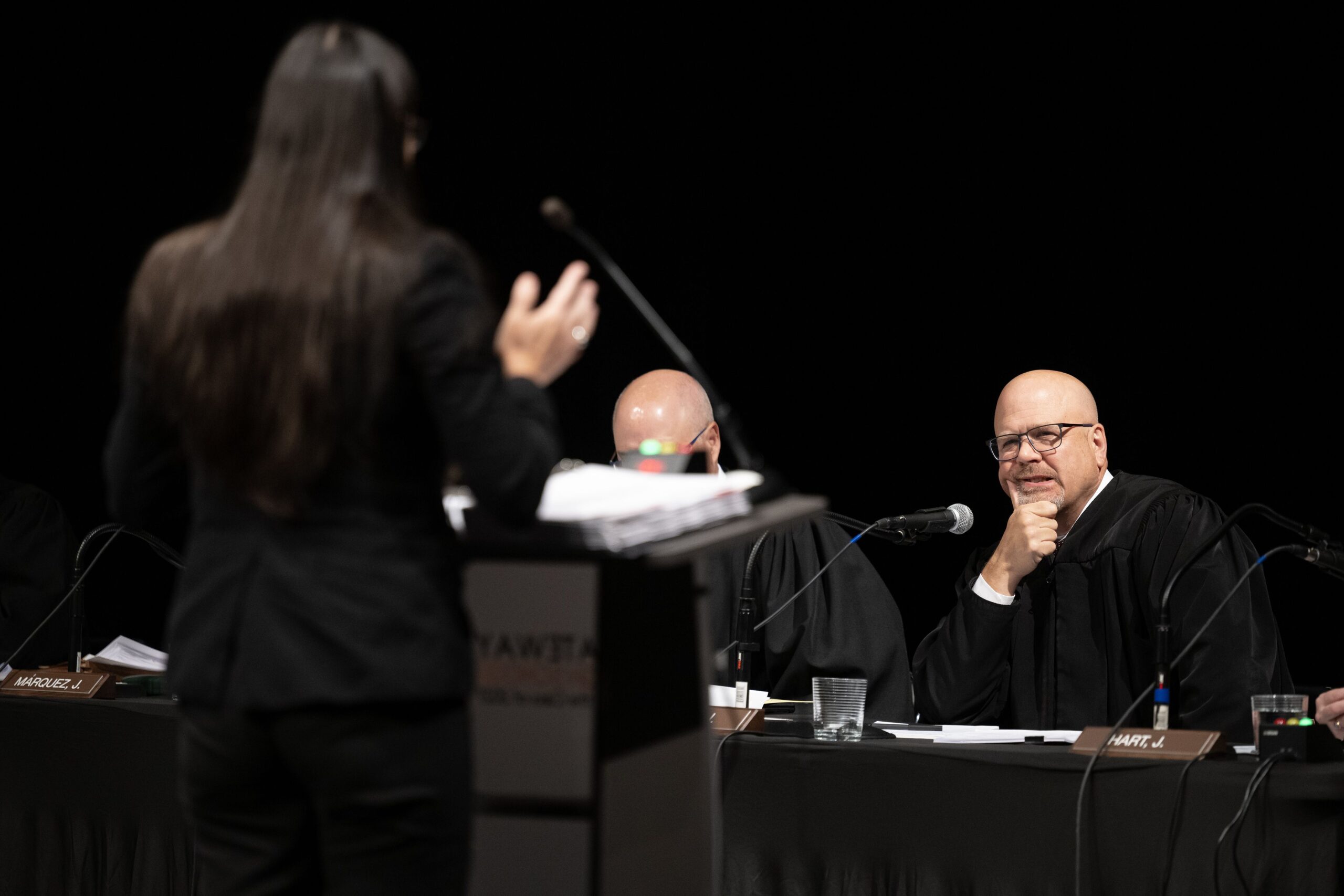
“What would he had to have said in this petition — guy from prison, no lawyer, no file — what would he had to have said in that motion to make it at least be referred to the PD?” said Boatright.
First Assistant Attorney General John T. Lee responded that a petition has to convey “not just that my attorney was ineffective … there needs to be facts asserted that, on its face, if proven true, would entitle a defendant to postconviction relief.”
“He has at least said, ‘Here’s what I think counsel did wrong. And I do think it would have made a difference,'” said Chief Justice Monica M. Márquez. “I’m worried that we’re asking him to drill down on alternate suspect theories and how the DNA evidence would tie to that. I’m struggling to see how pro se, incarcerated defendants are able to do all that on their own.”
Justice Melissa Hart was not present for the arguments, but Márquez said it is her “intent to participate in the decision.” A spokesperson for the judicial branch said Hart is attending to personal matters.
The case is Townsell v. People.


10th Circuit partially revives lawsuit over 2020 Denver protest injuries
Michael Karlik
michael.karlik@coloradopolitics.com
Updated 11 hours ago
The Colorado-based federal appeals court revived a man’s claims against Denver on Friday after concluding a trial judge resolved the case in the city’s favor without analyzing two of the three instances of alleged excessive force and other constitutional violations....

Federal judges find Colorado immigration judge violated several orders
Michael Karlik
michael.karlik@coloradopolitics.com
Updated 12 hours ago
Multiple federal judges in Colorado have freed people from immigration custody after determining that one immigration judge violated their directives for properly conducting bond hearings. For nearly a year, Colorado’s U.S. District Court has faced a flood of “habeas corpus” petitions...

Misconduct complaints from ex-Colorado judicial discipline director dismissed against federal judges
Michael Karlik
michael.karlik@coloradopolitics.com
Updated 1 day ago
The administrative body for the Denver-based federal appeals court upheld a finding last week that misconduct complaints against Colorado’s chief federal trial judge and the chief appeals judge warranted dismissal and appeared to be a “litigation tactic” by the complaining...

First-ever Red Rocks naturalization ceremony draws most diverse group of new citizens
Michael Karlik
michael.karlik@coloradopolitics.com
Updated 13 hours ago
Colorado’s federal trial court held its first-ever naturalization ceremony for nearly 300 new citizens on Thursday at Red Rocks Park and Amphitheatre. “We’re doing it to commemorate the 250th anniversary of the Declaration of Independence and the United States. Red...

Jeffco taxpayers could be on the hook for a possible child sex assault settlement
Matt Kyle
matt.kyle@denvergazette.com
Updated 17 hours ago
Taxpayers may end up on the hook for a child sexual assault settlement, possibly worth up to $15 million, after Jeffco Public Schools failed to notify its insurance company in a timely manner about the case. The incident stems from...
10th Circuit finds no fair housing violation by Littleton landlord for worker’s alleged rape of tenant
Michael Karlik
michael.karlik@coloradopolitics.com
Updated 11 hours ago
The Denver-based federal appeals court concluded on Monday that Littleton’s housing authority could not be held liable for a maintenance worker’s alleged rape of a tenant, as the worker’s employment did not provide any special access to the victim. A...

Jeffco Public Schools sues Trump administration to protect funding after alleged transgender policies violation
Matt Kyle
matt.kyle@denvergazette.com
Updated 2 days ago
In the wake of several threats by the Trump administration to revoke federal funding, Jeffco Public Schools filed a lawsuit against the Department of Education seeking to protect that badly needed money. Jeffco has been under investigation by the DOE’s...
Denver detox center did not violate man’s rights with 10-hour hold, 10th Circuit says
Michael Karlik
michael.karlik@coloradopolitics.com
Updated 3 days ago
The Colorado-based federal appeals court concluded on Tuesday that Denver’s detoxification facility did not violate a man’s rights by holding him against his will for 10 hours until his blood alcohol content was projected to reach zero. Unusually, Brian Garrett’s...

Federal judge clarifies ex-GOP treasurer candidate’s burden to prove defamation claims
Michael Karlik
michael.karlik@coloradopolitics.com
Updated 3 days ago
A federal judge clarified last week that businessman and former Republican statewide candidate Brian Watson will need to surmount a higher hurdle in proving his claim that a party guest’s alleged description of him as a “criminal” amounted to defamation....
Colorado board permits state to appeal injunction against arthritis drug price cap
Marissa Ventrelli
marissa.ventrelli@coloradopolitics.com
Updated 4 days ago
A Colorado board voted Friday to allow the Attorney General’s Office to fight an injunction against a price cap on a drug that treats arthritis. A U.S. district court judge had granted the company Amgen a preliminary injunction, temporarily blocking...
PREV
PREVIOUS

Aurora council to meet in-person after months of online meetings
After months of meeting via video conference, Aurora City Council will meet in person again at the first meeting following the municipal election, councilmembers decided in Monday night’s meeting. The decision got two “no” votes from Councilmembers Alison Coombs and Crystal Murillo, who said the council should come back in-person at the next council meeting […]

Colorado's energy crunch: Can renewables keep pace with data center demands? | ANALYSIS
Colorado faces mounting pressure on its electrical grid as data centers and advanced manufacturing drive up power needs, even as the state moves away from coal and natural gas, in favor of wind and solar energies, and battery systems. At the same time, Colorado is competing with surrounding states to attract data centers and technology […]