

Rural Reckoning | Wolves prey on relationship between Polis and rural Colorado


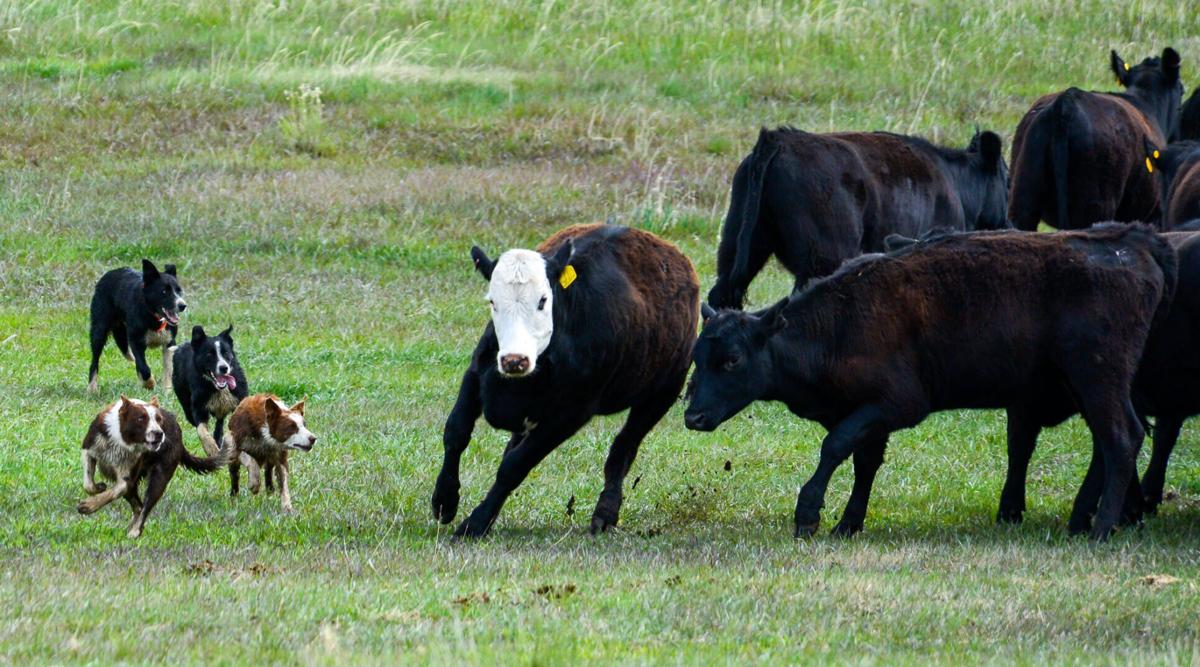
Middle Park rancher Conway Farrell's cattle dogs Chase, Roxy, JR, and Freddy turn yearling Angus cattle from a herd of 300 towards new pasture on May 25, 2024. Farrell said the cattle are so spooked by the wolves that it's making it very difficult to round them up using the cattle dogs.
Scott Weiser The Denver Gazette
Middle Park rancher Conway Farrell's cattle dogs Chase, Roxy, JR, and Freddy turn yearling Angus cattle from a herd of 300 towards new pasture on May 25, 2024. Farrell said the cattle are so spooked by the wolves that it's making it very difficult to round them up using the cattle dogs.
Scott Weiser The Denver Gazette
Polis blames ranchers for soaring costs
In one of the signs of the deteriorating relationship between livestock growers and the governor, Polis blamed ranchers for advocating with their counterparts in other states, where Colorado was going to source more wolves, to deny that request. During a 2024 meeting with Colorado Counties, Inc., Polis said if ranchers, such as those from the Middle Park Stockgrowers in Grand County, had requested wolves from nearby Wyoming, the state would probably have given them to Colorado. In a later statement, a Polis spokesperson said, “The reality is the state initially attempted to source wolves from Wyoming, Montana, and Idaho, but these common-sense requests were denied following special interest, lobbying, and political games by certain organizations.” Since wolves were reintroduced in Colorado, Middle Park ranchers have been hit the hardest by livestock losses. It took just a few months for the problems to surface, beginning during calving season in 2024, when wolves fed on livestock throughout Middle Park. The management plan called for non-lethal techniques to ward off the wolves, but the state failed to set up most of those programs until after the second batch of wolves were released in Pitkin County in January 2025. Ranchers and local officials said anew they were left in the dark about the wolves’ release. The release of the Copper Creek pack in Pitkin County also violated the state’s wolf plan, which stated that predators that killed livestock in other parts of the state would not be relocated elsewhere. The Copper Creek pack had originally been placed in Grand County, but with dozens of livestock killed there, much of it attributed to the male and female mating pair of the group, the state wildlife agency captured the wolves and four pups and placed them in a sanctuary for several months. This move shifted the problem from one county to another. The killings continued, now in Pitkin County, with the worst over the Memorial Day weekend this year, when the new pack attacked and killed livestock on at least three ranches. That’s despite the efforts of state-hired range riders, who ranchers claimed sometimes ended up on the wrong locations.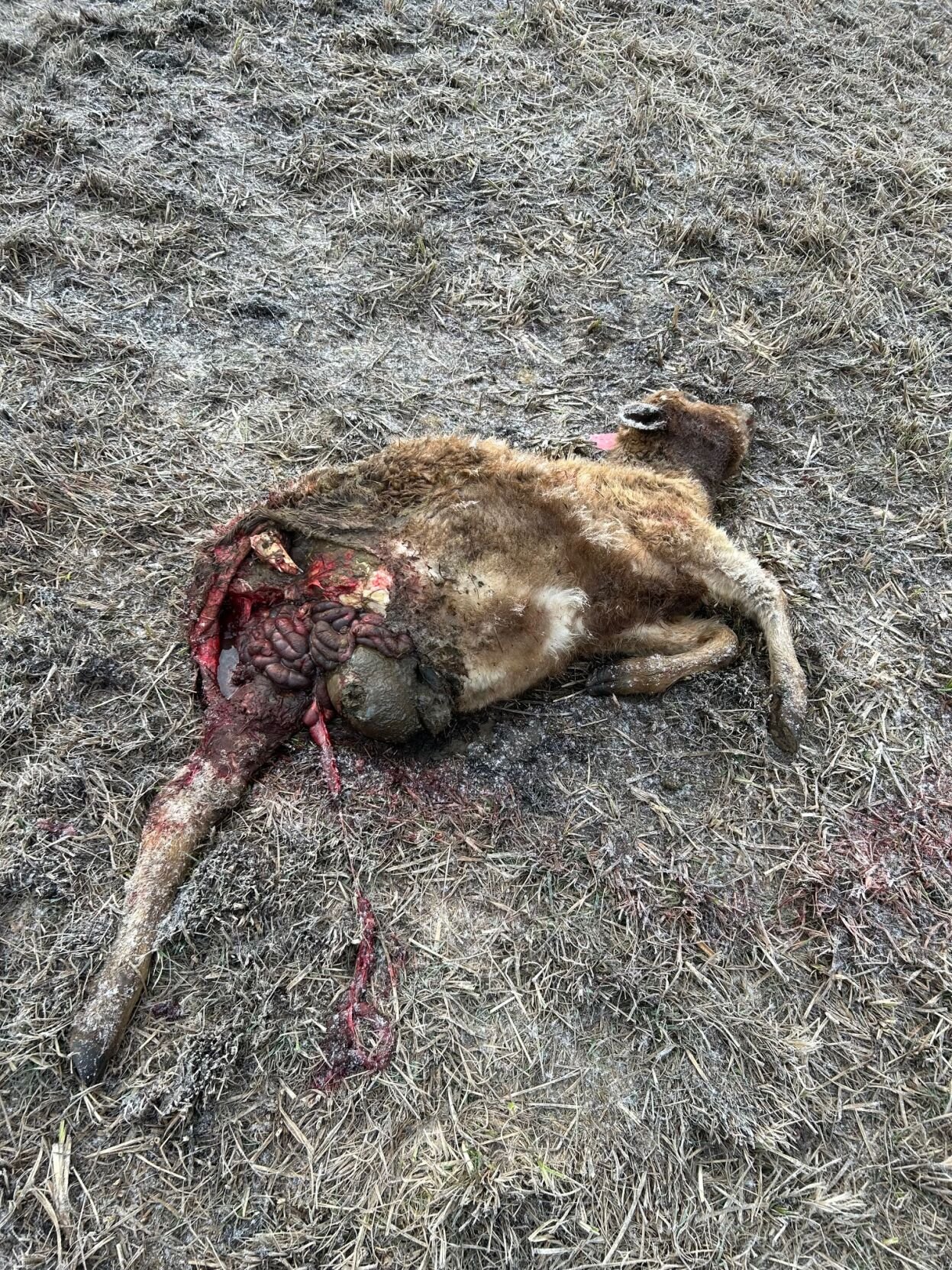
The remains of a yearling killed by a wolf in Grand County during the week of April 15. The yearling was one of four killed by wolves this week. Photo courtesy Middle Park Stockgrowers and The Fence Post.

Ranchers: State intervention to kill wolf didn’t change pack’s depredating behavior
After the Memorial Day weekend kills, wildlife officers killed one of the wolves, a yearling from the pack, in the hopes the intervention would change the group’s behavior. On July 18, CPW confirmed a Copper Creek wolf was still killing livestock and at the same ranch in Pitkin County. A wildlife commissioner, Tai Jacober, told his colleagues in a July 3 meeting that wolves, likely from Copper Creek, scattered a herd of cattle over the Fourth of July weekend, requiring the rancher to spend the entire weekend rounding them up. Jacober, a Pitkin County rancher, recently referred to the relocation of the Copper Creek pack there as a “mistake.” Meanwhile, a video shot near the McCabe Ranch, where wolves have been killing livestock, shows two wolves trying to separate a calf from its mother. The wildlife commission in early July declined to act on requests for lethal permits against the Copper Creek pack, saying that matter should be left to the state agency. The Holy Cross Cattlemen’s Association is now seeking a permit to lethally take the Copper Creek wolves.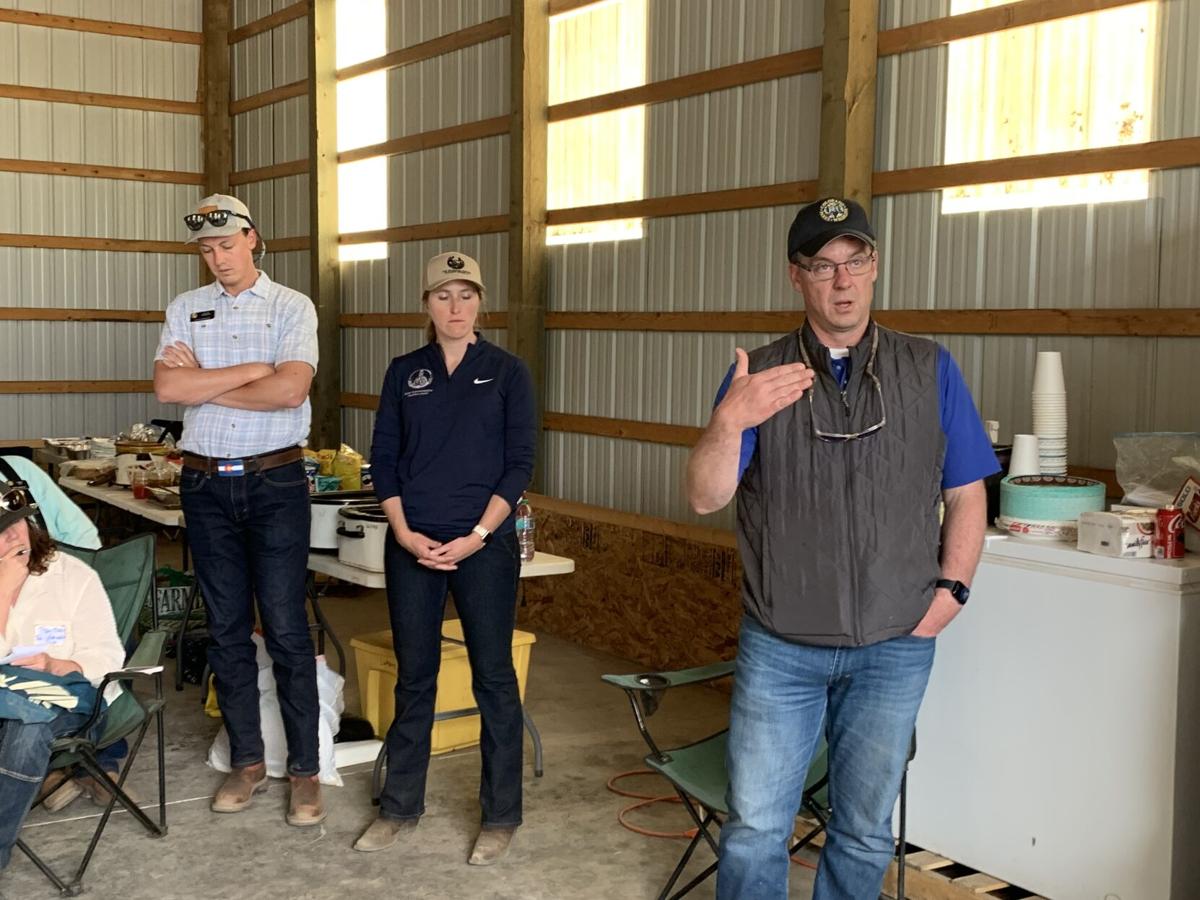
Jeff Davis, director of Colorado Parks and Wildlife, talks to ranchers during the Saturday summit at the Gittleson ranch near Walden.
Marianne Goodland marianne.goodland@coloradopolitics.com

Governor reshapes wildlife commission — and draws criticism
Further fueling the tension, Polis is reshaping the Colorado Parks and Wildlife commission into one that, critics said, appears to favor wolves. Often, the Senate Agriculture and Natural Resources Committee has served as a stopgap for gubernatorial nominees, though the decision to confirm ultimately rests with the state Senate. The committee has rejected Polis’ nominees three times in the past two years, although two of the three later won confirmation from the Democratic-controlled Senate. This year, they included Jay Tuchton, a former attorney for WildEarth Guardians who now manages a nature preserve in southeastern Colorado. The Senate committee rejected Tutchton’s nomination. During the hearing, lawmakers called Tuchton to task for calling the chair of the Senate agriculture panel and the House Speaker “whiny politicians” who pander to the newspapers on the issue of “chronic depredation” by wolves. The preserve that Tuchton manages was founded by the new executive director of the state land board, who advocates for the “rewilding” of grazing lands. Nicole Rosmarino previously served a policy advisor on wildlife, agriculture, and rural economic development in the governor’s office. In 2024, two nominees were rejected by the committee: Jessica Beaulieu, an environmental lawyer and formerly with the Center for Biological Diversity, and Gary Skiba, a former CPW biologist previously associated with Defenders of Wildlife. The group had called Skiba “the primary author of Colorado’s wolf conservation plan” in a lawsuit filed against the state of California in 2021. That legal challenge also included the Center for Biological Diversity. Beaulieu was nominated to represent state parks, despite a confession that she didn’t have a state park pass and could only name a few Front Range parks she had visited. She also admitted she had asked for help in figuring out who her constituents are. Skiba, who was nominated to represent hunters and anglers, faced opposition from those very groups. Ranchers also opposed his selection. Skiba later withdrew his nomination. Last month, the governor nominated John Emerick, the treasurer of Colorado Wild, a pro-wolf group, to replace Commissioner Karen Bailey, who served just one term. Emerick’s partner is Delia Malone, the president of Colorado Wild, who is also the wildlife chair for the Colorado Sierra Club, a major backer of the wolf reintroduction program and a frequent commenter at CPW meetings on the wolf issue. The second nominee is Francis Silva Blayney, a former “supervolunteer” for the Colorado Sierra Club. She replaces Marie Haskett, an outfitter who was term-limited and who was viewed as a champion for the Western Slope and for ranchers on the wolf issue. Silvia Blayney, who was nominated as representative of the outfitters, is unknown in that community and has only held a legally required outfitters’ registration from the Department of Regulatory Agencies since April 1, 2025. One outfitter called her nomination “manufactured,” claiming it was a way to increase the number of Sierra Club representatives on the wildlife commission.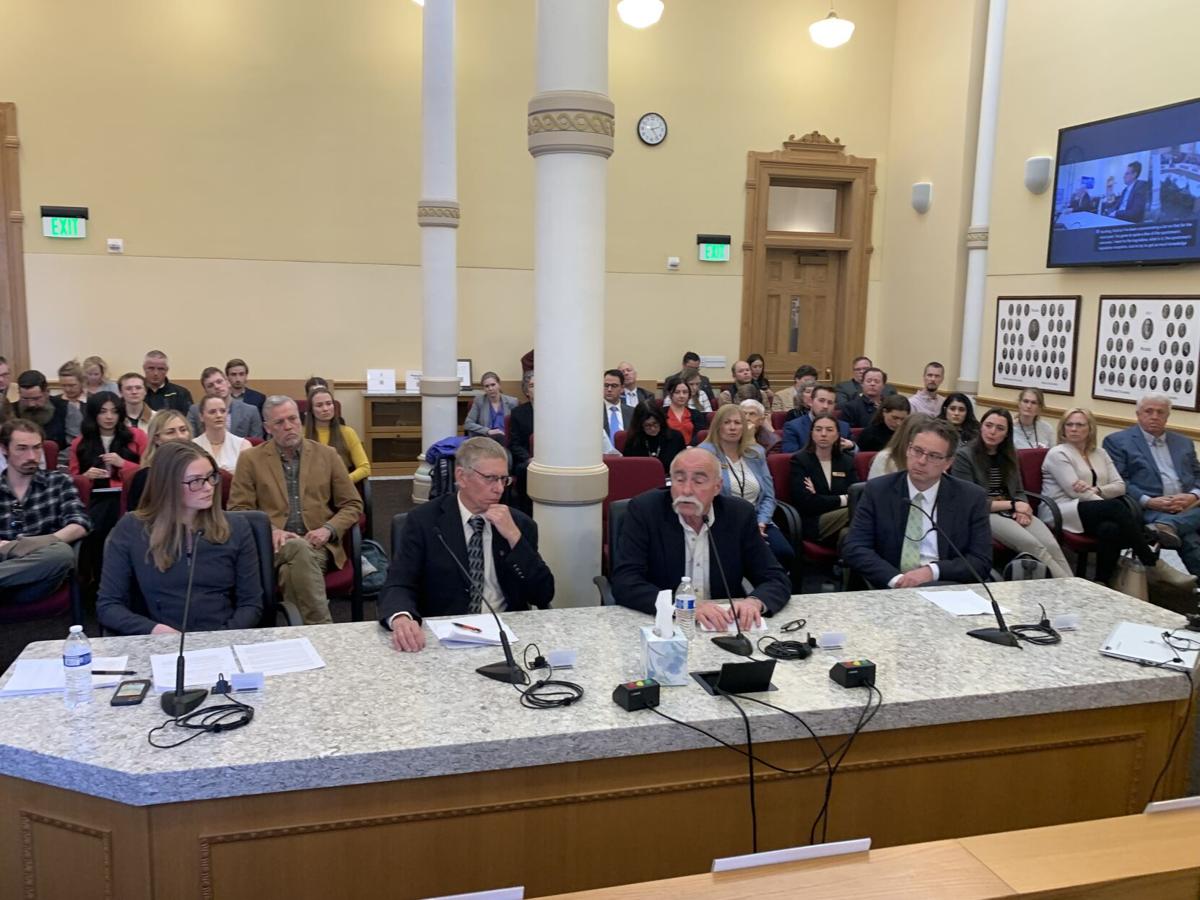
Three nominees to the state's Park and Wildlife Commission during their confirmation hearings on Feb. 29, 2024. From left to right, Jessica Beaulieu, Gary Skiba, Jack Murphy and CPW Director Jeff Davis. The Senate ag committee voted down Skiba and Beaulieu's nominations, although they will still head to the full Senate, albeit with an unfavorable recommendation.
Marianne Goodland marianne.goodland@coloradopolitics.com

Polis insists rural Colorado is well-represented in appointments
On July 16, Polis told Colorado Politics his intention is never to change of the makeup of a board to fit his interests. While touting his excitement over Silvia Blayney’s appointment, he stressed that filling all of the state’s open board positions is far from easy. There are more than 3,000 such positions, Polis said, emphasizing that Colorado Parks and Wildlife is not the only priority. Polis said his administration has worked to ensure rural Colorado is represented — that 23% of boards are comprised of rural members. “Again, we always try to have a geographic spread,” he said. “I also have a lot fewer Democrats and Republicans on our boards. A lot of them are unaffiliated.” Additionally, for the makeup of boards to change, residents need to start volunteering for them, he said.
As wolves prey on livestock, state-landowner partnerships disintegrated
The state sought to frame its relationship with ranchers in a more positive light. CPW spokesman Luke Perkins told Colorado Politics the agency values its relationships with Colorado farmers and ranchers. “They are some of our most passionate constituents, and we continue to engage with them and value their feedback on CPW’s operations and efforts,” Perkins said. “Producers and landowners have certainly expressed valuable concerns about the reintroduction of wolves, and CPW is grateful for their continued support and willingness to express those concerns in ways that lead to productive outcomes that benefit the environments, wildlife, and people of the Centennial State.” But for many, the long-time partnership between some private landowners and the state has disintegrated in the last three years of Colorado’s wolf program. Colorado Parks and Wildlife relies on private landowners, including ranchers, to assist with conservation, wildlife habitat restoration and access to private lands for hunting and angling. Some of those private landowners have “closed the gates” to CPW since the wolf program was launched, according to sources. While many blame the wildlife agency and its executive director, Jeff Davis, some also point to Polis and Reis. In a June 30 meeting with the legislature’s Agriculture and Water Resources Review Committee, Davis was asked about interference from Polis and Reis, particularly on who decided to release the Copper Creek pack into Pitkin County, as well as on depredation investigations. Davis said it was his decision alone on the Copper Creek pack. His answer didn’t satisfy ranchers, including Tom Harrington, president of the Colorado Cattlemen’s Association, who said he believes Polis and Reis wield influence over state decisions and that their agenda is “more wolves at any cost.” Editor’s Note: This is the second part of a series examining Colorado’s urban-rural relationship. New stories in the series will be published every Friday through Aug. 8. Follow all the stories in the series here. Thelma Grimes contributed to this report.
Victor Marx says he’ll only debate Phil Weiser once in Colorado governor’s race — without a moderator
Ernest Luning
ernest.luning@coloradopolitics.com
Updated 14 hours ago
Colorado Republican gubernatorial nominee Victor Marx said on Tuesday that he will participate in only one debate with Attorney General Phil Weiser before the November election — and he challenged the Democratic nominee to hold the event without a moderator....
10th Circuit finds no fair housing violation by Littleton landlord for worker’s alleged rape of tenant
Michael Karlik
michael.karlik@coloradopolitics.com
Updated 16 hours ago
The Denver-based federal appeals court concluded on Monday that Littleton’s housing authority could not be held liable for a maintenance worker’s alleged rape of a tenant, as the worker’s employment did not provide any special access to the victim. A...
Fauci’s Fifth Amendment answers may test Biden pardon as GOP eyes contempt
Kaelan Deese
kaelan-deese@coloradopolitics.com
Updated 16 hours ago
Dr. Anthony Fauci invoked his Fifth Amendment right against self-incrimination more than 100 times on Wednesday, a move legal experts described as strategically sound despite the politically damaging optics. Sen. Rand Paul (R-KY), chairman of the U.S. Senate Committee on...

Democrats must win 57 out of 77 competitive House seats to take majority: Cook Political Report
Hailey Bullis
hailey-bullis@coloradopolitics.com
Updated 18 hours ago
Democrats’ path to retaking the House in November has significantly slimmed as a result of the mid-decade redistricting war this cycle, a new analysis found. The nonpartisan Cook Political Report found that under the newly drawn maps across 10 states,...

Denver labor acknowledgment proposal faces council committee questions
Deborah Grigsby
deborah.smith@denvergazette.com
Updated 22 hours ago
A proposal to add a labor acknowledgment to Denver City Council proceedings has been delayed by the Finance and Business Committee after members raised questions about its wording, intentions and place in the council’s opening proceedings. The proposal, put forth...
Fauci invokes the Fifth Amendment and declines to testify in GOP-led Senate panel’s COVID-19 hearing
The Associated Press
the-associated-press@coloradopolitics.com
Updated 23 hours ago
WASHINGTON (AP) — Dr. Anthony Fauci on Wednesday invoked the Fifth Amendment and declined to answer questions from senators in a Republican-led committee hearing about his handling of the COVID-19 pandemic. The move injects new drama into the lingering tensions...

Colorado residents rush to buy guns ahead of new restrictions, breaking sales records for several stores
By Debbie Kelley
by-debbie-kelley@coloradopolitics.com
Updated 22 hours ago
Colorado residents are lining up to buy guns ahead of the latest weapons restrictions set to take effect this Saturday. The new law mandates individuals seeking to purchase semiautomatic firearms with detachable magazines to first complete a firearm safety course...

Crime continues to decline in Aurora, police chief says
Kyla Pearce
kyla.pearce@gazette.com
Updated 22 hours ago
Crime in Aurora continued to decline in the first half of 2026, according to Aurora Police Department officials. Crime overall in the city has been on a downward trend since 2024, according to APD. Between Jan. 1 and June 30,...

El Paso County rejects multi-family zoning request near Monument Academy
Savannah Eller
savannah-eller@coloradopolitics.com
Updated 21 hours ago
The El Paso County Board of Commissioners narrowly rejected a developer’s bid to convert land from low- to high-density residential zoning. The request, made by MA Infrastructure, LLC, would have allowed 12 units per acre on half of a 14-acre...

Atop taxes, here’s how much each Colorado resident pays in fees
Marissa Ventrelli
marissa.ventrelli@coloradopolitics.com
Updated 2 days ago
Each Colorado resident paid nearly $5,000 in state-sanctioned fees last year, according to a report by a policy think tank. The report, which analyzed how fees have affected Colorado’s economy, found that fee revenue has more than tripled since 2008...
PREV
PREVIOUS
Rural Reckoning | Colorado rancher: 'This is no longer an agriculture-friendly environment'
Janie VanWinkle is contemplating something she never thought she’d ever consider — selling the family ranch after four generations of living and working in Colorado. “The political environment is so toxic that if we do speak up at all, it falls on deaf ears,” said VanWinkle, a Western Slope rancher. “This is no longer an […]
ICE arrests more than 200 immigrants over weeklong sweep in metro Denver
During a weeklong operation earlier this month, U.S. Immigration and Customs Enforcement arrested 243 immigrants in the metro Denver area, part of the Trump administration’s intensified enforcement on the illegal immigration front. The agency confirmed the arrests occurred between July 12 and July 20. ICE officials also criticized Colorado’s “sanctuary” policies, saying many of the […]