

Assisted-living facility in Colorado faced minimal fine after death of 73-year-old man
On Jan. 6, just after 8:30 p.m., Robert Dutkevitch rolled his wheelchair onto the smoking patio outside The Argyle assisted-living facility in Denver. Minutes later, the 73-year-old suddenly slumped in his chair, his head lolling to the side.

He then fell headfirst into some rocks, not moving. Another resident outside went in to report what had happened.
Thirteen minutes passed before anyone inside the facility responded and tried to revive him, according to a health department investigation, police records, a 911 transcript, and outdoor surveillance footage obtained by The Denver Gazette.
It is unclear whether Dutkevitch could have been saved. But the potentially crucial time gap occurred despite state regulations that the patio be monitored when residents are present and that qualified staff quickly administer life-saving measures based on their training.
The then-minimal consequences to The Argyle that followed raise troubling questions about whether a Colorado law enacted two years ago to ensure safety and force accountability is fully being followed, critics say.
In fact, one lawmaker said the incident, along with others since the law was passed in which fines were well below the maximum, could signal a need for renewed action.

Dutkevitch was on the ground for about eight minutes before two staff members came out. On the facility’s patio surveillance video, the workers appear confused as to what to do after no pulse was found.
Later, the staff members told investigators they were waiting to determine if he had a do-not-resuscitate request on file. He did not and, in fact, his widow said he had wanted everything done to save him.
During the inquiry, some staff members maintained they had not received training on what to do if a resident was unresponsive, according to the public health department’s investigation report.
In addition, when a caller from the facility requested an ambulance, she was told by the dispatcher to begin chest compressions. She replied she did not want to because she had the flu, the 911 transcript showed.
Although a staff member did begin cardiopulmonary resuscitation, by the time the ambulance arrived and emergency workers took over, it may have been too late.
The official time of death was listed as 9:53 p.m., but the death certificate also noted it could have been more than an hour earlier.

The cause of death was “acute coronary syndrome” and “atherosclerosis,” according to his death certificate. Atherosclerosis, also called arteriosclerosis, is a chronic build-up of plaque in the artery walls.
On Feb. 12, the Colorado Department of Public Health and Environment, which oversees assisted-living facilities, cited The Argyle with two violations, including one at its most severe level. That triggered a determination that all the facility’s 125 residents were in “immediate jeopardy.”
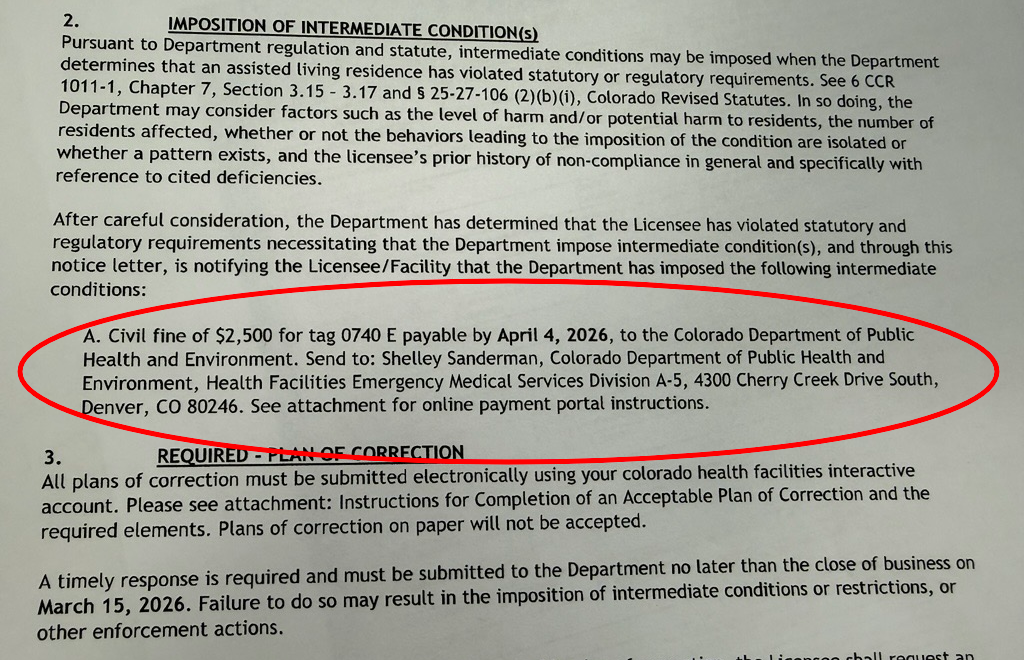
The fine for the first violation was $2,500 for “failure to ensure that staff certified in cardiopulmonary resuscitation provide prompt services in accordance with their training.”
The fine for the second violation of not monitoring the outdoor patio was zero.
The Argyle, a nonprofit which caters to low- and middle-income seniors, disputed the “immediate jeopardy” designation and it was lifted after the facility submitted “an acceptable plan of correction,” the health department said.
As for the second violation, staff members told investigators they were unaware of a state regulation concerning monitoring the patio when residents were outside, according to the health department report. The facility’s administrator confirmed to investigators there was no “official process” for such monitoring, the report said.
An Argyle spokesperson said the facility submitted a correction plan that included video monitoring, which was accepted by the state on April 1. The facility said it was closing the smoking patio from 10 p.m. until 7 a.m.
The Colorado Department of Public Health and Environment declined to comment specifically on details of the correction plan but said in an email that video monitoring alone of residents at an assisted-living facility was insufficient.
The department added it was unable to comment further about the case, because the investigation was ongoing.
In its emailed statement to The Denver Gazette, a department spokesperson said that penalties are determined, in part, to reflect “the history of harm at the facility, and whether the fined citation is related to systemwide or individual staff failures.”
“We are dedicated to ensuring facilities provide safe patient care, and we have several tools to support that goal. This includes, in addition to or in lieu of fines, directing plans of correction, requiring consultants or temporary management companies, issuing conditional licenses, denying license renewal, or license revocation,” the department’s statement said.
Lawyer calls fine a ‘slap in the face’
The fine of $2,500 is less than half of what some residents pay each month to live at The Argyle. The base range of monthly fees for residents there is $3,200 to $5,600, a spokesperson for the facility said.
“It’s woefully insufficient,” Anita Springsteen, the lawyer representing the Dutkevitch family, said of the fine. “It’s such a slap in the face. This is a person’s life.”
In 2022, legislators passed Senate Bill 154, which, in part, raised fines on assisted-living facilities for serious violations to as much as $10,000 per incident or even higher if the violation is especially egregious.
The law went into effect in January 2024.
Backers said it was designed to keep vulnerable seniors safe by holding assisted-living owners accountable through significant financial penalty.
Previously, by law the maximum fine per year, no matter how many violations, was $2,000.
At the time, the penalties were so low in Colorado that Sam Brooks, director of Washington D.C.-based Consumer Voice, a national advocacy group for residents in long-term care and their families, thought it was a typo. When he learned it was not, he called the system “absurd,” and asked “why would you comply with anything?”
A Denver Gazette investigation in 2023 found that, even in some especially gruesome deaths, there were no fines at all, including one where an elderly woman with dementia was left unmonitored for more than 12 hours and froze to death when she wandered outside and was trapped in the cold.
In that investigation, The Denver Gazette analyzed 4,500 incident reports over four years and discovered that the number of potentially preventable deaths was higher than what the state reported to the public. Some were classified in the records as something other than deaths, such as abuse or neglect, and, in at least one case, a death was never recorded at all.
State Sen. Jessie Danielson, D-Jefferson County, introduced the legislation because, she said, tougher penalties were the best way to force compliance and she wanted to give the Colorado Department of Public Health and Environment a way to do so. She initially wanted no ceiling on the amount of fine.
A coalition of assisted-living facility owners and their advocates argued that high fines could drive smaller facilities out of business, and they contended there was no proof that financial penalty would ultimately improve resident care.
A compromise was reached with a $10,000 maximum, with the possibility of going higher in extreme cases.
Despite such possibility, in the two years since the law was passed, it has never been used.
So far, the highest fine imposed was $8,500 in 2025 against Winslow Court Retirement Community in Colorado Springs, according to CDPHE data requested by the Denver Gazette.
There were multiple violations in that case, the most serious involved medication errors, including one resident missing seven doses of pain medication.
In another incident, a resident had six fentanyl patches left on his body. He was supposed to receive two patches containing small but potent doses of the opioid with the old ones removed before new ones were applied, according to the investigation report obtained by The Denver Gazette.
Instead, because the patches were not removed, he may have received triple the dosage, which led to a fall and caused an “altered mental state,” the report said. The resident left the facility.
Colorado legislator: health agency should ‘take these deaths seriously’
Since the law was passed, there were also three fines of $6,000 and 12 for $5,000 to facilities across the state, according to CDPHE data.
The violations included verbal abuse of residents by staff, failure to provide meals, inadequate safety measures and care. Violations included an incident where a resident fell and complained of pain but more than three hours passed before she was taken to the hospital. Once there, it was determined she had broken her hip.
Also included were two incidents at separate facilities, where suicide warning signs were ignored and residents soon after killed themselves, and a resident died after an infected wound led to fatal septic shock.
Still, those fines remain the exception. Of the total 468 fines assessed against Colorado assisted-living facilities since the law passed, the average was just $1,330, according to CDPHE records.
Danielson, who was unaware of the fine amounts, said she is concerned that little has changed.
“I want the department to take these deaths seriously,” Danielson told The Denver Gazette. “The law gave the department the tools to do this, and it appears that they are not using them to the extent that we intended.
“Perhaps we need to revisit the legislation.”
Robert Dutkevitch moved into The Argyle in August 2022 with a diagnosis of hypertension and some mild cognitive decline, according to the state investigation and his widow.
Also, his right leg had been amputated below the knee before moving in after complications from a skin infection.
Sharon Dutkevitch, who has serious health issues of her own, said her husband needed more assistance that she could provide. But they spoke frequently, sometimes several times a day, during in-person visits or video chats.

On the night of his death, she said they talked by video before he went outside and he seemed in good spirits and relatively healthy.
Facility says findings ‘include conclusions we respectfully contest’
The Argyle, a century-old nonprofit owned by the Ladies Relief Society of Denver, has two residential options: independent living and assisted living. Dutkevitch was in the latter and received Medicaid.
While the facility does not directly accept Medicaid, it partners with Innovage, a for-profit health care provider that coordinates and offers senior care and helps residents navigate eligibility for state and federal benefits.
The Argyle is likely to challenge the CDPHE findings, a facility spokesperson said in an emailed statement.
“The Argyle takes both resident safety and regulatory compliance extremely seriously,” the statement said. “The Argyle reviewed CDPHE findings and is actively engaging in the review and dispute process where appropriate. We believe portions of the report do not fully reflect the totality of the circumstances and include conclusions we respectfully contest.”
One issue in dispute is that the staff member did not perform CPR as trained, the spokesperson said, adding that no staff member was fired or disciplined following Dutkevitch’s death.
Since June 2022, The Argyle has been fined five times: twice at $500, once at $1,500 and twice at $2,500, including the one for circumstances surrounding Dutkevitch’s death, according to CDPHE records.
Springsteen, the family’s lawyer, sees a larger problem.
“The elephant in the room is that in Colorado we do not value our elders enough,” she said, “People do not have an expiration on when their lives matter. There needs to be a shift in attitude through regulation with teeth if nothing else.”
Nearly four months after her husband’s death, Sharon Dutkevitch worries for others living at the facility.
“I thought he was in secure and safe place,” she said. “I am just heartbroken. I miss him every day.”



Denver police reopen 13 sex assault cases after retesting Missy Woods’ CBI work
Jenny Deam
jenny.deam@gazette.com
Updated 5 hours ago
Thirteen previously closed Denver sexual assault cases have been reopened after the city’s crime lab retested DNA evidence once analyzed by former Colorado Bureau of Investigation forensic analyst Yvonne Woods. A police spokesperson told The Denver Gazette the once-closed cases...

Ballot measure aims to shift Colorado sporting goods tax revenue to land, water and wildfire projects
Marissa Ventrelli
marissa.ventrelli@coloradopolitics.com
Updated 21 hours ago
Colorado voters this November will decide whether to direct a share of sales tax revenue from sporting goods — including bicycles and skiing equipment — toward land and water conservation, wildfire prevention and expanding outdoor recreation. Supporters say the measure...

‘The smell of jet fuel lingered for years’: Colorado veterans recall 9/11
Deborah Grigsby
deborah.smith@denvergazette.com
Updated 2 days ago
For many years after the Sept. 11 attacks in Washington, D.C., Mark Schoenrock said he could still smell the burning jet fuel from American Airlines Flight 77. “It was just such an overpowering sensation,” Schoenrock, a former Lone Tree resident...

Denver sues Trump to block armed ICE agents from polling sites
Deborah Grigsby
deborah.smith@denvergazette.com
Updated 3 days ago
The city of Denver, along with several groups, sued the Trump administration Thursday, seeking to block U.S. Immigration and Customs Enforcement officers who are armed from polling sites during the upcoming midterm elections. In fact, there are no official orders...

Colorado Parks & Wildlife staff kill third wolf in 3 days
Marianne Goodland
marianne.goodland@coloradopolitics.com
Updated 21 hours ago
Colorado’s wildlife division on Thursday said that staff and contracted agents killed an uncollared female yearling wolf a pack after confirming she had been killing livestock in Grand County. Three wolves from three separate packs have been killed in the...

Evergreen High School marks one year since shooting on campus
Kyla Pearce
kyla.pearce@gazette.com
Updated 3 days ago
Thursday marks one year since the Evergreen High School shooting that injured two students and left the shooter dead. On Sept. 10, 2025, Desmond Holly, 16, entered the school armed with a Smith & Wesson .38 revolver and opened fire...

Denver mayor unveils 2027 budget after weeks of warning of tough choices
Nico Brambila
nico.brambila@denvergazette.com
Updated 3 days ago
Denver Mayor Mike Johnston unveiled his proposed 2027 budget Thursday after weeks of warning that the city is entering a tighter financial era despite stronger-than-expected revenue collections this year. The projected general fund revenue for 2027 is $1.684 billion, the...

Lawsuit challenges Douglas County commissioners’ ballot actions
Nicholas Fogleman
nicholas.fogleman@denvergazette.com
Updated 3 days ago
A new lawsuit against Douglas County commissioners seeks to invalidate the board’s intervention in efforts to expand the commission from three members to five and restore the original ballot language approved by more than 20,000 petition signers. The suit marks...

United abruptly cancels flyover marking 9/11 anniversary after ‘concerns in the community’
Mark Samuelson Special to The Denver Gazette
mark.samuelson@denvergazette.com
Updated 2 days ago
United Airlines had planned a dramatic flyover in Denver on Friday to mark the 25th anniversary of the 9/11 attacks, when it lost two of the four U.S. passenger jetliners hijacked by terrorists. But the airline abruptly cancelled plans late...

Denver Water proposes 6% rate increase for 2027
Nico Brambila
nico.brambila@denvergazette.com
Updated 3 days ago
Water could be more expensive for Denver residents next year. Denver Water commissioners received a staff proposal for rate increases Wednesday expected to generate about 6% more revenue in 2027. What individual customers pay would depend on where they live...
PREV
PREVIOUS

Denver City Council: Scooters, syringes, fancy airport lawyers
The Denver City Council returns this week with a 24-page agenda packed with a variety of interesting items for consideration. From the Community Planning and Housing Committee comes a $3.4 million contract between the City and Jewish Family Service of Colorado to provide rapid rehousing support for at least 55 homeless individuals or families living […]

Boebert and Sheehy prepping bills to approve Trump ballroom after dinner shooting
Congressional Republicans are preparing bills to grant approval for President Donald Trump‘s ballroom after the correspondents’ dinner shooting sparked serious security concerns for him and his Cabinet. Sen. Tim Sheehy (R-MT) and Rep. Lauren Boebert (R-CO) both announced on Sunday they will introduce bills that would give congressional approval for the ballroom. Sheehy framed the […]