

The applicability of Hungary’s election to our politics | SONDERMANN
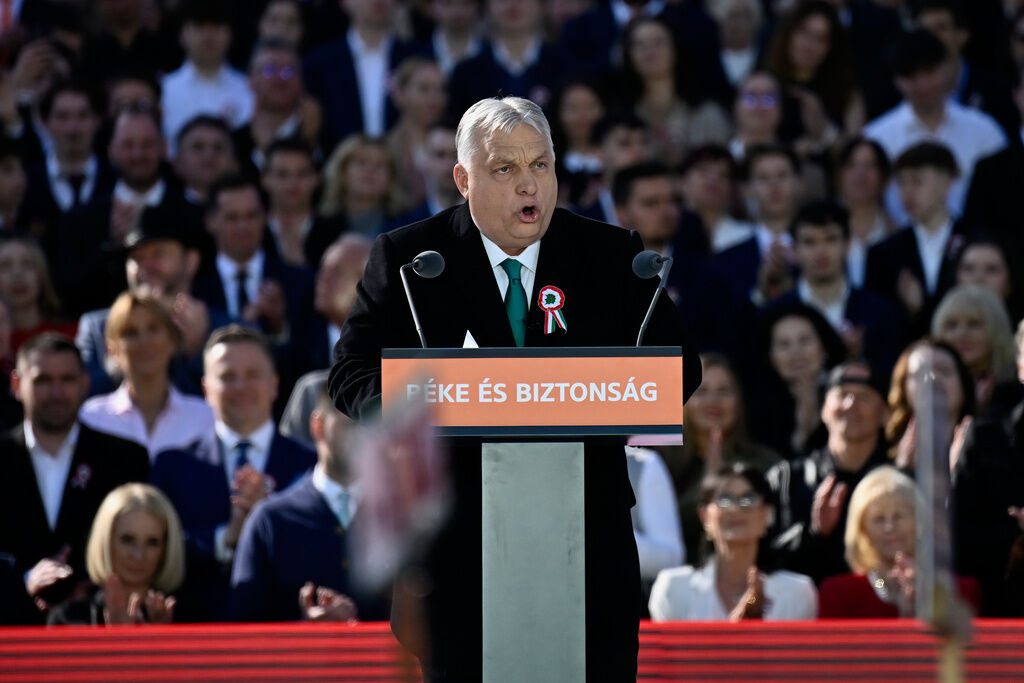
American conservatives, largely synonymous these days with MAGA save for a few lonely voices of courage and dissent, have plenty to lament.
Their domination of the political landscape is waning. Various special elections hither and yon have presented bright, flashing caution signs. A very difficult, perhaps devastating, off-year election beckons. Major fractures have surfaced within the movement. A Middle Eastern war that had divided the base is not going well. A Wall Street executive noted that a recession could be “only one tweet away.” The only thing stopping analysts from making a big deal of the President’s plummeting approval numbers is that they were already so low.
Against that backdrop, the election a couple of weeks ago in faraway Hungary constituted the biggest yellow flag.
It is no exaggeration to say that the MAGA project has been all-in on Hungary. Budapest became a major outpost. Between 2022 and 2026, the American Conservative Union and the Conservative Political Action Conference (CPAC) held not one, but five major gatherings in the Hungarian capital.
Forget New York or Washington or Palm Beach – or key political targets like Charlotte, Pittsburgh, Grand Rapids or Milwaukee. CPAC was going to Budapest time and again.
The attraction, of course, was Prime Minister Viktor Orbán, who controlled the country’s reins for the last 16 years. Orbán was a MAGA-like figure before MAGA, touting Hungary as an “illiberal democracy” and presenting himself as an only-I-can-fix-it strongman of authoritarian bent with a nationalist agenda, a distaste for immigrants, a mingling of the state and business sectors, and an all-too-willing acceptance of the corruption that inevitably followed.
The Trump administration invested as deeply in Orbán’s reelection as it would in a hotly contested Senate race in North Carolina or Michigan. The President lent his full-throated endorsement. Secretary of State Marco Rubio made a February pilgrimage to give Orban a pat on the back.
With but five days left in the Hungary campaign and with the Iranian war at a delicate moment, and again defying standard American practice of avoiding such public involvement in a foreign election, Vice President JD Vance was airborne to Budapest for a final embrace.
Despite widespread discontent across the country, Orbán had long been considered unassailable due to his control of much of the Hungarian media and many mechanisms of the electoral process. The European Union had branded Hungary an “electoral autocracy.”
When the votes were counted on April 12th, Orbán had been rejected by a resounding margin in favor of challenger Peter Magyar. Orban’s autocratic stronghold was only invulnerable until it was not.
If the defeat was crushing for Orbán and his Fidesz Party cronies, it had to be received as almost equally alarming in the White House and throughout the MAGA ranks.
But this is not simply the story of the fall of our president’s favorite foreign role model. It is also a tale of what it took to dislodge him.
What Magyar, soon to be Hungary’s new leader, did not do throughout the campaign is just as important as what he did. Most of all, he did not counter Orban’s nationalistic conservatism with any kind of left-leaning orientation. If anything, Magyar ran as a center-right candidate with a pledge to revive democratic institutions, clean up the rot and give his country a fresh start.
In Hungarian, “Magyar” literally means “Hungarian,” referring to the country and its people. The corollary would be an opposition figure in our country named Joe American. That is quite the political calling card.
Given that antipathy to immigrants was at the core of Orbán’s long rule, Magyar did not run on an open-borders, pro-immigrant platform. In fact, Magyar avoided making immigration a central issue in the campaign.
Moreover, Magyar carefully stayed far away from the usual list of divisive, hot-button social issues. His message was one of cleansing, revitalization and economic opportunity, not some kind of marked turn to the left.
In short form, Magyar did not take the political bait. Nor did he let Orbán dictate the terms of debate.
An analysis in The Atlantic summed it well. Orbán’s “political demise was hardly inevitable. It had to be shrewdly engineered by politicians and voters who put aside their ideological differences to defeat him. In politics, there is no natural law of self-correction.”
Here is suggesting that there may well be some lessons in the Hungarian experience for those in America most incensed by the corruption of our politics, real, procedural and ideological.
And a final observation: When his defeat became clear on election night, contrary to what seems the MAGA ethos, Orbán phoned his opponent to congratulate him and then made a public statement of concession. There goes his invitation to Mar-a-Lago.
Eric Sondermann is a Colorado-based independent political commentator. He writes regularly for Colorado Politics and The Gazette. Reach him at EWS@EricSondermann.com; follow him at @EricSondermann


The Denver Broncos are on the ballot this fall | Jon Caldara
Jon Caldara
jon-caldara@coloradopolitics.com
Updated 3 days ago
Do you want the Broncos to win the Super Bowl? Then you’d better hope Amendment 87 — which brings back Colorado’s economy-strangling “graduated” income tax — loses at the ballot box this fall. Seriously. Forget Republicans and Democrats. Forget tax...
Was there ever a Colorado city that required racial segregation by law? | BOB LOEVY
Bob Loevy
bob-loevy@coloradopolitics.com
Updated 2 days ago
The answer is “yes.” The Black Racial Equity Study Commission, led by Colorado Senate President James Coleman, has learned the city of Fruita had laws forbidding black people from being on the city streets at night and from being buried...
The African roots of three Colorado leaders | SONDERMANN
Eric Sondermann
eric-sondermann@coloradopolitics.com
Updated 3 days ago
Colorado’s political transformation is measured in many ways. A once reliably red state (with asterisks) became purple and is now a rather deep blue. For better or worse, probably the latter, power is ever more consolidated along the Front Range...
Colorado ed department must up its competence to prevent waste, fraud, abuse | Paula Noonan
Paula Noonan
paula-noonan@coloradopolitics.com
Updated 3 days ago
The Colorado Department of Education let $24 million fly from its checking accounts from January 2017 through June 2026 to CHE, aka Colorado Homeschool Enrichment. The details show how easily CHE and Education Re-Envisioned BOCES re-envisioned how to convert public...
Trumpicans thumb their nose at the Constitution | Hal Bidlack
Hal Bidlack
hal-bidlack@coloradopolitics.com
Updated 6 days ago
As is all too often the case, there are again too many interesting things appearing in Colorado Politics for me to comment on all of them. So let me tell you what I won’t be talking about before I get...

CoComandering? | Miller Hudson
Miller Hudson
miller-hudson@coloradopolitics.com
Updated 3 days ago
At 8 a.m., Friday morning, Aug. 28, 70 or 80 mostly bleary-eyed visitors to the Transportation Technology Center outside Pueblo packed a conference room to attend the Front Range Passenger Rail District’s (FRPRD) Board meeting. With the exception of those...

Even Dem court couldn’t abide theft of GOP seats | Dick Wadhams
Dick Wadhams
dick-wadhams@coloradopolitics.com
Updated 3 days ago
Thanks to the Colorado Supreme Court, Colorado voters will be able to reaffirm their support for the Independent Congressional Redistricting Commission after the court struck down the Democratic scheme to steal three Republican congressional seats. Billionaire-funded national Democratic groups from...

Chaotic meeting began with attempt to squelch public comment | Rachel Gabel
Rachel Gabel
rachel-gabel@coloradopolitics.com
Updated 1 week ago
When Attorney General Phil Weiser takes the governor’s office in January, he must immediately address the chaos of the latest round of appointees to the Colorado Parks and Wildlife Commission to assure stakeholders he’s willing to put pressure on the...
Graduated income tax proposal is a flat tax in disguise | Jon Caldara
Jon Caldara
jon-caldara@coloradopolitics.com
Updated 1 week ago
“Youth is wasted on all the wrong people.” That’s one of my favorite lines from “It’s a Wonderful Life.” The older I get, the less it sounds like a joke. Every generation inherits victories it did not win. Young Americans...
AI optimism vs. anxiety — podcasters debate this every night | Tom Cronin
Tom Cronin
tom-cronin@coloradopolitics.com
Updated 1 week ago
President Donald Trump, CNBC’s “Mad Money” host Jim Cramer and entrepreneurial “accelerationists” celebrate the AI revolution and the infrastructure data-center build-out. Cramer recently gushed, “I like data centers so much that I wish I lived in one.” Trump criticized any community...
PREV
PREVIOUS

Federal judge tosses class-action lawsuit over poor Vail Resorts experience during strike
A federal judge dismissed a plaintiff’s proposed class-action lawsuit last month that sought compensation from Vail Resorts after a ski patrol strike turned a family vacation into a “colossal disaster.” U.S. District Court Judge Nina Y. Wang concluded plaintiff Christopher Bisaillon entered into a valid agreement with Vail when he bought his ski pass, and […]

Colorado Politics Calendar Apr. 27-May 3
CoPo’s weekly political calendar will help you find political and public-policy events throughout Colorado. It includes candidate and issue campaign events, public policy meetings, court hearings, state and local party conventions, assemblies, debates, rallies, parades, speaking engagements, traveling dignitary appearances, water meetings, book signings, county commission hearings, city council meetings and more. As a subscriber, […]