

Supreme Court justice, appeals judge spar over authority to decide issues | APPELLATE UPDATE
One of Colorado’s Supreme Court justices and a member of the Court of Appeals debated on Friday about how far appellate judges should go when deciding cases using reasons that are different from the ones the litigants argued in court.
Justice Richard L. Gabriel described the “party presentation principle” as stemming from the idea that the parties to a case are the ones who get to frame what the issues are for the courts to adjudicate.
“If the parties raise these issues and the court goes off on its own and addresses something, there’s a question of whether the parties got a full and fair opportunity to address the issue,” he said. “I tend to think it reflects judicial restraint, judicial humility and the proper role of the court.”
Judge Elizabeth L. Harris of the Court of Appeals countered that she rarely sees issues raised by courts without prompting. She believes the real dispute is whether appellate judges can decide an in-bounds issue using reasoning that is different from what the parties argued.
“It comes up on appeal and we sort of see the issue differently,” Harris said. “And some parties say, ‘That wasn’t the direction we presented to you.’ And my response, I guess generally, would be, ‘But that’s our role, is to resolve the issue in the way that we think is the best way to resolve it.’
“Once you brought the issue to us,” she continued, “I sort of feel like now, you’re done. And now, we take over.”

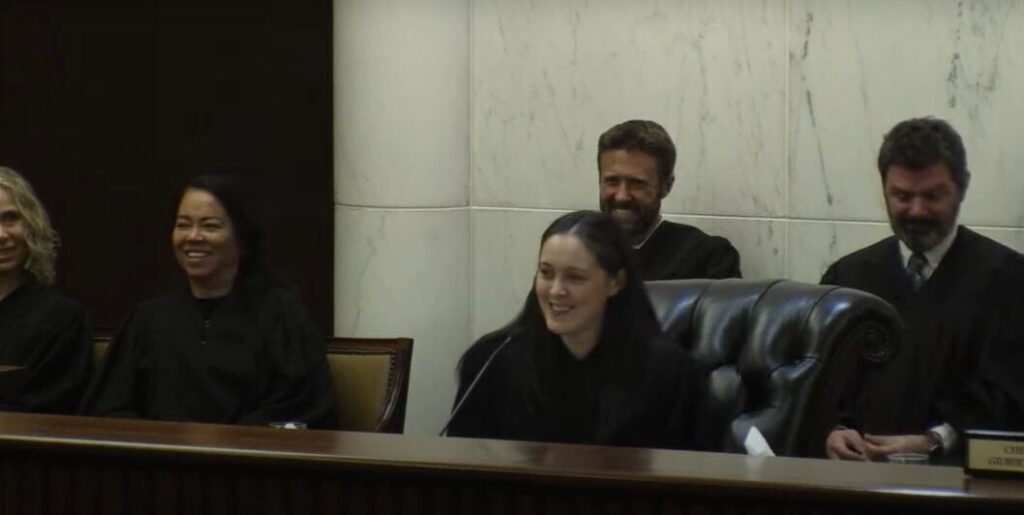
Members of Colorado's Court of Appeals attend the ceremonial swearing-in of Judge Melissa C. Meirink on Feb. 27, 2025.

Gabriel and Harris were part of a panel discussion at the annual Appellate Practice Update sponsored by the Colorado Bar Association.
The Supreme Court recently delivered an explicit direction to the Court of Appeals to avoid addressing issues “not presented by the parties without offering some clear justification for doing so.” However, last fall, the Supreme Court also decided a case, by 4-3, based on an argument that was different from the one the parties made.
“I believe that it is particularly important for a court not to raise and rely on arguments of its own derivation, so as not to open itself to questions about its proper role or neutrality,” Gabriel wrote for the dissenting justices at the time.
Speaking on the panel, Gabriel said it is troubling for him if litigants do not dispute a key point on appeal, but the court does. He referenced a 2016 ruling, from which Gabriel also dissented, where the Supreme Court’s majority decided a defendant in custody had not invoked his constitutional right to counsel — even though the parties did not dispute that he had. Problematically for Gabriel, the court originally took the case to evaluate not whether the defendant requested counsel, but whether police circumvented the request for counsel.
“I don’t think it’s the proper role of the court to say, ‘We think the result should go this way, so we should address this other issue,'” Gabriel said.
Judge Timothy J. Schutz of the Court of Appeals, who also sat on the panel, made the point that judges are obligated to be lenient toward self-represented litigants when identifying and evaluating their arguments. In that scenario, judges have more flexibility to define the contours of a case.
But “candidly, I think sometimes we ignore party presentation principles in order to avoid a particular issue or avoid a particular result,” he said. “And there may be a perception there’s a greater good associated with that. But I think it’s risky and creates the potential to undermine the confidence in the decision-making.”

Court of Appeals Judge Timothy J. Schutz at the Ralph L. Carr Colorado Judicial Center in December 2024
Michael Karlik michael.karlik@coloradopolitics.com

“I think some people would be surprised at how much horse trading happens in certain cases,” Harris added. “In terms of outcomes, sometimes we say, ‘If we come out this way, that’s not a good rule for all the defendants coming down the road. Let’s try to make it a narrower outcome.’ Because it can be a narrower outcome.”
Both Gabriel and Harris acknowledged that courts are allowed to uphold a judge’s decision if there are sufficient grounds in the case record to do so. Still, Gabriel expressed concern about making a mistake by employing reasoning that the parties did not fully flesh out for the court.
And yet, Harris pushed back, “If a judge says, ‘I’m gonna let that evidence in under rule X, and that turned out to be wrong and on appeal everybody’s fighting about whether it should come in under rule X,” she said, “and nobody mentions that it’s actually admissible under rule Y, now what? You reverse and have the parties go back and do their case again? That seems weird.”

10th Circuit dismisses woman’s lawsuit following 10-year attempt to undo restraining order
Michael Karlik
michael.karlik@coloradopolitics.com
Updated 1 day ago
The Denver-based federal appeals court rejected a woman’s challenge on Friday to a restraining order imposed on her more than a decade ago, finding that she cannot credibly claim she will be prosecuted for violating the restraining order through her...
10th Circuit dismisses woman’s lawsuit following 10-year attempt to undo restraining order
Michael Karlik
michael.karlik@coloradopolitics.com
Updated 1 day ago
The Denver-based federal appeals court rejected a woman’s challenge on Friday to a restraining order imposed on her more than a decade ago, finding that she cannot credibly claim she will be prosecuted for violating the restraining order through her...
Colorado equal pay law does not require plaintiffs to allege gender-based retaliation, appeals court finds
Michael Karlik
michael.karlik@coloradopolitics.com
Updated 7 hours ago
The 2019 Colorado law aimed at rooting out pay discrimination on the basis of sex does not require a plaintiff to allege their employer retaliated against them for sex- or gender-related reasons, the state’s second-highest court decided on Thursday. Lawmakers...
Hudson faces lawsuit over ICE detention facility
Nicole C. Brambila
nicole-c-brambila@coloradopolitics.com
Updated 1 day ago
A nonprofit organization filed a lawsuit against the Town of Hudson Wednesday, challenging plans to reopen a former federal prison in the town as a U.S. Immigration and Customs Enforcement detention facility. Together Colorado, along with Janet E. Carlson, filed...
Senate committee advances Trump’s 10th Circuit nominee, as Domenico responds to questions about delays
Michael Karlik
michael.karlik@coloradopolitics.com
Updated 1 day ago
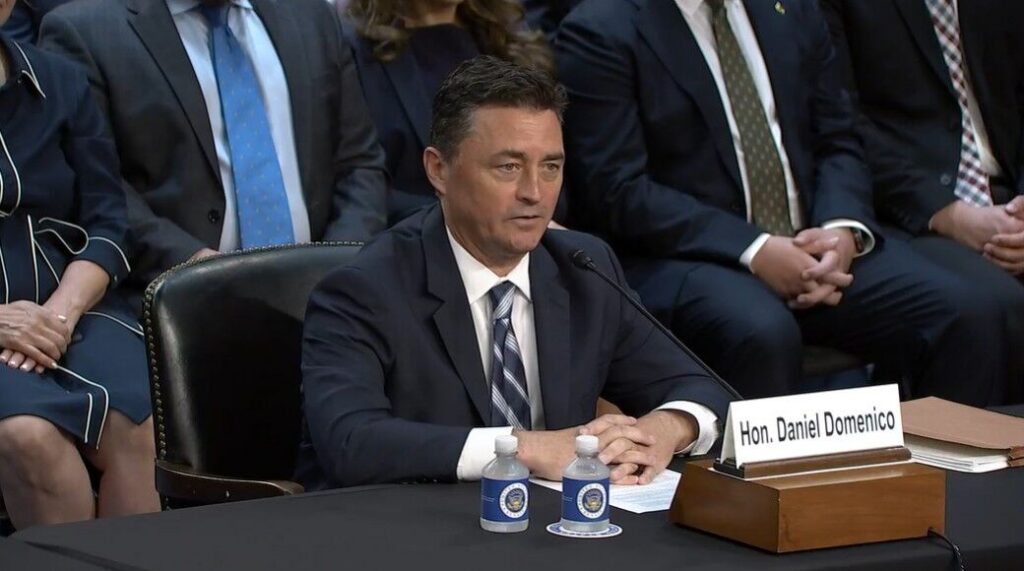
The U.S. Senate Judiciary Committee advanced President Donald Trump’s nominee to the Denver-based federal appeals court on Thursday by a party-line vote of 12-10. U.S. District Court Judge Daniel D. Domenico, who was Trump’s first-term appointee to Colorado’s federal trial...
Colorado justices to hear embryonic donation dispute
Michael Karlik
michael.karlik@coloradopolitics.com
Updated 2 days ago
The Colorado Supreme Court announced on Monday that it will decide whether lower court judges properly applied its framework for adjudicating disputes over the fate of pre-embryos, in which one person wants to use them to become a parent and...

Isolation, emotion, persona: Colorado judicial programming prepares people for life on the bench
Michael Karlik
michael.karlik@coloradopolitics.com
Updated 2 days ago
As a trial judge and now as a member of the Colorado Supreme Court, Justice Carlos A. Samour Jr. has heard the view that being a judge is isolating. “In neither court have I felt isolated. I’ve always interacted a...

Federal judge dismisses Colorado county sheriff’s challenge to law limiting immigration cooperation
Michael Karlik
michael.karlik@coloradopolitics.com
Updated 7 hours ago
A federal judge dismissed a challenge from Mesa County Sheriff’s Office leaders last week to a Colorado law limiting public employees’ cooperation with immigration authorities, concluding that the plaintiffs did not allege they engage in any conduct that the law...

10th Circuit raises bar for fraud victims to sue debt collectors over inaccurate information
Michael Karlik
michael.karlik@coloradopolitics.com
Updated 3 hours ago
The Denver-based federal appeals court wiped away a jury’s $500,000 award to a fraud victim on Monday and made it more difficult for consumers to hold companies liable for disseminating inaccurate credit information. The Fair Credit Reporting Act regulates credit...

Montezuma County judge’s censure, suspension approved by discipline panel
Michael Karlik
michael.karlik@coloradopolitics.com
Updated 3 days ago
A three-member disciplinary panel accepted, on Monday, an agreement between a Montezuma County judge and the Colorado Commission on Judicial Discipline that specifies he will receive a censure, a suspension, and additional education for his admitted instances of misconduct. Under...