

Children’s Colorado must resume care to transgender plaintiffs, state Supreme Court rules by 5-2

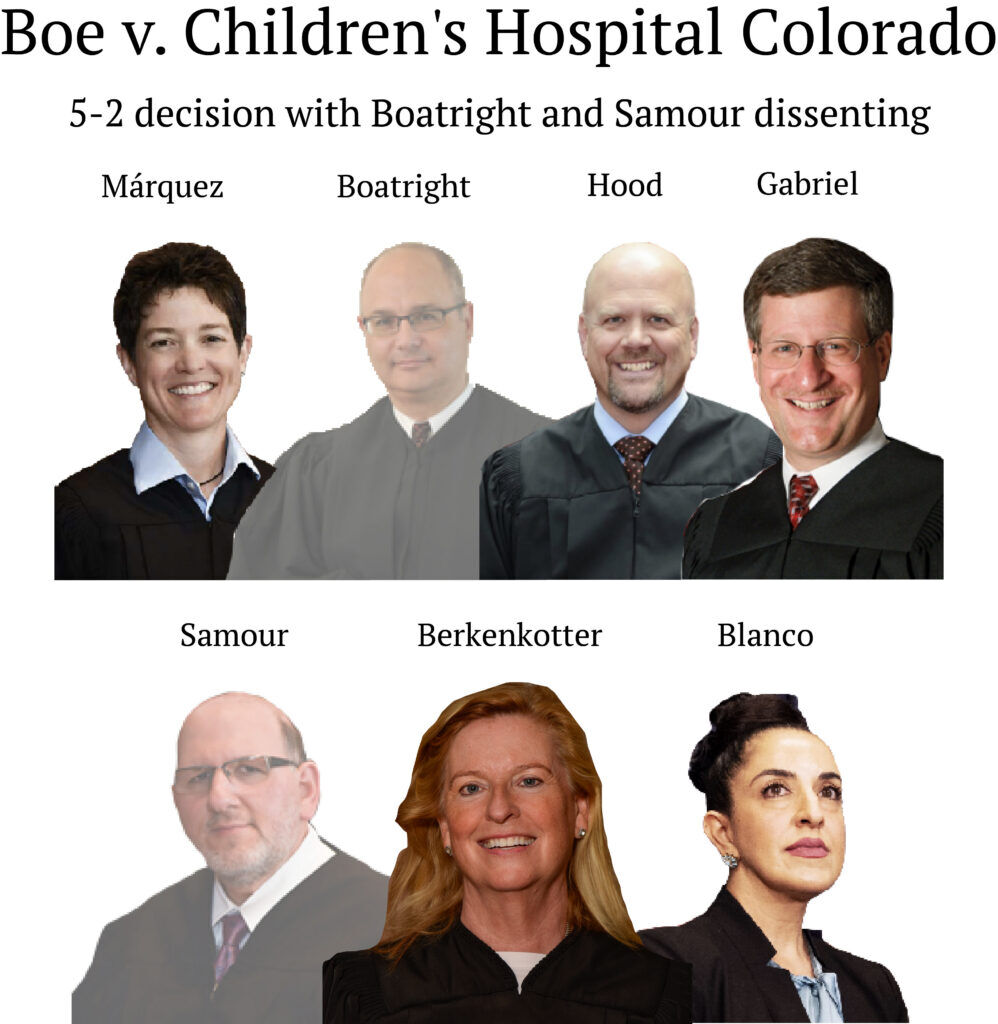
The Colorado Supreme Court, by a 5-2 vote, ordered Children’s Hospital Colorado on Monday to resume providing certain medical services to a group of transgender plaintiffs, which it had ceased in the face of funding threats from the federal government last year.
The unusual appeal before the Supreme Court stemmed from a trial judge’s rejection of a preliminary injunction to four trans plaintiffs who are minors seeking treatment from Children’s Colorado. The plaintiffs filed a class action alleging that the cessation of services based on their status violates the Colorado Anti-Discrimination Act.
While multiple considerations inform whether a judge should grant an injunction, the Supreme Court’s majority concluded the plaintiffs were likely to succeed on their underlying discrimination claims and that the hypothetical harm to the broader public from withdrawn federal funding could not outweigh the plaintiffs’ rights.
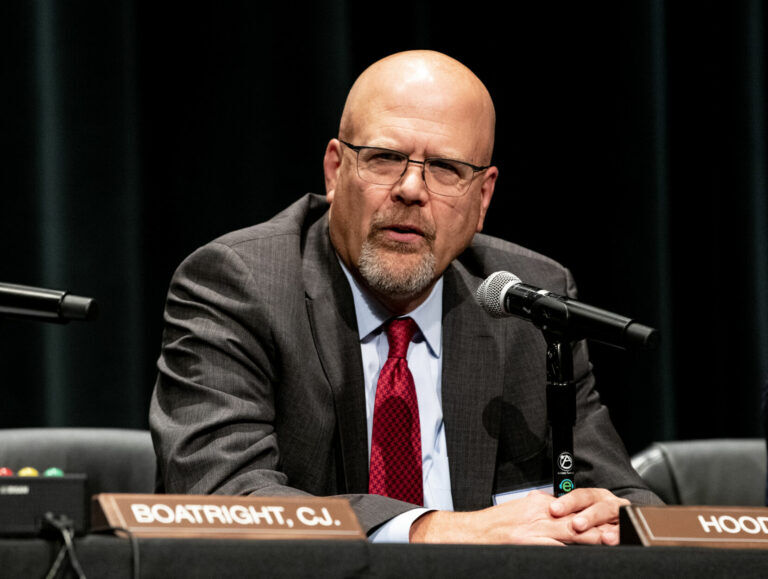
A “strict numerical comparison of affected individuals isn’t appropriate when the individuals seeking injunctive relief are part of a protected class and seeking an injunction because of discrimination based on that protected class. Were it otherwise, minority groups would always lose. But that is not the law,” wrote Justice William W. Hood III in the May 18 opinion.
Justice Brian D. Boatright dissented, arguing that Children’s Colorado had not stopped providing services to the plaintiffs because of their protected characteristics under state law.
“This decision was made only after CHC was threatened with exclusion from federal health care programs, which again, would halt all federal reimbursements and threaten the hospital’s license, accreditation, and participation in commercial insurance plans. It was a decision driven by the direct threat to the viability of the entire hospital,” he wrote for himself and Justice Carlos A. Samour Jr.
The sequence of events underlying the Children’s Colorado case began on Dec. 18, when U.S. Secretary of Health and Human Services Robert F. Kennedy Jr. published a statement declaring that “sex-rejecting procedures” for children are “neither safe nor effective” and “fail to meet professionally recognized standards of health care.”
Kennedy clarified that, while he has the authority to exclude entities from federal programs such as Medicare and Medicaid, his declaration did not constitute an exclusion. Further, any excluded entities could seek administrative and judicial review of the decision.
Days later, Colorado Attorney General Phil Weiser joined other states in suing to block Kennedy’s declaration in Oregon’s federal court. He noted that Colorado law protects the treatment implicated in Kennedy’s statement.
Then, on Jan. 2, Children’s Colorado announced it was “pausing medical gender services for patients under the age of 18 as we wait for any federal court rulings and assess the rapidly evolving legal landscape.”
Four trans children, through their parents, sued Children’s Colorado, alleging the hospital was violating the Colorado Anti-Discrimination Act. After a hearing in early February, Denver District Court Judge Ericka F.H. Englert declined to issue a preliminary injunction requiring Children’s Colorado to resume its care.
Englert acknowledged that the plaintiffs would likely succeed on their claims that Children’s Colorado was violating their rights on the basis of gender identity or disability. However, she believed it would be too risky to order Children’s Colorado to cross the federal government and potentially trigger an end to its participation in federal programs, which, in turn, could end its relationship with commercial insurers.
“Plaintiffs essentially ask the Court to call the bluff of the federal government and order CHC to take action in violation of federal law,” she wrote. “The Court cannot discount the very real possibility that the federal government will take enforcement action against CHC.”

The plaintiffs appealed to the Supreme Court, arguing Englert had essentially found that violations of the Colorado Anti-Discrimination Act were in the public’s broader interest.
Prior to oral arguments, a federal judge in Oregon blocked Kennedy’s declaration. But Children’s Colorado warned that the Health and Human Services Office of the Inspector General could still take action to exclude it from Medicare and Medicaid.
“Federal exclusion is a death sentence,” its attorneys wrote.
During oral arguments, the hospital maintained that it has discretion over which services to provide, and it can make decisions for budgetary, logistical, or other reasons.
“The challenge I have here, though, is that it was providing this care. And all of a sudden, it stopped,” said Chief Justice Monica M. Márquez. “And it is providing essentially the same medications, etc. to cisgender children.”
“You’re giving it to one group of children and not to another. How is that not discrimination?” added Justice Susan Blanco.
Attorney Paula Greisen, representing the plaintiffs, argued that Children’s Colorado could seek relief from the federal judiciary and would likely succeed if the government moved to exclude it from federal health programs.
“There are probably 25-40 different types of injunctions right now based on the federal administration’s attempt to take away federal funding,” she said during the oral arguments. “What this court has to do is enforce the law.”
“I think we are all in favor of enforcing those laws,” responded Samour. “In this case, it gets really complicated because the hospital is saying, ‘Look, if we’re required to continue to provide treatment, all these horrible, catastrophic things will very well happen.’”

Ultimately, the majority agreed that the plaintiffs were likely to succeed on their discrimination claims. Hood noted that the treatments Children’s Colorado withheld from trans minors were still being provided to other patients. Moreover, he observed that Kennedy’s declaration was not law, and there was a process for challenging any adverse action the federal government may take.
“Therefore, given all of the contingencies in play and the various opportunities CHC has to avoid exclusion, we conclude that the actual immediate and irreparable harm to petitioners outweighs the speculative harm CHC may face if the federal government further acts against it,” Hood wrote.
Boatright, in dissent, wrote that Children’s Hospital could not discriminate against the plaintiffs if discrimination was not its motive.
“CHC has made it very clear that its decision to stop the provision of medical gender-affirming care to minors does not come from a place of animus, disdain, or disapproval of transgender individuals seeking these kinds of services. In fact, the very opposite is true,” he argued.
In a statement, Children’s Colorado said it is reviewing the decision and will provide guidance “in the near future.”
“This ruling reaffirms that Colorado’s civil rights laws apply fully and equally to transgender youth and that hospitals cannot selectively refuse treatment because of political pressure or ideology,” said John M. McHugh, an attorney for the plaintiffs.
The case is Boe et al. v. Children’s Hospital Colorado.


Judicial performance evaluations released, Montezuma County judge disciplined | COURT CRAWL
Michael Karlik
michael.karlik@coloradopolitics.com
Updated 5 hours ago
Welcome to Court Crawl, Colorado Politics’ roundup of news from the third branch of government. Colorado’s citizen-led judicial performance commissions released their voter narratives for the judges standing for retention in November, plus a disciplinary panel imposed consequences on a...
Federal judge holds off on dismissing formerly bankrupt medical contractor from Jeffco jail death lawsuit
Michael Karlik
michael.karlik@coloradopolitics.com
Updated 7 hours ago
A federal judge declined on Monday to dismiss the formerly bankrupt medical contractor from a lawsuit over a detainee’s death in Jefferson County jail, but indicated she would do so if the plaintiffs’ attorneys go through the process to ensure...
Federal judge green-lights excessive force, retaliation claims for trial against Fort Collins officers
Michael Karlik
michael.karlik@coloradopolitics.com
Updated 2 days ago
A federal judge green-lit a jury trial last week against multiple Fort Collins police officers on claims that they used excessive force on one man who was standing unarmed in his underwear, and retaliated against another man for exercising his...

10th Circuit revives wage violation lawsuit against Papa John’s operator
Michael Karlik
michael.karlik@coloradopolitics.com
Updated 3 days ago
The Denver-based federal appeals court on Tuesday reinstated a former Papa John’s delivery driver’s lawsuit alleging violations of federal and state wage law. Steve Mighell worked for one month at a Denver Papa John’s location in summer 2023. He alleged...
Colorado appeals judge’s delays in releasing opinions noted by performance commission
Michael Karlik
michael.karlik@coloradopolitics.com
Updated 2 days ago
The citizen-led performance commission that provides guidance to voters about whether to retain members of Colorado’s second-highest court raised concerns by judges and attorneys that Judge Elizabeth L. Harris sometimes struggles with releasing opinions promptly. Harris, who joined the Court...

Colorado judge explores sanctions against DOJ, ICE for rearresting man 4 days after release on bond
Michael Karlik
michael.karlik@coloradopolitics.com
Updated 3 days ago
A federal judge in Colorado is considering sanctions against the government after immigration agents rearrested a man four days after an immigration judge found him suitable for release on bond. On July 28, U.S. Magistrate Judge N. Reid Neureiter ordered...

Divided disciplinary panel censures Montezuma County judge after agreement reached
Michael Karlik
michael.karlik@coloradopolitics.com
Updated 3 days ago
A disciplinary panel formally imposed a public censure, suspension, and further training on Montezuma County Court Judge Ian J. MacLaren on Tuesday by a 2-1 vote. Under constitutional Amendment H, which voters adopted in November 2024, MacLaren was set to...

Colorado’s Western Slope magistrate judges describe unique role in federal judiciary
Michael Karlik
michael.karlik@coloradopolitics.com
Updated 5 days ago
Two of Colorado’s federal judges stationed on the Western Slope spoke to lawyers on Wednesday about their unique roles, the ways their workloads differ, and the need for more criminal defense lawyers to take cases outside the Front Range. “Here...

Denver sues Philip Morris, other tobacco companies over cigarette butt litter
Deborah Grigsby
deborah.smith@denvergazette.com
Updated 4 days ago
Denver is demanding that some of the biggest tobacco companies in the world pay for the cleanup of discarded cigarette butts on its streets, following a similar campaign that cities in other states have pursued. Denver’s lawsuit, filed this week...
Federal judge rules that request for bond hearing not necessary to challenge immigration detention
Michael Karlik
michael.karlik@coloradopolitics.com
Updated 3 days ago
A federal judge in Colorado ruled last week that it is not mandatory for a person to seek a bond hearing with an immigration judge before they challenge the lawfulness of their detention in federal court. For the past year,...
PREV
PREVIOUS

House approves measure aimed at better tracking veteran suicides at VA facilities
The House on Friday passed a measure that would better track veteran suicides on Department of Veterans Affairs campuses as part of a larger bill. Rep. Jason Crow, D-Aurora, sponsored the measure that would set aside $500,000 to create a working group to improve the data collection and analysis of deaths by suicide and attempted […]
Man who asked mom to lie to parole officer can stand convicted, Colorado Supreme Court decides
Attempting to influence a public servant is a crime that can include a defendant’s use of a third party to convey false information, the Colorado Supreme Court decided on Monday. There was no dispute that Michael Thomas Hupke asked his mother to lie to his parole officer on his behalf. Further, Hupke acknowledged Mesa County […]