

More endangered Mexican gray wolves are roaming the southwestern US, survey shows | OUT WEST ROUNDUP
NEW MEXICO
More Mexican gray wolves roaming Southwest
ALBUQUERQUE — The recovery of the smallest subspecies of gray wolf in North America is inching forward, an annual population survey conducted by federal and state wildlife managers has found.
The survey released this year shows there are now at least 286 Mexican gray wolves roaming parts of New Mexico and Arizona — 11% more than the previous year, marking the ninth straight year that the population of endangered animals has grown. A look at the numbers also shows there are 26 breeding pairs in the wild. Of the more than 160 pups born in 2024, just under half survived to the end of the year.
Colorado ranchers and commissioners urge halt on wolf ballot measure, seek better management plan from state
The survey involves a ritual that takes place every winter — wildlife managers use remote cameras, scat collection, radio telemetry devices and helicopters to count Mexican gray wolves that are roaming mountain ranges in parts of New Mexico and Arizona.
The predators that are captured during the annual survey are weighed and vaccinated, their blood is drawn and their radio collars are checked. It is all part of a decades-long effort to gauge the success of the work being done to return the endangered species to its historic range in the southwestern U.S. and in Mexico.
The smallest subspecies of gray wolf in North America, Mexican wolves were listed as endangered in 1976, and a binational captive breeding program was started to guard against extinction. The reintroduction program has been the source of many legal battles over the years — with environmentalists seeking to get more captive wolves released into the wild and ranchers fighting to protect their way of life.
The subspecies’ recovery effort carries a $203 million price tag based on a 25-year time frame, according to estimates included in the 2022 revised recovery plan. Environmentalists are concerned that recent federal funding and job cuts could derail the progress made so far.
Bill hikes oil royalty rates
SANTA FE — The state legislature has endorsed a bill that would raise royalty rates for new petroleum development on prime pieces of land in New Mexico, on one of the world’s most prolific oil production areas.
The proposal would increase the top royalty rate for oil and gas development from 20% to 25% on New Mexico’s state trust lands with implications for the energy industry in the Permian Basin, which overlaps southeastern New Mexico and western Texas. The area accounted for 46% of U.S. oil production in 2023, according to the Federal Reserve Bank of Dallas.
New Mexico deposits royalty payments from oil and gas development in a multibillion-dollar investment trust that benefits public schools, universities and hospitals.
Democratic state Rep. Matthew McQueen of Galisteo, a co-sponsor of the bill, said the state has a duty to maximize benefits from the asset.
Colorado Republican Jeff Hurd wants to reopen federal lands across the West to drilling, mining
Legislative approval was the culmination of a yearslong effort backed by Public Lands Commissioner Stephanie Garcia Richard to increase top-tier royalty rates.
Proponents say neighboring Texas already charges up to 25% on state trust land amid intense competition to drill in the Permian Basin. The royalty changes in neighboring New Mexico would not go into effect in Texas.
Opponents say the rate change threatens to penalize petroleum producers and public beneficiaries, noting that oil production is significantly taxed in other ways and hinges on volatile commodity prices.
WYOMING
Bill requiring citizenship proof becomes law
A bill requiring people to reside in Wyoming for 30 days prior to registering to vote in the Cowboy State will become law, but without a signature from Gov. Mark Gordon.
House Bill 156, sponsored by Rep. John Bear, R-Gillette, requires people seeking to register to vote in Wyoming to show proof of U.S. citizenship and Wyoming residency, a measure that Wyoming Secretary of State Chuck Gray identified as a key issue during the 2025 Legislative Session. The bill also says that people seeking to register to vote must be a resident of the state for at least 30 days prior to registering.
The bill makes Wyoming the first state in the nation to apply proof of citizenship for registering to vote for all elections.
Gordon, a Republican, announced that he would allow the bill to go into law and penned a letter alongside the announcement stating that he believes only citizens should be voting in elections but that the 30-day residency requirement conflicts with federal law, which he noted says no citizen otherwise qualified to vote can be denied that right by state residency requirements.
He added that he believes Wyoming’s elections are secure and that the residency requirement would likely have to be resolved in court.
The bill is set to go into law July 1.
MONTANA
Court backs pro-housing laws
A district court judge in Bozeman ruled on March 3 against most of the claims made by a homeowners group that sued to challenge four pro-construction housing laws passed by the 2023 legislature. But he also concluded that provisions of one law intended to prevent not-in-my-backyard-style activism from derailing development proposals violate the Montana Constitution’s right of participation.
District Court Judge Mike Salvagni additionally concluded the 2023 laws, which include measures forcing cities to permit more accessory dwelling units and duplexes, can’t override homeowner association covenants.
The split ruling was applauded by supporters and detractors of the housing laws, with Republican Gov. Greg Gianforte and free-market housing advocates focusing on three zoning laws passing constitutional muster and a plaintiffs’ attorney stressing the judge’s ruling on public participation in project-specific development decisions.
Colorado House approves bill to revive condo market by addressing construction defects
An attorney for the plaintiffs, Bozeman-based Montanans Against Irresponsible Densification — or MAID — said the court had correctly struck down provisions of a 2023 bill that cut the public out of the land use decisions.
MAID filed the legal challenge in late 2023, arguing the laws would force its homeowner-members to live in more-densely populated areas with larger buildings, more traffic and “any number of other changes that spur uninterrupted development under the guise of affordable housing.”
The three laws upheld in their entirety by Salvagni’s ruling require cities of 7,000 residents or more to allow apartment-style housing in most commercial zones, requires cities of at least 5,000 residents to allow duplexes on any home lot, and requires cities to allow more accessory dwelling units.
Carbon-capture pipeline could be delayed after eminent domain ban in South Dakota | OUT WEST ROUNDUP
Utah will be first state to ban fluoride in public drinking water systems | OUT WEST ROUNDUP
Montana legislature green-lights Medicaid expansion as Congress eyes cuts | OUT WEST ROUNDUP

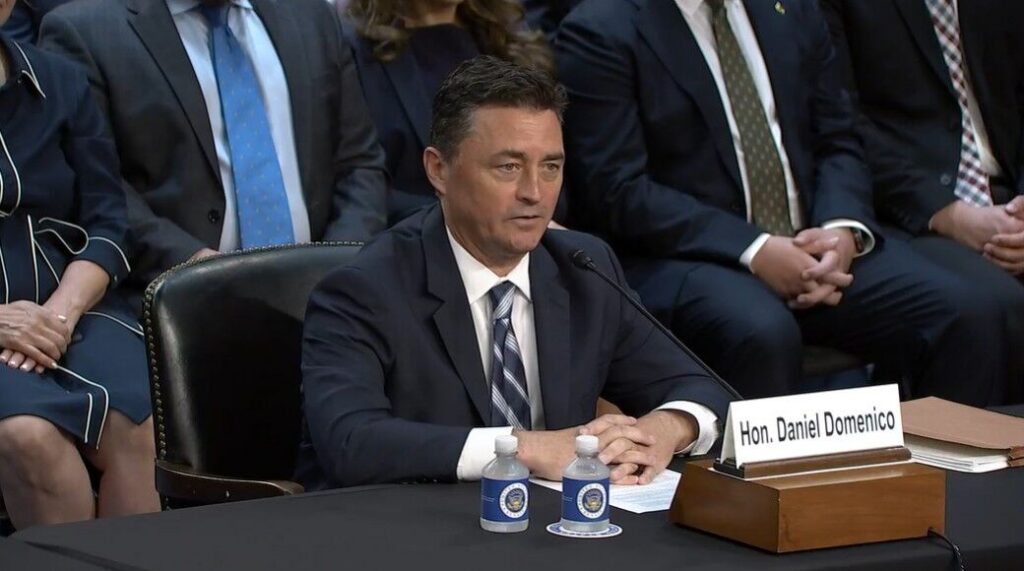
Senate committee advances Trump’s 10th Circuit nominee, as Domenico responds to questions about delays
MICHAEL KARLIK Colorado Politics
michael_karlik_colorado_politics@coloradopolitics.com
Updated 7 hours ago
The U.S. Senate Judiciary Committee advanced President Donald Trump’s nominee to the Denver-based federal appeals court on Thursday by a party-line vote of 12-10. U.S. District Court Judge Daniel D. Domenico, who was Trump’s first-term appointee to Colorado’s federal trial...

Colorado justices to hear embryonic donation dispute
MICHAEL KARLIK Colorado Politics
michael_karlik_colorado_politics@coloradopolitics.com
Updated 7 hours ago
The Colorado Supreme Court announced on Monday that it will decide whether lower court judges properly applied its framework for adjudicating disputes over the fate of pre-embryos, in which one person wants to use them to become a parent and...

Colorado faces $8M repayment demand after federal Medicaid audit
Marianne Goodland
marianne_goodland@coloradopolitics.com
Updated 9 hours ago
Colorado failed to follow federal and state requirements for certain Medicaid personal care service payments, according to a report from the U.S. Department of Health and Human Services inspector general, which is now seeking an $8 million repayment from the...

Jefferson County to fill commissioner vacancy after Dahlkemper tapped for lieutenant governor
Matt Kyle
matt.kyle@denvergazette.com
Updated 7 hours ago
Democratic gubernatorial nominee Phil Weiser on Wednesday announced that Jefferson County Commissioner Lesley Dahlkemper would be his lieutenant governor, meaning she would be leaving her commissioner seat open should he win the race in November. However, Dahlkemper’s term was already...

New wolf pack confirmed in Eagle County, marking 4th Colorado pack with pups this year
Marissa Ventrelli
marissa.ventrelli@coloradopolitics.com
Updated 9 hours ago
A new gray wolf pack has formed in Eagle County, Colorado Parks and Wildlife announced on Wednesday. Known as the Piney Ridge Pack, it is the fourth pack of gray wolves in the state to have produced pups this year....
Colorado justices to hear embryonic donation dispute
Michael Karlik
michael.karlik@coloradopolitics.com
Updated 5 hours ago
The Colorado Supreme Court announced on Monday that it will decide whether lower court judges properly applied its framework for adjudicating disputes over the fate of pre-embryos, in which one person wants to use them to become a parent and...

Isolation, emotion, persona: Colorado judicial programming prepares people for life on the bench
Michael Karlik
michael.karlik@coloradopolitics.com
Updated 7 hours ago
As a trial judge and now as a member of the Colorado Supreme Court, Justice Carlos A. Samour Jr. has heard the view that being a judge is isolating. “In neither court have I felt isolated. I’ve always interacted a...

Colorado housing laws take effect, expanding tools for affordable and workforce housing
Marissa Ventrelli
marissa.ventrelli@coloradopolitics.com
Updated 1 day ago
New housing laws taking effect on Aug. 12 in Colorado aim to boost affordability, improve homelessness response and ensure safer water systems for mobile‑home communities. The first bill, Senate Bill 001, allows municipalities to sell county- or town-owned property to...

Ex-Venezuelan dictator Nicolas Maduro and wife scheduled for June 2027 drug trafficking trial
Kaelan Deese
kaelan-deese@coloradopolitics.com
Updated 1 day ago
Disgraced former Venezuelan dictator Nicolas Maduro and his wife are scheduled to stand trial June 1, 2027, on charges that they participated in a decadeslong conspiracy to flood the United States with cocaine. U.S. District Judge Alvin Hellerstein, a 92-year-old...
Democrat Phil Weiser names Jeffco Commissioner Lesley Dahlkemper as his gubernatorial running mate
Ernest Luning
ernest.luning@coloradopolitics.com
Updated 1 day ago
Colorado Attorney General Phil Weiser, the Democratic nominee for governor, on Wednesday named Jefferson County Commissioner Lesley Dahlkemper to be his lieutenant governor running mate in the general election. Calling her “someone who can be a governing partner,” Weiser said...