

Bill permitting lawsuits against ICE agents reaches Gov. Jared Polis’ desk

Colorado lawmakers advanced two high‑profile measures Thursday — one seeks to reshape how the state manages its strained prison population and another allows Coloradans to sue federal immigration agents for alleged constitutional violations.
The state policymakers sent both bills to Gov. Jared Polis as the legislative session enters its final stretch.
Prison population management
Senate Bill 036 — sponsored by Sens. Julie Gonzales, D-Denver, and Mike Weissman, D-Aurora, Assistant Majority Leader Jennifer Bacon, D-Denver, and Rep. Yara Zokaie, D-Fort Collins — makes changes to the state’s prison population management measures.
Established in 2018, the measures are intended to reduce burdens on Colorado Department of Corrections facilities when their vacancy rates fall below 3% for 30 consecutive days.
The plan, which the governor activated for the first time last August, allows the parole board to review a list of inmates who are within 90 days of their mandatory release date or eligible for conditional release.
According to Zokaie, only 237 parole applications have been reviewed since the measures were activated nine months ago. Of those, only 29 individuals have been granted parole.
“This is a budget concern, but it’s also just a human dignity concern,” she told her colleagues on the House Floor.
Amid a deficit of more than $1 billion, the General Assembly’s Joint Budget Committee approved a nearly $100 million allocation to DOC, including funding for 940 additional prison beds. Gov. Jared Polis has also expressed interest in opening another prison.
The administration is seeking to add prison beds amid overcrowding, though advocates on both sides of the spectrum disagree over its cause. Some advocates have argued that the crisis is partly the result of a backlog of inmates awaiting parole placement. Others maintained that the “crisis” resulted from Democrats’ policies that ultimately seek to release offenders back into communities.
The JBC ultimately approved a budget placeholder that would allow DOC to contract for beds at two previously closed private prisons in Trinidad and Burlington.
Senate Bill 036 increases the threshold for activating the prison population management measure from a 3% vacancy rate to 4% and adds additional agencies to be notified when the threshold is reached. Additionally, the measure establishes certain expectations for the parole board, requires ongoing reporting of population numbers, and establishes pathways to move individuals past their parole eligibility date out of prison and into a new setting.
“We need the Department of Corrections, the Board of Parole, and Community Corrections to better coordinate to move people who are eligible for parole out of corrections to free up the beds so we don’t have to keep paying for new ones,” said Bacon.
As previously reported by Colorado Politics, the corrections system is under strain largely because — some advocates argued — more than 5,000 inmates approved for parole remain incarcerated due to a lack of parole officers, available beds in community corrections, and required transition programs.
Others, such as District Attorney George Brauchler of the 23rd Judicial District, have countered that prison overcrowding is an artificial crisis, manufactured by what he described as a “Democrat-led prison-closing frenzy. In an opinion piece, he said it’s the result of the “predictable, deliberate and unnecessary outcome of Democrat political decision-making that has long prioritized offenders over public safety and victims.”
Senate Bill 036 passed on a 41-23 vote, with all Republicans and Democratic Rep. Bob Marshall of Highlands Ranch voting against it.
Bill gives residents right to sue federal agents
Senate Bill 005, which is also headed to the governor’s desk, would allow individuals to sue federal immigration agents for alleged constitutional violations during civil immigration enforcement actions.
The bill passed on a 20-11 party-line vote in the Senate, where it is sponsored by Sens. Mike Weissman, D-Aurora, and Julie Gonzales, D-Denver.
During House floor debate on Wednesday, sponsor Rep. Yara Zokaie, D-Fort Collins, called the bill “sort of a converse 1983,” referring to Section 1983, a federal statute that allows individuals to sue state or local government officials in federal court for constitutional violations.
“Ultimately, what this bill is about is that government officials are subject to the law and that where we have rights, we have to also have remedies,” she said. “The law has consistently affirmed that when government actors exceed their authority and infringe on individual rights, they can and should be held accountable.”
Zokaie cited several incidents, in which, she said, Americans were targeted by federal immigration officials based on their accent or skin color.
“Our neighbors are living in fear because the immigration enforcement has been causing injury and death to citizens and non-citizens alike,” Zokaie said, adding that 46 individuals have died in ICE custody since 2025. “The Constitution does not mean anything if it isn’t enforceable, and that principle applies to federal actors as well.”
Rep. Carlos Barron, R-Fort Lupton, noted that the deaths of Renee Good and Alex Pretti, both American citizens killed by ICE agents in Minnesota, were tragic, but that “they put themselves in a situation that was far from being safe.”
Barron said “so many people” came into the country under the Biden administration — some legally, others not. If the bill becomes law, immigration agents may be afraid to do their jobs for fear of being sued, Barron added.
“By limiting these federal agents and having them fear of breaking this state law is allowing for actual illegal alien criminals to roam our state and our country, plotting their next attack,” he said.
The bill passed on a 41-22 party-line vote.


Democratic group aims Spanish-language TV ad at Gabe Evans in Colorado’s battleground 8th CD
Ernest Luning
ernest.luning@coloradopolitics.com
Updated 1 day ago
A national group tied to House Democratic leadership launched a six-figure Spanish-language TV ad in Colorado this week targeting Republican U.S. Rep. Gabe Evans and the GOP’s signature budget legislation. The 30-second spot is part of $15 million in new...

Judge dismisses lawsuit seeking records from Colorado Democratic group
Marianne Goodland
marianne.goodland@coloradopolitics.com
Updated 1 day ago
A lawsuit seeking to obtain records from Democratic lawmakers affiliated with a caucus has been thrown out by a Denver District Court judge. On July 17, Judge Ericka Englert dismissed the April lawsuit filed by progressive activist Derrick Blanton, who...
Colorado must continue finding common ground on wildfire policy | GUEST COLUMN
Colorado Politics
colorado-politics@coloradopolitics.com
Updated 2 days ago
By John Herrick Colorado has never lacked for opinions about wildfire policy. We debate forest management, climate change, prescribed burns, land use, air quality and budgets. Those debates are familiar territory, but a new discussion is beginning to happen around...

Proposition NN is the best investment for Colorado’s students and schools | GUEST COLUMN
Colorado Politics
colorado-politics@coloradopolitics.com
Updated 2 days ago
By Justin Ogden Colorado families know what it means to make difficult budget decisions. Inflation has driven up the cost of groceries, housing, utilities and just about everything else. Families like mine work hard to stretch every dollar while still...

Right-to-natural-gas proposal in Colorado qualifies for ballot
Marissa Ventrelli
marissa.ventrelli@coloradopolitics.com
Updated 2 days ago
A citizen initiative that seeks to enshrine the right to natural gas has qualified for the November ballot, Colorado’s election office confirmed on Thursday. Petitions containing signatures for Initiative No. 177 were turned in to the Secretary of State’s Office for review...
Former VP Mike Pence joining Colorado Christian University faculty
Marissa Ventrelli
marissa.ventrelli@coloradopolitics.com
Updated 2 days ago
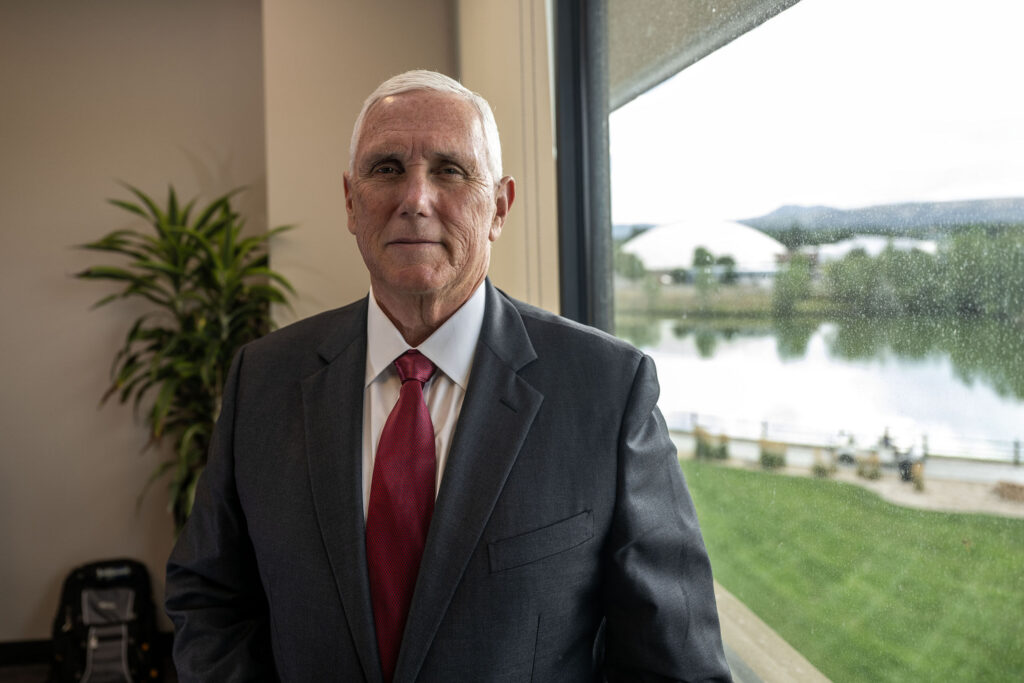
Former Vice President Mike Pence has been hired as a visiting faculty member at Colorado Christian University, the Lakewood-based private evangelical university announced Tuesday. Pence will be on campus about once a month during the 2026-2027 school year to give...

Were the primaries a preview for consequential general election? | Paula Noonan
Paula Noonan
paula-noonan@coloradopolitics.com
Updated 3 days ago
Colorado’s political future will go the way of this election. Historically, the state has not had both chambers controlled by a supermajority. This election may change that. The primaries suggest how the general election may play out. Democrats had solid...
Disagreement doesn’t have to mean disrespect | GUEST COLUMN
Colorado Politics
colorado-politics@coloradopolitics.com
Updated 3 days ago
By Vincent Atchity These days, it doesn’t take long to feel overwhelmed by politics. Turn on the news, scroll through social media or read the comments on almost any political post and you’ll find anger, outrage and personal attacks. For...
What happens if voters pass Colorado’s two competing income tax measures?
Marianne Goodland
marianne.goodland@coloradopolitics.com
Updated 3 days ago
The battle between two competing ballot measures — one seeking to cap Colorado’s income tax rate, the other pushing for a tiered system depending on income levels — might come down to whichever ballot proposal gets one more vote. The...

New Colorado laws going into effect cover AI disclosures, medical marijuana access and gambling limits
Marissa Ventrelli
marissa.ventrelli@coloradopolitics.com
Updated 3 days ago
More than 100 new Colorado laws take effect Aug. 12, bringing changes to chatbot safety rules, psychedelic research, campus wellness checks and sports betting restrictions. Here is a look at some of those laws set to take effect. The law:...
PREV
PREVIOUS
Mike Lindell's lawyer sanctioned again over flawed case citations
A federal judge financially sanctioned a lawyer for MyPillow CEO Mike Lindell for a second time on Thursday for including a “materially incorrect citation” in a case filing. U.S. District Court Judge Nina Y. Wang imposed a $5,000 fine on attorney Christopher Kachouroff and his law firm. Because Lindell, his media company, and Kachouroff’s co-counsel […]

Denver could be back in DNC spotlight 20 years later
It’s been nearly two decades since Denver shared the spotlight as host to the 2008 Democratic National Convention — and a lot has happened in the city since then. But not major party conventions. In fact, before 2008, Denver hadn’t hosted a major party convention since 1908, when Democrats nominated William Jennings Bryan, who supported […]