

Wildlife initiatives run roughshod over sitting-duck rural Coloradans | GABEL
Rachel Gabel

Despite author of Colorado’s Taxpayer Bill of Rights (TABOR) Douglas Bruce’s attempts to sway me, I wish the ballot-initiative process in the state would go the way of the dodo.
I remain firmly opposed to what is now Initiative 35 seeking to “end gray wolf reintroduction and prohibit the importation of wolves from out of state.” The Title Board set a title last week though the process to pare it down to a single subject must have left some exhausted. The effort, which will require millions of dollars to place on the ballot, will end releases by the end of 2026 and, if the letter is an indication, lacks the support of anyone with skin in the game.
Stakeholders who have been a part of the process and conversation since the passage of Prop 114, which mandated wolf release, sent a letter to proponent Patrick Davis asking him to suspend his efforts. The list included statewide and county livestock organizations, counties, commissioners in affected areas, hunting organizations, outfitting organizations and others. Their ask was to suspend the ballot initiative that is in no way supported or requested by the people most affected. Seems reasonable.
The groups said “the effort to end the gray wolf reintroduction was initiated without consulting the primary stakeholder groups and constituencies most affected by the wolf reintroduction. As a result, this approach is at odds with the strategy and policy outcomes that our coalition is working on.”
The signers went on to “ask that you allow those of us directly impacted to work through the pathways already in front of us.” They also expressed concerns about the financial resources necessary, and the social and political consequences if this measure were to fail, saying “any failed effort could potentially impact subsequent policy efforts currently underway, both administratively and legislatively, as well as undermine recent public opinion support that the landowner community has received.”
Stay up to speed: Sign up for daily opinion in your inbox Monday-Friday
In the letter, the groups cited my March 10 column, “A half-baked proposal to stop wolf reintroduction,” saying it “highlights the significant rift that exists on this issue. It doesn’t bode well for a successful campaign when key stakeholders are not unified.”
As if I needed another reason to rail against the initiative process, I received one on March 19 in the form of the proposed Colorado Wildlife and Biodiversity Protection Act. Contrary to the single-subject requirement of the Title Board, this initiative takes a “throw it and see what sticks” approach, attempting to establish an independent Wildlife and Ecosystem Conservation Commission. This WECC would oversee species protection in collaboration with existing federal and state agencies; ensure continuity of wildlife protections by granting WECC the authority to assume CPW’s and other state conservation agencies responsibilities if they are defunded, disbanded, or rendered nonfunctional due to legislative action or budgetary cuts; create a Colorado Wildlife Corridor Network to connect fragmented habitats; strengthen protections for keystone species and ecosystems critical to biodiversity; and enforce violations with strict penalties, independent oversight and a self-sustaining funding mechanism without imposing unfunded mandates on landowners.
This commission will include three ecologists appointed by Colorado universities; two conservation biologists appointed by nonpartisan environmental groups, a wildlife advocate appointed by a group of 10 members including individuals with backgrounds in conservation, outdoor recreation, or environmental advocacy; an indigenous representative; an environmental policy specialist appointed by a legal or policy institute specializing in conservation law; and a wildlife management expert appointed by a national or state-level wildlife agency.
No members of this commission may have financial ties to extractive industries including logging, mining, development, or ranching.
The powers they hope to grant themselves include the ability to designate species as endangered; conduct environmental impact studies prior to major infrastructure projects; develop voluntary compliance programs for private landowners; the ability to review and approve reintroduction programs; assess fines of $1,000 per square foot for destruction of a wildlife corridor; refer violations for prosecution to the state Attorney General’s office; the full investigative authority, including to subpoena records, and the power to leverage permanent bans on operating businesses in protected areas.
This is the stuff of nightmares. The least of my concerns with this laundry list of wishes is the complete omission and downright restriction of involvement from ranchers, the people who steward 32 million of the state’s 66 million acres and provide habitat for the state’s 900-some species.
This initiative proposal seeks to override state and federal agencies and allow an entirely unaccountable group to run roughshod over industry and the families on the landscape. If this and Initiative 35 don’t illustrate how the initiative process leaves agriculture, rural communities, and actual experts sitting ducks, then I can’t make it any clearer.
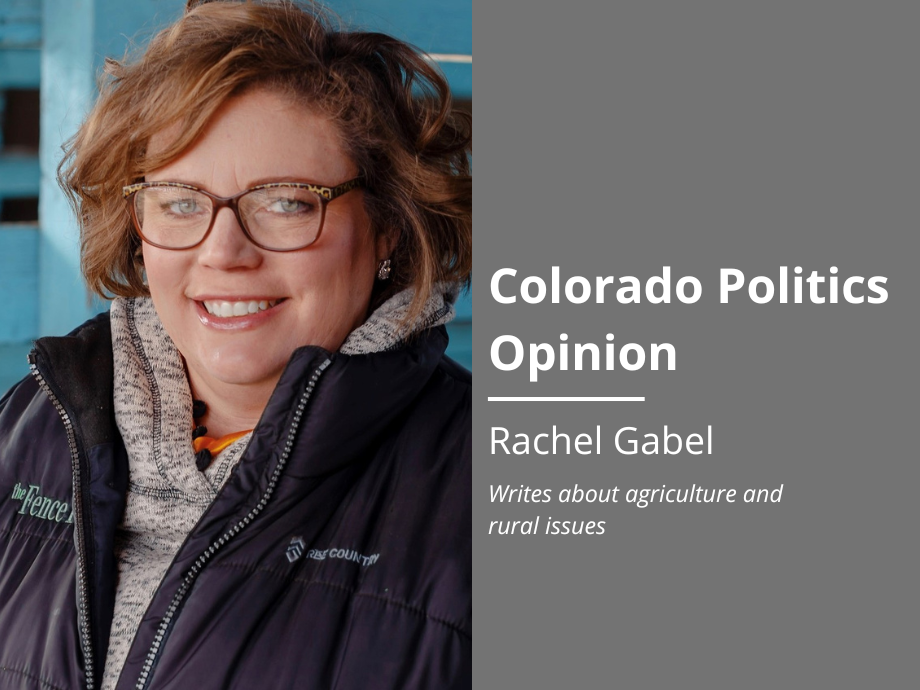
Rachel Gabel writes about agriculture and rural issues. She is assistant editor of The Fence Post Magazine, the region’s preeminent agriculture publication. Gabel is a daughter of the state’s oil and gas industry and a member of one of the state’s 12,000 cattle-raising families, and she has authored children’s books used in hundreds of classrooms to teach students about agriculture.

Don’t trade away our TABOR refunds | PODIUM
Barb Kirkmeyer
barb-kirkmeyer@gazette.com
Updated 11 hours ago
Here we go again — tax-and-spend politicians going in the wrong direction. Colorado families are being asked to believe a familiar lie: the only way to fund education is to let politicians keep more of your money — forever. Proposition...
Trump’s ‘BBB’ casts aside rural Colorado healthcare | Hal Bidlack
Hal Bidlack
hal-bidlack@coloradopolitics.com
Updated 1 day ago
Well, as I often do, let me start by yet again telling you what I am not going to be writing about (Editor: sigh…). I’m not going to talk about President Donald Trump’s most recent (of many, many) attacks on...
A course correction Canada would concur with | Miller Hudson
Miller Hudson
miller-hudson@coloradopolitics.com
Updated 4 days ago
I’ve always harbored a soft spot for Canada. My father was stationed there twice, once in the 1960s as the Atomic Energy Commission’s American liaison with the Canadian nuclear reactor program in Chalk River, Ontario and again in the 1970s...
Private property rights challenge rural Colorado communities | Rachel Gabel
Rachel Gabel
rachel-gabel@coloradopolitics.com
Updated 4 days ago
If there were ever a topic I believe deeply in, it’s private property rights. If there were ever a topic that leaves me in a moral conundrum more often than not, it’s private property rights. The northern portion of Weld...

Gaylord — you never check in, but still pay | Jon Caldara
Jon Caldara
jon-caldara@coloradopolitics.com
Updated 6 days ago
I go to a lot of conferences, often in beautiful cities I never actually see. Friends hear where I’ve been and ask depressing questions like, “Did you visit the famous museum?” No. I saw Ballroom C, the lobby bar and...
Reflections on Weiser-Lopez, Crank-Killian debates | Tom Cronin
Tom Cronin
tom-cronin@coloradopolitics.com
Updated 4 days ago
Thursday night, The Gazette and KOAA TV hosted two important candidate debates. The first featured incumbent Republican U.S. Rep. Jeff Crank, who is just completing his first term representing El Paso County in Congress, and Jessica Killian, a Democrat who has...
What courageous citizenship really looks like | Vince Bzdek
Vince Bzdek
vince.bzdek@gazette.com
Updated 4 days ago
By Vince Bzdek What exactly is courage? Ernest Hemingway famously called it grace under pressure. Mark Twain wrote that “courage is resistance to fear, mastery of fear — not absence of fear.” C.S. Lewis refined that even more: “Courage is...

The coming election and mischief in the making | SONDERMANN
Eric Sondermann
eric-sondermann@coloradopolitics.com
Updated 7 days ago
America’s tribalism is such these days that we struggle to even agree on the basic rules. Elections have always been hotly contested. As the saying goes, “Politics ain’t beanbag.” The process has long involved elements of nastiness and underhanded conduct....

Colorado’s hunting and fishing traditions rest on science, conservation and a proven heritage | IN RESPONSE
Colorado Politics
colorado-politics@coloradopolitics.com
Updated 5 days ago
By John Howard Eric Washburn’s recent column warns Coloradans the right to hunt and fish amendment is a Trojan horse designed to resurrect “cruel” practices voters have already banned and to elevate killing above every other form of wildlife management....
Why does Colorado limit who can safeguard taxpayer dollars? | GUEST COLUMN
Colorado Politics
colorado-politics@coloradopolitics.com
Updated 5 days ago
By Devin Camacho Recently, PNC Bank announced its purchase of FirstBank Colorado. Not only did Colorado lose a local banking option, but nearly 1,000 people lost jobs, with more job losses coming as the big bank now closes branches too....