

Public Lands Rule rescinding keeps public lands in public hands | Rachel Gabel

The Public Lands Rule has been rescinded. The rule, first proposed in 2023, would have complicated the balanced partnership between federal agencies and all multiple uses on those public lands.
In 2024, the Bureau of Land Management made the rule worse by allowing conservation to rise above the level of all other multiple uses, essentially locking public lands from use. The lands ripe for this brand of conservation would have been determined by a rather subjective set of criteria and rather than applying a balanced set of uses to public lands, conservation would have been the sole use.
This Biden-era rule flew in the face of the Federal Land Policy and Management Act of 1976 (FLPMA) that established a regulatory system for the U.S. Bureau of Land Management (BLM) to manage the lands. The rule was created without congressional direction or consent.
Though some decry this is a win only for the greedy ranchers paying pennies on the dollar for BLM leases, it is a win for those who believe in keeping public lands in public hands. A neighbor who is a public-lands hunter visited with me last week, and he told me there is no political party for the public-lands hunters. He said one party is trying to take his guns, and the other is trying to take his access. It’s interesting perspective and solidifies the importance of this rescinding which will continue to ensure access.
Though only one of the users, livestock grazing in the western U.S. on public lands is significant and is an important part of maintaining a protein supply chain. About half of the cattle in the west and nearly 60% of the sheep in the west graze public lands, and they do so in tandem with other uses. When this rule was initially proposed and released for comment, the opposing comments didn’t only come from grazing users. The other users who would have been locked out of lands by the rule also lodged their opposition, including energy interests, timber interests, recreation users and conservation groups. A number of western states also filed litigation, demonstrating how egregious the rule truly was.
One of the most glaring issues with the rule was the potential use of the designation of Areas of Critical Environmental Concern (ACECs). Anyone may nominate an area for ACEC designation, and those lands could then be leases only for conservation. In my nightmares, NGO-funded permittees would gather conservation leases and throw ACEC nominations at the BLM and effectively lock away lands and run livestock grazing — and all other uses — off the land. It begs the question, though, about the acres grazed by the feral horses managed by the BLM and how land health assessments on those acres would reflect on their impact and whether they would be removed. It’s murky, man.
Public-lands grazing permittees do pay what seem like bargain amounts per animal unit month, but it is unlike leasing private land. We don’t graze public lands primarily due to geography, but our cows are not likely up to the challenge of sharing pasture with mountain bikers and hikers. They’re not that worldly. It works well for many permittees on public lands, and those permittees are also charged with maintaining fences and water sources. The land health assessments notably are only applied to lands with grazing leases on them, so any poor evaluations land squarely on the shoulders of grazing, despite all other activity and uses.
The rescinding of the rule also came with a landmark proposal to modernize BLM grazing regulations from rules made in response to the “grazing free by ‘93” movement. The repeal removes the conservation leases that prioritized non-use; recognizes grazing formally as a primary tool for reducing fuel loads and preventing wildfires; and provides “adaptive management” power, allowing ranchers to respond to weather and forage changes without waiting for lengthy federal approval. It also requires permit holders to be actively engaged in livestock production, something that was illustrated in real time with the recent removal of Montana BLM permits from American Prairie, a rewilding group that grazes bison for conservation rather than production.
There are a number of problems with this now-dead rule, the least of which ought to be abundantly apparent this year, and that is the removal of livestock grazing increases the risk of catastrophic wildfires on unmanaged acres.
Rachel Gabel writes about agriculture and rural issues. She is assistant editor of The Fence Post Magazine, the region’s preeminent agriculture publication.

Democrat running in Colorado’s 4th Congressional District urges long-term water planning and support for rural communities
Marianne Goodland
marianne.goodland@coloradopolitics.com
Updated 8 hours ago
Eileen Laubacher hopes to become the next representative of Colorado’s 4th Congressional District, and on Thursday she made her case on the final day of Colorado Water Congress in Steamboat Springs. Laubacher, a Democrat, spent 34 years in the U.S....

Proposal to cap Colorado income tax rate qualifies for November ballot
Thelma Grimes
thelma.grimes@coloradopolitics.com
Updated 4 hours ago
Election officials on Thursday confirmed that the proposal to cap the state’s income tax at the current rate submitted signatures and voters will consequently decide its fate this November. The fight over tax rates is part of the tug and...
Democratic gubernatorial candidate Phil Weiser promises to appoint rural outreach director, water adviser
Marianne Goodland
marianne.goodland@coloradopolitics.com
Updated 12 hours ago
Democratic gubernatorial candidate and current Attorney General Phil Weiser told the Colorado Water Congress Thursday he intends to appoint a rural outreach director and a water policy adviser should he win the election in November. Weiser’s speech at the Steamboat...
Attorney general candidates present priorities at Colorado Water Congress
Marianne Goodland
marianne.goodland@coloradopolitics.com
Updated 1 hour ago
The two major-party candidates for attorney general — Republican Michael Allen, the district attorney for Teller and El Paso counties, and Democratic Secretary of State Jena Griswold — on Thursday outlined their priorities at the Colorado Water Congress. Griswold attended...
State money diversion scheme the unsurprising downfall of ERBOCES scam | Paula Noonan
Paula Noonan
paula-noonan@coloradopolitics.com
Updated 1 day ago
Falcon School District 49, aka El Paso County School District 49, has finally cut bait, thrown the fishing pole into the lake and sunk the canoe. The longtime enabler of the Education Reenvisioned BOCES’ (ERBOCES) schemes to fund private Christian...
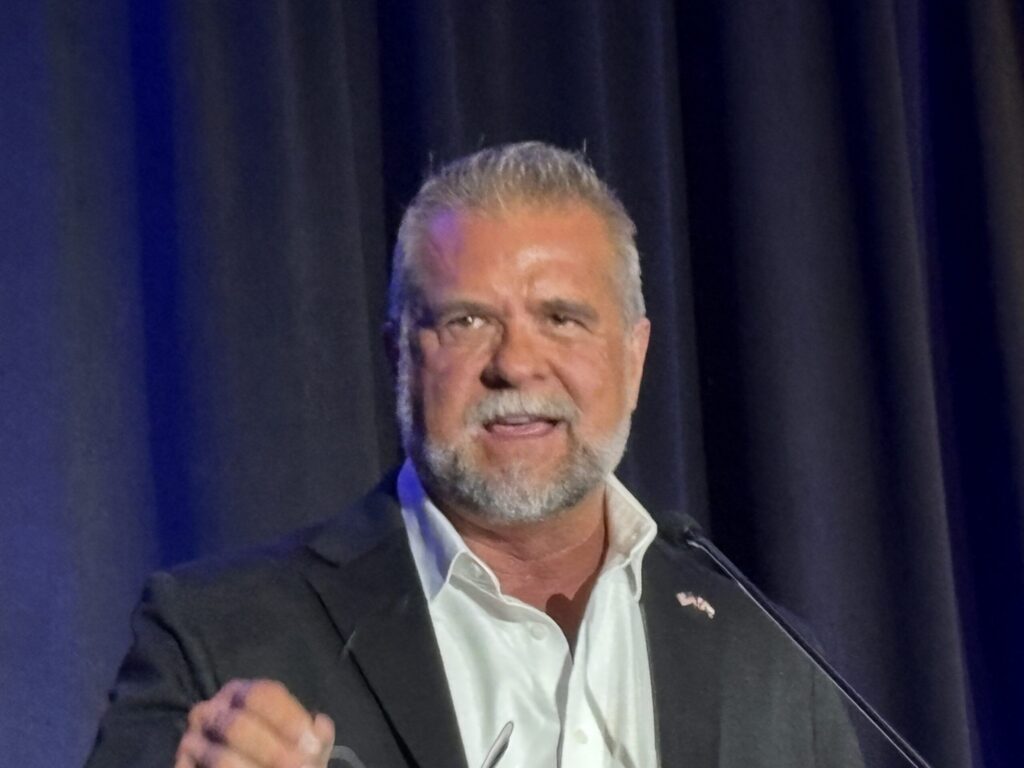
GOP gubernatorial candidate Victor Marx pushes aggressive water-storage expansion at Colorado Water Congress
Marianne Goodland
marianne.goodland@coloradopolitics.com
Updated 2 days ago
Victor Marx, the Republican nominee for governor, took the spotlight Wednesday during the opening day of the Colorado Water Congress, laying out how he says the state should approach its water future. Marx told the standing-room-only audience in Steamboat Springs...

U.S. Rep. Lauren Boebert stresses storage, forest health and Upper Basin rights at Colorado Water Congress
Marianne Goodland
marianne.goodland@coloradopolitics.com
Updated 1 day ago
Republican U.S. Rep. Lauren Boebert used her brief Wednesday appearance at Colorado Water Congress to tout her record on delivering water projects for the state and her district. Boebert, who is running for her second term representing the 4th Congressional...

Steve Schuck on the ‘magic’ of school choice | The OpEdge Podcast
Tony Olivero
tony.olivero@gazette.com
Updated 2 days ago
Parents Challenge co-founder and longtime school choice advocate Steve Schuck joins The OpEdge to discuss expanding educational opportunities and ensuring parents are in charge of their kids’ education. Schuck tells investigative columnist and host Jimmy Sengenberger why he believes Colorado...
Do lobbyists add value to policymaking? | PODIUM
Colorado Politics
colorado-politics@coloradopolitics.com
Updated 2 days ago
By Corky Kyle I was recently asked a straightforward question: are lobbyists a valuable component in the development of public policy? After more than four decades working with the Colorado General Assembly, state agencies, local governments, associations and businesses, my...
Ain’t Polis’ Peters commutation a pity? | Hal Bidlack
Hal Bidlack
hal-bidlack@coloradopolitics.com
Updated 4 days ago
I am hoping that, yet again, my long-suffering and very forgiving editor will pardon my rambling thoughts today, as there are too many open tabs on my computer that deal with issues I want to talk about (Ed: pretty used...
PREV
PREVIOUS

America wrestles with its 'Leaving MAGA' moment | Miller Hudson
For those Americans who glance at President Donald Trump and only see a raving lunatic, little is more confounding than the millions of MAGA adherents who discern a force for good. Reconciling these differing viewpoints feels nearly impossible. Dismissing this conflict as just politics misses the visceral intensity of the emotions embraced on each side […]

Colorado GOP plays with fire as primary approaches | Dick Wadhams
Over the next several weeks, the Colorado Republican Party will make consequential decisions that will determine just how relevant it will be in 2026 and beyond. The 600-member Colorado Republican State Central Committee will meet on May 30 to elect a new state chair following the resignation of Brita Horn. The Colorado Republican Primary Election […]