

As the AI age evolves, Colorado must step up to protect our kids | GUEST COLUMN
By Ann O’Leary
Artificial intelligence is creating new opportunities for young people to learn, create, explore and build confidence. It is opening new doors for students in Denver, on the eastern plains and on the western slope. But as our kids enter the AI era, we need to put the right guardrails in place to keep them safe from the risks that come along with those benefits.
That’s why we’d called on the Colorado General Assembly to make Colorado House Bill 26-1263 stronger. We hope potential future legislation will include more robust protections.
AI is evolving quickly, and the safeguards protecting children need to keep pace. HB26-1263 is an important step, but parents and child safety advocates made clear it did not go far enough. In fact, more than a third of the legislature voted against the bill because it does not do enough to protect minors. That’s why OpenAI had proposed amendments focused on youth well-being, crisis response, serious risk mitigation and stronger accountability.
They included:
- If a user’s age cannot be determined, companies should default to protective safeguards.
- Companies should regularly assess serious risks to children’s safety and address them proactively.
- Companies should make sure families can read and understand their child safety policies, which should explain safeguards in place, parental tools available and how protections evolve.
- Companies should design their AI services to avoid generating harmful or developmentally inappropriate content for children, and establish clear protocols for serious safety situations.
- AI services used by children should protect against manipulative, deceptive, or emotionally exploitative interactions.
- Children’s personal information should be protected from privacy-invasive, targeted advertising and from sale without parental consent.
- Companies should be held accountable for their approach to child safety through strong enforcement and privacy-preserving, independent audits.
The proposed amendments reflect OpenAI’s focus on keeping young users safe. We’ve introduced parental controls to help families shape how ChatGPT works in their homes. We’ve added Under-18 Principles to OpenAI’s internal rulebook that governs how our models should behave, which we call our “Model Spec”. And we’ve developed an age prediction model to help teens receive the right protections. When the system estimates an account belongs to someone under 18, it is designed to apply additional safeguards that reduce exposure to sensitive material, including violence, unhealthy dieting and other forms of body shaming.
Our work on teen safety is guided by close engagement with experts across many disciplines. Last year, we established an Expert Council on Well-Being and AI to help advise and define what healthy interactions with AI should look like for users of all ages. Our Global Physician Network provides insights that directly inform our safety research. We also collaborate with both national and state-level organizations on youth safety and well-being, including work focused on responsible AI protections for minors.
The American tech industry must continue investing in the research necessary to better understand how young people interact with AI over time and to close the gap between innovation and safety. That vital work cannot fall solely on parents or teachers, and AI companies have a responsibility to protect younger users from the start.
We’re grateful to the legislators who sponsored HB 26-1263, and we look forward to working with them more. Keeping kids safe in the AI era will require ongoing collaboration between lawmakers, parents, educators and technology companies, and we are committed to being a long-term partner in that work.
Colorado has always led the way in tech and innovation. As AI becomes part of daily life for young people across the state, it’s time for Colorado to lead again by setting a new national standard for how best to keep kids safe in the AI era.
Ann O’Leary is vice president of Global Policy at OpenAI.

Add Lynn Bartels to Colorado’s roll call of legends | Dick Wadhams
Dick Wadhams
dick-wadhams@coloradopolitics.com
Updated 1 day ago
A few weeks after the Rocky Mountain News shut its doors forever in 2009, more than 600 Republicans gathered for the state party’s annual Centennial Dinner. Lamenting the historic significance of the loss of one of Colorado’s great daily newspapers,...

Conservation efforts emphasize the lesser prairie chicken | Rachel Gabel
Rachel Gabel
rachel-gabel@coloradopolitics.com
Updated 1 day ago
Reid DeWalt, deputy director of Colorado Parks and Wildlife, spoke to the Water Resources and Agriculture Review Committee about the Lesser Prairie Chicken and moving conservation forward. He said in 2026, CPW staff counted 77 males on 13 leks, a...

Colorado’s regulations should address policy challenges only as truly needed | Miller Hudson
Miller Hudson
miller-hudson@coloradopolitics.com
Updated 1 day ago
As Colorado approaches its 150th birthday, we should remember its first 100 years were characterized by repeated boom-and-bust economic cycles. Dependence on mineral extraction and agricultural commodity prices was subject to the volatility of these markets. In 1972, as I...
The last, best hope for the Colorado GOP | Kelly Sloan
Kelly Sloan
kelly-sloan@coloradopolitics.com
Updated 1 day ago
If the Colorado Republican Party desires to retain any relevancy, let alone wrest back any of the levers of political control in the state, it needs to elect Barb Kirkmeyer in the June 30 primary. To be sure, Kirkmeyer would...
Colorado, Utah mourn after 3 firefighters killed in wildfires
Nicholas Fogleman
nicholas.fogleman@denvergazette.com
Updated 1 day ago
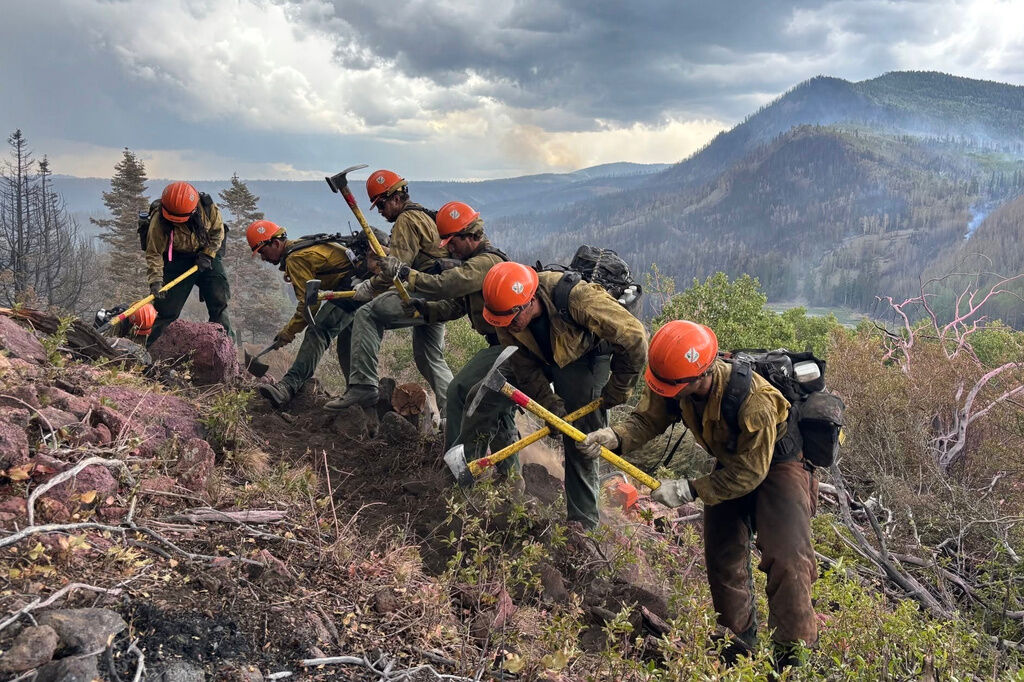
Gov. Jared Polis on Sunday mourned the deaths of three firefighters killed while battling a wildfire on the Colorado-Utah border, calling the loss a tragedy for the state and the firefighting community. The firefighters died Saturday while responding to a...

Read Michener’s ‘Centennial’ | Jon Caldara
Jon Caldara
jon-caldara@coloradopolitics.com
Updated 4 days ago
If you’ve been reading my columns, you’ve noticed I’m basically illiterate. I blame my dyslexia and public education, but my Olympic-level laziness could be the driving factor. Anyway, I basically can’t read (and, still, I graduated from CU Boulder, so...
Crank challenger Jessica Killin signs on to new centrist Democratic group’s ‘Promise to America’
Ernest Luning
ernest.luning@coloradopolitics.com
Updated 5 hours ago
Jessica Killin, one of the Democrats running in Tuesday’s primary for the chance to challenge U.S. Rep. Jeff Crank in Colorado’s 5th Congressional District, joined with more than a dozen incumbent Democratic lawmakers and candidates this week signing on to...
Who’s spending in Colorado to get your vote?
Marianne Goodland
marianne.goodland@coloradopolitics.com
Updated 3 days ago
Groups that raise unlimited amounts of money have spent about $20 million in May and June to try and influence Colorado voters’ choices in the upcoming June 30 primaries. By law, these groups cannot coordinate with the candidates they support....
Tina Peters tells supporters to ‘stand up and fight back’ at Castle Rock event
Marissa Ventrelli
marissa.ventrelli@coloradopolitics.com
Updated 3 days ago
Tina Peters, the former Mesa County clerk recently released from prison, warned supporters that what happened to her could happen to them, too, if they did not “stand up and fight back” at an event at the Douglas County Fairgrounds....
Will one unqualified AG replace another? | George Brauchler
George Brauchler
george-brauchler@gazette.com
Updated 4 days ago
Colorado Democrats are poised to nominate another attorney general candidate with de minimis relevant credentials or experience. Far from disqualifying, Colorado’s recent voting history mirrors that of America in favoring biography over experience, partisanship over policy, and emphasizing what divides...
PREV
PREVIOUS

Strengthening Colorado's mental-health workforce | GUEST COLUMN
By Kyle Brown and Lindsay Gilchrist More than 1.2 million Coloradans live with a diagnosed mental health condition, and in 2023, one in five people seeking care were unable to get the treatment they needed. Overwhelmingly, insurance delays and inadequate provider networks are to blame. A recent study found credentialing for providers takes up to […]

Which Colorado candidate for governor will commit to the 'public' in public education? | Paula Noonan
The General Assembly finished its work with a flurry, not a whimper. The Joint Budget Committee (JBC) managed to outplay Gov. Jared Polis with its final amendments to the School Finance Act. Polis is all in on “innovation” with public school money, even if innovation includes jiu-jitsu lessons for private school students. He didn’t want […]