

‘It’s fun’: Justice Melissa Hart joins counterparts in advocating for state supreme court clerkships
Justice Melissa Hart spoke on Monday about what aspiring law clerks should consider when applying to work at the Colorado Supreme Court, including the ability to be involved in more than just screening appeals and drafting decisions.
“I think people would be surprised to know — and I don’t know how much this is true in other states — I would say 35-40% of our time is spent in Colorado on this administrative part of the job,” Hart said, referring to the Supreme Court’s rulemaking function for the legal system.
“We’re doing all of those things in addition to wearing our black robes and sitting on the bench,” she continued, “and we get our clerks more or less involved in those things. And I think the clerks love it when they get to get involved.”
Hart spoke alongside members of three other states’ supreme courts during a virtual event hosted by the Brennan Center for Justice’s “State Court Report.” The participants spoke about why law students should not focus exclusively on working for federal judges after graduating.
“When you get into practice, you realize that most of that law that is in the American legal system is at the state. That is evident from the caseloads,” said Justice Goodwin H. Liu of the California Supreme Court. “In California alone, we have on the order of 1,600 state court judges — which is almost twice the size of federal judiciary.”
During the last fiscal year, there were almost 600,000 cases filed in Colorado’s state trial courts, which has approximately 340 judges and justices. In contrast, Colorado’s federal trial court saw approximately 4,000 civil and criminal cases filed during all of 2023.
Hart said that her motivation for joining Colorado’s Supreme Court was to enhance access to justice for civil litigants. To that end, one of her clerks is her “access-to-justice law clerk.”
“I think that’s one of the reasons people apply to me to clerk. Because they know that’s my reputation, that it’s something I care about and work on,” she said.
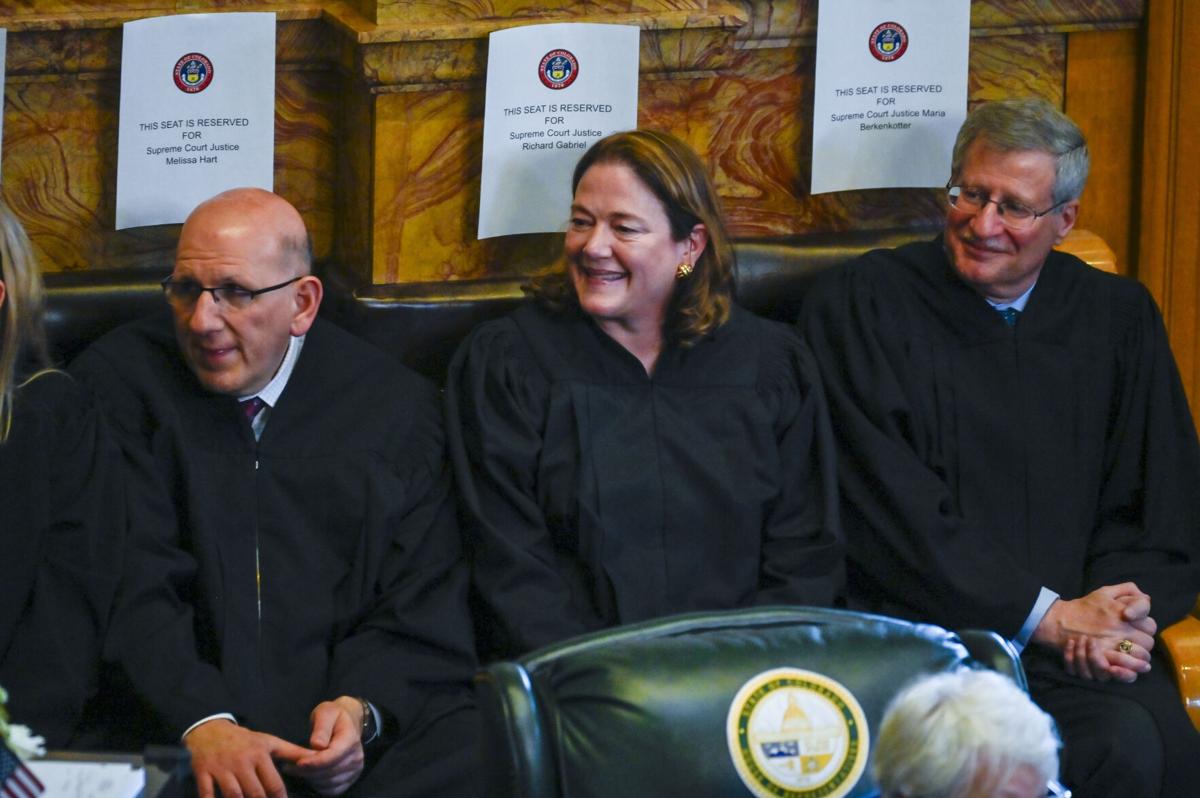
Justices Carlos A. Samour Jr., Melissa Hart and Richard L. Gabriel attend Gov. Jared Polis' 2025 State of the State address on Thursday January 9, 2025 at the Colorado State Capitol. Special to Colorado Politics/John Leyba
John Leyba

She also noted that Colorado’s highest court generally has discretion in the cases it accepts, so clerks for the justices “have a unique experience of seeing cases that would be especially consequential” for the state that the court chooses to hear.
However, Justice Melissa A. Long of the Rhode Island Supreme Court said her state does not have an intermediate appeals court. Therefore, she hears cases that are both consequential for the state and for which litigants are simply asking for a second look.
“That closeness or that sense of it really matters for these particular people is really consequential,” Long said, adding that her court, unlike Colorado’s, often has self-represented litigants appear before it.
Hart also spoke glowingly of the dynamics of the current Colorado Supreme Court, and said the camaraderie extends to the clerks, as well.
“It’s so great. We just really like each other. And we disagree with each other, but we disagree so well it’s really wonderful. And our clerks really like each other,” she said. “It’s fun because it’s intellectually engaging but it’s fun also because it’s fun.”
“My takeaway is I wish I were Justice Hart’s law clerk,” quipped Liu.
In describing who she prefers to hire, Hart, a former law professor, said she prioritizes a candidate’s legal writing grade, their connection to Colorado and anything that demonstrates a focus on public interest law. She also tends to hire two clerks who have just graduated from law school and one clerk who has some years of work experience.
Other participants agreed it is helpful to come to the job with experience beyond undergraduate and law school.
“I currently also have an intern who served in Iraq and Afghanistan and his greatest accomplishment is better than any I’ll ever have,” said Long, “and that is he brought all his troops home alive.”
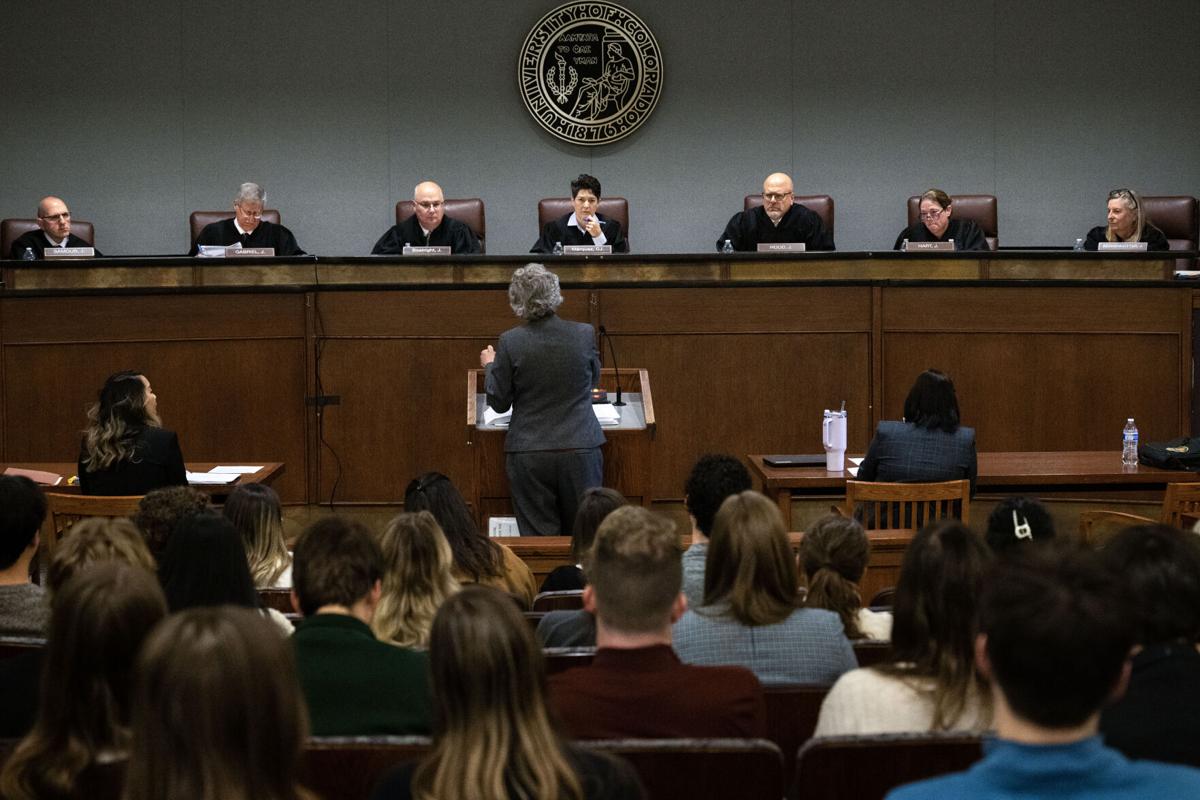
The Colorado Supreme Court hears a rebuttal from First Assistant Attorney General Wendy J. Ritz during arguments for People v. Rodriguez-Morelos as part of Courts in the Community at the Wolf Law building at University of Colorado Boulder on Thursday, Oct. 24, 2024. The semi-annual event entails the Colorado Supreme Court hearing arguments before an audience of students throughout the state. (Stephen Swofford, Denver Gazette)
Stephen Swofford Denver Gazette

Kasia Szymborski Wolfkot, who moderated the discussion for the Brennan Center, observed that state supreme courts are able to hear cases based on state constitutional provisions that, while similar to provisions in the U.S. Constitution, may provide greater protections than those recognized by the U.S. Supreme Court.
“For example, state supreme courts, relying on state law, upheld marriage equality before SCOTUS did,” she said.
Judge Caitin J. Halligan of New York’s Court of Appeals — the highest court in New York — agreed state supreme courts generally have the last word on state law absent a federal issue.
“As Justice Hart said, we’re really trying to think about the downstream implications of our writings because those cases will govern the work of all of the courts in our respective states,” she said. “I think the clerks, it’s an opportunity for them to think with a little broader lens.”

Parenting from prison: Inmates hope to be present in their children’s lives, while physically absent
Marianne Goodland
marianne.goodland@coloradopolitics.com
Updated 6 hours ago
The room was decorated with balloons, the tables sparking bright with colors as the smell of pizza and cake wafted through the air. As did music. This was, after all, a father-daughter dance. Except this was not a typical father-daughter...
Appeals court confirms Colorado judges can compel electronic records from out of state
Michael Karlik
michael.karlik@coloradopolitics.com
Updated 2 days ago
Colorado’s second-highest court clarified on Thursday that judges are empowered to compel out-of-state companies to produce electronic records under state law. El Paso County jurors convicted Mischa Jargowsky on three counts of money laundering and one violation of Colorado’s organized...
10th Circuit upholds finding of no racial discrimination against family at Denver Chili’s
Michael Karlik
michael.karlik@coloradopolitics.com
Updated 3 days ago
The Denver-based federal appeals court agreed on Wednesday that a Black plaintiff failed to show that a Chili’s manager’s request for her family to provide valid payment at the outset of their meal amounted to racial discrimination. Markesha Futrell-Smith filed...
Appeals court reinstates Mesa County defendant’s request for DNA testing under new Colorado law
Michael Karlik
michael.karlik@coloradopolitics.com
Updated 4 days ago
Colorado’s second-highest court revived a Mesa County defendant’s petition for DNA testing in his three-decade-old attempted murder case on Thursday, concluding that a trial judge wrongly interpreted a recent Colorado law in dismissing the request outright. Jurors convicted Billy Joe...
Appeals court reverses Denver juvenile’s conviction due to improper expert testimony
Michael Karlik
michael.karlik@coloradopolitics.com
Updated 2 days ago
Colorado’s second-highest court reversed a juvenile defendant’s conviction for unlawful sexual contact on Thursday after an expert witness’s testimony improperly suggested the child victim was telling the truth. The defendant, identified as S.H-S., was around 16 years old when he...

Judge orders home confinement for Barry Morphew
Dennis Huspeni
dennis.huspeni@gazette.com
Updated 4 days ago
An Alamosa County district judge has ordered home confinement for Barry Morphew, who is accused of murdering his wife. Barry Morphew, 59, faces a first-degree murder charge in the death of his wife, Suzanne Morphew, who disappeared Mother’s Day weekend...
Appeals court says jury does not need to view porn to determine if it’s ‘obscene’
Michael Karlik
michael.karlik@coloradopolitics.com
Updated 2 days ago
Colorado’s second-highest court ruled for the first time on Thursday that a jury does not always need to view pornographic material to determine if it meets the criteria for obscenity. Mesa County jurors found Shayla Ann Simpson guilty of child...
10th Circuit disagrees Sterling officer had no basis to arrest motorist who lacked insurance details
Michael Karlik
michael.karlik@coloradopolitics.com
Updated 5 days ago
The Denver-based federal appeals court disagreed on Tuesday with a trial judge’s decision to bar evidence from a pat-down search from being used against a defendant. Federal prosecutors obtained an indictment of Jorge Sigala-Baray for being a felon in possession of a...
Colorado Springs officers’ tasing, threats prompt federal judge to block use of suspect’s statements
Michael Karlik
michael.karlik@coloradopolitics.com
Updated 5 days ago
A federal judge blocked the government last month from using some of a defendant’s statements as evidence, reasoning that the defendant made them involuntarily as Colorado Springs officers tased him five times and one officer threatened to kill him. Officers...
Appeals court rejects CDOT employee’s discrimination, retaliation claims
Michael Karlik
michael.karlik@coloradopolitics.com
Updated 3 days ago
Colorado’s second-highest court agreed last week that a Colorado Department of Transportation employee had not shown that his employer discriminated and retaliated against him due to his religion and national origin. Ayman Salloum, who described himself as a 70-year-old Muslim...