

Colorado lawmakers push bill to limit access to public records, cancel repeal of closed meeting exemption
A House committee on Monday greenlighted a bill that critics said would make it more difficult to obtain records through the state’s open records law and canceled a proposal that would have reversed a law that has made it harder for the public and reporters to know what lawmakers are doing.
House Bill 1242 sought to repeal Senate Bill 24-157, the measure that granted legislators an exemption from the state’s open meetings law, allowing them to negotiate legislation behind closed doors and out of public view.
The bill also sought to make several changes to the state’s open records law, including extending the amount of time a governmental agency would have to respond to a Colorado Open Records Act request, reducing CORA costs, allowing for more free research time, and changing the Colorado Criminal Justice Records Act.
The 2024 law prevented reporters from attending Democratic caucus meetings that focused on property tax legislation being prepared for a special session. Even some lawmakers complained, as they felt forced to vote on a deal they weren’t involved in crafting. House Speaker Julie McCluskie said the meetings weren’t public because they weren’t voting on proposed legislation.
Under the 2024 law, public hearings become nothing more than a formality and lead to erosion of public trust, said HB 1242 sponsor Rep. Lori Garcia Sander, R-Eaton. HB 1242 would ensure public business remains public, she told the House State, Civic, Veterans and Military Affairs Committee on Monday.
She said that, as a result of SB 157, an entire committee could meet a week before the session begins to discuss a bill, hammer out all the details, and not violate state open meeting laws.
“The people of Colorado deserve an open, accountable and transparent government. Let’s give it back to them,” Garcia Sander said.
‘Political enemies’ band together to try and undo 2024 law
Governmental transparency advocates lined up to support the measure, pointing out that the legislature’s efforts to cut off public access to their businesses have drawn disparate groups together.
“Never in my life have I seen such drastic and violent polarization going on throughout the country and throughout the state,” said Jon Caldara, president of the Independence Institute. “I have never seen such vile inability for sides to be able to talk to one another about common goals and common goals. And with that, I’d like to thank the state legislature for doing something that I thought was completely impossible — to bring together so many different sides of the political aisle to work on this bill and trying to correct the overreach of last year’s Senate Bill 157.”
“All of us, who have been political enemies, are working for a fix to what you did last year,” he told the committee.
Caldara was referring to a coalition of 50 groups working on a constitutional ballot measure for 2026 that would seek to overturn SB 157. The coalition was not involved in the drafting of HB 1242 but its members showed up in support for the measure on Monday.
Linda Hutchinson of the League of Women Voters of Colorado told the committee that, while the league favors efficient and effective government, it does not favor expediency at the expense of transparency. The group also supports the bill’s attempt to reduce the cost of CORA requests, currently at $41.37 per hour for data retrieval, to $25 per hour. She warned that other government entities will seek their own exemption from the open meetings law due to SB 157, which applied only to the General Assembly.
How does the legislature’s efforts to cloak its business look to ordinary Coloradans? Cory Gaines of Sterling said, pointing to the Democrats’ use of “quadratic voting,” which was kept secret for several years; the lawsuits filed by lawmakers against their colleagues over using apps with disappearing messages; and the vote to approve Senate Bill 77, which took place earlier in the same hearing.
This is “thumbing your nose” at Colorado citizens, Gaines said.
Lawmaker: ‘Every action … is public’
Rep. Chad Clifford, D-Littleton, appeared to bristle at the idea that the legislature is not transparent.
“Every action I take as an action in this building is public. Almost every dialogue that I have that matters is in a committee room, just like this one on a mic where you can go back and listen and get the transcript. And 100% of every vote I have ever taken in this building is recorded in a journal. There’s very little that the legislature does in private,” he said.
At the same time, Clifford said lawmakers should be able to have conversations with one another to talk about legislation or legislative strategy “without … involvement from the media, the lobbyists or the general public.”
Jessica Capsel, an Elbert County resident, said HB 1242 lacks any enforcement for violating the law.
It “continues to put the burden on citizens at their own expense to be the CORA police,” she said, adding that governments will keep doing business as usual, knowing no one is watching and no one will do anything anyway.
While the bill a variety of government groups, including cities such as Colorado Springs and the Colorado Municipal League, oppose the bill, they didn’t speak on Monday.
The only person to speak against HB 1242 was Jina Koultchitzka, an attorney representing the Pikes Peak Regional Building Department. She told the committee her agency is already transparent and complained about the number of CORA requests it gets and the costs — and staff time it will incur to have attorneys review those requests should the measure pass.
The proposal failed on a party-line 8-3 vote.
Bill extends CORA response time
The committee approved another two-year effort by Sen. Cathy Kipp, D-Fort Collins to allow more time for government agencies to respond to CORA requests from three to five days, even more when an entity has only a single “custodian” of documents.
That led to worries during the hearing that CORA requests could take months for a response.
Critics also said Senate Bill 77 creates two classes of record requestors: the media and the general public.
Many of those who testified for HB 1242 also opposed SB 77.
SB 77 co-sponsor Rep. Matt Soper, R-Delta, said he serves on a hospital district board that finds it hard to fill CORA requests in the current three business days allotted under the law.
Soper said five days is more reasonable, noting that in “extenuating circumstances,” a government entity would have 10 days, up from seven days in current law.
The bill does not define what an “extenuating circumstance” might entail, but Soper mentioned a situation, in which an agency has only one person who responds to those requests.
Co-sponsor Rep. Michael Carter, D-Aurora, also noted the bill’s provision for “collapsing” requests — if someone makes more than one request in 14 days, that can be reduced into one request.
Critics said what matters is that the bill allows for up to the first hour of research for free, and under that provision, only one free hour would be provided for multiple CORA requests, driving up the costs of those requests.
Brandon Wark, who raised concerns about two classes of requestors, pointed out that the changes in SB 77 don’t all apply to the media.
Previous statutes define “media” as any publisher of a newspaper or periodical, wire service, radio or television station, network news, feature syndicate, or cable television system. Wark said that leaves out online or citizen journalists.
To say “that their voices are not as important as the mass medium organizations that have lots of money to pay for these CORA requests is doing a disservice to the people,” he said.
Wark told the committee that carrying out special protections for the media is 100% against the idea of representative government.
Hutchinson of the League of Women Voters of Colorado expressed concerns about collapsing CORA requests, which she said would deny requestors the free time allowed under current law for research. While she applauded some of the bill’s “user-friendly” aspects, her group doesn’t support extending the amount of time an agency would have to respond to a CORA request.
Capsel noted that CORA requestors in her school district have been accused of stealing from the district to fulfill CORA requests.
“We need more transparency upfront so that CORAs aren’t required in the first place,” she said.
‘Coloradans need access to public records, not more obstacles’
The Colorado Municipal League’s Heather Stauffer spoke in favor of the bill’s extension of time, which she said acknowledges the “operational realities” faced by those in charge of public records. She, however, questioned the value of the two tiers of requestors, saying the media should have the same amount of time as everyone else.
“Senate Bill 77 will give municipalities some needed flexibility to ensure timely responses,” she said.
Jefferson County’s Karen Wick pointed to the ballooning of CORA requests over the past five years — from 217 in 2019 to 650 last year.
“Our residents are very active, which is great,” Wick said. “We support that they have every right to know what’s going on in Jefferson County, but sometimes it does take time to process CORA requests.”
And those requests are getting more complex, requiring hours and even days to fulfill just one.
Wick said that taking care of CORA requests means some county employees cannot complete their other duties.
The Colorado Freedom of Information Coalition’s Jeff Roberts said his group is in an “amend” position, with concerns about extending the time for a CORA request response. The bill does nothing about the costs of those requests, Roberts said, adding the fees are already a significant barrier to obtaining public records, “which is why governments don’t need a reason to take longer to process CORA requests.”
Roberts said many CORA requests are fulfilled long after the three-day requirement in current law. He noted a recent ruling from the state Court of Appeals, which said requesters cannot sue over delayed responses if they eventually get the records, even if it takes months.
“Coloradans need access to public records, not more obstacles,” Roberts told the committee.
The bill passed on a party-line 8-3 vote and heads to the full House.

Homeless recruits of ‘The Program’ say they were told to sign NDAs amid investigations in Colorado
David Migoya
david.migoya@gazette.com
Updated 3 hours ago
Several formerly homeless people — each drawn into an Aurora-based enterprise known as “The Program” that promised free housing and cash in return for letting a home-health business administer prescriptions they were given — said they were pressed into signing...
Homeless recruits of ‘The Program’ say they were told to sign NDAs amid investigations in Colorado
David Migoya
david.migoya@gazette.com
Updated 3 hours ago
Several formerly homeless people — each drawn into an Aurora-based enterprise known as “The Program” that promised free housing and cash in return for letting a home-health business administer prescriptions they were given — said they were pressed into signing...
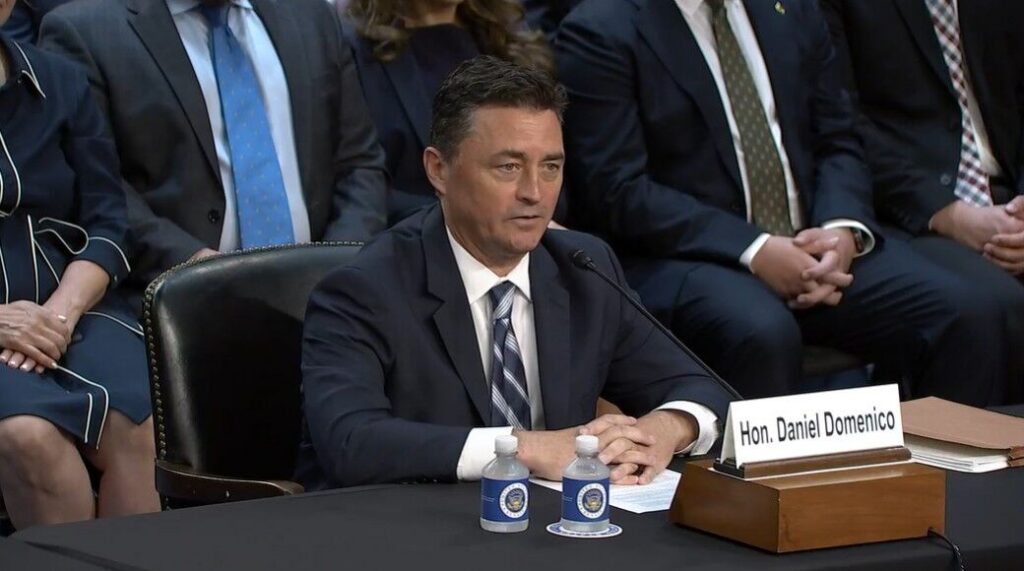
Trump’s 10th Circuit nominee declines to name 2020 election winner, defends immigration decisions
Michael Karlik
michael.karlik@coloradopolitics.com
Updated 3 hours ago
President Donald Trump’s nominee to the Denver-based federal appeals court declined to say who won the 2020 presidential election during his appearance before the U.S. Senate Judiciary Committee on Wednesday, and defended his recent rulings in immigration detention cases. U.S....
Colorado repeals attorney immigration attestation law after one year
Nico Brambila
nico.brambila@denvergazette.com
Updated 2 hours ago
One year and 12 days. That’s how long a Colorado law requiring attorneys to certify they would not use court data for federal immigration enforcement remained on the books before lawmakers repealed it. Gov. Jared Polis signed the initial legislation,...
Colorado’s ‘right to natural gas’ measure submits signatures to qualify for November ballot
Marissa Ventrelli
marissa.ventrelli@coloradopolitics.com
Updated 5 hours ago
A natural-gas rights initiative backed by Advance Colorado is likely headed to the November ballot, triggering a parallel campaign by environmental groups seeking to impose new liabilities on oil and gas operators. Petitions for Initiative No. 177 were turned in...

Economists: Colorado budget improves slightly, but deficits still loom
Marianne Goodland
marianne.goodland@coloradopolitics.com
Updated 5 hours ago
State economists reported a stronger-than-expected bump in general fund revenue driven largely by higher individual income tax collections, yet warned that Colorado remains on track to begin the next fiscal year with a sizable shortfall. State economists upgraded “significantly” the...

Colorado law allowing lawsuits against ‘conversion therapy’ providers takes effect July 1
Marissa Ventrelli
marissa.ventrelli@coloradopolitics.com
Updated 5 hours ago
With a new law taking effect July 1, Colorado is creating a legal pathway for people to sue licensed providers of “conversion therapy,” even as debate over the practice’s constitutionality continues in the wake of a recent U.S. Supreme Court...
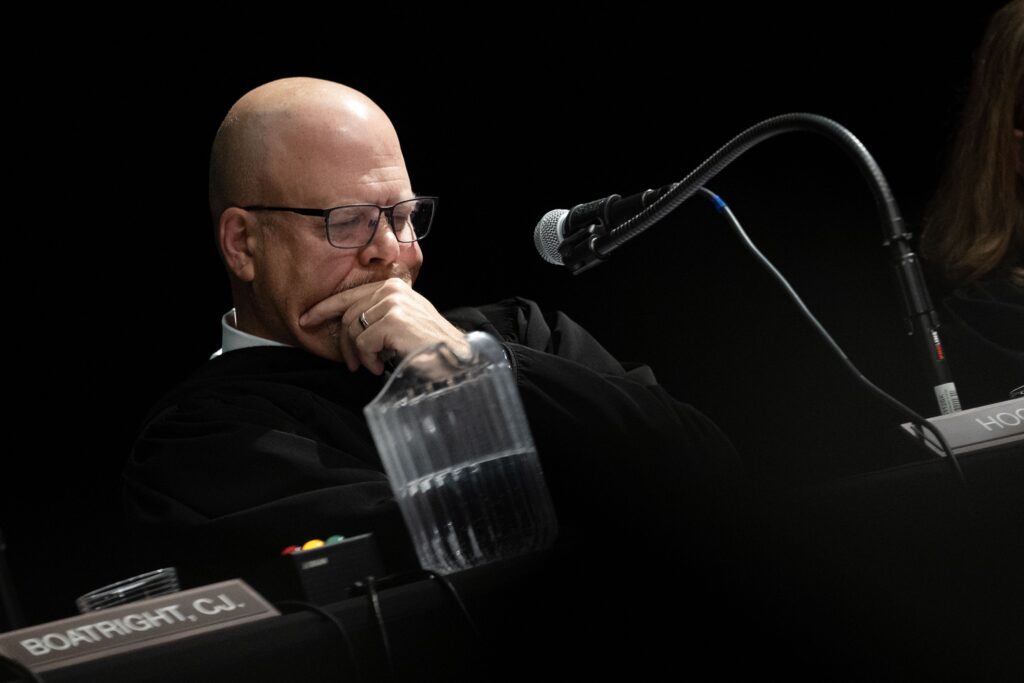
Colorado justices expand ability for civil defendants to avoid participating, win after trial
Michael Karlik
michael.karlik@coloradopolitics.com
Updated 8 hours ago
The Colorado Supreme Court decided on Tuesday that a civil defendant, whose non-participation in the case meant that he legally admitted to the sexual assault allegations against him, could nonetheless prevail after he showed up to testify at trial. A...
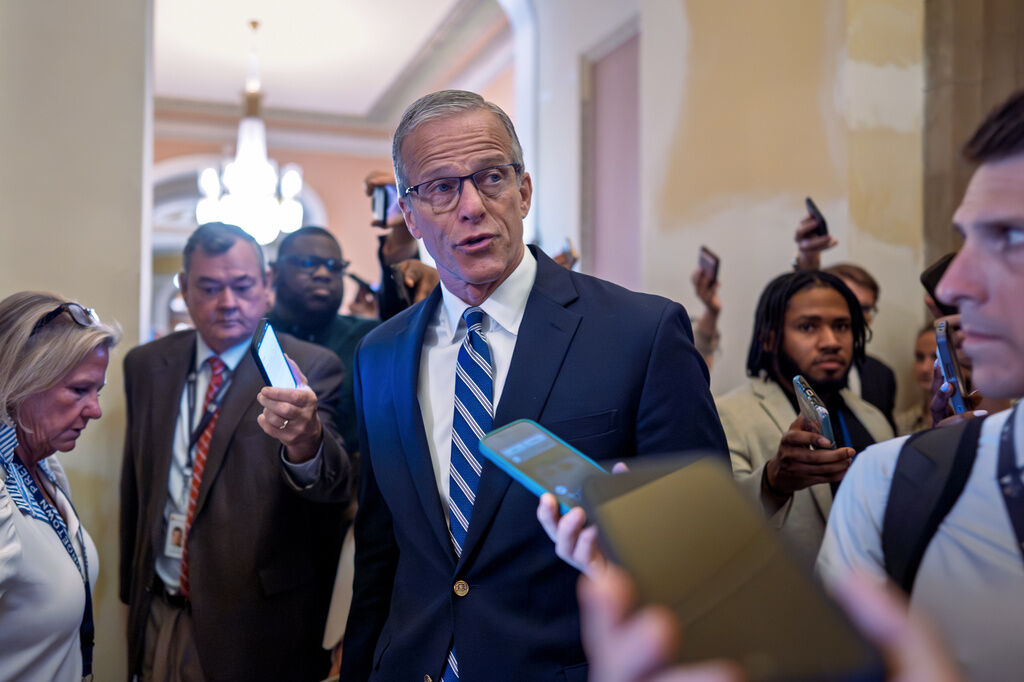
Trump heads to Senate as GOP grows more willing to challenge White House
Naomi Lim
naomi-lim@coloradopolitics.com
Updated 8 hours ago
President Donald Trump normally summons congressional Republicans to the White House, but on Wednesday, he is making a rare trip to Capitol Hill to have lunch with GOP senators. And at least publicly, there is one agenda item. “We’re just...

Trump blasts oil companies for not lowering prices to consumers, accuses them of price gouging
Washington Examiner Staff
washington-examiner-staff@coloradopolitics.com
Updated 8 hours ago
President Donald Trump criticized “big oil companies” for not lowering prices for consumers, even though oil purchase costs have dropped. He accused oil companies of price gouging consumers, ordered the Department of Justice to investigate current practices, and demanded that...