

In final weeks of Colorado legislative session, 374 bills still need action
On day 105 of the 120-day legislative session, lawmakers have 374 bills out of 673 bills introduced that need action between now and midnight, May 8, when the session adjourns.
The number of bills introduced in 2024 is the fifth highest in the last 25 years. Four sessions have had more than 700 bills, with 2003 at the high watermark, with 736.
According to data from the Office of Legislative Legal Services, the House has introduced 462 bills, the Senate 211. The larger number for the House reflects not only its more members but also the fact that it took the lead on appropriations bills this year, including the state budget and dozens of related bills.
Compared to 2023, 70 more bills have been introduced in the 2024 session. Ninety-eight more bills than a year ago are still awaiting their first committee hearings, meaning some very busy committees in the next 10 days. Any bill that has not cleared its first committee hearing by Monday, May 6, will not have a chance of making it to the end of the session.
Of the pending bills, the House has 212 bills to work on that originated in the House, and 221 bills total awaiting action. The Senate has 79 bills that originated in the Senate, and 153 bills are awaiting action.
This year’s bill total is the highest in the last five sessions.
The state constitution prohibits lawmakers from submitting more than six referred measures to the ballot.
Two measures from the 2023 session are already on the ballot: a modification of property taxes for veterans with disabilities and a measure on judicial discipline.
One measure, HCR 1002, on constitutional bail exceptions for first-degree murder, has already been approved, leaving three others competing for the remaining three slots.
Those include two from Rep. Bob Marshall, D-Highlands Ranch, on qualifications for senators and representatives. HCR 1004 is intended to ban vacancy committee members from running for office in the following election. The measure passed the House State, Civic, Military and Veterans Affairs Committee on a 7-4 vote Monday. Marshall’s other referred measure would set a property tax revenue growth limit. House Finance approved HCR 1006 on Monday and is awaiting action from House Appropriations.
The last measure, SCR 002, is a modification to election deadlines offered by Senate President Steve Fenberg, D-Boulder.
Eighty bills have been postponed indefinitely; one was lost on the second reading in the House, and two were lost on the third reading, one each in the House and Senate.
The governor has signed 145 bills through Monday.


Colorado to get $615M from Meta child safety settlement
Thelma Grimes
thelma.grimes@coloradopolitics.com
Updated 5 hours ago
The parent company of Facebook and Instagram will pay hundreds of millions of dollars to Colorado, part of an $18 billion multistate deal, in which the company also agreed to adopt extensive child-safety changes to its operations. The settlement ended...

Colorado’s chief federal judge orders return of wrongfully deported man, second judge to explore ‘series’ of violations
Michael Karlik
michael.karlik@coloradopolitics.com
Updated 8 hours ago
Colorado’s chief federal judge took the extraordinary step of directing the government on Tuesday to do everything it can to return a man it deported in violation of his order. At the same time, Colorado’s chief magistrate judge has set...

Counties warn CPW that new comment limits sideline local governments
Marianne Goodland
marianne.goodland@coloradopolitics.com
Updated 5 hours ago
The September meeting of the Colorado Parks and Wildlife Commission will feature newly revised public‑comment rules — changes introduced by chair Jay Tutchton of Bent County, who announced them without first discussing the revisions publicly with the rest of the...

Controversial two-bag furbearer limit heads to CPW meeting under legal threat
Marianne Goodland
marianne.goodland@coloradopolitics.com
Updated 5 hours ago
Next week’s Colorado Parks and Wildlife Commission meeting in La Junta is likely to open under the cloud of threatened legal action. Safari Club International and the Sportsmen’s Alliance Foundation warned the commission this month that its July vote imposing...

Golden to pay $155,000 to fired city manager
Matt Kyle
matt.kyle@denvergazette.com
Updated 7 hours ago
The Golden City Council on Tuesday approved a roughly $155,000 severance payout to former city manager Scott Vargo, who was fired earlier this month following a “racist incident” at a city fire station. The payout is part of a separation...

Trump says the US doesn’t need Canada. America’s economy says otherwise.
The Associated Press
the-associated-press@coloradopolitics.com
Updated 9 hours ago
TORONTO (AP) — U.S. President Donald Trump says his country does not need Canada. But every day, roughly 4 million barrels of Canadian crude oil flow south, helping fuel American cars, trucks and airplanes and supply U.S. industry. And oil...

USPS ballot rule faces lawsuit from Colorado, other states
Thelma Grimes
thelma.grimes@coloradopolitics.com
Updated 6 hours ago
Colorado, along with 25 other states, filed a lawsuit against the U.S. Postal Service to challenge a new rule that seeks to restrict the mailing of ballots to American citizens in an eligible voters list. Colorado relies heavily on the...

FDA approves landmark pancreatic cancer drug that’s shown to improve survival
The Associated Press
the-associated-press@coloradopolitics.com
Updated 8 hours ago
WASHINGTON (AP) — The Food and Drug Administration on Wednesday approved a groundbreaking new drug for advanced pancreatic cancer, offering U.S. patients a more effective treatment against one of the deadliest types of cancer. FDA officials gave expedited approval to...

Trump defends pause on beef tariffs: Prices are ‘coming down very rapidly’
Naomi Lim
naomi-lim@coloradopolitics.com
Updated 11 hours ago
President Donald Trump defended his decision to pause tariffs on some beef imports, even as Republicans criticize the decision. “Prices are coming down very rapidly, and now beef is starting to come down,” Trump told The Glenn Beck Program on...
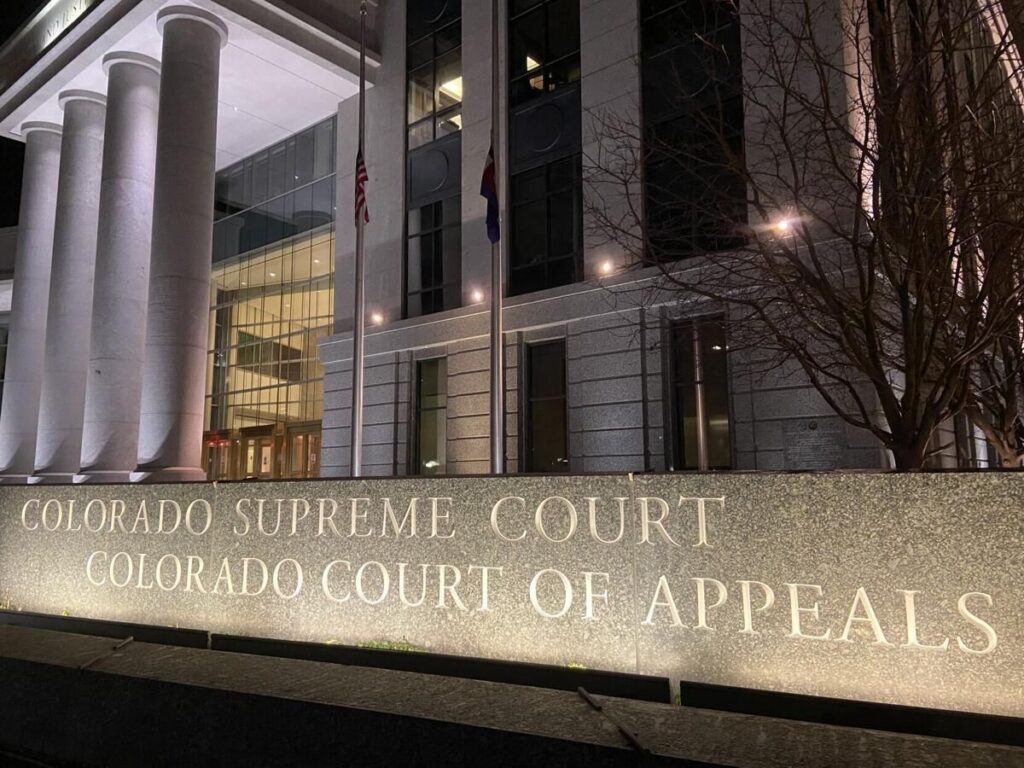
Denver murder, assault convictions reversed due to faulty jury instructions
Michael Karlik
michael.karlik@coloradopolitics.com
Updated 6 hours ago
Colorado’s second-highest court reversed a defendant’s convictions for murder and assault last week after concluding a Denver judge incorrectly omitted key jury instructions that could have affected the verdict and sentencing. Stephen C. Swainson fatally stabbed Israel Casillas in downtown...