

House Republicans object to Democratic resolution setting end-of-session rules
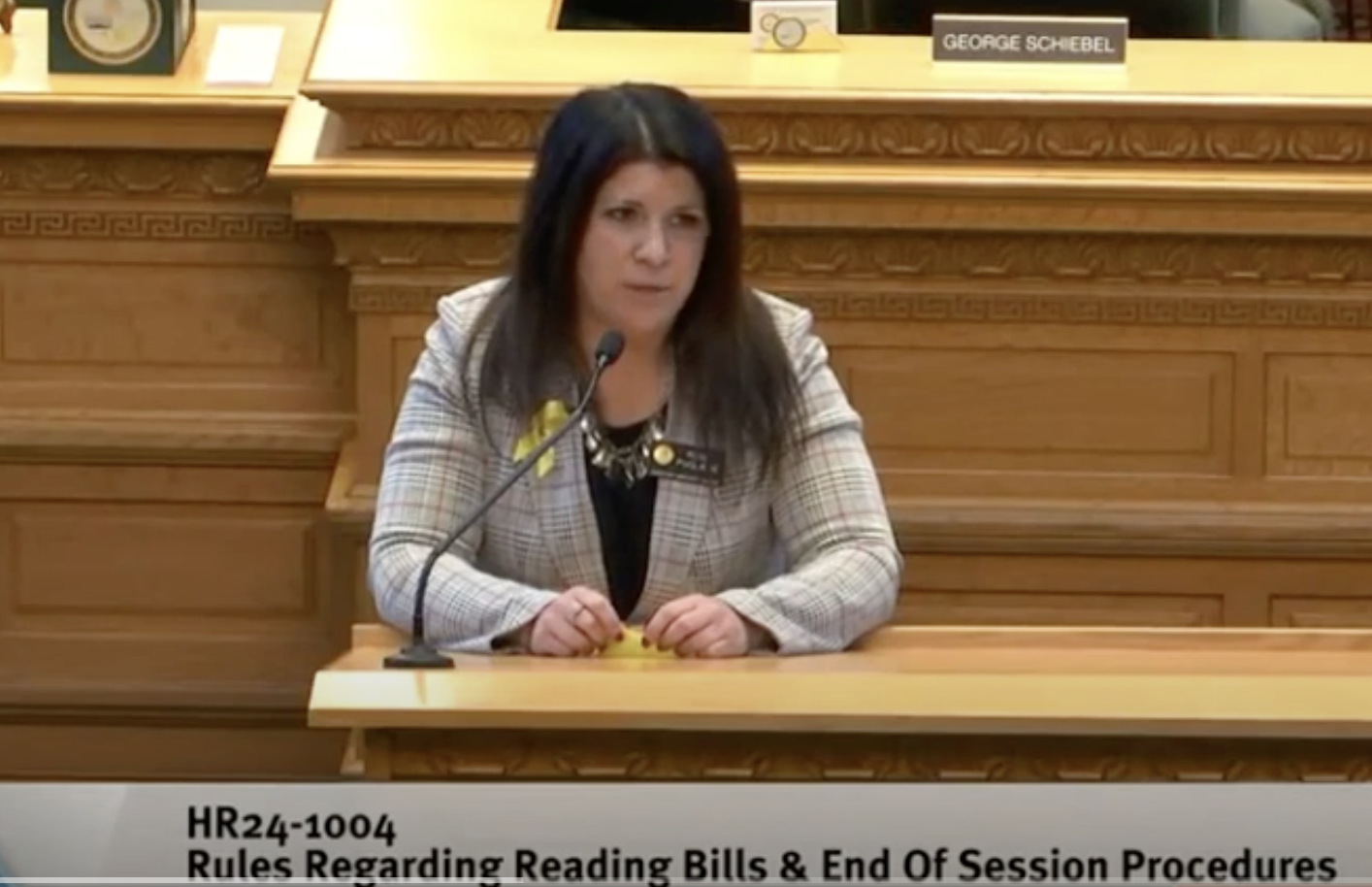
A resolution offered by House Majority Leader Monica Duran drew protests from Republicans Friday, who claimed changing rules in the last days of the session is an effort to silence GOP voices.
House Resolution 1004 passed on a 42-19 party-line vote after a brief protest from Minority Leader Rose Pugliese of Colorado Springs, who spoke on behalf of her caucus.
In launching her protest over the resolution, Pugliese pointed out opening week comments by Gov. Jared Polis and House Speaker Julie McCluskie, who both pleaded for more civility and “disagreeing better” among lawmakers.
“We have strong objections to our voices being silenced,” Pugliese said.
The approved resolution makes several rule changes that apply to the end of the session.
Currently, House and Senate rules are suspended in the last three days of the 120-day session. For example, committees are decreased to three or four in each chamber, instead of 10 apiece. It also means many rules around procedure go by the wayside.
However, under the resolution, House rules would be suspended up to 10 days before Sine Die.
This could avoid what happened in the 2023 session when lawmakers worked longer hours and on through more weekends than they had in at least a quarter-century. The increased work hours were partly due to delay tactics and filibusters launched by the Republicans, which claimed it was one of the few tactics they had to slow down the Democrats’ agenda.
The other significant change applies to reading bills at length, which also directly takes aim at tactics used last year.
Republicans asked for bills to be read at length, and for some of the longer bills, maybe 40 pages or more, the requestor and other members left the floor while the reading was taking place, a point raised by House Democrats, particularly on social media.
The resolution states that if a requestor asks for a bill to be read at length and then leaves the House floor, the request is considered withdrawn, and the reading ends.
If a second person asks for the same bill to be read at length during the same House proceeding, the resolution allows for the reading to pick up where it left off instead of starting over.
A third change allows that when someone asks for a reading at length, the majority leader may decide to lay the bill over to another day — a non-disputable motion that requires only a simple majority vote.
The resolution also puts into rule what happened in 2019, when Senate Republicans sued Senate Democrats and won, over the reading at length of a 1,200-page bill. Democrats responded by setting up a bank of computers with reading programs that would each read a different section of the bill. The computers read the bill at about 600 words per minute, with close to a dozen computers all talking simultaneously, rendering the reading unintelligible.
The resolution caps the number of computer reading programs to one program or person doing the reading at a time.
Pugliese did seek legal advice on the constitutionality of the resolution in its changes to reading a bill at length but said she is satisfied the changes are legal, even if she doesn’t like them.
In a statement issued after the resolution passed, Pugliese said “On behalf of our caucus, we object to this Resolution, especially the suspension of the rules in the last 10 days of session. As many of us remember, during the last 3 days of the session, when the rules were suspended, our voices were silenced. We were not allowed to represent the people of Colorado that elected us to be here.”
Pugliese pointed to the comments from McCluskie on opening day. “Disagreeing better by suspending the rules and not letting us speak as the majority has done in the past, is not acceptable and we will not stand for it,” Pugliese said. “This is not a partisan issue; this is not a Republican-Democrat issue. This is making sure every single one of us gets our voices heard and can represent our constituents in the way we were elected to do.”
The statement also raised questions about House Democrats’ commitment to free speech. “The passage of HR24-1004 on strict party lines underscores the pressing need for a bipartisan commitment to protect the constitutional freedoms that define our great state,” the GOP caucus said.
Duran told Colorado Politics via a spokesman “reading bills at length is typically nothing more than a delay tactic that has increased in frequency the last few years. This resolution restores integrity to that process to ensure that requests are made in good faith and that our institution functions as intended to deliver results for Coloradans. The resolution also provides clarity to the body regarding our end of session rules, which do not limit debate in any way. Historically, these rules have gone into place around day 110, even though colloquially they have been referred to as the ‘last three days’ rules. The resolution ensures there is not longer any ambiguity for when these rules are in effect.”


Jeff Crank, Jessica Killin set to face off in 2 debates in Colorado’s 5th Congressional District
Ernest Luning
ernest.luning@coloradopolitics.com
Updated 3 hours ago
Republican U.S. Rep. Jeff Crank and Jessica Killin, his Democratic challenger, have agreed to debate twice in the weeks leading up to the general election in Colorado’s 5th Congressional District, their campaigns have said. Crank is seeking a second term...

Colorado judge explores sanctions against DOJ, ICE for rearresting man 4 days after release on bond
Michael Karlik
michael.karlik@coloradopolitics.com
Updated 4 hours ago
A federal judge in Colorado is considering sanctions against the government after immigration agents rearrested a man four days after an immigration judge found him suitable for release on bond. On July 28, U.S. Magistrate Judge N. Reid Neureiter ordered...

White House deploys private companies to help crack down on cybersecurity breaches
David Zimmermann
david-zimmermann@coloradopolitics.com
Updated 10 hours ago
The White House intends to use private companies in the United States to help crack down on cybersecurity breaches perpetrated by transnational criminal organizations. President Donald Trump signed a memorandum on Wednesday, directing his administration to employ the private sector...

Voters prefer socialist over MAGA candidate in 2028 matchup: Poll
Mabinty Quarshie
mabinty-quarshie@coloradopolitics.com
Updated 9 hours ago
New polling released this week suggests that a socialist candidate would defeat a Make America Great Again candidate in a hypothetical 2028 presidential matchup, a move that implies the reach of progressive leftists isn’t abating despite recent setbacks in Wisconsin....

Fort Carson garrison commander says staff cuts created ‘uncertainty and fear’
Mary Shinn
mary-shinn@coloradopolitics.com
Updated 6 hours ago
The Fort Carson garrison commander departed Wednesday after what he described as a difficult 18 months for installation and garrison staff. “I know the last 18 months has been marked by profound uncertainty and fear, but you weathered the storm...

Divided disciplinary panel censures Montezuma County judge after agreement reached
Michael Karlik
michael.karlik@coloradopolitics.com
Updated 11 hours ago
A disciplinary panel formally imposed a public censure, suspension, and further training on Montezuma County Court Judge Ian J. MacLaren on Tuesday by a 2-1 vote. Under constitutional Amendment H, which voters adopted in November 2024, MacLaren was set to...

Aurora police officer resigns after taking narcotics found during traffic stop
Kyla Pearce
kyla.pearce@gazette.com
Updated 6 hours ago
An Aurora Police Department officer resigned after investigators found that he took narcotics that were collected as evidence during a traffic stop. Michael Gallagher violated several agency policies, including substance abuse, tampering with evidence and lying in a criminal investigation,...

Douglas County measure to expand county commission advances to November ballot
Nicholas Fogleman
nicholas.fogleman@denvergazette.com
Updated 6 hours ago
Douglas County voters will decide in November whether to expand the county’s Board of County Commissioners from three members to five after election officials certified a citizen-led petition effort Wednesday. The Douglas County Clerk and Recorder verified 20,434 petition signatures,...

Colorado’s Western Slope magistrate judges describe unique role in federal judiciary
Michael Karlik
michael.karlik@coloradopolitics.com
Updated 1 day ago
Two of Colorado’s federal judges stationed on the Western Slope spoke to lawyers on Wednesday about their unique roles, the ways their workloads differ, and the need for more criminal defense lawyers to take cases outside the Front Range. “Here...

‘Ticked off’: Third-party U.S. Senate candidate in Colorado launches $1.3 million TV ad campaign
Ernest Luning
ernest.luning@coloradopolitics.com
Updated 3 hours ago
Bob Chew, the Forward Party nominee for U.S. Senate in Colorado, sends household objects flying in a TV ad set to run statewide through September, backed by $1.3 million in ad reservations across multiple platforms, his campaign told Colorado Politics....
PREV
PREVIOUS
Adam Frisch more than quintupled Lauren Boebert's fundraising haul last quarter | TRAIL MIX
Democratic challenger Adam Frisch hauled in more than five times as much campaign cash as U.S. Rep. Lauren Boebert in the final quarter of 2023, before the Republican incumbent announced she was moving across the state to run in another congressional district. As he did all last year, Frisch, the former Aspen City Council member […]

Judge denies Colorado GOP's request to exclude unaffiliated voters from primary elections
A federal judge on Friday declined a request from the Colorado Republican Party to block unaffiliated voters from participating in its primary elections, finding the GOP was unlikely to succeed in its constitutional challenge to a 2016 ballot measure allowing for unaffiliateds to vote in major party primaries. After a two-day hearing last week, U.S. […]