

Colorado justices weigh drunk driving suspects’ ability to change mind, consent to blood test

The Colorado Supreme Court considered on Wednesday whether an Arapahoe County judge improperly permitted prosecutors to share a misleading account of a drunk driving suspect’s arrest – making jurors believe Glen Gary Montoya categorically refused a blood alcohol test when, in reality, he changed his mind and ultimately agreed to one.
However, some members of the court noted the case likely required the answer to a more fundamental question first: Do drivers even have the ability to agree to an alcohol test after they initially turn it down?
“In looking at whether this created an unfair representation or somehow this misled the jury, it depends, right?” said Justice Carlos A. Samour Jr. during oral arguments. “It’s like, if the defendant can change their mind, then yeah, I think this created a misimpression because the jury was left with the impression that he just refused.”
Underlying Montoya’s case is Colorado’s “expressed consent” law, in which motorists have automatically consented to taking a blood or breath test if an officer has probable cause to suspect them of impaired driving. If drivers refuse to test within two hours of being stopped, the refusal can be used against them at trial and is grounds for revoking their driver license.
Montoya rear-ended a vehicle and the responding officer believed him to be drunk. After hearing about the expressed consent law, Montoya agreed to take a blood test for his alcohol level.
At the detox facility, Montoya wavered about whether to take the test, before saying, “I don’t think I’m gonna.”
Approximately 90 minutes after the accident, the officer recorded Montoya on his body-worn camera saying he refused the blood test, and that was what Montoya’s jury saw. Jurors convicted him of driving under the influence.
What they did not know, however, was that Montoya changed his mind again shortly after the refusal, and within the two-hour testing window. Then-District Court Judge Phillip L. Douglass allowed prosecutors to redact that portion of the body-worn camera footage, believing once Montoya turned down the blood draw, “he no longer has the right to take a test. That is no longer an option.”
Douglass also speculated that Montoya, who had previous DUI convictions, “may have been counseled to refuse and then say that ‘I will do it’ to make himself look good.”
The Court of Appeals reversed Montoya’s DUI conviction. The panel synthesized multiple elements of the expressed consent law to conclude that drivers are not allowed to change what type of test they choose, but changing their mind on whether to cooperate is still possible. Looking to cases that dealt with driver license revocations, the panel determined a refusal to take a test within the two-hour window depends on whether the test can still be administered in time.
The panel also deemed it wrong to shield the jury from Montoya’s final statement indicating he would cooperate after all.
“Redacting the video allowed the prosecution to stop it at the refusal,” wrote Judge Sueanna P. Johnson, “and relieved it of its responsibility to present evidence as to why Montoya’s later change of mind still nonetheless constituted refusal.”

On appeal, both the prosecution and defense agreed the Court of Appeals’ reliance on the standards for driver license revocations was inappropriate in a criminal case. However, they disagreed about whether the “rule of completeness” required jurors to know about Montoya’s final agreement to get his blood drawn.
“Defendant was welcome to get up there (on the witness stand) and testify he was actually wiling to take the test,” said Assistant Attorney General Brenna A. Brackett.
But it is the prosecution’s burden to “not present a misleading picture to the jury,” responded Justice Richard L. Gabriel. “Why do they get to put on half the video and then say it’s the defendant’s job to put on the rest of the story?”
Members of the court acknowledged Colorado’s expressed consent law permits juries to hear evidence of refusal to show the defendant may believe he is guilty based on what the alcohol test will show. To that end, a defendant’s last-minute agreement to take a test – beyond the point when it is feasible to draw blood – could distort the reality, as well.
“If we have a repeated offender who knows about this two-hour window,” suggested Justice Monica M. Márquez, they could decline to take a test “then recant two minutes before the two-hour window closes. I worry about that kind of rule enabling some gaming of the system.”
Public defender Mackenzie R. Shields responded that the appropriate move would be for juries to weigh the credibility of the defendant’s statement, not to redact it altogether.
Samour noted Colorado’s expressed consent law explicitly prohibits drunk driving suspects from switching from a blood test to a breath test or vice versa once they make their choice. But lawmakers did not specify whether suspects were similarly barred from changing their mind about whether to take a test in the first place.
“Why wouldn’t we infer that the legislature didn’t mean to prohibit that?” he asked.
Regardless of the Supreme Court’s decision, Montoya’s felony DUI conviction will likely not stand. After his trial, the justices issued a landmark ruling altering the way in which misdemeanor DUI convictions could be enhanced to felonies based on prior offenses, as was the case with Montoya. Based on that decision, Montoya would either be retried under the new protocol or stand convicted of only a misdemeanor.
The case is People v. Montoya.


Federal judge green-lights civil trial against ex-Fort Collins DUI officer
Michael Karlik
michael.karlik@coloradopolitics.com
Updated 2 days ago
A federal judge ruled on Thursday that Fort Collins’ former “DUI officer” will face a civil trial for allegedly investigating a motorist for impaired driving without any reasonable suspicion to do so. In recent years, several people arrested by Officer...

Colorado Supreme Court suspends Mesa County judge pending misconduct investigation
Michael Karlik
michael.karlik@coloradopolitics.com
Updated 22 hours ago
The Colorado Supreme Court suspended Mesa County Court Judge Michael J. Grattan on Thursday amid a misconduct investigation. The court’s Sept. 10 order gave Grattan 21 days to explain why his paid suspension should not continue through the end of...
Colorado Supreme Court changes course, dismisses case about special district bonds
Michael Karlik
michael.karlik@coloradopolitics.com
Updated 22 hours ago
The Colorado Supreme Court declined on Friday to decide a dispute between a large-scale Commerce City development and the various districts financing it, after initially showing interest in the ongoing case. Colorado has roughly 2,800 special districts, which are local...
10th Circuit tosses GEO Group’s pretrial appeal in human trafficking lawsuit
Michael Karlik
michael.karlik@coloradopolitics.com
Updated 3 days ago
The Denver-based federal appeals court dismissed an attempt by The GEO Group on Wednesday to appeal a trial judge’s non-existent decision two months before the company is scheduled to face a civil trial over alleged trafficking violations at the Aurora...
Denver sues Trump to block armed ICE agents from polling sites
Deborah Grigsby
deborah.smith@denvergazette.com
Updated 3 days ago
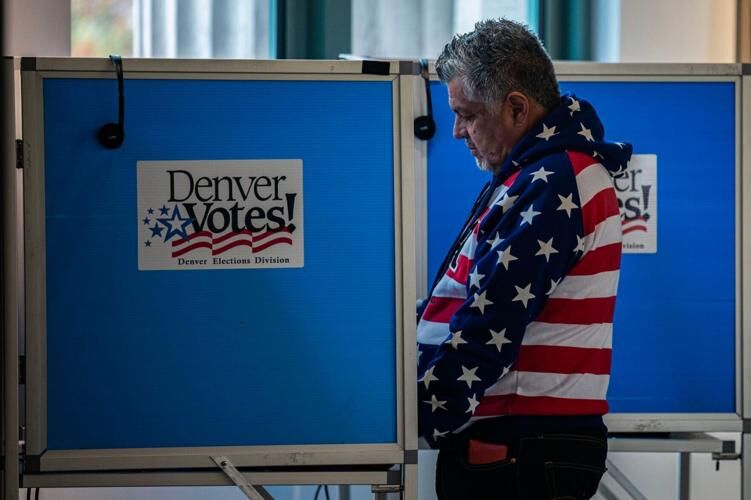
The city of Denver, along with several groups, sued the Trump administration Thursday, seeking to block U.S. Immigration and Customs Enforcement officers who are armed from polling sites during the upcoming midterm elections. In fact, there are no official orders...
Federal judge takes no action against ICE in Colorado after hearing about mistakes, not ‘blatant violations’
Michael Karlik
michael.karlik@coloradopolitics.com
Updated 20 hours ago
A federal judge declined to take action against U.S. Immigration and Customs Enforcement on Thursday after hearing that a pattern of alleged lawbreaking amounted to mistakes and a misunderstanding of the government’s position in court. For nearly a year, Colorado’s...
Colorado doctors, dentists challenge state law on gender‑transition services in new federal lawsuit
Marissa Ventrelli
marissa.ventrelli@coloradopolitics.com
Updated 17 hours ago
A group of Christian doctors and dentists has filed a federal lawsuit challenging a Colorado law they say requires them to provide gender‑transition services that conflict with their religious and ethical beliefs. The lawsuit, filed by the Christian Medical and...
Federal judge directs plaintiff to revise complaint alleging Denver officers’ constitutional violations
Michael Karlik
michael.karlik@coloradopolitics.com
Updated 20 hours ago
A federal judge directed a plaintiff to revise his allegations on Wednesday to more precisely state what two Denver officers and the city itself allegedly did to violate his constitutional rights by facilitating his prosecution for murder until prosecutors dropped...
Lawsuit challenges Douglas County commissioners’ ballot actions
Nicholas Fogleman
nicholas.fogleman@denvergazette.com
Updated 3 days ago
A new lawsuit against Douglas County commissioners seeks to invalidate the board’s intervention in efforts to expand the commission from three members to five and restore the original ballot language approved by more than 20,000 petition signers. The suit marks...
Federal judge explores new sanctions against ex-Colorado judicial discipline director
Michael Karlik
michael.karlik@coloradopolitics.com
Updated 22 hours ago
A federal judge on Wednesday directed Colorado’s former judicial discipline director, for the third time this year, to explain why she should not sanction him for his latest conduct in his litigation against the state’s judiciary. Christopher S.P. Gregory, who served...
PREV
PREVIOUS
Trump-supporting attorney Lin Wood disbarred in Colorado's federal trial court
Colorado’s federal trial court on Thursday disbarred an attorney who spoke favorably about the Jan. 6, 2021 attack on the U.S. Capitol, called for former Vice President Mike Pence to be subjected to firing squads and claimed he had evidence of fraud in the 2020 presidential election. The penalty imposed on L. Lin Wood was based […]

Colorado's Doug Lamborn celebrates defense bill, pans lawmakers for 'tilting at windmills' | TRAIL MIX
This week’s lopsided, bipartisan vote passing the 2024 National Defense Authorization Act in the House of Representatives caps a series of wins for U.S. Rep. Doug Lamborn. The Colorado Springs Republican, who chairs a key subcommittee on the House Armed Services Committee, claims more than 50 provisions in the massive, $886 billion defense bill, known […]