

Location, location, location | BIDLACK
Did you ever wonder why so much of the space program is based in Houston, Texas? Well, back in the Apollo days, the folks at the actual launch site in the Kennedy Space Center at Cape Canaveral controlled the launch of spacecraft until the launching rocket cleared the launch tower. At that point, Houston took over and controlled the rest of the mission, all the way to splashdown in the ocean. Heck, you likely recall one of the most famous phrases ever radioed back to Earth invoked the Texas city, “Houston, we have a problem.” Of course, that’s not what the astronauts actually said. Instead, they actually said “Houston, we’ve had a problem here,” which wasn’t quite as cool sounding as the makers of the movie Apollo 13 wanted, so they tightened up the phrasing a bit. Oh, and Gene Kranz, the legendary flight director never said that “failure is not an option.”
But in any case, why Houston? Wouldn’t it have made a lot more sense to just put all that control center stuff at the Cape, right next to where they launch from? Yet, for some reason, the massive bureaucracy that was and is the space flight center ended up in Houston. How come?
Three letters: L – B – J.
First vice president and later President Lyndon Johnson was from Texas, and he wanted lots of governmental infrastructure to be in Texas, with all the economic benefits that come with huge payrolls and lots of construction. He has massive influence and directed as much as he possibly could to his home state.
Which, of course, brings me to the recent Colorado Politics story regarding a few Space Force units moving from Colorado to Florida. Oh, and I’m still not used to typing the words “Space Force.” I first typed Air Force, and then had to correct it. Forgive me, but after 25-plus years wearing Air Force blue, I’m still getting used to this silly new military designation that a certain former president forced through, much like he tried to force the entire Space Force command structure to move to Alabama a couple of days before he left office, but I digress a bit.
Stay up to speed: Sign-up for daily opinion in your inbox Monday-Friday
It seems Ron DeSantis is crowing about four relatively small Space Force units moving from Colorado Springs to Florida. Not to be outdone, local congressman Doug Lamborn (who whipped my backside in the 2008 election) announced four other Space Force units will stay here in Colorado, at Peterson Space Force Base and Schriever Air Force Base. I admittedly know nothing of the reasoning behind each particular unit’s basing decisions, but this does follow a pattern over the past couple hundred years or so, of at least some military units being placed where powerful elected officials would like them, rather than where they should be based on a military need.
A while back, if you are old enough, you may recall the Air Force was trying to figure out where to base the new high-speed B-1A bomber. If you’ve been to an Air Force Academy football game, you may well have seen a B-1A flyover as part of the pregame festivities. While some argue about the B1-A’s military utility, it is a heck of a flyover aircraft, as it is unbelievably loud, but I digress…
When the basing decisions on the B1-A were announced, to the surprise of many, one of the very few locations to house the bomber was Dyess Air Force Base in, well, Texas, just outside of Abilene. Now, you might ask why that’s odd, and I can’t talk about all the factors, but just ask yourself, whom we might want to deter with a threat of bombers. And what’s the quickest way there?
Think globes and not flat maps.
North, right? So, some of the bombers ended up in South Dakota and others in Texas. Therefore, the first thousand miles or so that a Texas-based B1-A would fly (and refuel over) would be the U.S. mainland. Makes little sense, right? Why not base them all as far north as possible?
Well, enter another very powerful Texan, then-Sen. John Tower. He wanted the bombers (and all the associated spending) in Texas, and he got what he wanted.
I mention all this because, in addition to the units DeSantis and Lamborn are arguing about, we still are awaiting a final ruling on the lame duck Trump order to move the massive Space Force HQ from its current (and paid for) home in Colorado to Alabama: blue state to reddest of the red states. This move would cost a couple-of-a-billion or so.
Not surprisingly, this issue has united the Colorado elected, with everyone arguing it makes no sense to move from the existing (and did I mention paid for?) location on Peterson SFB. No sense, until you allow rank political goals to kick in.
Aerospace is a huge business in Colorado, but it is alsoa big deal in Alabama and Florida. And, frankly, one of the measures that voters use when deciding whom to vote for has often been about what the elected person seems to have done for the folks back home. Heck, my brother-in-law, an officer and Navy SEAL, spent his last SEAL assignment in Tennessee. Yup, there is a naval unit located in a state which, as I recall, has very limited access to the oceans of the world. But Tennessee did have Al Gore, who as a senator (and with the help of others) urged the Navy to locate this unit and others in The Volunteer State.
I don’t know what the final outcome will be of any of these ongoing basing decisions, but I would hope that they would depend more on military need and military requirements than on rank political power.
That’s not going to happen, of course, but it would be refreshing.
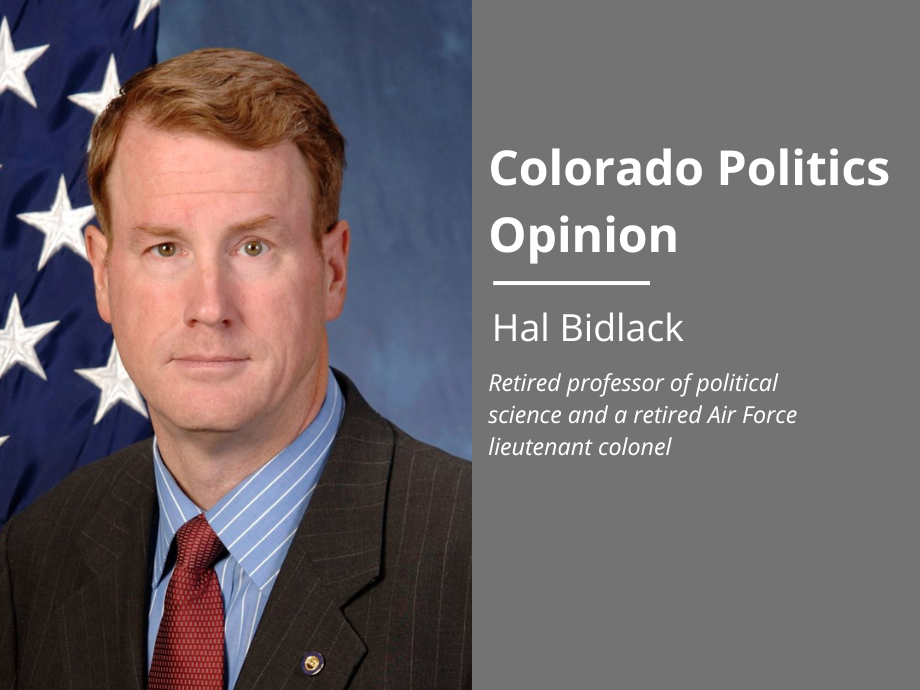
Hal Bidlack is a retired professor of political science and a retired Air Force lieutenant colonel who taught more than 17 years at the U.S. Air Force Academy in Colorado Springs.

Set appropriate state guidelines for critical surveillance technology | OPINION
Colorado Politics
colorado-politics@coloradopolitics.com
Updated 19 hours ago
I admit it: I’m worried. I’m hearing a lot about surveillance in the public arena. I hear cameras are capturing my car’s license plate wherever I drive, my face as I go in and out of stores and health facilities,...

Puppy trafficking bill promotes inhumane breeding | OPINION
Colorado Politics
colorado-politics@coloradopolitics.com
Updated 18 hours ago
By Patti Strand When Justice Thurgood Marshall wrote “The Constitution does not prohibit legislatures from enacting stupid laws,” he wasn’t wrong. He was referring to a political process sometimes ill-equipped to deal with complex issues that require subject-matter knowledge and a...
Penny wise but foolish by pounds | Paula Noonan
Paula Noonan
paula-noonan@coloradopolitics.com
Updated 1 day ago
Leadership of Colorado’s General Assembly introduced the Fiscal Year 2026-2027 Legislative Appropriation bill, HB26-1333, at $75.72 million. That will be the budget to run the state legislature next year. About $74 million comes out of the general fund and the...

Proposed evictions bill fails to improve housing stability while threatening higher rents | OPINION
Colorado Politics
colorado-politics@coloradopolitics.com
Updated 2 days ago
No landlord wants to evict a tenant for non-payment of rent. That is true for large housing providers, small “mom-and-pop” owners and nonprofit housing rental providers alike. Evictions are financially and emotionally costly for everyone involved. But when rent goes unpaid, eviction...

Prevention works — invest in conflict prevention with wolves | FEEDBACK
Colorado Politics
colorado-politics@coloradopolitics.com
Updated 1 day ago
The recent reporting on Colorado’s wolf depredation payouts exceeding $700,000 highlights a critical problem with the current approach to wolf recovery: current mainstream systems focus on compensation and ineffective reactive non-lethals. These systems are not designed to prevent conflict but attempts...
Colorado’s clean-energy future must be affordable for older adults | PODIUM
Colorado Politics
colorado-politics@coloradopolitics.com
Updated 1 day ago
By Jason DeaBueno Last winter, one of the older adults we serve at Silver Key shared something that has stayed with me. She begun turning her heat down at night — not because she wanted to, but because she was...
Why Denver should care about conservation easements — even if you’ve never set foot on a ranch | OPINION
Colorado Politics
colorado-politics@coloradopolitics.com
Updated 2 days ago
By Jason Swann I live in Denver. I drink tap water from my kitchen sink, hike close to home when I can, worry about wildfire smoke every summer, and try, like many families, to keep up with the rising cost...

Could it be the end of hunting as we’ve always known it in Colorado? | FEEDBACK
Colorado Politics
colorado-politics@coloradopolitics.com
Updated 2 days ago
By Eric Washburn Recently, the Colorado Parks and Wildlife (CPW) Commission voted to ban the commercial sale of fur and reject CPW’s proposed daily bag limits of 15 per day per person (450 per person per month!!) for harvesting 17...
Want to talk to the Colorado legislature? Be nice | Hal Bidlack
Hal Bidlack
hal-bidlack@coloradopolitics.com
Updated 4 days ago
As I peruse Colorado Politics each week, in search of a topic upon which I can wax philosophic, I sometimes come across stories that seem, frankly, to be quite dull or even unimportant upon first glance. But when I dig...

Constituents still message DC — but are our reps even listening? | Miller Hudson
Miller Hudson
miller-hudson@coloradopolitics.com
Updated 1 day ago
Each time I visit the nation’s capital, it feels a bit like a homecoming — not that I would ever wish to return as a resident. Yet, I did grow up outside the city in Montgomery County, Maryland from 1956...
PREV
PREVIOUS

Time to repeal Section 232 tariffs | OPINION
Byron Pelton However you may choose to look at them, tariffs are a damaging economic tool, one of the most misguided economic policies a free economy can pursue. Tariffs are a tax, one that hinders free trade, distorts markets and ultimately artificially increases costs for consumers. The argument for the imposition of tariffs is often […]

Charge 'er up — and bill Colorado ratepayers | Colorado Springs Gazette
Hard-pressed Colorado ratepayers won’t be the only ones who get the shaft under a proposal by the state’s largest utility to stick them with the $140 million tab for a new network of electric-vehicle charging stations. The EVs’ owners will get shortchanged, too. As reported this week by The Gazette, a national coalition of consumers […]