

Constituents still message DC — but are our reps even listening? | Miller Hudson
Each time I visit the nation’s capital, it feels a bit like a homecoming — not that I would ever wish to return as a resident. Yet, I did grow up outside the city in Montgomery County, Maryland from 1956 to 1972. Though I visited regularly during the 1980s and 1990s on business, I’ve only dropped in twice since COVID, once last year for a classmate’s 80th birthday party in Annapolis and then again last week. Washington has always been an arrogant metropolis, convinced Americans wake each morning to turn their eyes toward our federal district on the Potomac. The truth is a majority of voters can’t name their member of Congress indicating months must fly by without a thought regarding what’s happening in Washington.
It is easy, however, to witness the riches which have enhanced both the city and its suburbs. A handful of the District’s surrounding counties in Maryland and Virginia are among the 10 wealthiest in the nation. Money is literally sloshing through the streets and across the bandit office parks hugging the beltway that surrounds the District of Columbia. Lobbyists number in the tens of thousands and virtually every interest group in the country, from professional associations to non-profit confederacies are headquartered there — each with their dippers at the ready to capture dollars running from federal troughs. Throw in the military contractors, tech junkies and health care pirates and you have a town that smells of money. This largesse has even produced the most prosperous African-American county in the nation, Prince George’s, Maryland. Its county executive is now U.S. Sen. Angela Alsobrooks.
There is a lot of history captured in Montgomery County’s road names. My favorite is Muncaster Mill Road, now four-laned in parts. We stayed at a hotel in the old Navy Yard neighborhood of southeast Washington abutting the Anacostia River, once an open sewer and now a riverfront park. It was just one block from the U. S. Department of Transportation and a subway stop from The Departments of Housing and Energy in one direction and another stop to the Rayburn House Office building the other direction. Returning clusters of well-dressed petitioners could be overheard at the lobby bar expressing concerns, “I don’t think they’re even listening to anyone.” Whether this opprobrium was directed at bureaucrats or legislators wasn’t always clear. It appears to be a tough time to be lobbying an increasingly ideologically rigid Washington.
In both the Senate and House Office buildings swarms of constituents, often shepherded by lobbyists, crowded the hallways. It was not uncommon to see visitors lined up six and eight groups deep, awaiting the opportunity to enter an office. Staff confirmed since COVID restrictions lifted, the sheer volume of visitation has required scheduling. Just “dropping in” to see your member is a fool’s errand. Emails pour across the internet in such volumes that, although each message receives a warm acknowledgement, they go largely unread now and are merely scored as “for or against” whatever the issue or pending bill. Postcard campaigns, which were similarly tallied, have become a thing of the past.
Visiting Union Station and traveling on the subway, I noticed national guard troops wearing flak vests and carrying sidearms wandering in apparent boredom. Whether stations are safer was hard to tell, but they seemed swept clean of beggars and the unhoused. Uber drivers arrived promptly but with minimal English skills. In one instance, our driver asked us to type our desired destination into his cellphone since meaningful communication attempts were failing. Nonetheless, with the help of GPS, these seemed good jobs for freshly minted Americans. Security was surprisingly lax despite the fact we started bombing Iran just 72 hours earlier. A National Guard officer ruefully explained, “Don’t worry, we’ll tighten things up after our first terrorist incident.” That was dubiously comforting.
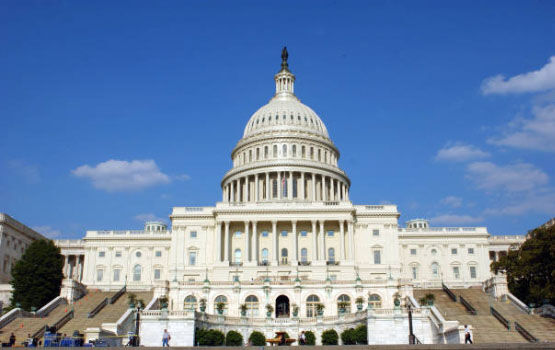
The U.S. Capitol is shown in Washington, DC.
Much of last week, squads of American Legion and VFW members were plumping for improved veteran services. They clogged the House and Senate cafeterias. Although the plaque recognizing the Jan. 6, 2021 heroics of the Capitol police had finally been mounted by Senate leaders without fanfare the previous weekend, I was surprised to find a duplicate previously mounted on the wall next to the entrance of U.S. Rep. Jason Crow’s office. One of a few heroes among members, Crow escorted several colleagues out of the House chambers to safety during the riot. Members can apparently place as many flags as they choose at the doorways to their offices, including tribal, municipal and state banners. Most surprising, perhaps, was a “trans” flag outside U.S. Sen. John Hickenlooper’s door.
At a time when affordability has percolated to the top of the congressional conversation, it is encouraging to see how many Americans can afford to make the trip to call on their members. Easier, of course, for Atlantic states. Colorado offices, however, were busy as well. When you noticed cowboy hats, you knew their owners weren’t from Massachusetts. Though the ambience felt somewhat imperfect, it was encouraging so many citizen advocates were willing to carry their opinions to Washington and Colorado’s delegations so willing to hear them out. Does any of this make a difference? Probably, certainly at the margins. Democracy is often messy, but it still feels better than the alternatives.
Miller Hudson is a public affairs consultant and a former Colorado legislator.


We must deliver on cost of living | GUEST COLUMN
Colorado Politics
colorado-politics@coloradopolitics.com
Updated 3 hours ago
By Ryan Gonzalez Insurance premiums are on the rise. Property taxes are increasing. Groceries are becoming more expensive. Gas prices are reaching record levels. Housing costs are becoming unsustainable. These are the concerns I hear from people in my district....

Counties warn CPW that new comment limits sideline local governments
Marianne Goodland
marianne.goodland@coloradopolitics.com
Updated 9 hours ago
The September meeting of the Colorado Parks and Wildlife Commission will feature newly revised public‑comment rules — changes introduced by chair Jay Tutchton of Bent County, who announced them without first discussing the revisions publicly with the rest of the...

Controversial two-bag furbearer limit heads to CPW meeting under legal threat
Marianne Goodland
marianne.goodland@coloradopolitics.com
Updated 9 hours ago
Next week’s Colorado Parks and Wildlife Commission meeting in La Junta is likely to open under the cloud of threatened legal action. Safari Club International and the Sportsmen’s Alliance Foundation warned the commission this month that its July vote imposing...

Dan Haley on the role of oil and gas in Colorado’s energy future | The OpEdge Podcast
Tony Olivero
tony.olivero@gazette.com
Updated 12 hours ago
Dan Haley, executive director of Coloradans for Responsible Energy Development, joins The OpEdge to discuss the role of oil and natural gas in Colorado’s energy future amid the state’s aggressive push toward “net zero.” Haley tells host and investigative columnist...

Rural hospitals don’t want special treatment, just a chance to care for locals | PODIUM
Colorado Politics
colorado-politics@coloradopolitics.com
Updated 1 day ago
By Kevin Stansbury As chief executive of Lincoln Health, my responsibility is simple: ensure the people of eastern Colorado have access to high-quality healthcare close to home when they need it most. That mission has never been easy. Rural hospitals...
Colorado lawmaker, House leaders named in workplace-retaliation lawsuit
Marianne Goodland
marianne.goodland@coloradopolitics.com
Updated 2 days ago
A former legislative aide has filed a lawsuit alleging she was mistreated, illegally directed to perform campaign work and harmed by a House leadership structure she charged was fragmented, politicized and ineffective at protecting employees. The lawsuit, filed by Jennifer...
Blue states should avoid disasters | Hal Bidlack
Hal Bidlack
hal-bidlack@coloradopolitics.com
Updated 2 days ago
Back when I was teaching political science at the U.S. Air Force Academy (and amazingly to me, a week from this column’s publication will mark 20 years since my retirement from active duty. Where the heck did that time go?)...
Right-to-hunt ballot measure’s a cruel, anti-wildlife solution to a nonexistent problem | GUEST COLUMN
Colorado Politics
colorado-politics@coloradopolitics.com
Updated 2 days ago
By Eric Washburn I love to hunt. Every year I try to hunt big game in Colorado and waterfowl in Louisiana. This year, I applied for five Colorado big game licenses — elk, deer, pronghorn, moose and bighorn sheep. I...

Jena Griswold’s record: corruption, incompetence | Dick Wadhams
Dick Wadhams
dick-wadhams@coloradopolitics.com
Updated 5 days ago
There is no statewide elected official going back decades who is as breathtakingly corrupt and incompetent as Secretary of State Jena Griswold, who is now running for attorney general of all things. And compliant ruling Democrats know it. Their silence...

Kiros exudes why Colorado’s political times are a-changin’ at annual Denver Dems gala | Miller Hudson
Miller Hudson
miller-hudson@coloradopolitics.com
Updated 5 days ago
Among Colorado’s few remaining bipartisan rituals are county and state party dinners. I was particularly intrigued by last week’s Denver Democratic Party’s 2026 Annual Gala, a “New Deal for a New Era.” Their glossy program featured an artist’s Technicolor rendering...
PREV
PREVIOUS

Access to earned wages increases retention, attendance, morale | OPINION
By Diane Macheers Every payday, I’m reminded how much trust our team members place in us. They work hard, show up for our residents, and do everything they can to support themselves and their families. As an employer, we believe our responsibility goes beyond a paycheck — we should also provide tools that help our […]

Want to talk to the Colorado legislature? Be nice | Hal Bidlack
As I peruse Colorado Politics each week, in search of a topic upon which I can wax philosophic, I sometimes come across stories that seem, frankly, to be quite dull or even unimportant upon first glance. But when I dig a bit deeper, sometimes things appear more significant than at first glance. Such is the […]