

Proposed water rule that could limit annexations moves forward

A proposed water-supply rule that could block properties from annexing into the city of Colorado Springs took a step forward Monday, with staff recommending against an alternative proposed by a developer.
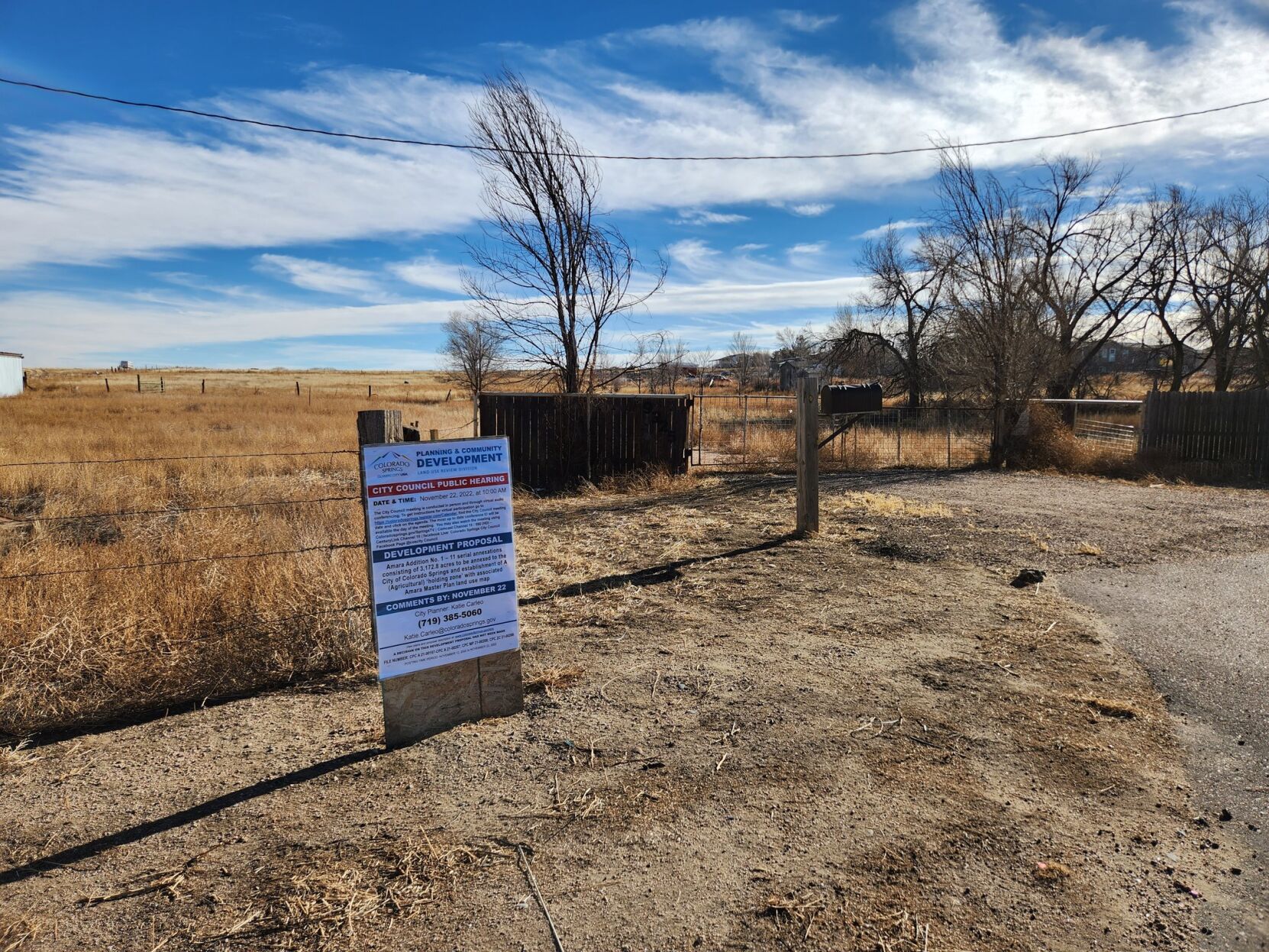
The draft rule requires Utilities to have 130% of the water required to serve existing city demand and the proposed future demand of a property wishing to annex, a rule that could block a 3,200-acre parcel east of Fountain from coming into the city.
Colorado Springs hearing on Amara annexation pushed back
La Plata Communities, the company proposing the 3,200-acre annexation known as Amara, suggested an alternative rule last month that would have applied a water supply standard further along in the development process.
Abby Ortega, Utilities’ water resources manager, said applying a water supply rule after properties have been added to the city and before homes are built could lead to infrastructure problems. For example, if a developer ultimately wants to build 1,500 homes but Utilities only has water for 200, the pipeline built out to those homes could be larger than needed. A small amount of water in a large pipeline can lead to water quality issues, she said.
If the city does not have the water to serve homes after they are annexed, developers may then seek to leave city limits, she said.
“You have got a lot of risks on both the developer and the city,” Ortega said of the proposal to apply water rules after annexation.
Utilities board members, who are also members of City Council, raised other questions about the water rule, including whether the underlying metrics used to determine the 130% supply will change in the new year with new data.
Residents raise drought concerns at meeting on annexation southeast of Colorado Springs
The staff is recommending using a five-year average to determine current city water demand, about 72,000 acre-feet of water, and that average is not expected to change, Ortega said. An acre-foot of water can cover an acre under a foot of water. Utilities staff also estimate they could provide 95,000-acre-feet of water annually, which provides a buffer for dry years and accommodates growth.
However, Ortega said while Utilities has been modeling for climate change and changes to water management along the Colorado River, those changes to water supply are happening quicker than anticipated. Colorado Springs relies on the Colorado River for about 70% of its water.
Councilman Dave Donelson asked if other communities along the Front Range are applying a similar water supply rule. Ortega said similar communities, such as Aurora, are getting more risk averse but they haven’t applied a similar 130% standard.
Kevin Walker, a Housing and Building Association of Colorado Springs representative, said his group is expected to come down in favor of a water supply standard, but proposed lowering the standard to 128%. He also asked for a more thorough discussion of how numbers are calculated.
At the lower standard, Amara still would not meet the threshold for annexation, Utilities staff said.
Fountain says it would welcome Amara, but developers say it couldn’t be done
La Plata Communities Chief Operating Officer Mike Ruebenson asked the board to consider grandfathering in Amara, a community expected to have 9,500 homes, and not applying the new water standard to the property. He also asked the board to consider the project a unique or extraordinary circumstance given the city’s need for additional housing. The board would consider those arguments when it considers the annexation petition for the property, Utilities Board Chairman Wayne Williams said.
The City Council could vote on the water rule at meetings on Jan. 10 and Jan. 24.
“We are continuing to receive input. We welcome that,” Williams said.




Trends and challenges in higher education | Tom Cronin
Tom Cronin
tom-cronin@coloradopolitics.com
Updated 1 day ago
Americans are both proud and critical of our higher educational system. More American universities are highly ranked than those in other countries. More international students come here than to any other country. And basic research at U.S. universities has earned more patents and Nobel Prizes than elsewhere. ...

White House withdraws hospitality executive as National Park Service nominee | OUT WEST ROUNDUP
The Associated Press
the-associated-press@coloradopolitics.com
Updated 6 days ago
MONTANA National parks nominee withdrawn BILLINGS — President Donald Trump is withdrawing his nomination of a hospitality company executive to lead the National Park Service, the White House announced on April 27. The withdrawal of nominee Scott Socha comes as...

Ron Hanks, Scott Bottoms sue to stop Colorado’s unaffiliated voters from participating in GOP primary
Ernest Luning
ernest.luning@coloradopolitics.com
Updated 23 hours ago
Three Republican candidates in Colorado filed a lawsuit in Denver District Court this week seeking to prevent unaffiliated voters from participating in next month’s GOP primary, arguing that the state’s semi-open primary system violates their constitutional rights by forcing Republicans...

Colorado needs a sane, viable opposition party | SONDERMANN
By Eric Sondermann
by-eric-sondermann@coloradopolitics.com
Updated 5 days ago
If you are upset with the increasing regulatory burden in Colorado, the exodus of too many large employers, accelerating property taxes, the condition of the roads, and all of the funding for transit schemes with low demand, of course, you...

Colorado Politics Calendar May 11-17
Rachael Wright, Special to Colorado Politics
rachael.wright@coloradopolitics.com
Updated 4 days ago
CoPo’s weekly political calendar will help you find political and public-policy events throughout Colorado. It includes candidate and issue campaign events, public policy meetings, court hearings, state and local party conventions, assemblies, debates, rallies, parades, speaking engagements, traveling dignitary appearances,...

NRA carves out early success story battling 1981 Colorado gun legislation | A LOOK BACK
Rachael Wright, Special to Colorado Politics
rachael.wright@coloradopolitics.com
Updated 3 days ago
Forty-Five Years Ago This Week: After House Bill 81-1542, which would have mandated detention for juveniles carrying concealed weapons, cleared the Senate Judiciary Committee, Sen. Paul Powers, R-Denver, said he had received 45 letters per day denouncing the legislation. And...

It’s almost Sine Die and it can’t come soon enough | Capitol M | Week of May 9, 2026
Marianne Goodland
marianne.goodland@coloradopolitics.com
Updated 3 days ago
The lighter side of the state Capitol, usually. At first, May the Fourth might have been a bit of a disappointment. Usually, there’s a lot of Star Wars foolishness on this particular day, but early on, it was low-key. The...

TABOR showdown: Senate moves bill forward, Advance Colorado prepares for legal action
Marianne Goodland
marianne.goodland@coloradopolitics.com
Updated 2 days ago
Despite objections from legislative staff and Republican opposition, Senate Democrats on Friday moved forward with a proposal to reroute $306 million in taxpayer refunds. Already, critics are preparing to sue over the proposal that seeks to take $300 million in Taxpayer’s...

Colorado governor signs $47 billion budget in which ‘nobody won’
Marianne Goodland
marianne.goodland@coloradopolitics.com
Updated 2 days ago
Gov. Jared Polis on Friday officially signed a $46.87 billion spending plan for the Colorado state government in the next fiscal year. His signature is the culmination of months of work by legislators, who resorted to cuts, transfers and other...

Latest Pinnacol proposal shifts sponsors and cuts state benefits, triggers union standoff
Marianne Goodland
marianne.goodland@coloradopolitics.com
Updated 20 hours ago
Colorado’s long‑running bid to let Pinnacol Assurance break away from state control is suddenly in jeopardy, as a newly revised bill — stripped of the payouts and structural changes once central to the deal — has triggered fresh tensions among...
PREV
PREVIOUS

Xcel's natural gas line upgrade in Denver Highlands area can proceed despite objections
The Colorado Public Utilities Commission dismissed objections to a proposed $27 million project to install larger natural gas main lines in Denver’s Highlands neighborhood, giving Xcel Energy permission to install some 8,000 feet of new, 12-inch gas pipe there. Xcel officials proposed the project to address problematic areas of the city where the existing pipelines […]
City council weighs revised ballot question to support open spaces in Colorado Springs
The Colorado Springs City Council reviewed a revised ballot question Monday to extend the sales tax for trails, open space and parks after public calls to ensure enough future money raised by the tax is protected for open space purchases. The revised ballot question to extend a .1% sales tax would set aside a minimum of […]