

10th Circuit rebuffs government for using non-existent rule to deport woman

The federal appeals court based in Denver has rebuked the government for relying on a non-existent rule to proceed with its deportation of a woman from Colorado and for disregarding the U.S. Supreme Court’s recent interpretation of immigration law.
Authorities deported Mayra Veronica Estrada-Cardona in 2020 from Colorado after she spent more than 17 years in the U.S. Although the government may choose not to deport someone who has been in the country continuously for 10 years, immigration authorities believed Estrada-Cardona’s clock had stopped when a judge ordered her deported in 2010 — after approximately seven years in the U.S.
She then filed a petition with the U.S. Court of Appeals for the 10th Circuit, arguing Congress had only outlined two scenarios for halting the accrual of time, and an immigration judge’s order was not one of them.
Last week, a three-judge panel of the 10th Circuit agreed with Estrada-Cardona.
“This petition for review represents the latest chapter in the government’s ongoing efforts to dig itself out of a hole it placed itself in,” Senior Judge Bobby R. Baldock wrote in a sharply-worded Aug. 17 opinion.
The section of immigration law under dispute is known as the “stop-time rule.” The U.S. attorney general has the discretion not to deport someone who has been continuously present for 10 years, but there are specific conditions that can stop the clock. One trigger is if a person commits certain crimes, and the other trigger is when the government serves someone with “a notice to appear.”
A written notice of deportation proceedings requires specific pieces of information. By law, it must specify the nature of the proceedings, the alleged legal violations and, relevant to Estrada-Cardona’s case, the “time and place at which the proceedings will be held.”
In 2018, the Supreme Court handed down an 8-1 decision, declaring notices to appear did not trigger the stop-time rule if they were missing the time and place of deportation proceedings. Estrada-Cardona’s case fell into that category, as her notice only indicated proceedings would take place on “a date to be set” and at “a time to be set.”
Following the ruling, the government began using “parking dates” on notices — setting hearing times at midnight or using dates that did not exist, in an attempt to comply with the ruling. The government also sent out supplemental documentation listing the date and time after the initial notices. Some federal circuit courts deemed the practice acceptable.
Then in April 2021, by a 6-3 decision in Niz-Chavez v. Garland, the Supreme Court determined the supplemental notices were not compliant with the law either.
“If the government finds filling out forms a chore, it has good company,” wrote Justice Neil M. Gorsuch, a former 10th Circuit judge, for the majority. “The world is awash in forms, and rarely do agencies afford individuals the same latitude in completing them that the government seeks for itself today.”
At the time of the Niz-Chavez decision, Estrada-Cardona had already been deported. She had arrived in the United States in July 2002 on a tourist visa and did not leave. In May 2009, police pulled her over for a defective headlight and driving without a license. Shortly afterward, her deportation proceedings began.
Her lawyer allegedly failed to appear, and Estrada-Cardona, representing herself, voluntarily agreed to leave the country in 2010. However, she appealed the immigration judge’s order for departure in a process that lasted until 2013. Although she was unsuccessful, she applied for and received a reprieve from deportation for the next four years.
Following the Supreme Court’s first stop-time decision, Estrada-Cardona argued her defective notice to appear meant that her physical presence in the country had not stopped at seven years upon her initial deportation proceedings. Therefore, she contended she was eligible to have her deportation canceled, having been in the U.S. for longer than 10 years.
The Board of Immigration Appeals denied her request, and authorities deported her shortly afterward.
Following the ruling in Niz-Chavez, Estrada-Cardona again appealed. A three-member Board of Immigration Appeals panel decided that, notwithstanding the Supreme Court’s interpretation of the stop-time rule, her continuous presence in the country ended “when the Immigration Judge issued the final administrative order of removal on Aug. 11, 2010.”
Turning to the 10th Circuit, Estrada-Cardona acknowledged the previous version of the immigration law stopped the clock when there was a final deportation order. But Congress changed the law in 1996 to prevent people from prolonging their proceedings to reach the 10-year threshold.
Allowing the government to claim the old procedure still applied would “be a prime example of judicial overreach to attempt by fiat to add completely different, unwritten categories of events that stop time,” wrote Estrada-Cardona’s lawyers.
The U.S. Department of Justice argued to the 10th Circuit panel in May that Congress could not have intended for inadequate notices to appear to compromise the stop-time rule.
“It seems very unfair,” acknowledged Judge Harris L Hartz. But, he continued, “the Supreme Court’s telling us that’s Congress’ job. That’s not the courts’ job to figure out what’s fair.”
Ultimately, the panel’s opinion made clear the government had only itself to blame for enabling immigrants to remain in the country with its failure to provide notices that comply with the law.
“After years of statutory short-circuiting, the government finds itself in the uncomfortable position of being wrong. To stop the clock, all the government had to do was serve an alien with a statutorily compliant notice to appear,” Baldock wrote.
He added sternly, “Instead of accepting its mistake or focusing its energies on Congress (who might be able to bail it out), the government has chosen to ‘continue down the same old path,’ asking us to ignore the clear statutory text in favor of its preferred interpretation.”
Because the Board of Immigration Appeals relied on a non-existent rule to determine Estrada-Cardona was ineligible to remain in the country, the appellate panel returned the case to the board so that members could consider whether to reopen Estrada-Cardona’s appeal based on the correct understanding of the law.
The case is Estrada-Cardona v. Garland.

Federal judge green-lights civil trial against ex-Fort Collins DUI officer
Michael Karlik
michael.karlik@coloradopolitics.com
Updated 1 day ago
A federal judge ruled on Thursday that Fort Collins’ former “DUI officer” will face a civil trial for allegedly investigating a motorist for impaired driving without any reasonable suspicion to do so. In recent years, several people arrested by Officer...

Colorado Supreme Court suspends Mesa County judge pending misconduct investigation
Michael Karlik
michael.karlik@coloradopolitics.com
Updated 12 hours ago
The Colorado Supreme Court suspended Mesa County Court Judge Michael J. Grattan on Thursday amid a misconduct investigation. The court’s Sept. 10 order gave Grattan 21 days to explain why his paid suspension should not continue through the end of...
Colorado Supreme Court changes course, dismisses case about special district bonds
Michael Karlik
michael.karlik@coloradopolitics.com
Updated 12 hours ago
The Colorado Supreme Court declined on Friday to decide a dispute between a large-scale Commerce City development and the various districts financing it, after initially showing interest in the ongoing case. Colorado has roughly 2,800 special districts, which are local...
10th Circuit tosses GEO Group’s pretrial appeal in human trafficking lawsuit
Michael Karlik
michael.karlik@coloradopolitics.com
Updated 2 days ago
The Denver-based federal appeals court dismissed an attempt by The GEO Group on Wednesday to appeal a trial judge’s non-existent decision two months before the company is scheduled to face a civil trial over alleged trafficking violations at the Aurora...
Denver sues Trump to block armed ICE agents from polling sites
Deborah Grigsby
deborah.smith@denvergazette.com
Updated 2 days ago
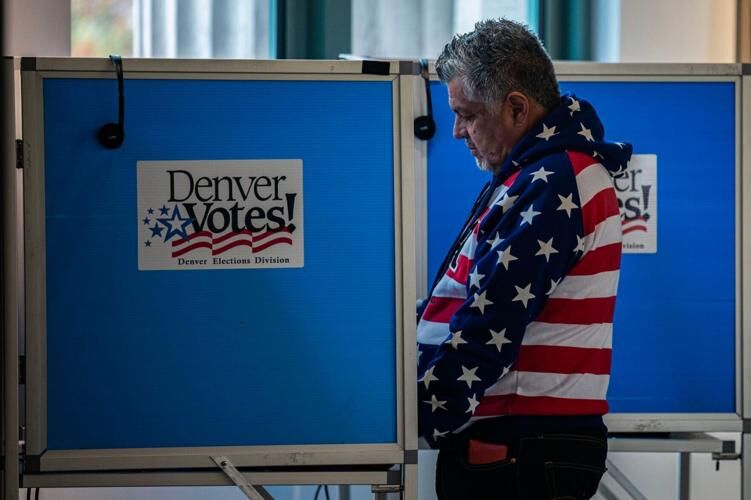
The city of Denver, along with several groups, sued the Trump administration Thursday, seeking to block U.S. Immigration and Customs Enforcement officers who are armed from polling sites during the upcoming midterm elections. In fact, there are no official orders...
Federal judge takes no action against ICE in Colorado after hearing about mistakes, not ‘blatant violations’
Michael Karlik
michael.karlik@coloradopolitics.com
Updated 10 hours ago
A federal judge declined to take action against U.S. Immigration and Customs Enforcement on Thursday after hearing that a pattern of alleged lawbreaking amounted to mistakes and a misunderstanding of the government’s position in court. For nearly a year, Colorado’s...
Colorado doctors, dentists challenge state law on gender‑transition services in new federal lawsuit
Marissa Ventrelli
marissa.ventrelli@coloradopolitics.com
Updated 7 hours ago
A group of Christian doctors and dentists has filed a federal lawsuit challenging a Colorado law they say requires them to provide gender‑transition services that conflict with their religious and ethical beliefs. The lawsuit, filed by the Christian Medical and...
Federal judge directs plaintiff to revise complaint alleging Denver officers’ constitutional violations
Michael Karlik
michael.karlik@coloradopolitics.com
Updated 10 hours ago
A federal judge directed a plaintiff to revise his allegations on Wednesday to more precisely state what two Denver officers and the city itself allegedly did to violate his constitutional rights by facilitating his prosecution for murder until prosecutors dropped...

Lawsuit challenges Douglas County commissioners’ ballot actions
Nicholas Fogleman
nicholas.fogleman@denvergazette.com
Updated 3 days ago
A new lawsuit against Douglas County commissioners seeks to invalidate the board’s intervention in efforts to expand the commission from three members to five and restore the original ballot language approved by more than 20,000 petition signers. The suit marks...
Federal judge explores new sanctions against ex-Colorado judicial discipline director
Michael Karlik
michael.karlik@coloradopolitics.com
Updated 12 hours ago
A federal judge on Wednesday directed Colorado’s former judicial discipline director, for the third time this year, to explain why she should not sanction him for his latest conduct in his litigation against the state’s judiciary. Christopher S.P. Gregory, who served...
PREV
PREVIOUS

Promotional text messages not covered under federal telemarketing law, judge says
A California man may not sue Greenwood Village-based Red Robin under the federal law governing telemarketing and robocalls after he received promotional text messages from the restaurant chain, a federal judge has determined. Although the Telephone Consumer Protection Act places restrictions on the use of random number generators that “store or produce telephone numbers to be […]
Appeals court reverses conviction over La Plata judge's potentially-coercive comments
A La Plata County judge potentially coerced jurors into reaching a guilty verdict after they informed him they were “hung up” and “stuck” on one of the defendant’s criminal charges, prompting the state’s Court of Appeals to reverse the conviction. Although the jury’s description of their problem to District Court Judge Todd P. Norvell was […]