

CRONIN & LOEVY | ‘Out with Iowa; out with New Hampshire’


Tom Cronin and Bob Loevy

We are pleased that the national Democratic Party is discussing shaking up the first four states that vote in the U.S. presidential caucuses and primaries.
Since 2008, Iowa, New Hampshire, Nevada, and South Carolina have enjoyed having a presidential caucuses or primary day to themselves and being the first four states in line to vote. As a result, all four have an advantage in determining who wins the Democratic and Republican presidential nominations.
Brace yourself. The 2024 presidential caucuses and primaries begin in late January and early February of 2024, in just 18 months. Any changes in the caucuses and primary process made by the national Democrats this summer will take effect at that time.
Final decisions have not been made, but there are rumors about what might be done. First, Iowa could be eliminated as the first state to participate, in part because its elaborate presidential caucuses system broke down in January of 2020. The results of the Iowa caucuses were delayed for almost a week, making those results practically worthless.
Another reason to remove Iowa is that its caucuses system greatly limits voter participation in the presidential nomination process when compared with the much greater voter turnout in presidential primaries. Caucuses require voters to attend a three-hour evening meeting, which disadvantages the old, the disabled, people working two jobs, and so forth.
There is talk of adding a fifth state to the opening lineup. Iowa and New Hampshire have been criticized for years for being relatively small in population and lacking racial and ethnic diversity. The new fifth state would be expected to be large in population and have high percentages of African American and Hispanic voters — and some Asian-American voters.
There is speculation about what the national Democrats are going to do with New Hampshire and its famous “First in the Nation” presidential primary. New Hampshire has a famous state law requiring that New Hampshire schedule its presidential primaries (Democratic and Republican) prior to those of any other state. This is merely a state law, but other states have respected it.
The national Democratic party will have to fight hard to knock New Hampshire out of its number one position for presidential primaries. U.S courts, however, have generally sided with national political party rules over state laws. New Hampshire’s small population and lack of diversity make it an obvious target for replacement.
One speculation is that Iowa will be replaced, but New Hampshire, Nevada, and South Carolina will remain in their present positions. The thinking is threefold:
New Hampshire will fight too hard and be too difficult to remove.
Nevada will be kept for its high percentageage of Hispanic voters.
South Carolina will stay because of its high percentage of African American voters.
The state replacing Iowa and the new fifth early primary state will be used to add high population and high percentages of minorities to the start of the presidential nominating process.
The Rules and Bylaws Committee of the Democratic National Committee has been holding hearings in Washington, D.C., to help it choose the new states to be added to the early primary list. Howard Chou, the first vice chair of the Colorado Democratic Party, made a presentation to the committee on behalf of the state of Colorado.
Chou emphasized the racial diversity in Colorado’s three largest cities — Denver, Aurora, and Colorado Springs. Unfortunately for Colorado’s case, the statewide perentage of African Americans is only 5 % whereas the national percentage of African Americans is 12 %. That fact alone will probably disqualify Colorado for an early presidential primary spot in 2024.
We have written about presidential caucuses and primaries and have visited states such as Iowa and New Hampshire and others while presidential caucuses and primaries were taking place.
It is our observation that states with small populations like Iowa and New Hampshire tend to advance the candidacies of relatively unknown and fringe candidates. They have often advantaged candidates to the far left or far right of their political party’s mainstream.
One example is Paul Tsongas, a little-known U.S. Senator from neighboring Massachusetts, who won the New Hampshire presidential primary in 1992. He was eventually defeated by Bill Clinton, who went on to win the presidency.
A second example is Howard Dean, a relatively unknown governor of Vermont. He won the 2004 New Hampshire primary but lost the Democratic nomination for president to John Kerry, a U.S. Senator from Massachusetts. Kerry then lost the general election to George W. Bush.
Well-known presidential candidates, such as some governors of populous states or important U.S. senators, tend to be moderate and mainstream in their politics. They also tend to do best when the states with large and diverse populations are voting in the presidential primaries.
Our recommendation is that the national Democrats remove Iowa from the early presidential primaries list and replace it with a large and diverse state such as Illinois, Michigan, or New Jersey.
We also recommend New Hampshire be dropped from the early presidential primaries and be replaced with one of the populous and diverse states listed above. It will be hard to remove New Hampshire, yet it should be done.
Reform is badly needed where the order of the presidential primaries and caucuses is concerned. It would be progress if all the national Democrats did was to drop Iowa, add a diverse and populous state in its place, and then add a fifth early primary state with similar populous and diverse characteristics.
And, if possible, they should go even further and replace New Hampshire with a diverse and populous state as well.
The Rules and Bylaws Committee will make its final decisions by this Aug. 5 and 6. The entire Rules Committee will adopt the final presidential primaries and caucuses rules changes in early September.
These are important reforms in an area that badly needs reforming. We will keep a close watch for you.
To sum up. Out with Iowa; out with New Hampshire; add a fifth early primary state; keep Nevada (Hispanic voters) and South Carolina (African American voters). The three new early primary states should be diverse and populous.
Tom Cronin and Bob Loevy write about Colorado and national politics.


Colorado Democrats, your time is coming | Jon Caldara
Jon Caldara
jon-caldara@coloradopolitics.com
Updated 14 hours ago
Hey, Colorado Democrats! All the fun you’ve had watching Republican dysfunction in Colorado for the last 20 years was just a preview of what is about to happen to you. The Colorado Republican Party no longer exists as a competitive...
The relevance of Watergate more than a half-century later | SONDERMANN
By Eric Sondermann
by-eric-sondermann@coloradopolitics.com
Updated 4 days ago
It was the scandal for which all other scandals are now named. In June 1972, a small group of Cuban burglars with high-level connections broke into the headquarters of the Democratic National Committee. Those headquarters were located in the Watergate...
Colorado must continue finding common ground on wildfire policy | GUEST COLUMN
Colorado Politics
colorado-politics@coloradopolitics.com
Updated 2 days ago
By John Herrick Colorado has never lacked for opinions about wildfire policy. We debate forest management, climate change, prescribed burns, land use, air quality and budgets. Those debates are familiar territory, but a new discussion is beginning to happen around...

Proposition NN is the best investment for Colorado’s students and schools | GUEST COLUMN
Colorado Politics
colorado-politics@coloradopolitics.com
Updated 2 days ago
By Justin Ogden Colorado families know what it means to make difficult budget decisions. Inflation has driven up the cost of groceries, housing, utilities and just about everything else. Families like mine work hard to stretch every dollar while still...
Were the primaries a preview for consequential general election? | Paula Noonan
Paula Noonan
paula-noonan@coloradopolitics.com
Updated 3 days ago
Colorado’s political future will go the way of this election. Historically, the state has not had both chambers controlled by a supermajority. This election may change that. The primaries suggest how the general election may play out. Democrats had solid...
Disagreement doesn’t have to mean disrespect | GUEST COLUMN
Colorado Politics
colorado-politics@coloradopolitics.com
Updated 3 days ago
By Vincent Atchity These days, it doesn’t take long to feel overwhelmed by politics. Turn on the news, scroll through social media or read the comments on almost any political post and you’ll find anger, outrage and personal attacks. For...

Keeping Colorado’s kids’ trust online | PODIUM
Colorado Politics
colorado-politics@coloradopolitics.com
Updated 4 days ago
By Stuart Jenkins Almost every day, the kids and teens we serve across Colorado are introduced to new generative artificial intelligence and other emerging technology, including conversational AI systems designed to simulate human conversation. These tools are no longer a...
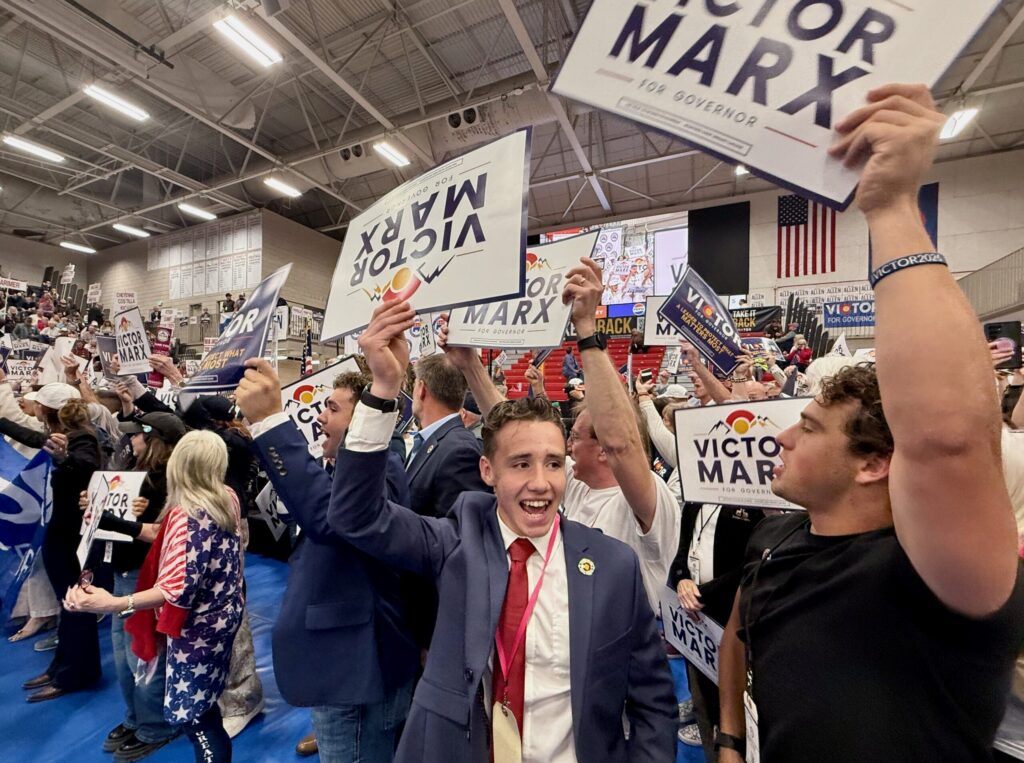
Marx’s ‘through line’ predates Trump, connects to Maes | FEEDBACK
Colorado Politics
colorado-politics@coloradopolitics.com
Updated 4 days ago
Eric Sondermann is of course correct Victor Marx is an unserious, unelectable, embarrassing Republican nominee for governor of Colorado. But I respectfully submit that the “through line,” as Mr. Sondermann describes it, is not from Trump to Marx, despite their...

Cedric Pride’s blueprint for opportunity through the trades | The OpEdge Podcast
Tony Olivero
tony.olivero@gazette.com
Updated 5 days ago
Cedric Pride, CEO of the nonprofit Pride Initiative in Denver, joins The OpEdge with a blueprint for workforce development, skilled trades, and economic opportunity. Pride tells host and investigative columnist Jimmy Sengenberger why he believes the trades offer a path...
Colorado’s No. 1 education ranking should raise our ambition | GUEST COLUMN
Colorado Politics
colorado-politics@coloradopolitics.com
Updated 5 days ago
By Scott Laband Colorado has earned the right to celebrate its new No. 1 ranking in education from U.S. News & World Report. Gov. Jared Polis called it “one of the proudest moments” of his time in office and shared the...
PREV
PREVIOUS
NOONAN | Refinery gets a pass on its pollution
Paula Noonan Suncor Refinery is seeking to renew EPA permits to pollute from Colorado’s Air Pollution Control Division (APCD) for its three plants in Commerce City. Suncor purchased the entire facility in two chunks in 2003 and 2005. The three plants are now under Suncor’s single ownership. This is important. The APCD has allowed Suncor […]

SLOAN | A shift in thinking on mental illness
Kelly Sloan Whatever register it is that tabulates the accumulation of social ills that plague modern society is filling up quickly, and with it the temptation to find answers for their solution. But that temptation does not, generally, run very deep, couched in the contemporary vernacular that limits such thoughts to whatever can be neatly […]