Colorado must continue finding common ground on wildfire policy | GUEST COLUMN

By John Herrick
Colorado has never lacked for opinions about wildfire policy. We debate forest management, climate change, prescribed burns, land use, air quality and budgets. Those debates are familiar territory, but a new discussion is beginning to happen around the use of chemical retardant in aerial firefighting.
Before I became an attorney and served as chief counsel for the Department of Energy overseeing the National Renewable Energy Laboratory, I spent my summers with an elite United States Forest Service “Hot Shot” crew. I fought remote fires across rugged country with little more than a pack, a Pulaski and the expectation our crew would stop a small fire before it became tomorrow’s headline.
From my days spent on the ground fighting those fires, I can tell you when a wildfire first ignites, our first instinct from the air should be to attack it aggressively with water whenever conditions allow. That may sound obvious, but in practice, it represents an important shift in how we think about protecting both our communities and our environment.
Fire retardants have an important place in wildfire suppression. They have undoubtedly protected lives and property in countless situations, but they are not magic and they are not without costs. As a young firefighter, I vividly remember working through fresh retardant drops. The red slurry coated everything, including trees, rocks, our equipment, our clothing, and even our skin. It itched severely, and you often had to sleep in it. At night, the slurry turned steep slopes into slick, muddy hazards that made footing uncertain. Digging line became much harder, visibility was reduced and the chemicals clung to everything they touched. It was messy work and sometimes it complicated the very operations we were trying to carry out.
Even more important, we understood retardant was something to use thoughtfully, not casually. You didn’t want it washing into streams or sensitive watersheds if there was another effective option. Today, we know even more.
Many fire retardants contain compounds that can introduce metals and chemicals into the environment. Federal and state agencies have long recognized the need to avoid waterways whenever possible because of the potential effects on aquatic ecosystems and drinking water sources, but it’s pretty obvious that, once it rains, the retardant ends up in our waterways no matter what.
Colorado depends on its watersheds. They provide drinking water to millions of people, sustain agriculture, power recreation and fuel our economy. Protecting those waters should be part of our wildfire strategy, not an afterthought. Fortunately, technology is giving us better choices.
Modern amphibious aircraft can repeatedly scoop or refill with plain water and place it with remarkable precision during the earliest stages of a fire. Water cools fuel loads immediately, and it suppresses flames without leaving behind chemical residues that can migrate into streams, reservoirs or municipal water systems.
Most importantly, rapid water-based initial attack often keeps a fire small enough we never need to escalate to larger, more environmentally disruptive suppression efforts. That is where Colorado has an opportunity.
I’m encouraged to see a growing consensus emerging among firefighters, policymakers, local communities, water managers and conservation advocates. We don’t need to eliminate retardant, as there will always be situations where it remains an essential tool, particularly when protecting lives and communities under extreme conditions. We just need to make water the first choice whenever operationally feasible, especially during initial attack and direct attack, when fires are still small enough to be contained.
As a concerned Democrat, I believe government works best when it invests in practical solutions rooted in science and experience rather than ideology. This is one of those moments. Colorado’s legislature should continue building on this growing consensus by prioritizing investments in aerial water-based suppression capabilities, expanding rapid-response aviation resources and ensuring our firefighting agencies have the aircraft and infrastructure necessary to deliver an aggressive initial attack where it can make the greatest difference.
I learned these lessons fighting forest fires decades ago in national forests, but they remain just as true today. Colorado has the opportunity to lead the nation with a wildfire-fighting strategy that protects our forests, our communities and our water. Our state legislature must act and codify its commitment to that strategy.
John Herrick is an attorney and a graduate of the University of North Dakota School of Law and served as chief counsel for the Department of Energy overseeing the National Renewable Energy Laboratory in Colorado. Before his admission to the bar, Mr. Herrick served on a United States Forest Service elite “Hot Shot” crew fighting forest fires.


Proposition NN is the best investment for Colorado’s students and schools | GUEST COLUMN
Colorado Politics
colorado-politics@coloradopolitics.com
Updated 8 hours ago
By Justin Ogden Colorado families know what it means to make difficult budget decisions. Inflation has driven up the cost of groceries, housing, utilities and just about everything else. Families like mine work hard to stretch every dollar while still...

Right-to-natural-gas proposal in Colorado qualifies for ballot
Marissa Ventrelli
marissa.ventrelli@coloradopolitics.com
Updated 6 hours ago
A citizen initiative that seeks to enshrine the right to natural gas has qualified for the November ballot, Colorado’s election office confirmed on Thursday. Petitions containing signatures for Initiative No. 177 were turned in to the Secretary of State’s Office for review...
Former VP Mike Pence joining Colorado Christian University faculty
Marissa Ventrelli
marissa.ventrelli@coloradopolitics.com
Updated 7 hours ago
Former Vice President Mike Pence has been hired as a visiting faculty member at Colorado Christian University, the Lakewood-based private evangelical university announced Tuesday. Pence will be on campus about once a month during the 2026-2027 school year to give...
Were the primaries a preview for consequential general election? | Paula Noonan
Paula Noonan
paula-noonan@coloradopolitics.com
Updated 1 day ago
Colorado’s political future will go the way of this election. Historically, the state has not had both chambers controlled by a supermajority. This election may change that. The primaries suggest how the general election may play out. Democrats had solid...
Disagreement doesn’t have to mean disrespect | GUEST COLUMN
Colorado Politics
colorado-politics@coloradopolitics.com
Updated 1 day ago
By Vincent Atchity These days, it doesn’t take long to feel overwhelmed by politics. Turn on the news, scroll through social media or read the comments on almost any political post and you’ll find anger, outrage and personal attacks. For...
What happens if voters pass Colorado’s two competing income tax measures?
Marianne Goodland
marianne.goodland@coloradopolitics.com
Updated 14 hours ago
The battle between two competing ballot measures — one seeking to cap Colorado’s income tax rate, the other pushing for a tiered system depending on income levels — might come down to whichever ballot proposal gets one more vote. The...

New Colorado laws going into effect cover AI disclosures, medical marijuana access and gambling limits
Marissa Ventrelli
marissa.ventrelli@coloradopolitics.com
Updated 16 hours ago
More than 100 new Colorado laws take effect Aug. 12, bringing changes to chatbot safety rules, psychedelic research, campus wellness checks and sports betting restrictions. Here is a look at some of those laws set to take effect. The law:...

Colorado background checks surge ahead of new semiautomatic gun requirement
Marissa Ventrelli
marissa.ventrelli@coloradopolitics.com
Updated 8 hours ago
The Colorado Bureau of Investigation processed a record number of firearm background checks in July, which the agency attributes to a new state requirement before guns can be purchased that went into effect on Aug. 1. In total, CBI performed...

National House Democrats add Colorado seats held by Lauren Boebert, Jeff Hurd to target list
Ernest Luning
ernest.luning@coloradopolitics.com
Updated 1 day ago
The national House Democrats’ campaign arm on Wednesday added the Colorado congressional district held by Republican U.S. Reps. Jeff Hurd and Lauren Boebert to the list of targeted seats the party believes are vulnerable in this year’s midterms. The Democratic...
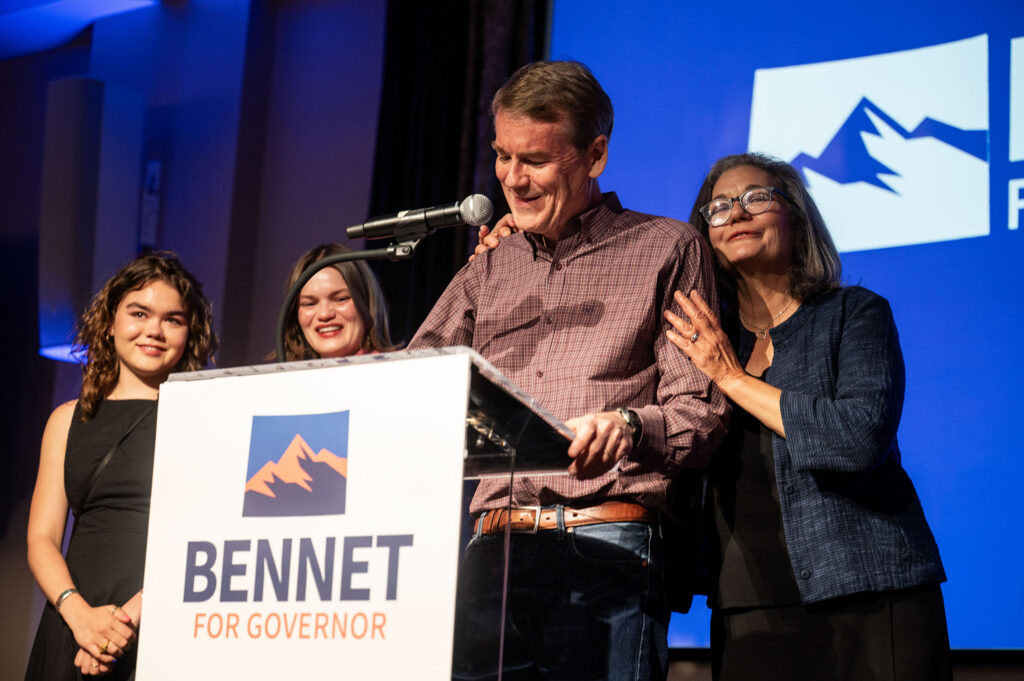
Bennet settles campaign finance complaints, admits violating state law
Marianne Goodland
marianne.goodland@coloradopolitics.com
Updated 1 day ago
U.S. Sen. Michael Bennet’s gubernatorial campaign has agreed to pay a $7,433 fine for using his Senate campaign account to pay for gubernatorial campaign travel expenses. The July 31 settlement includes an admission by Bennet and his campaign that they...