

Judge: Department of Corrections violated First Amendment by confiscating inmate’s racy photos

The Colorado Department of Corrections violated an inmate’s First Amendment rights when it withheld mail that did not fall under its own obscenity policy, a federal judge ruled last week.
U.S. District Court Senior Judge Marcia S. Krieger determined that even though the government had asked her to dismiss the case and decide in their favor, she was prepared to side with the plaintiff in finding employees had confiscated his mail through an overly-restrictive interpretation of the CDOC’s contraband definition.
The department’s reading of its own policy on sexually explicit materials, she wrote in a Feb. 2 order, “would allow the regulation to censor an incredible array of decidedly nonsexual imagery.” She listed as an example the “quadrennial hilarity of prospective presidential candidates photographed gamely attempting to eat a corn-dog-on-a-stick at the Iowa State Fair.”
Henry Lee Griffin Jr. resided at the Buena Vista Correctional Facility when, in 2016, he ordered approximately 75 photographs from Flix 4 You, a company that sells racy or erotic photos. A mailroom employee, upon reviewing the delivery, forwarded six of the images for possible censorship given their depictions.
The CDOC’s Administrative Regulation 300-26 provides that a correction facility’s mailroom will screen incoming mail to inmates and forward certain concerning materials to the “reading committee.” The committee makes decisions about whether to censor mail containing, among other things, nudity or sexually explicit conduct. As defined in the regulation, “blackened dots or stars and other such covering” on images of humans are still deemed nudity.
The committee confiscated the six images, which contained women with visible underwear, body paint and “exposed buttocks and thighs.” Griffin received a subsequent delivery of 18 images, of which the reading committee confiscated one.
“It is not clear from the record what became of the confiscated photos,” Krieger noted, observing that it is the prison’s policy to dispose of contraband mail, but the Department of Corrections apparently still had the images to use in the lawsuit
Griffin filed a complaint by himself against the members of the reading committee and the mailroom employee, arguing the administrative regulation was unconstitutional and the department staff violated his First Amendment right to free expression by confiscating his mail.
“None of the defendants,” Griffin wrote in a court filing last year, “stated or presented any evidence that I or my photos subjected any of them to a hostile environment or sexual harassment.”
He elaborated that he had purchased a photo album from CDOC to keep his photos secure and that would have shielded them from the plain view of anyone else. Griffin also argued the department considered images of women in swimsuits, lingerie and yoga pants to be sexually explicit.
Krieger explained in her order that inmates do have a First Amendment right to receive information while incarcerated, but the burden of proving that a court should invalidate a regulation falls on them. Courts must evaluate whether a restriction serves a legitimate governmental interest, and what effect it would have on guards, other inmates and prison resources if a prisoner’s claim were to prevail.
Krieger determined Griffin had not demonstrated sufficiently that she should void the administrative regulation on First Amendment grounds. Upon review of the erotic images in question, the judge also found that three of them – depicting women in wet t-shirts and body paint – did fall under the category of nudity and therefore the reading committee had acted appropriately in confiscating them.
However, given that the administrative regulation defined “sexually explicit conduct” primarily as sexual intercourse or masturbation, Krieger concluded the four remaining photos that depicted women who were merely scantily clad did not violate the policy.
“Stretching that definition to encompass images that simply depict the subject in a sexually-receptive pose,” Krieger determined, infringed on Griffin’s First Amendment right. The judge gave the state 14 days to argue why she should not decide in Griffin’s favor. Griffin could recover monetary damages if he ultimately prevails, because Krieger also decided the defendants are not entitled to qualified immunity.
Qualified immunity is a judicial doctrine that shields government employees from liability absent a violation of clearly-established constitutional rights. The defendants had previously argued that even if the confiscation violated Griffin’s rights, “any inconsistencies between the Defendants’ conduct and A.R. 300-26 are the result of Defendants’ reasonable mistake as to what that policy requires, and cannot give rise to a constitutional violation.”
Alan Chen, a professor of First Amendment law at the University of Denver, called the judge’s order noteworthy for several reasons.
“It’s rare for prisoners to win First Amendment cases, even rarer when they represent themselves and also rare for courts to deny qualified immunity,” he said.
While he was not surprised at the outcome, Andy McNulty, an attorney with Killmer, Lane & Newman who has brought First Amendment cases on behalf of inmates, said the odds were not in Griffin’s favor as an incarcerated person representing himself.
“The mail system is the only way that the prisoners connect with the outside world,” McNulty said, because phone calls or e-mail cost money and may be unaffordable for many inmates. “We take for granted on the outside the right to use the mail. But for them it’s a lifeline to their communities.”
He added that the court could award Griffin a small amount of monetary compensation or order the return of the photographs. The Department of Corrections did not immediately return a request for comment.
The case is Griffin v. Gorman et al.


10th Circuit partially revives lawsuit over 2020 Denver protest injuries
Michael Karlik
michael.karlik@coloradopolitics.com
Updated 1 day ago
The Colorado-based federal appeals court revived a man’s claims against Denver on Friday after concluding a trial judge resolved the case in the city’s favor without analyzing two of the three instances of alleged excessive force and other constitutional violations....
Federal judges find Colorado immigration judge violated several orders
Michael Karlik
michael.karlik@coloradopolitics.com
Updated 1 day ago
Multiple federal judges in Colorado have freed people from immigration custody after determining that one immigration judge violated their directives for properly conducting bond hearings. For nearly a year, Colorado’s U.S. District Court has faced a flood of “habeas corpus” petitions...

Misconduct complaints from ex-Colorado judicial discipline director dismissed against federal judges
Michael Karlik
michael.karlik@coloradopolitics.com
Updated 2 days ago
The administrative body for the Denver-based federal appeals court upheld a finding last week that misconduct complaints against Colorado’s chief federal trial judge and the chief appeals judge warranted dismissal and appeared to be a “litigation tactic” by the complaining...

First-ever Red Rocks naturalization ceremony draws most diverse group of new citizens
Michael Karlik
michael.karlik@coloradopolitics.com
Updated 1 day ago
Colorado’s federal trial court held its first-ever naturalization ceremony for nearly 300 new citizens on Thursday at Red Rocks Park and Amphitheatre. “We’re doing it to commemorate the 250th anniversary of the Declaration of Independence and the United States. Red...
Jeffco taxpayers could be on the hook for a possible child sex assault settlement
Matt Kyle
matt.kyle@denvergazette.com
Updated 1 day ago
Taxpayers may end up on the hook for a child sexual assault settlement, possibly worth up to $15 million, after Jeffco Public Schools failed to notify its insurance company in a timely manner about the case. The incident stems from...
10th Circuit finds no fair housing violation by Littleton landlord for worker’s alleged rape of tenant
Michael Karlik
michael.karlik@coloradopolitics.com
Updated 24 hours ago
The Denver-based federal appeals court concluded on Monday that Littleton’s housing authority could not be held liable for a maintenance worker’s alleged rape of a tenant, as the worker’s employment did not provide any special access to the victim. A...

Jeffco Public Schools sues Trump administration to protect funding after alleged transgender policies violation
Matt Kyle
matt.kyle@denvergazette.com
Updated 2 days ago
In the wake of several threats by the Trump administration to revoke federal funding, Jeffco Public Schools filed a lawsuit against the Department of Education seeking to protect that badly needed money. Jeffco has been under investigation by the DOE’s...
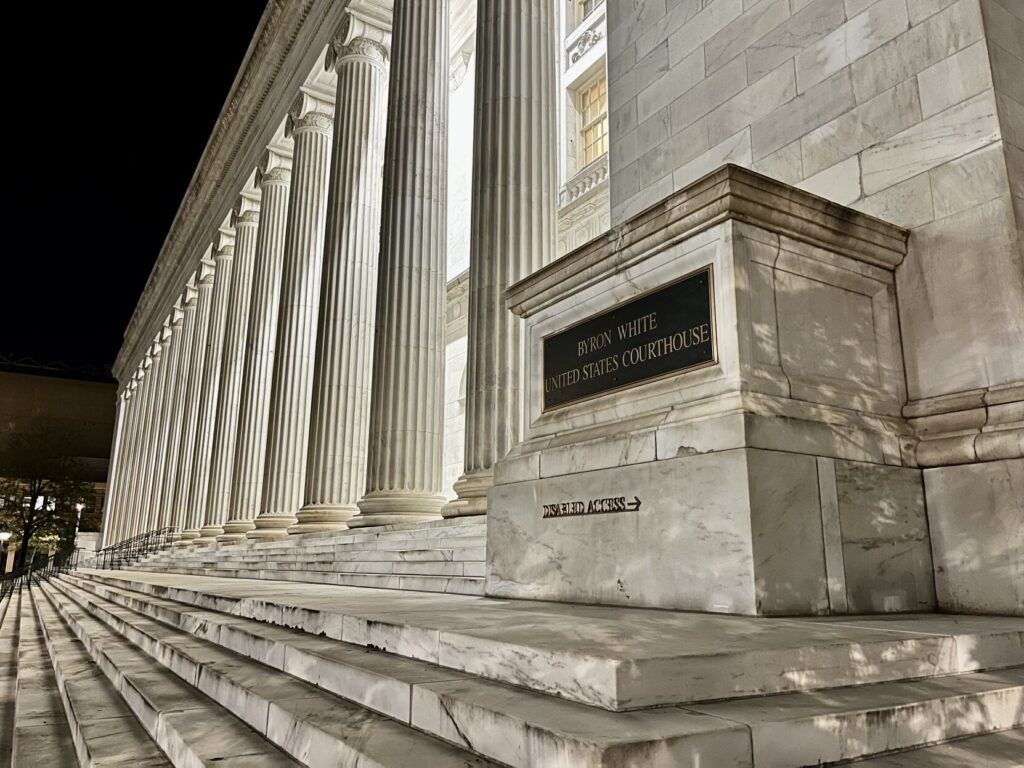
Denver detox center did not violate man’s rights with 10-hour hold, 10th Circuit says
Michael Karlik
michael.karlik@coloradopolitics.com
Updated 4 days ago
The Colorado-based federal appeals court concluded on Tuesday that Denver’s detoxification facility did not violate a man’s rights by holding him against his will for 10 hours until his blood alcohol content was projected to reach zero. Unusually, Brian Garrett’s...

Federal judge clarifies ex-GOP treasurer candidate’s burden to prove defamation claims
Michael Karlik
michael.karlik@coloradopolitics.com
Updated 4 days ago
A federal judge clarified last week that businessman and former Republican statewide candidate Brian Watson will need to surmount a higher hurdle in proving his claim that a party guest’s alleged description of him as a “criminal” amounted to defamation....
Colorado board permits state to appeal injunction against arthritis drug price cap
Marissa Ventrelli
marissa.ventrelli@coloradopolitics.com
Updated 4 days ago
A Colorado board voted Friday to allow the Attorney General’s Office to fight an injunction against a price cap on a drug that treats arthritis. A U.S. district court judge had granted the company Amgen a preliminary injunction, temporarily blocking...
PREV
PREVIOUS

Court rejects request to pause McClain family’s civil suit against Aurora, employees
A federal court has refused to halt the discovery of evidence in the civil lawsuit against Aurora for the death of Elijah McClain, even though the state attorney general has opened a grand jury investigation into the matter. “The plaintiffs here are family members of a dead young man. Elijah McClain’s family deserves answers to […]

Some good news on funding for water: Sports betting tax revenue gaining strength
Coloradans legally bet more than $1.1 billion on sports in 2020, exceeding expectations and funneling some cash to the Colorado Water Plan sooner than anticipated. Colorado collected more than $3.4 million in sports betting taxes in 2020, with operators running from May through December. Voters agreed to legalize and tax sports betting in November 2019 with […]