

House approves police accountability bill in 52-13 vote, one step away from Polis signature
In a bipartisan vote of 52-13, the House of Representatives gave final approval to a package of reforms to disclose, deter and discipline excessive uses of force by police officers, an effort to halt further slayings at the hands of law enforcement.
“There’s nothing new about black and brown Coloradans feeling a target on their backs,” said House Speaker K.C. Becker, D-Boulder. “It shouldn’t take viral videos of police brutality or massive protests all over the country to jolt us into action. But in any case, I’m glad we’re here now.”
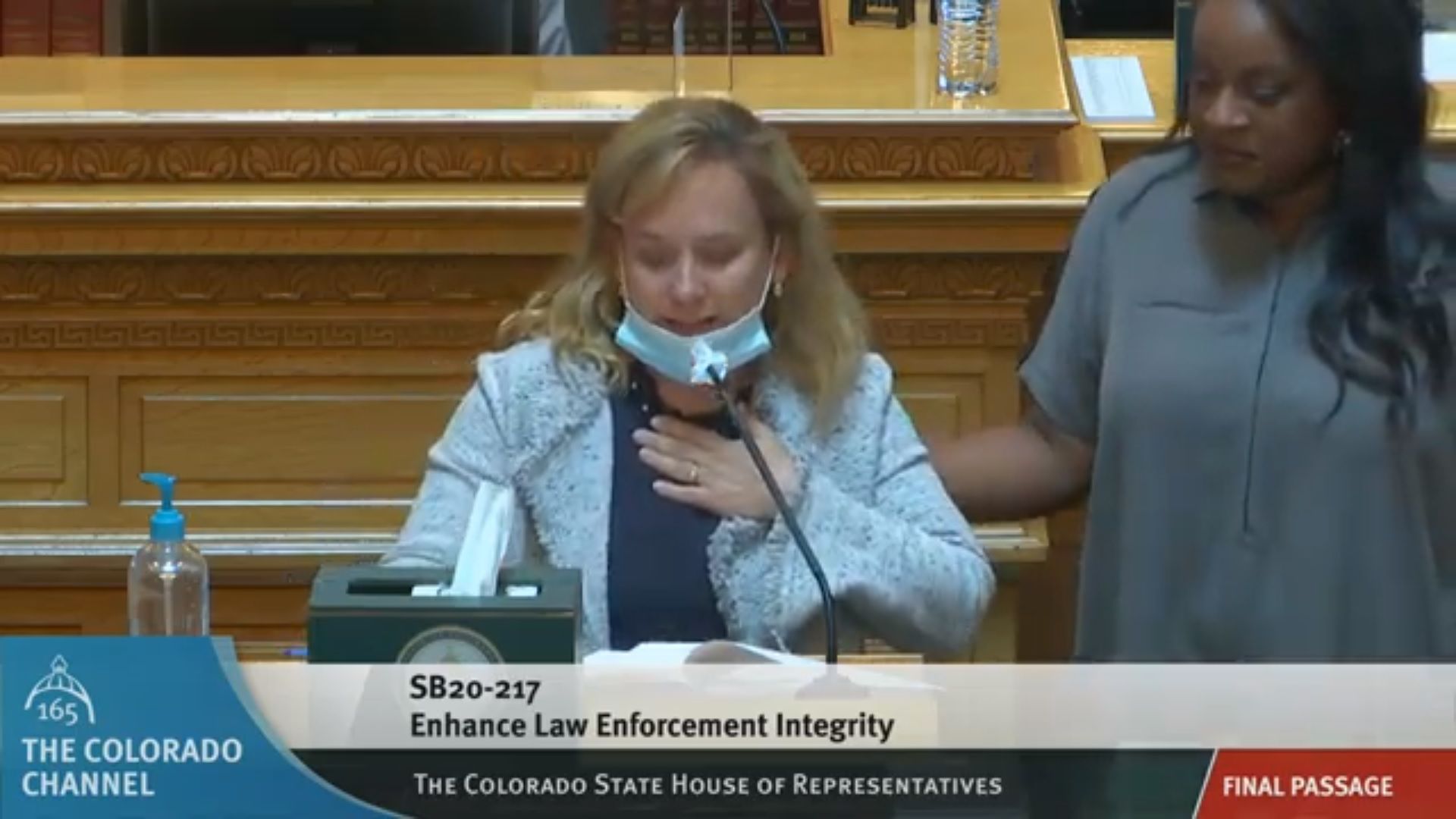
Starting to cry, Becker addressed bill sponsor Rep. Leslie Herod, D-Denver, who handed Becker a tissue and patted her reassuringly on the back. “Thank you for helping this body make history today,” Becker continued. “Today we’re honoring the memory of George Floyd and every other victim of police violence with action. We’re channeling our sympathy, our empathy, our sadness and our rage into making lasting change.”
Senate Bill 217, introduced last week, contains several provisions discussed in recent years to address police use of force and accountability standards. Among the provisions would be mandated body-worn camera usage and disclosure of footage by local departments and the Colorado State Patrol, a ban on chokeholds, and the ability to sue officers directly for their conduct. An amendment added in response to the racial justice protests would place limits on departments’ use of chemical agents and projectiles when handling protesters.
In the final vote, 11 Republicans joined all Democrats in passing the measure. Gov. Jared Polis issued a statement saying he will sign the bill when it reaches his desk.
Lawmakers acknowledged representatives of the families of De’Von Bailey and Elijah McClain, two black men killed in Colorado Springs and Aurora, respectively, who were present in the chamber. House Majority Leader Alec Garnett, D-Denver, recognized that the repeated advocacy of protesters since the death of Floyd in Minneapolis police custody in late May spurred the legislature to act.
“In that moment where you’re about to see red, where you’re about to fire that pepper ball at the innocent bystander at the sidewalk, when you’re about to fire that rubber bullet at somebody who’s exercising their First Amendment rights, when you’re about to fire a bullet at somebody who’s running away because they are scared,” he said, “this bill is going to say, ‘Stop. Nothing is worth taking that life.”
In addition to Democratic leaders, the House Minority Leader, Patrick Neville, voted yes on SB217, despite being “100% against” the original draft.
“I can be a yes vote and still be absolutely disgusted by some of the comments and the graffiti outside of these walls,” said Neville, R-Castle Rock. “I can be a yes vote and still support our men and women in blue.”
Bill sponsors consulted intensively with police, victim and local government groups while drafting and amending the bill. During the second reading of SB217 the night before, Rep. Rod Bockenfeld, R-Watkins, lamented that rank-and-file officers did not have a bigger voice in the legislation. He read from an email he said he received from an officer, illustrating the difficult situation that a rookie officer may encounter of needing to call out superior officers’ misconduct.
If “a superior officer orders an officer to effect an arrest … the officer must obey, and he is the one who will be personally liable if the arrestee sues,” Bockenfeld said, quoting the email. “When they follow the orders of a superior officer, the superior officer should be the one who assumes the liability. Or the officer should be able to refuse the order if it places him in legal jeopardy.”
Bockenfeld mentioned riot response as a scenario in which officers could be disciplined for not following orders or sued for following unreasonable directives for use of force, which he deemed a “no-win situation.”
Due to the complications of the COVID-19 pandemic and the ability of the General Assembly to pause its legislative session until a few weeks ago, lawmakers happened to reconvene around the same time as daily protests commenced at the state Capitol. Colorado moved quickly to create an omnibus policing bill, the first such measure introduced after Floyd’s death at the hands of Minneapolis police officers, although other states have seen individual bills or amendments to address the topic.
The debate was freighted with emotion, in particular because of the personal experiences of several legislators of color. Rep. Monica Duran, D-Wheat Ridge, spoke of her son, whom she alleged police profiled and harassed in Jefferson County unprovoked several years ago.
“They proceeded to beat him and beat him,” she recalled. “When he was thrown in the back of a police car, he wasn’t sure if he would live or die or what they were going to do with him.”
Tearing up while retelling the story, Duran said that when she and her husband went to bail out her son from police custody, “we saw many families coming in. Many sons and daughters that look like mine.” A lawyer later told her, “Mrs. Duran, this is nothing new. This happens every night of the week.”
During Thursday night’s debate, Rep. James Coleman, D-Denver, delivered an impassioned speech asking Republican members to think of him as being just as easily the victim of police violence as was Floyd. Rep. Janet Buckner, D-Aurora, referenced his comments in her own plea to pass the bill.
“When I heard James speak last night, I heard my husband. My husband always said, ‘call it what it is,'” she said, referring to the late Rep. John Buckner, who she said was Coleman’s school principal. “And James called it what it is last night.”
Buckner said that every legislator has a constituent of color in their district, and implored lawmakers to “please keep them in mind.” Her comments appeared to sway the vote of at least one uncommitted member.
“If I vote yes, I’m voting for change,” said Rep. Richard Champion, R-Columbine Valley. “And if I say no, it feels very different, that I’m standing up for the police.” Champion said that he had been torn on how to vote, before acknowledging, “I didn’t know which way to vote until I listened to Rep. Buckner. Dear lady, you convinced me that it is time.”
The bill returns to the Senate to consider the House’s amendments. On Tuesday, the upper chamber approved the bill on a widely-bipartisan vote of 32-1.
Editor’s note: This story has been updated to correct the details in the deaths of De’Von Bailey and Elijah McClain.

Atop taxes, here’s how much each Colorado resident pays in fees
Marissa Ventrelli
marissa.ventrelli@coloradopolitics.com
Updated 43 minutes ago
Each Colorado resident paid nearly $5,000 in state-sanctioned fees last year, according to a report by policy think tank. The report, which analyzed how fees have affected Colorado’s economy, found that fee revenue has more than tripled since 2008 —...

Colorado National Guard, Swiss Armed Forces celebrate partnership
Marissa Ventrelli
marissa.ventrelli@coloradopolitics.com
Updated 59 minutes ago
Colorado’s National Guard marked a year of partnership with the Swiss Armed Forces at the Governor’s Mansion on Monday. “This anniversary marks one strong year of friendship and collaboration between the State of Colorado and Switzerland,” said Gov. Jared Polis....
Judge allows Trump to refile $15 billion lawsuit against the New York Times
Emily Hallas
emily-hallas@coloradopolitics.com
Updated 2 hours ago
A federal judge declined to dismiss President Donald Trump’s multibillion-dollar lawsuit against the New York Times on Monday, giving him roughly four weeks to amend his case after the outlet moved to toss it on First Amendment grounds. District Judge...

Gov. Polis celebrates Colorado’s first-place education ranking from U.S. News
Marianne Goodland
marianne.goodland@coloradopolitics.com
Updated 11 minutes ago
Colorado officials said they have something to celebrate this week, in addition to the state’s sesquicentennial birthday on Saturday. U.S. News & World Report on Tuesday gave Colorado its top ranking for education efforts from pre-K to postsecondary, though it...
Denver detox center did not violate man’s rights with 10-hour hold, 10th Circuit says
Michael Karlik
michael.karlik@coloradopolitics.com
Updated 2 hours ago
The Colorado-based federal appeals court concluded on Tuesday that Denver’s detoxification facility did not violate a man’s rights by holding him against his will for 10 hours until his blood alcohol content was projected to reach zero. Unusually, Brian Garrett’s...

Federal judge clarifies ex-GOP treasurer candidate’s burden to prove defamation claims
Michael Karlik
michael.karlik@coloradopolitics.com
Updated 2 hours ago
A federal judge clarified last week that businessman and former Republican statewide candidate Brian Watson will need to surmount a higher hurdle in proving his claim that a party guest’s alleged description of him as a “criminal” amounted to defamation....

Denver City Council sends Xcel franchise deal to voters
Deborah Grigsby
deborah.smith@denvergazette.com
Updated 4 hours ago
This November, Denver voters will decide whether to renew the city’s longstanding franchise agreement with Xcel Energy. Members of the Denver City Council approved on Monday sending a proposed 20-year franchise agreement with Xcel that would deliver more than $180...
Independent gubernatorial candidate Greg Lopez, a former GOP congressman, qualifies for Colorado ballot
Ernest Luning
ernest.luning@coloradopolitics.com
Updated 48 minutes ago
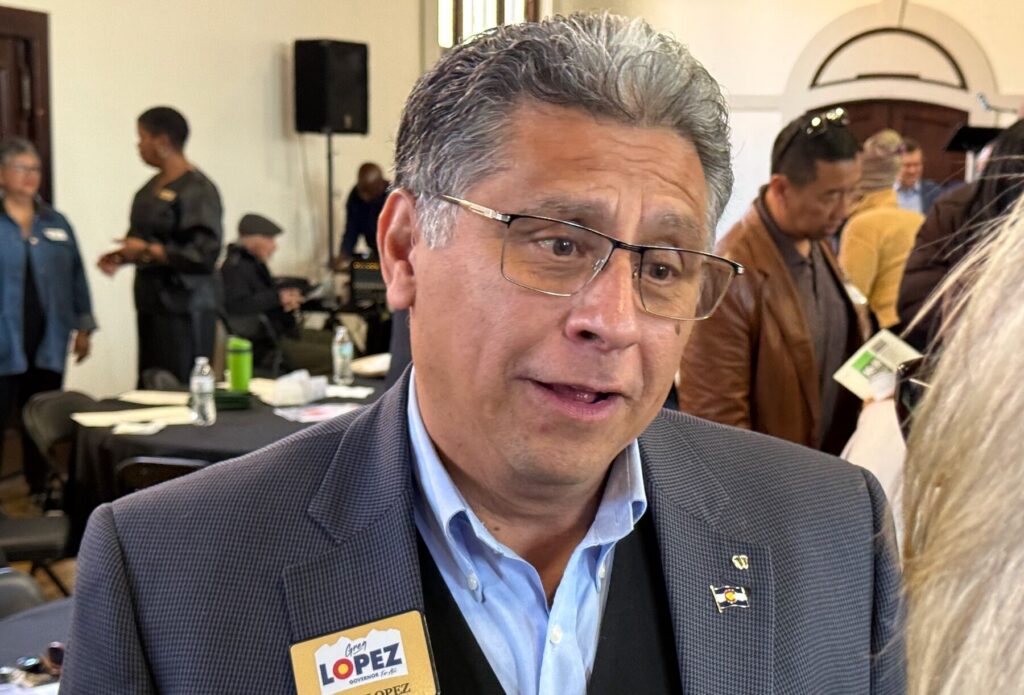
Unaffiliated gubernatorial candidate Greg Lopez, a former Republican congressman from Elizabeth who left the GOP to run as an independent, has qualified for the ballot by submitting enough petition signatures, the Colorado Secretary of State’s Office said Tuesday. He’ll face...

At Colorado’s 150th anniversary, leaders offer birthday wishes
Thelma Grimes
thelma.grimes@coloradopolitics.com
Updated 5 hours ago
As Colorado’s 150th anniversary approaches, leaders from across the state reflect on the spirit that binds the plains, mountains, Western Slope and Front Range — a shared commitment, they underscored, to opportunity, community, stewardship and personal freedom. Their tributes highlight...
Fauci’s private COVID-19 diaries: Six takeaways on fame, prize money and the lab leak debate
The Washington Examiner
the-washington-examiner@coloradopolitics.com
Updated 8 hours ago
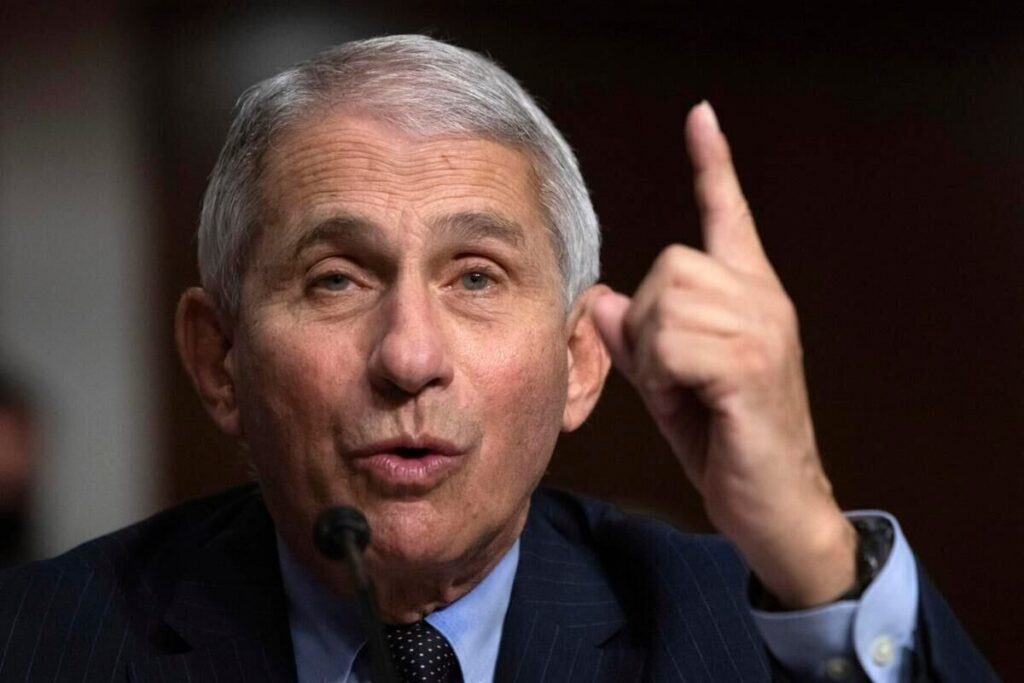
Anthony Fauci’s private writings from 2020 and beyond portray a public health official who was fixated on his growing celebrity while privately grappling with a pandemic response he believed was chaotic, leaderless and consumed by internal rivalries. The writings of...
PREV
PREVIOUS

Attorneys' group wants to hear from Ken Buck about El Paso County GOP assembly dispute
The office that oversees the conduct of Colorado attorneys wants U.S. Rep. Ken Buck, the chairman of the Colorado Republican Party, to answer questions about a complaint submitted last month alleging Buck pressured a local GOP official to file a false form with the state. A spokesman for the state GOP blasted the complaint – […]

2020-21 State budget reaches the finish line, heads to governor
The state Senate late Friday night adopted changes made to the 2020-21 state budget as contained in House Bill 1360 and readopted it on a 24-11 vote. The House had taken that action earlier in the evening, and so the budget bill now heads to the governor for signing. The 2020-21 budget of $30.3 billion […]