

Title Board to consider objections to 14 ballot measures

The Title Board will hear objections to 14 measures that received ballot titles last week, nine of which pertain to regulation of oil and gas development.
Timothy Steven Howard took issue with five similar proposals, Initiatives 307-311, that would replace the Colorado Oil and Gas Conservation Commission with a new, independent board to regulate the extraction industry. The board would need to establish safe setback distances from wells and would be prohibited from weakening certain environmental and safety rules. Local governments would also have authority over regulation.
Howard argued that there are multiple subjects to the measures besides the stated goal of replacing the COGCC. He identified a new veto power for the independent board over other agencies’ rules and the limiting of local jurisdictions’ regulatory powers as other purposes buried within the initiatives.
The proposals provide the independent board with approval power over certain rules that the air quality, water quality, state health and solid waste regulators create. “The expertise, judgment, and missions” of those four boards, Howard wrote, “will be subservient to the Independent Board. The wholesale shift of authority from state agencies charged with protecting public health, air quality, drinking water quality, and radioactive and hazardous waste disposal to the Independent Board is an unlawful second subject.”
Howard also observed that the initiatives would limit local governments’ authority over oil and gas to the topics of setback distances, flow lines, air quality, plugging of wells, and training for industry employees. He concluded that this was a narrowing of localities’ current powers, and as such, was a second subject.
“Voters would be surprised to learn that the initiative that abolishes the COGCC also severely curtails the ability of local governments to regulate oil and gas development within their jurisdictions,” Howard wrote.
Howard objected to two related measures, Initiatives 312-313, that would prohibit the COGCC or its successor body from weakening its own regulations or those of the Air Quality Control Commission. Pointing out that one rulemaking board has no authority over another, Howard deemed this attempt at expanding jurisdiction beyond what the law allows to be a second subject.
Two other initiatives, 300-301, would give localities the ability to assume COGCC’s authority over oil and gas operations if they choose and require economic impact analyses for proposed COGCC rules, respectively. Howard objected to both.
He pointed out that Initiative 300 also denied municipalities and counties the ability to enact moratoriums, which Howard felt was a second and contrary subject to the local control proposal. For 301, Howard wrote that the ballot title should enumerate all of the factors that an economic impact report would include.
Initiatives 316-318 would eliminate the political parties’ caucus and assembly process for placing candidates on primary ballots for offices other than the presidency. Celeste Landry objected to each on the grounds that the measures’ true purpose was to reduce the number of candidates on primary ballots. Writing that voters will “grow weary of signature gatherers” if every candidate must petition onto the ballot, Landry believed the effect would be to limit competitive contests.
Landry also claimed an unfairness, if not mathematical impossibility, of petitioning onto the ballot in certain counties. She wrote that in Rio Blanco County, the Democratic Party has fewer than the 275 active voters needed to sign a candidate’s primary ballot petition for county commissioner. (The secretary of state’s office shows 278 registered Democrats as of January 2019.)
“The titles set by the Title Board do not fairly express the initiative’s intent to effectively prohibit a major political party from placing a candidate on its primary ballot,” she wrote.
Brett Rutledge and Joyce R. Kelly objected to Initiative 314, which seeks to prohibit excessive confinement conditions for farm animals. They allege that the ballot title omits several key features about enforcement and penalties, while words like “confinement” and “adequate space” unfairly gin up voter sympathy and should be stricken.
Finally, Anna Jo Haynes asked for rehearing of Initiative 315, which would divert tobacco tax revenue and tobacco master settlement money to fund preschool programming. In her interpretation, the measure goes beyond that one subject: it also creates a tax on tobacco-derived nicotine vapor products and denies revenue to localities that ban tobacco or nicotine.
“A key purpose of the single subject requirement is to guard against ‘uninformed voting caused by items concealed within a lengthy or complex proposal,'” Haynes cautioned.


Out-of-state group seeks to add right to hunt and fish to Colorado Constitution
Marissa Ventrelli
marissa.ventrelli@coloradopolitics.com
Updated 14 hours ago
A group is seeking to make Colorado the 25th state in the nation with an established constitutional right to hunting and fishing through a proposed ballot initiative. Backed by the International Order of T. Roosevelt, the group dedicated to preserving...

Colorado Politics Calendar June 15-21
Rachael Wright, Special to Colorado Politics
rachael.wright@coloradopolitics.com
Updated 3 days ago
CoPo’s weekly political calendar helps you find political and public policy events throughout Colorado. It includes candidate and issue campaign events, public policy meetings, court hearings, state and local party conventions, assemblies, debates, rallies, parades, speaking engagements, traveling dignitary appearances,...

A primary brings out primal instincts | SONDERMANN
Eric Sondermann
eric-sondermann@coloradopolitics.com
Updated 2 days ago
There are no Stanley Cup finals or NBA title showdowns involving local teams this June. In their place, we are inundated with primary election campaign ads. Coloradans can be excused for missing the diversion and alternate programming. But life can...

Dem-GOP tension dominates 1,000-bill legislative session | A LOOK BACK
Rachael Wright, Special to Colorado Politics
rachael.wright@coloradopolitics.com
Updated 2 days ago
Forty-Five Years Ago This Week: “I can honestly say that until now, we got along well with the governor’s office,” said House Minority Leader Federico Peña, D-Denver. “We visited frequently with the staff. And you didn’t see certain legislators speaking...

Hickenlooper lands endorsements from Elizabeth Warren, Ministerial Alliance in US Senate primary
Ernest Luning
ernest.luning@coloradopolitics.com
Updated 15 hours ago
U.S. Sen. John Hickenlooper won endorsements this week from a progressive Democratic colleague and a coalition of metro-area African American faith leaders as voting began in Colorado’s primary election. U.S. Sen. Elizabeth Warren of Massachusetts and the Greater Metro Denver...
Colorado justices say insurers may access policyholders’ medical info in denied-benefits litigation
Michael Karlik
michael.karlik@coloradopolitics.com
Updated 17 hours ago
The Colorado Supreme Court declined on Monday to expand its narrow prohibition on insurance companies accessing policyholders’ medical information, clarifying that a dispute over an insurer’s bad-faith decision to deny benefits is the only situation where a company is limited...

House District 14: Businesswoman, consultant square off in GOP primary
Mary Shinn
mary-shinn@coloradopolitics.com
Updated 18 hours ago
Firearms training company owner Ava Flanell will face Troy Vanderhule, the chief fundraising officer for Dobson Philanthropic, in the June 30 Republican primary for state House District 14, an area in northern Colorado Springs. Flanell was appointed to the seat...
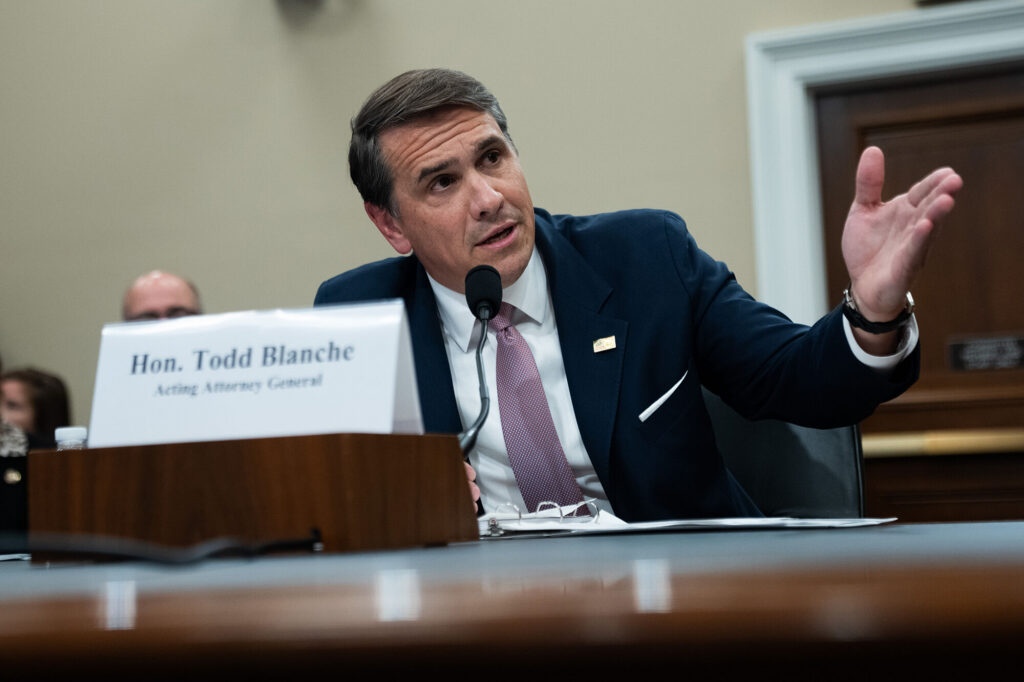
Federal judge wants Todd Blanche to swear in writing anti-weaponization fund won’t be revived
Jack Birle, Washington Examiner
jack.birle.washington.examiner@gazetteedit.wpenginepowered.com
Updated 16 hours ago
A federal judge maintained a block on the Department of Justice’s $1.776 billion anti-weaponization fund Friday, despite the DOJ claiming they have abandoned the planned fund aimed at compensating allies of President Donald Trump and others who say they were politically targeted by...
Colorado Supreme Court declines to loosen requirements for insurance company defendants
Michael Karlik
michael.karlik@coloradopolitics.com
Updated 11 hours ago
The Colorado Supreme Court declined last week to reconsider its longstanding expectations for insurance company defendants, and agreed that an insurer failed to properly raise its defenses against a policyholder’s breach-of-contract lawsuit. When an insured driver has an accident with...

Teen defendant properly transferred from youth detention to jail, Colorado justices conclude
Michael Karlik
michael.karlik@coloradopolitics.com
Updated 21 hours ago
Colorado law required the transfer of a teenage murder suspect from youth detention to the county jail when he turned 18, the state Supreme Court ruled last week. Prosecutors have accused Issac James Lawrence of killing a younger boy and attempting to...
PREV
PREVIOUS

As US House approves latest COVID-19 relief package, cities and counties are left wanting
While the U.S. House votes on a fourth COVID-19 relief package to the tune of $484 billion on Thursday, the measure lacks the aid for cities and counties that are losing revenue and making decisions to lay off or furlough employees. The Colorado Municipal League, Colorado Counties Inc. the state Department of Local Affairs and […]

Colorado House and Senate Democrats criticize anti-Semitic language, House Minority Leader
Nearly two dozen members of the Colorado House and Senate Democratic caucuses spoke to reporters Wednesday about a letter they’ve authored that criticized what they call increasingly bigoted language, including statements made by House Minority Leader Patrick Neville, a Castle Rock Republican. The Black caucus, Latino caucus, LGBTQ caucus and Jewish caucus, the latter led […]