

The Colorado Springs Gazette: School choice began with desegregation
The death of Linda Brown last week reminds us how far we have come and how far we must go in liberating children to reach their highest potential in schools.
Linda’s father tried to enroll her at Sumner Elementary School near the family’s home in Topeka, Kan., when she was 9 in 1951. Sumner was a good school, within walking distance.
The Topeka Board of Education forbade Linda’s enrollment, insisting she remain at a school for people referred to as “negros.”
Oliver Brown fought all the way to the U.S. Supreme Court, which sided with minority families in the 1954 landmark ruling in Brown v. Board of Education. No more would school boards dictate which schools children attend on the basis of color.
The Brown family’s victory was the first step in a long march toward equality for all, which continues today.
Moving forward from improving access to better schools for blacks, Colorado has become a state where people of any ethnic background, neighborhood or socioeconomic status have access to more than just the school down the block.
More than two decades ago, school boards still determined where the vast majority of Colorado children went to school. Students in low-income neighborhoods attended institutions so underfunded they typically underperformed schools in more economically fortunate, mostly white communities.
Colorado children were economically and racially segregated – not by intent but by attendance dictates based on geography. It was the old model, and the Colorado Legislature overhauled it with the bipartisan Charter Schools Act of 1993. The law allows parents, teachers or others to open innovative public schools with charters that focus on music, science, aerospace technology, math, the arts, special education needs, and more.
Charters and open enrollment save children who do not perform well in traditional classrooms. They provide unique opportunities for deaf and blind students. Economically disadvantaged students obtain college credits – even four year degrees – while attending tuition-free schools. Charters help teen parents obtain diplomas.
More than 250 Colorado charter schools serve 120,000 students, which amounts to 13 percent of the state’s total K-12 enrollment. Fifth-one percent of charter students are children of color, compared to 45 percent in traditional schools. Black students comprise 6.1 percent of charter enrollment, compared to only 3.7 percent of traditional enrollment. Hispanics comprise 36 percent of charter enrollment, compared to 33.6 percent at traditional schools.
Much of the rest of the country wants to emulate our school choice model. But Colorado parents, business leaders, and minority communities should not get complacent and take school choice for granted.
Leading Democratic gubernatorial candidate Cary Kennedy worries about escalating choice and school competition, and the Colorado Education Association and American Federation of Teachers endorses her.
“I’m concerned that we’d build a system where the success of some schools is coming at the expense of other schools,” Kennedy said at a candidate’s forum in October.
The teachers unions backed anti-choice candidates successfully in nearly every 2018 Colorado school board election, and will fund and support candidates who want to move our system backward.
“Teachers unions hate school choice, which is why they’ve consistently worked overtime to hide their involvement in local school board elections,” explaines former Colorado Secretary of State Scott Gessler in a column for The Denver Post.
School choice began next door in Kansas, 64 years ago, and improved the life of Linda Brown and millions of other children throughout the country. Colorado continues perfecting the concept, by increasing competition and options for families from all walks of life. Let’s protect school choice, and avoid reverting to limitations of the past.

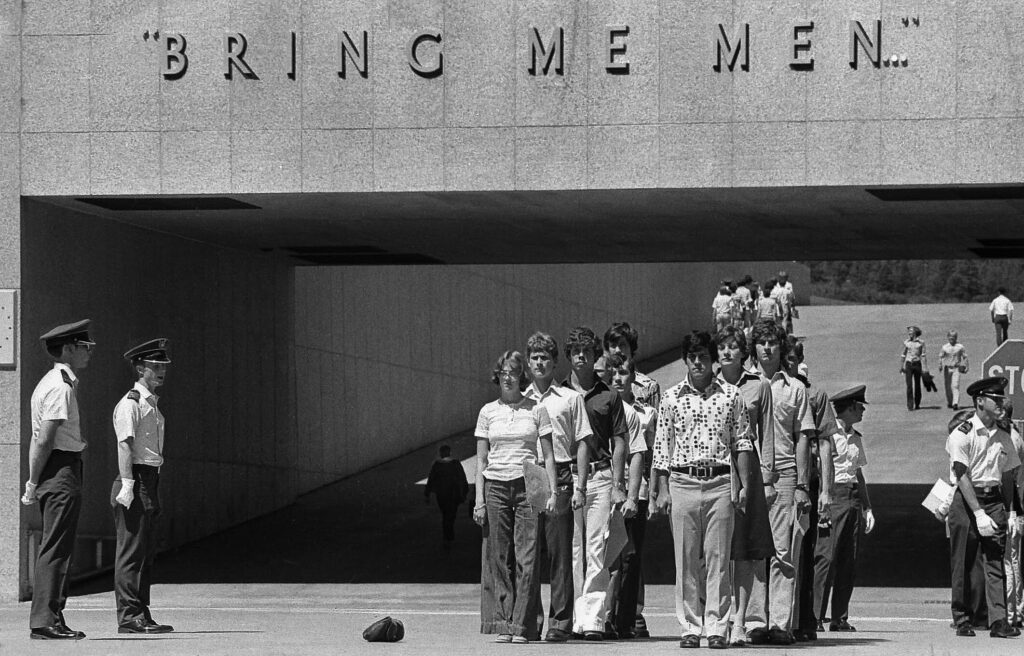
Fifty years later, women reflect on first coed class at the Air Force Academy, struggle for equality
Mary Shinn
mary-shinn@coloradopolitics.com
Updated 1 day ago
When the first female Air Force Academy cadets arrived 50 years ago this summer, they stood in front of an enormous sign on campus that read “Bring me men.” In the shadow of that sign, Kathleen Utley Kornahrens, one of...

As Lake Powell shrinks, marinas are having to adapt to dwindling water levels | OUT WEST ROUNDUP
The Associated Press
the-associated-press@coloradopolitics.com
Updated 4 days ago
ARIZONA Reservoirs near record lows PAGE — The Colorado River’s Lake Powell, the second largest reservoir in the U.S., is shrinking. A record-dry winter and extreme heat — as well as decades of overuse, chronic drought and climate change —...

A new day? Colorado’s troubled guardianship office pursues ‘cultural reset’
Marianne Goodland
marianne.goodland@coloradopolitics.com
Updated 3 days ago
Colorado’s guardianship program, long criticized for mismanagement and high staff attrition, is undergoing a “cultural reset,” as its new director works to repair partnerships and prepare for a major expansion under recent legislation. Created by lawmakers in 2017, the Office...

U.S. Senate OKs funding bill to avoid government shutdown
Wire Services
wire-services@coloradopolitics.com
Updated 1 day ago
Hemp provision became point of contention WASHINGTON • The U.S. Senate in an overnight vote Saturday approved a short-term measure to fund federal agencies into early December and avoid a government shutdown during the middle of campaign season. The late-summer...

The relevance of Watergate more than a half-century later | SONDERMANN
By Eric Sondermann
by-eric-sondermann@coloradopolitics.com
Updated 4 days ago
It was the scandal for which all other scandals are now named. In June 1972, a small group of Cuban burglars with high-level connections broke into the headquarters of the Democratic National Committee. Those headquarters were located in the Watergate...

Wirth downplays Social Security disaster talk | A LOOK BACK
Rachael Wright, Special to Colorado Politics
rachael.wright@coloradopolitics.com
Updated 3 days ago
Forty-five years ago this week: “As time goes on,” said Democratic U.S. Rep. Tim Wirth, of the 2nd Congressional District, “we are finding that the safety net, which was proposed earlier this year, has some very large holes in it,”...

Colorado Politics Calendar Aug. 10-16
Rachael Wright, Special to Colorado Politics
rachael.wright@coloradopolitics.com
Updated 3 days ago
CoPo’s weekly political calendar will help you find political and public-policy events throughout Colorado. It includes candidate and issue campaign events, public policy meetings, court hearings, state and local party conventions, assemblies, debates, rallies, parades, speaking engagements, traveling dignitary appearances,...

Democratic group aims Spanish-language TV ad at Gabe Evans in Colorado’s battleground 8th CD
Ernest Luning
ernest.luning@coloradopolitics.com
Updated 2 days ago
A national group tied to House Democratic leadership launched a six-figure Spanish-language TV ad in Colorado this week targeting Republican U.S. Rep. Gabe Evans and the GOP’s signature budget legislation. The 30-second spot is part of $15 million in new...

Colorado School of Mines lands major share in Trump’s $100M mining-education plan
Thelma Grimes
thelma.grimes@coloradopolitics.com
Updated 2 days ago
President Donald Trump on Friday named the Colorado School of Mines among roughly a dozen institutions that will share in a $100 million commitment “to train the next generation of American miners.” Paul Johnson, the university’s president, said he is...

Local party leaders, incoming judge among members of judicial performance commission that violated law
Michael Karlik
michael.karlik@coloradopolitics.com
Updated 1 day ago
A local Democratic leader and 2024 presidential elector. A legislative aide and leader in the Young Republicans. An incoming county court judge freshly appointed by the governor. They are among the eight members of the northeastern Colorado judicial performance commission...
PREV
PREVIOUS

'A point of crisis': Trump directs troops deployed to border
WASHINGTON – Asserting the situation had reached “a point of crisis,” President Donald Trump signed a proclamation directing the deployment of the National Guard to the U.S.-Mexico border to fight illegal immigration and drug smuggling. “The lawlessness that continues at our southern border is fundamentally incompatible with the safety, security, and sovereignty of the American […]
PCC, other 2-year colleges may offer 4-year nursing degrees
The shortage of nurses may be eased by a new state law authorizing two-year community colleges to offer four-year bachelor of science degrees in nursing. This includes Pueblo Community College, which supported House Bill 1086 before it passed the Colorado Legislature. Gov. John Hickenlooper let HB1086 become law despite his misgivings that it would allow […]