

As Lake Powell shrinks, marinas are having to adapt to dwindling water levels | OUT WEST ROUNDUP

ARIZONA
Reservoirs near record lows
PAGE — The Colorado River’s Lake Powell, the second largest reservoir in the U.S., is shrinking. A record-dry winter and extreme heat — as well as decades of overuse, chronic drought and climate change — are threatening to pummel the lake to near historic lows. Low water levels have forced marinas in this important tourist destination to adapt. Boat ramps have closed or moved, new ones are being added and marinas have been temporarily relocated to deeper waters.
“The Colorado River is in full-blown crisis mode,” said John Berggren, regional policy manager with Western Resource Advocates, an environmental nonprofit.
But there’s still enough water on Lake Powell for recreation, marina managers say.
Lake Powell is currently about 23% full and is about 33 feet from reaching water levels so low that hydropower can’t be produced. The reservoir could break its all-time record low in early September.
Together with U.S.’s largest reservoir Lake Mead downstream, the two bodies of water are the lowest they’ve been in nearly 70 years. The last time their combined storage was this small was in May 1957 when Glen Canyon Dam that holds back Powell was being built, according to a recent paper published by a group of academics and retired water officials. Powell began to fill in 1963.
“There’s less water in the two reservoirs than there has ever been at any time in the history of Lake Powell even existing,” said Jack Schmidt, the paper’s lead author and director for the Center for Colorado River Studies at Utah State University. Combined, Mead and Powell hold slightly less than 60% of all water stashed in the basin.
OKLAHOMA
Black members sue tribe for citizenship
Two descendants of Black people once enslaved by a Native American tribe are asking a federal court in Oklahoma to force tribal leaders to issue them citizenship cards as ordered a year ago by a tribal court.
A lawsuit filed July 23 in U.S. District Court in Oklahoma City on behalf of Rhonda Grayson and Jeffrey Kennedy names Principal Chief David Hill and the Muscogee Nation Citizenship Board as defendants.
It says that Hill and the citizenship board are violating an 1866 treaty between the tribe and the U.S. government by refusing to recognize Black Creek Freedmen as citizens as ordered by the Muscogee Nation Supreme Court in July 2025.
The board denied the applications of Grayson and Kennedy in 2019 after it incorrectly determined they could not identify a lineal descendant of the tribe, but the court said the pair are entitled to tribal citizenship.
However, Hill and the board have not yet issued the citizenship cards, denying Grayson and Kennedy their “right to vote and the ability to participate fully as members of the Nation,” according to the lawsuit.
Last August, Hill blocked the tribe’s citizenship board from issuing citizenship cards until leaders decide how to change the tribe’s constitution. The tribe’s headquarters is in Okmulgee, about 100 miles northeast of Oklahoma City.
“We would point out that federal law and precedent is clear that matters of Muscogee Nation law and governance are to be addressed through the Nation’s own governmental institutions,” the Muscogee Nation said in a statement.
The Muscogee Nation is one of five tribes in Oklahoma that once practiced slavery.
MONTANA
Lawmaker’s guilty verdict tossed
The guilty verdict in the official misconduct case against former Senate President Jason Ellsworth has been thrown out following revelations that jurors were exposed to sealed exhibits concerning communications with a potential key witness.
Lewis and Clark County District Judge Christopher Abbott said in a July 22 court hearing that he learned that morning that jurors deliberating in the misdemeanor trial were inadvertently given exhibits by court staff regarding the scheduling of potential key witness Bryce Eggleston.
Abbott vacated the previous day’s verdict against Ellsworth from the bench on the afternoon of July 23
The mistaken provision of the material to jurors at the start of deliberations became known to Ellsworth’s legal team as they visited with a juror after the verdict was announced shortly after 8 p.m. on July 22. The juror mentioned details considered by jurors that weren’t part of the trial.
Eggleston is Ellsworth’s longtime friend and former employee, who in 2024 pitched the senator on tracking the state’s progress implementing 27 legislative bills created by lawmakers with the purpose of curtailing the powers of Montana courts. Ellsworth signed two contracts totaling $170,000 for the proposed services on Dec. 26, 2024.
The work was to be performed by Agile Analytics, a then newly formed company for which Eggleston was the registered agent. Prosecutors allege that Ellsworth circumvented competitive bidding requirements and signed the contracts without a required review by state procurement agents.
Jury deliberations following the six-day trial took four hours on July 22 and left Ellsworth, a Hamilton Republican, potentially facing a six-month jail sentence for mishandling the two contracts awarded to Agile Analytics.
WYOMING
Microsoft annexation OK’d
CHEYENNE — Members of the Cheyenne City Council voted on July 14 to advance Microsoft’s request to annex nearly 3,460 acres on the city’s southeast edge, rejecting calls from some residents and council members to delay action so the city can develop stricter policies governing large-scale industrial projects.
The land is owned by ARP and Hammond Hardware Co., Old Horse Pasture Inc. and Lummis Livestock Company LLC. It would be used to house the future expansion of Microsoft’s data center operations.
The proposal generated several hours of public comment from residents, elected officials and Microsoft workers and supporters, pushing the July 13 council meeting until nearly 2 a.m. Many debated the project’s economic benefits against concerns about water use, environmental impacts, infrastructure demands, transparency from council members and the long-term effects of industrial development near residential areas.
Several residents living in the area urged the council to postpone the annexation until additional studies on the land could be completed and legally binding protections could be negotiated for nearby homeowners.
Residents also referenced a recent incident involving the city’s reclaimed water system, which the contractor building the Meta data center, Goat Systems LLC, contaminated with Cupriavidus gilardii bacteria earlier this year.
However, supporters of the annexation said Microsoft’s continued investment would strengthen Cheyenne’s economy, create well-paying jobs and build on the city’s decades-long growth as a technology hub.

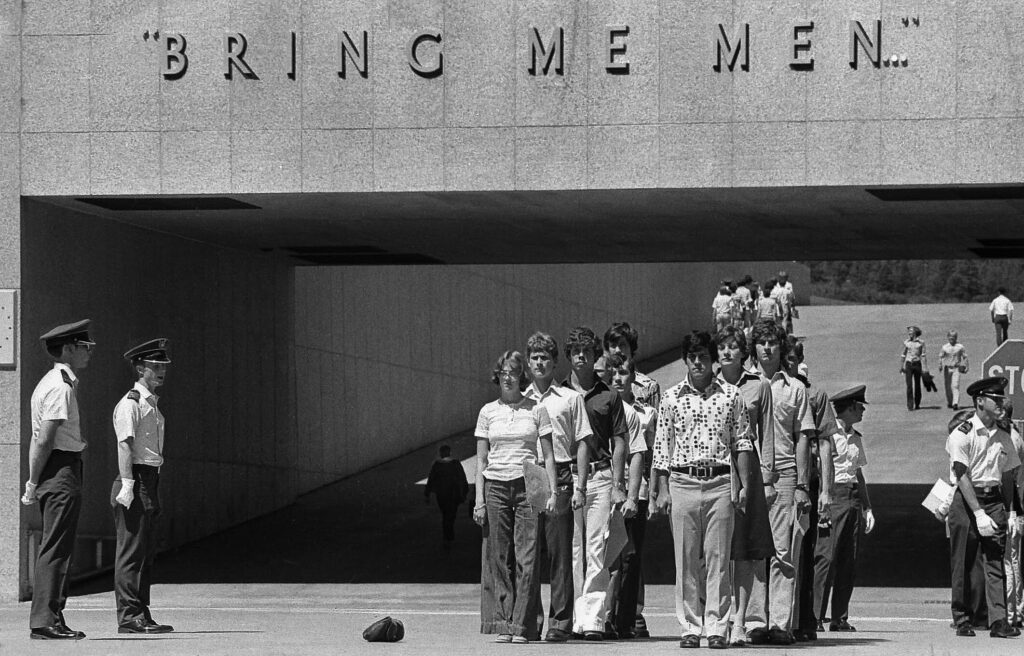
Fifty years later, women reflect on first coed class at the Air Force Academy, struggle for equality
Mary Shinn
mary-shinn@coloradopolitics.com
Updated 2 days ago
When the first female Air Force Academy cadets arrived 50 years ago this summer, they stood in front of an enormous sign on campus that read “Bring me men.” In the shadow of that sign, Kathleen Utley Kornahrens, one of...

A new day? Colorado’s troubled guardianship office pursues ‘cultural reset’
Marianne Goodland
marianne.goodland@coloradopolitics.com
Updated 4 days ago
Colorado’s guardianship program, long criticized for mismanagement and high staff attrition, is undergoing a “cultural reset,” as its new director works to repair partnerships and prepare for a major expansion under recent legislation. Created by lawmakers in 2017, the Office...

U.S. Senate OKs funding bill to avoid government shutdown
Wire Services
wire-services@coloradopolitics.com
Updated 2 days ago
Hemp provision became point of contention WASHINGTON • The U.S. Senate in an overnight vote Saturday approved a short-term measure to fund federal agencies into early December and avoid a government shutdown during the middle of campaign season. The late-summer...

The relevance of Watergate more than a half-century later | SONDERMANN
By Eric Sondermann
by-eric-sondermann@coloradopolitics.com
Updated 5 days ago
It was the scandal for which all other scandals are now named. In June 1972, a small group of Cuban burglars with high-level connections broke into the headquarters of the Democratic National Committee. Those headquarters were located in the Watergate...

Wirth downplays Social Security disaster talk | A LOOK BACK
Rachael Wright, Special to Colorado Politics
rachael.wright@coloradopolitics.com
Updated 4 days ago
Forty-five years ago this week: “As time goes on,” said Democratic U.S. Rep. Tim Wirth, of the 2nd Congressional District, “we are finding that the safety net, which was proposed earlier this year, has some very large holes in it,”...

Colorado Politics Calendar Aug. 10-16
Rachael Wright, Special to Colorado Politics
rachael.wright@coloradopolitics.com
Updated 4 days ago
CoPo’s weekly political calendar will help you find political and public-policy events throughout Colorado. It includes candidate and issue campaign events, public policy meetings, court hearings, state and local party conventions, assemblies, debates, rallies, parades, speaking engagements, traveling dignitary appearances,...

Democratic group aims Spanish-language TV ad at Gabe Evans in Colorado’s battleground 8th CD
Ernest Luning
ernest.luning@coloradopolitics.com
Updated 3 days ago
A national group tied to House Democratic leadership launched a six-figure Spanish-language TV ad in Colorado this week targeting Republican U.S. Rep. Gabe Evans and the GOP’s signature budget legislation. The 30-second spot is part of $15 million in new...

Colorado School of Mines lands major share in Trump’s $100M mining-education plan
Thelma Grimes
thelma.grimes@coloradopolitics.com
Updated 3 days ago
President Donald Trump on Friday named the Colorado School of Mines among roughly a dozen institutions that will share in a $100 million commitment “to train the next generation of American miners.” Paul Johnson, the university’s president, said he is...

Local party leaders, incoming judge among members of judicial performance commission that violated law
Michael Karlik
michael.karlik@coloradopolitics.com
Updated 2 days ago
A local Democratic leader and 2024 presidential elector. A legislative aide and leader in the Young Republicans. An incoming county court judge freshly appointed by the governor. They are among the eight members of the northeastern Colorado judicial performance commission...

Judge dismisses lawsuit seeking records from Colorado Democratic group
Marianne Goodland
marianne.goodland@coloradopolitics.com
Updated 3 days ago
A lawsuit seeking to obtain records from Democratic lawmakers affiliated with a caucus has been thrown out by a Denver District Court judge. On July 17, Judge Ericka Englert dismissed the April lawsuit filed by progressive activist Derrick Blanton, who...
PREV
PREVIOUS

U.S. Senate OKs funding bill to avoid government shutdown
Hemp provision became point of contention WASHINGTON • The U.S. Senate in an overnight vote Saturday approved a short-term measure to fund federal agencies into early December and avoid a government shutdown during the middle of campaign season. The late-summer action on a funding fix is unusual. Normally, Congress waits until the final days or […]

A new day? Colorado’s troubled guardianship office pursues ‘cultural reset'
Colorado’s guardianship program, long criticized for mismanagement and high staff attrition, is undergoing a “cultural reset,” as its new director works to repair partnerships and prepare for a major expansion under recent legislation. Created by lawmakers in 2017, the Office of Public Guardianship serves as a ward of last resort for indigent or incapacitated people […]