

Will Bennet sponsor antibiotics legislation?

Antibiotics have transformed the practice of medicine over the past century, allowing doctors to cure bacterial infections that once meant amputations, disabilities and often death. Now doctors are increasingly seeing patients with infections like MRSA (Methicillin-resistant Staphylococcus aureus) that are not responding to usually effective antibiotics. Widespread misuse of these curative medicines undermines their effectiveness. In recognition of this fact, healthcare providers are increasingly protecting antibiotics by moving away from prescribing them preventively.
Unfortunately, the same cannot be said for factory farm operators. According to the Food & Drug Administration (FDA), up to 80 percent of antibiotics sold in the United States are fed to animals raised for food. This is a misguided effort to control the diseases that spread in over-crowded and unsanitary factory farm environments.

Dr. Kajsa Harris


Dr. Larry Moore
For decades, the medical community has been able to prescribe antibiotics with an extraordinarily high level of confidence that doing so would improve patients’ lives. Now, the Centers for Disease Control & Prevention (CDC) has declared that we are entering a post-antibiotic era. The CDC reported in 2013 that 2 million people in the United States contract an antibiotic-resistant infection each year, and of these, 23,000 die.
Antibiotics work to eradicate bacterial infections. They are not effective for treatment of viral infections such as head colds or influenza. Additionally, an antibiotic must be administered in appropriate doses and for long enough to kill the infecting bacteria, which is why it is important to follow the prescription directions completely.
Antibiotics are administered to factory farmed food animals in a way that creates the ideal conditions for bacterial antibiotic resistance to develop. Because these animals are fed low daily doses of antibiotics, bacteria that are present in the animals develop an immunity or resistance to these medicines.
These resistant bacteria, sometimes known as “superbugs,” persist in the environment and are much less susceptible to the antibiotics meant to kill them. Superbugs can infect anyone. They are in our waterways, our public places, and with increasing frequency, in our food supply. Excluding meat from our diet will not protect us from antibiotic-resistant infections.
Regulators continue to ignore the root causes of the rise of superbugs. The FDA reported in the 1970s that there was a clear necessity to decrease the use of antibiotics in food animal production. Large agricultural companies lobbied the FDA, but the government took no action. Continuing to improperly feed our life-saving antibiotics to farm animals that aren’t sick will only maintain the upward trend of illness and death for thousands of Americans and their families.
Congress has an opportunity to take action. The Preventing Antibiotic Resistance Act (PARA), now active in the Senate, would allow farmers to give antibiotics to farm animals for treatment of real infections, but prohibit preventive feeding of antibiotics in animals’ daily food and water. Decreasing the overuse of antibiotics on factory farms will help slow the development of antibiotic resistant infections. Passing PARA (and its counterpart in the House, PAMTA) is the necessary first step.
Senator Michael Bennet is aware that factory-farming practices compromise the effectiveness of antibiotics, but he has not yet sponsored PARA. Instead, Senator Bennet recently sponsored the PATH Act to speed up the approval of new antibiotics. But, as long as we continue this misuse of antibiotics, it is only a matter of time before any newly approved antibiotics will also be rendered ineffective.
As physicians we rely on the use of antibiotics to treat some of our most seriously ill and dying patients. We urge Senator Bennet to take the right action to protect the effectiveness of all antibiotics by ending their misuse on factory farms. By sponsoring PARA, Senator Bennet can play a direct role in saving lives in Colorado and across the United States.
— Dr. Kajsa Harris works at Rocky Mountain P.A.C.E. and as an associate medical director at Gentivia hospice in Colorado Springs. Dr. Larry Moore is Board Certified in Emergency Medicine, and practices Urgent Care Medicine in Woodland Park; he is a member of the El Paso County Medical Society, and the Colorado Medical Society.


Democratic ballots outpace Republicans’ as Colorado’s primary vote starts to trickle in
Ernest Luning
ernest.luning@coloradopolitics.com
Updated 9 minutes ago
With less than two weeks left before ballots are due in Colorado’s primary election, election officials have logged in ballots from just under 6% of the state’s 4 million active, registered voters, the Colorado Secretary of State’s Office said Thursday....
Colorado court upholds murder conviction despite jury disobeying instructions
Michael Karlik
michael.karlik@coloradopolitics.com
Updated 5 hours ago
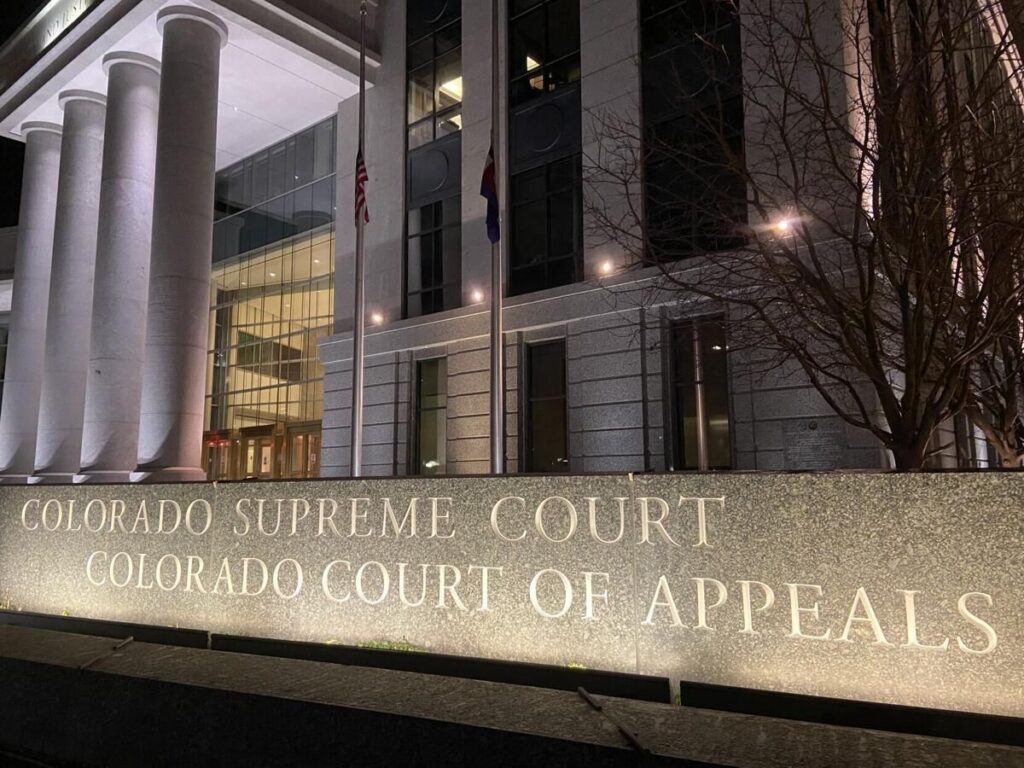
Colorado’s second-highest court upheld an Arapahoe County defendant’s murder conviction last month, even though jurors found he was not the one who shot the victim and the evidence suggested he was not present for the shooting. A three-judge Court of...

July 1 brings new Colorado rules on ammunition purchases, wildfire‑risk scoring and wildlife enforcement
Marissa Ventrelli
marissa.ventrelli@coloradopolitics.com
Updated 7 hours ago
Colorado will usher in a new set of laws on July 1 that touch everything from ammunition sales to insurance transparency and wildlife trafficking enforcement Here is a look at some of the state’s new laws: Ammunition sales Sponsored by...

Divided appeals court reverses conviction after judge declined to define ‘bludgeon’
Michael Karlik
michael.karlik@coloradopolitics.com
Updated 9 hours ago
Colorado’s second-highest court reversed a Jefferson County defendant’s felony menacing conviction on Thursday, concluding that the trial judge’s failure to define “bludgeon” for jurors may have affected the outcome. A three-judge Court of Appeals panel divided in unusual ways in...

Poll finds majority believe US military action against Iran was a mistake
Brady Knox, Washington Examiner
brady.knox.washington.examiner@gazetteedit.wpenginepowered.com
Updated 9 hours ago
A poll found a wide majority of U.S. voters believed the decision to launch military action against Iran was a mistake. The Beacon Research and Shaw & Company Research poll for Fox News was conducted from June 12-15, meaning many...

For Vance, Iran deal presents opportunity and risk
W. James Antle III Washington Examiner
wjamesantleiiiwashingtonexaminer@wpstage.coloradopolitics.com
Updated 11 hours ago
Vice President JD Vance has a lot riding on the deal to end the war in Iran. The memorandum of understanding between the United States and Iran came together at the outset of Vance’s book tour, but that’s not the...

10th Circuit dismisses Tina Peters’ challenge to confinement as moot
Michael Karlik
michael.karlik@coloradopolitics.com
Updated 33 minutes ago
The Denver-based federal appeals court granted the state’s unopposed request on Wednesday to dismiss former Mesa County clerk Tina Peters’ challenge to her confinement as moot. Although Peters received a commutation of her prison sentence last month from Gov. Jared...

Federal judge declines to recuse from death penalty case after Supermax visit
Michael Karlik
michael.karlik@coloradopolitics.com
Updated 3 hours ago
A federal judge declined to recuse herself last month from a death penalty case arising out of Colorado’s “Supermax” prison, finding that her tour of the facility earlier this year did not bias her decision-making. U.S. District Court Judge Charlotte...

Amid public pressure, Colorado candidates tackle social media regulations for minors
Bethany Johnson
bethany.johnson@denvergazette.com
Updated 10 hours ago
Following the accidental overdose of her daughter in 2020, Patti Lujan pursued a lawsuit against Snapchat, the social media platform that, she claimed, connected her daughter with a drug dealer. In a news release announcing the lawsuit, Lujan alleged that...

Denver gets more time to answer FAA questions in probe regarding Key Lime lease denial
Deborah Grigsby
deborah.smith@denvergazette.com
Updated 10 hours ago
The City of Denver has asked the Federal Aviation Administration for additional time to gather information and prepare its response to the federal agency’s investigation of the city’s 2025 denial of a Denver International Airport ground lease expansion for Key...
PREV
PREVIOUS
Hickenlooper vetoes high-cost lending bill
A bill that would have altered the interest rate structure on high risk personal loans died on Gov. John Hickenlooper’s desk on Thursday.The governor vetoed House Bill 1390 after consumer groups blasted the bill as being unfair to the poor and one that would have resulted in higher-cost loans. Supervised loans provide borrowing options for […]

Denver elects four to council in run-offs
Denver voters elected four newcomers to City Council in a run-off election on Tuesday, bringing to seven the number of rookies who will take office on the 13-member body next month. It’s the most turnover since 2003, when term limits kicked in and shook up the city council. In the closest race of the night, […]