

Douglas County commissioners reject challenge to ballot language for 3 to 5 petition
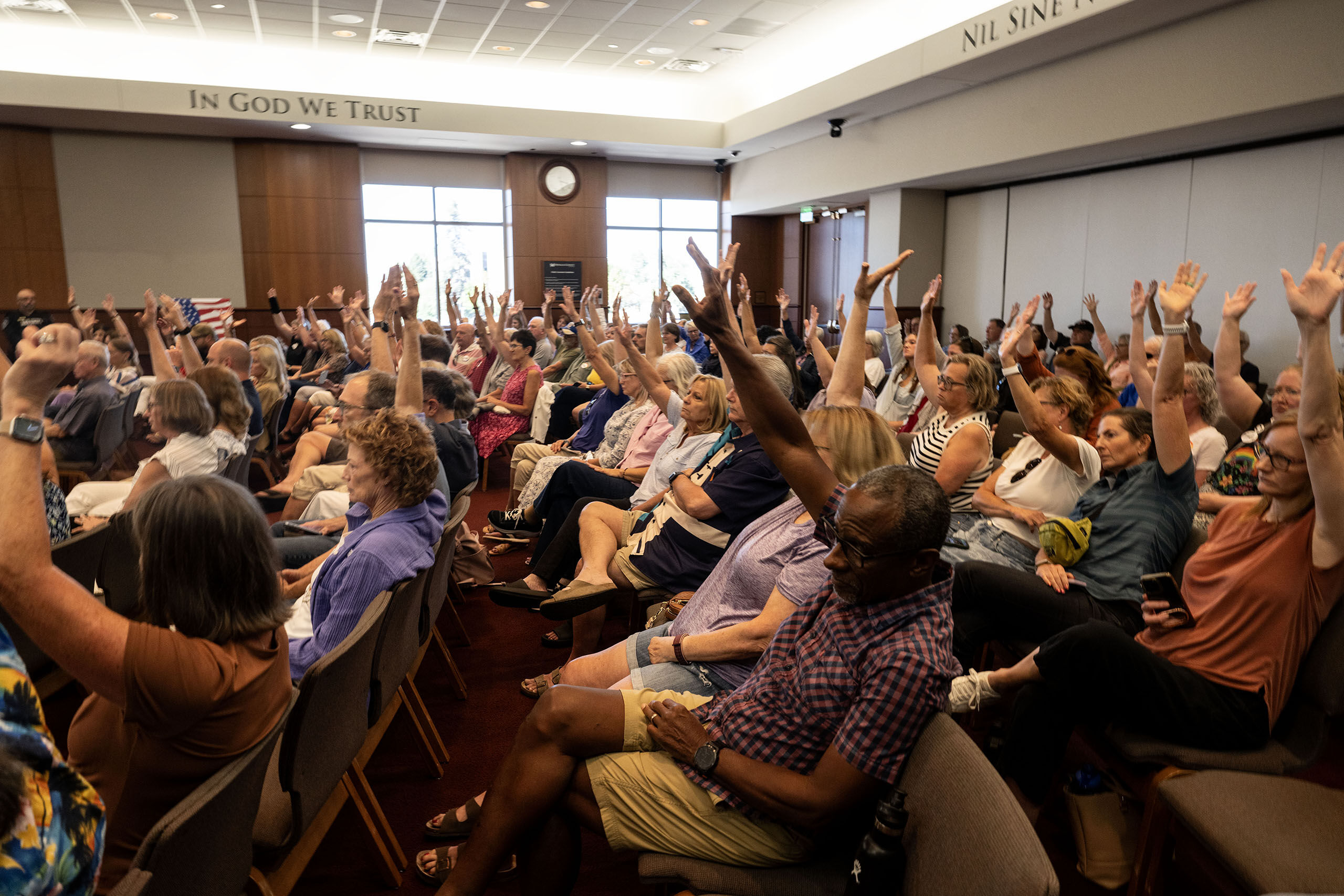
Douglas County commissioners denied a challenge Thursday to the language of a ballot initiative that would expand the board from three to five members.
Following a contentious hearing that saw multiple audience members escorted out by police for disruptions, commissioners concluded that the challengers “failed to demonstrate that the ballot title does not meet the requirements” of state law.
The hearing stems from a citizen-organized petition to expand the number of county commissioners. Petition signatures were certified in August, and on Aug. 25, county commissioners designated themselves as the title board, which sets ballot language and hears protests on approved ballot titles.
This is the first citizen-initiated ballot measure in Douglas County in 32 years, according to county staff.
The board later approved additional language stating that the expansion would result in “an ongoing annual expense of $760,000 to $1.3 million from county revenues” and that those revenues currently “support public safety, transportation, and essential county services.”
Organizers subsequently filed a challenge to the language.
What the challengers say
During the hearing, organizers Angela Thomas and Kim Carroll argued that the additional language violated state statutes and undermined the intent of the more than 20,000 voters who signed the petition by changing the language they believed would appear on the ballot.

(Stephen Swofford, Denver Gazette)
Under state standards, a title board must consider whether a title could create public confusion, avoid language that makes the effect of a “yes” or “no” vote unclear, and ensure the title correctly and fairly expresses the true intent and meaning of the measure.
Organizers argued that the estimated cost calculated by county staff could mislead voters by implying that the ballot mandated those expenses.
The costs were calculated by county staff to include optional additional staffing, salaries, equipment and other expenses associated with commissioner’s duties.
According to county estimates, the direct ongoing cost of two additional commissioners would be approximately $481,708 annually.
Thomas and Carroll argued that because the costs were speculative and subject to the board’s discretion, they could be misleading and confusing to voters. They noted that state law does not require a cost estimate because the ballot does not change local taxes.
Petition organizers also argued that language referencing public services was included to incorrectly imply that those services would be reduced because of increased costs.
“Placing a cost figure immediately next to the county’s most important and politically sensitive services does not provide more information. It creates a message,” Thomas said.
Challengers also argued that the commissioners incorrectly applied state law, including designating themselves the titling board under a state statute they contend does not apply to a measure increasing the number of county commissioners.
What the Board found
Commissioners ultimately found that the challengers had not provided evidence that the board incorrectly applied state law or that the approved ballot language would mislead or confuse voters.
They argued that omitting cost information would mislead voters into believing there would be no expense associated with the expansion. The board said the $760,000 to $1.3 million range was a realistic representation of what the county expects the expansion to cost.
Commissioners also argued that including fiscal information would give voters a better understanding of how county funding is used and said the references to county services would not mislead voters.
The board said state law gives titles boards broad discretion when setting ballot language and found that challengers failed to provide evidence that the board acted unfairly or altered the measure’s intent.
Commissioner George Teal told The Denver Gazette that he did not see any ethical conflicts of interest, or the appearance of a conflict, in setting the title for a ballot measure that affects the Board of County Commissioners.
He argued that commissioners would not personally benefit from either outcome of the election.
“We’re not the beneficiaries of two people appearing on the board,” Teal said. “I don’t understand how there’s an ethical problem there. I don’t get paid more if everybody votes to go to five county commissioners this November.”
What is next
Thomas told The Denver Gazette after the hearing that the contentious meeting “went exactly the way I expected it to go.”
“They did not act impartially,” Thomas said. “They would not hear that their actions were outside the statutes they cited and used for justification.”
When asked what comes next, Thomas said her focus is now turning to the November election.
“We fought and won against the home rule ballot measure last year, and we will win on this measure too,” Thomas said.
Another protest hearing will be held Friday concerning the county-led ballot that would elect all five commissioners on a countywide election voting system.


Regulators knew this marijuana product was harming people. It stayed on shelves for more than a year
Christopher Osher
chris.osher@gazette.com
Updated 1 day ago
Colorado’s Marijuana Enforcement Division can take months or even years to issue formal safety warnings about marijuana products even when it receives reports that the products are harming people’s health, The Denver Gazette and ProPublica found. This article was produced...

Favorability rating of Mayor Mike Johnston, Denver City Council slides
Nico Brambila
nico.brambila@denvergazette.com
Updated 2 hours ago
Denver Mayor Mike Johnston’s favorability rating fell 7 percentage points over the past year, while the City Council’s favorability rating dropped 3 percentage points, a new poll has found. A little more than a year after taking office, Johnston had...

Judge orders home confinement for Barry Morphew
Dennis Huspeni
dennis.huspeni@gazette.com
Updated 23 hours ago
An Alamosa County district judge has ordered home confinement for Barry Morphew, who is accused of murdering his wife. Barry Morphew, 59, faces a first-degree murder charge in the death of his wife, Suzanne Morphew, who disappeared Mother’s Day weekend...

Ikon Pass company Alterra to move into former Denver Post building, create downtown ‘outdoor hub’
Bernadette Berdychowski
bernadette.berdychowski@denvergazette.com
Updated 1 day ago
What was once the home of two of Colorado’s longest-running daily newspapers could soon become a central location for the state’s ski resort and outdoor companies, city and state leaders said Thursday. Alterra Mountain Co. is moving its headquarters to...

Castle Rock Town Council passes measure expanding authority over school-designated land and funds
Nicholas Fogleman
nicholas.fogleman@denvergazette.com
Updated 1 day ago
The Castle Rock Town Council passed an ordinance Tuesday that gives the council broader authority to repurpose land and cash designated for school facilities. Douglas County School District officials argue the move would allow the town to do so without...

Denver plans to spend $50M on improvements to Sloan’s Lake
Nicole C. Brambila
nicole-c-brambila@coloradopolitics.com
Updated 2 days ago
Denver plans to spend $50 million for Sloan’s Lake improvements. Mayor Mike Johnston and Councilmembers Amanda P. Sandoval and Jamie Torres announced the project’s launch steps from the lake’s shore near the jetty in the park on Wednesday morning. “After...

Petitions seek to place noise restrictions, surveillance cameras and water limits on Colorado Springs ballot
Brennen Kauffman
brennen-kauffman@coloradopolitics.com
Updated 1 day ago
Petitioners in Colorado Springs are preparing to gather signatures to place restrictions on noise levels, developments that use a large volume of water and surveillance cameras that use automatic tracking technology. The City Clerk’s office on Monday gave final approval...

Douglas County sheriff warns of scam impersonating officer
Nicholas Fogleman
nicholas.fogleman@denvergazette.com
Updated 2 days ago
The Douglas County Sheriff’s Office is warning residents about an ongoing scam in which a caller impersonates a sheriff’s office commander in an attempt to solicit payment. Officials said the scammer is posing as Sheriff’s Office Commander Chad Walker and...
Colorado judges may use professional name in lieu of legal name, ethics panel says
Michael Karlik
michael.karlik@coloradopolitics.com
Updated 23 hours ago
Colorado’s Judicial Ethics Advisory Board concluded on Tuesday that members of the bench may go by a professional name, rather than their legal name, so long as their intent is not to deceive. The board, which consists of judges, attorneys...

Fort Carson combat medic killed by fellow soldier remembered as supportive brother and son
Mary Shinn
mary-shinn@coloradopolitics.com
Updated 1 day ago
A Fort Carson infantryman told police he shot a fellow soldier with a gun he believed was unloaded while at a home in Pueblo during late August. Private 2nd Class Kalob Deyo, 23, is facing a felony manslaughter charge and...
PREV
PREVIOUS

Favorability rating of Mayor Mike Johnston, Denver City Council slides
Denver Mayor Mike Johnston’s favorability rating fell 7 percentage points over the past year, while the City Council’s favorability rating dropped 3 percentage points, a new poll has found. A little more than a year after taking office, Johnston had enjoyed a 48% favorability rating among likely voters. That declined to 46% in 2025, sliding […]

Regulators knew this marijuana product was harming people. It stayed on shelves for more than a year
Colorado’s Marijuana Enforcement Division can take months or even years to issue formal safety warnings about marijuana products even when it receives reports that the products are harming people’s health, The Denver Gazette and ProPublica found. This article was produced in partnership with ProPublica’s Local Reporting Network. In March 2022, Colorado public health officials started […]