

Veo scooter clutter, sidewalk riders frustrate Denverites
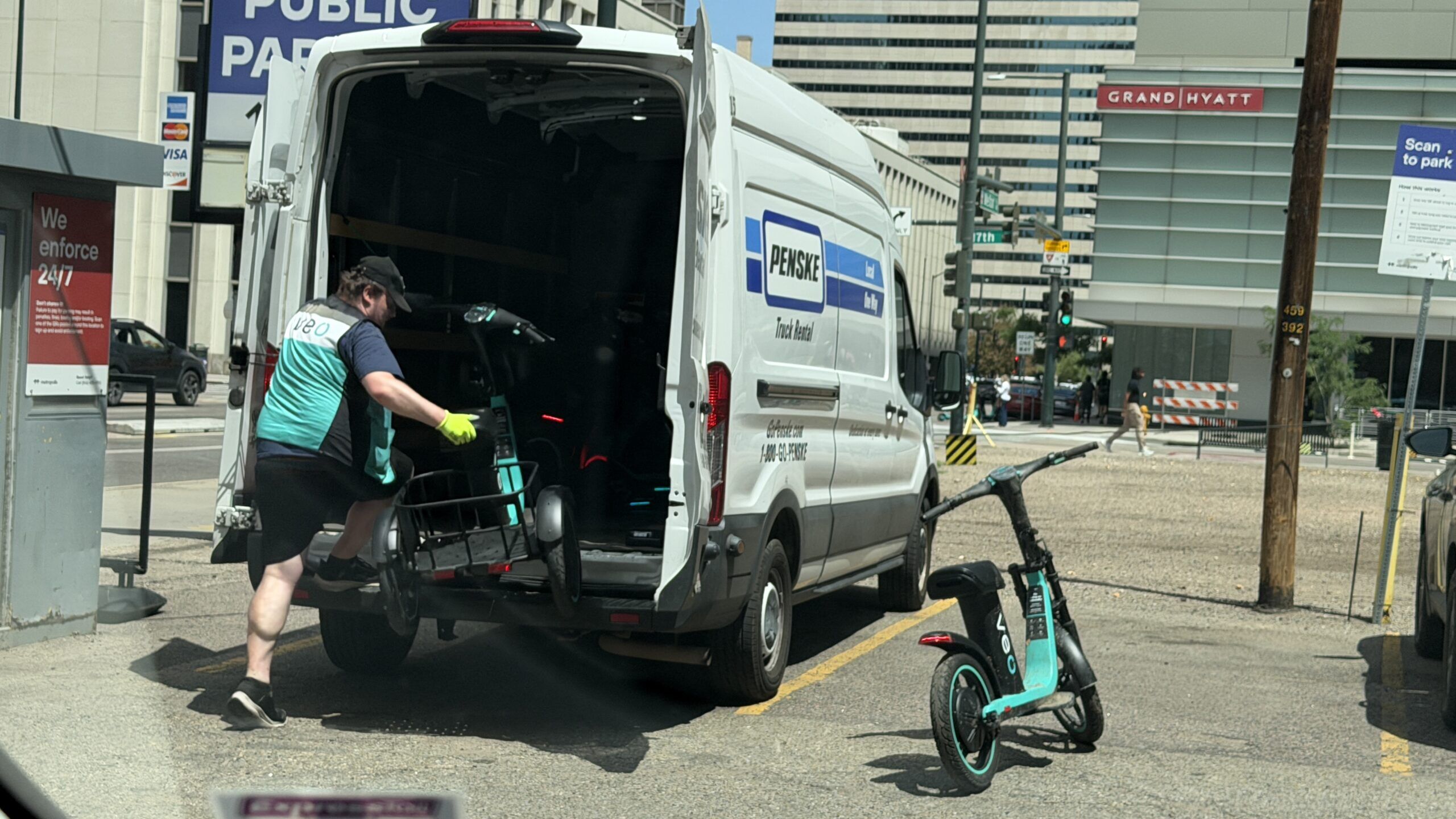
Denver resident Mike Miller was on a downtown sidewalk recently when a Veo scooter rider traveling at full speed passed him as the scooter blasted a “do not ride on sidewalks” warning.
In a letter to Veo Policy and Partnerships Manager Rebekah Hernandez obtained by The Denver Gazette, Miller said that the rider was wearing headphones, never acknowledged him and missed striking him on the sidewalk by “a narrow margin.”
Veo, a Santa Monica-based company, is just 90 days into its three-year license agreement with the City and County of Denver but downtown residents who gathered at a City Council District 10 town hall on Thursday said their concerns over illegally parked scooters and pedestrian safety are growing.
Miller, in an email to The Denver Gazette, said, “As advocates for our LoDo neighborhood, our goal is to help effect positive change with Veo, not just to complain about issues.”
Miller is a co-chair of the Lower Downtown Denver Neighborhood Association’s pedestrian safety committee.
He said his group has reached out to Veo with specific concerns and “they have been responsive and collaborative to date.”
But that has not been the case with everyone who has complained, according to Denver City Councilmember Chris Hinds.
Hinds, who has received more than 100 complaints to his office regarding Veo, addressed questions about the company’s lack of response to complaints, adding that he reached out to Veo for clarification.
He said he has even forwarded complaints directly to Veo.
Requests to remove illegally parked scooters and other complaints submitted online are “acknowledged” with an auto-response message and a ticket number.
In an email obtained by The Denver Gazette, Hernandez said that “it’s not customary to respond to customer complaints or tickets due to the volume of complaints we receive across nationwide markets.”
Hernandez accepted and then declined an invitation to attend the town hall at the Denver Central Library to provide Veo’s “perspective” on the matter. She emailed Hinds late Tuesday afternoon that an “internal meeting (came) up” and she would not be able to attend.
Hinds told The Denver Gazette on Thursday that his office asked Veo to reconsider sending a representative.
Hinds, who reserved a seat in anticipation of a representative’s arrival, joked, “We invited them. The scooter showed up instead.”
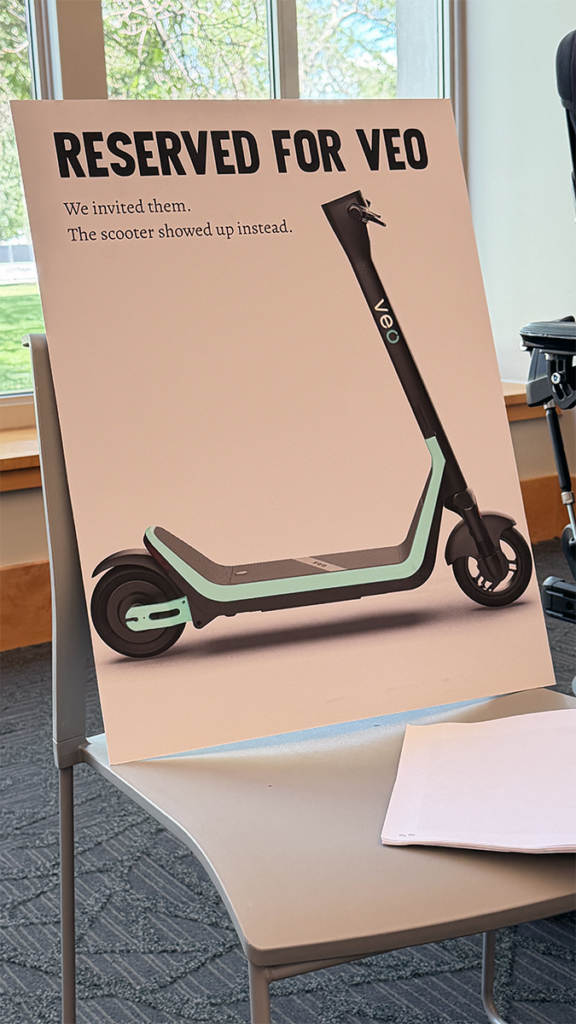
More than an hour into the meeting, a Veo representative had yet to show up.
“This isn’t comfortable for me to publicly shame a vendor, a city vendor,” Hinds said. “Obviously, they don’t care because they’re not here exactly.”
Hinds, who sponsored city legislation requiring “micromobility” vendors to include sidewalk detection technology, said he believes Veo may be in violation of its agreement with the city and has asked the city attorney to review the contract.
The legislation shifts responsibility for preventing sidewalk riding from the city to the vendor and requires the use of technology to do so, Hinds said.
“Veo is currently working to identify which sidewalks we can safely label as ‘no ride zones’ around the city,” Hernandez wrote in a July 20 email. “Right now, riders on sidewalks hear a loud warning notification and can eventually be fined for chronic sidewalk violations. While I know it’s frustrating to see scooters zooming down sidewalks, Veo allows this behavior in the scenario that a scooter needs to jump on a sidewalk to avoid being hit by a car.”
Veo officials said that most of its Denver fleet already has GPS technology on board to prevent sidewalk riding.
“It’s still early, but the law took effect July 1, and certainly in the town hall, we heard from lots of constituents that they see the current vendor and their devices on the sidewalk just as often as the previous vendor had their devices or vendors,” Hinds said.
Jeff Hoover, Veo’s director of government partnerships, told The Denver Gazette that the company is actively collecting data to ensure the accuracy of its geofencing and rider safety.
“In the shadow of, say, like tall downtown buildings, the GPS can drift a handful of feet and that handful of feet can make all the difference whether the GPS perceives you to be in a bike lane or on the sidewalk and/or on the street and on the sidewalk,” Hoover told The Denver Gazette.
Veo’s agreement with the city is not exclusive, Hinds said.
Denver resident Rob Farol, 60, whose main mode of transportation is Veo, said one of his biggest complaints with the company is that many functions on the Veo app are not working.
Farol said issues with micromobility could be greatly improved if the city supported more protected infrastructure, bike lanes and designated areas for the vehicles to operate, such as in many European cities.
“I feel like Denver can move in the right direction, but they need to do it faster by providing us the funding to make our streets safe,” Farol said. “And if they’re really concerned about youngsters on all these different types of mobility things — 16 years old, you need to have a license before you get on these. You’re riding in the street just like everybody else. You should have a license, in my opinion.”
The issue of instituting protected lanes for bikes and similar modes of transportation and moving people away from cars — part of a concept some have called “road dieting” — has been the focal point of debate in the city.
Broadly speaking, supporters said road dieting would improve safety, in particular curb fatal pedestrian-motorist crashes, while critics said the concept is copied from a European experiment that doesn’t work on American streets and has increased the danger for motorists and pedestrians alike, not lessened it.


Federal biotech commission examines Colorado’s role in critical minerals production
Scott Weiser
scott.weiser@gazette.com
Updated 1 day ago
China’s dominance over critical mineral supplies has left U.S. manufacturers vulnerable. Colorado’s biotech and research community is working to ease that dependence. Leaders from the National Security Commission on Emerging Biotechnology met last week at the Colorado School of Mines...

Douglas County schools to consolidate administrative offices into $29M headquarters to cut costs
Nicholas Fogleman
nicholas.fogleman@denvergazette.com
Updated 1 day ago
The Douglas County School Board is moving forward with a $29 million plan to consolidate district administrative operations into a new headquarters. It’s part of an effort to reduce annual costs as the district faces ongoing budget pressures. In June,...

Colorado’s 72-hour social media warrant law takes effect Aug. 12
Marissa Ventrelli
marissa.ventrelli@coloradopolitics.com
Updated 2 days ago
A law requiring social media platforms to respond to search warrants within 72 hours goes into effect on Aug. 12. Senate Bill 011 also requires platforms to create a staffed hotline for Colorado law enforcement agencies to contact regarding pending...
El Paso County rejects multi-family zoning request near Monument Academy
Savannah Eller
savannah-eller@coloradopolitics.com
Updated 3 days ago
The El Paso County Board of Commissioners narrowly rejected a developer’s bid to convert land from low- to high-density residential zoning. The request, made by MA Infrastructure, LLC, would have allowed 12 units per acre on half of a 14-acre...

Denver City Council sends Xcel franchise deal to voters
Deborah Grigsby
deborah.smith@denvergazette.com
Updated 4 days ago
This November, Denver voters will decide whether to renew the city’s longstanding franchise agreement with Xcel Energy. Members of the Denver City Council approved on Monday sending a proposed 20-year franchise agreement with Xcel that would deliver more than $180...

Chamber names its Top 25 Most Powerful Women in Business | NONPROFIT REGISTER
Joanne Davidson Special to Colorado Politics
joanne-davidson-special-to-colorado-politics@coloradopolitics.com
Updated 3 hours ago
COLORADO WOMEN’S CHAMBER OF COMMERCE Denver News: Marielena DeSanctis, chancellor of the Colorado Community College System; Terri Jackson, executive director and co-founder of the African American Trade Association and Emily Trujillo, chief operating officer at HCA HealthONE Centennial, are among the 2026 Top 25 Most Powerful Women...

Colorado produce not tied to nationwide cyclospora outbreak, agriculture officials say
Marissa Ventrelli
marissa.ventrelli@coloradopolitics.com
Updated 1 week ago
There is no indication that the recent outbreak of cyclospora, a fecal parasite that has contaminated food and water across nearly every state, can be linked to produce grown in Colorado, according to the state’s Department of Agriculture. “Colorado growers...

Planning Commission rejects resident appeals to stop proposed data center
alex-edwards
alex.edwards@gazette.com
Updated 5 days ago
Editor’s note: This story has been updated to reflect comment from District 11 clarifying that it has not conducted a financial review of Project Taurus. The Colorado Springs Planning Commission rejected appeals Thursday night against a proposed artificial-intelligence data center...

Inspiration for film ‘Safety’ is tourney’s special guest | NONPROFIT REGISTER
Joanne Davidson Special to Colorado Politics
joanne-davidson-special-to-colorado-politics@coloradopolitics.com
Updated 1 week ago
VOLUNTEERS OF AMERICA COLORADO Denver News: Ray McElrathbey, a former Clemson University football player whose story of fighting to keep his brother out of foster care inspired the Disney+ movie “Safety,” will be the special guest when Volunteers of America Colorado hosts...

2026 Legends of Agriculture to be honored at fundraising dinner | NONPROFIT REGISTER
Joanne Davidson
joanne-davidson@coloradopolitics.com
Updated 1 week ago
COLORADO AGRICULTURAL LEADERSHIP FOUNDATION Castle Rock News: Mark and Teri Moore have been selected as the 2026 Legends of Agriculture and will be honored at a Sept. 18 dinner benefiting the Colorado Agricultural Leadership Foundation (CALF). The event begins at 5 p.m. at CALF’s...
PREV
PREVIOUS

Jeffco taxpayers could be on the hook for a possible child sex assault settlement
Taxpayers may end up on the hook for a child sexual assault settlement, possibly worth up to $15 million, after Jeffco Public Schools failed to notify its insurance company in a timely manner about the case. The incident stems from the Imagine Kay Ewer case. Ewer, a former paraprofessional in the district, groomed and sexually […]

Douglas County schools to consolidate administrative offices into $29M headquarters to cut costs
The Douglas County School Board is moving forward with a $29 million plan to consolidate district administrative operations into a new headquarters. It’s part of an effort to reduce annual costs as the district faces ongoing budget pressures. In June, the board voted 5-1 to authorize the purchase of Meridian One, a 140,000-square-foot office building […]