

It won’t end the drought, but ‘Super El Niño’ expected to boost Colorado moisture
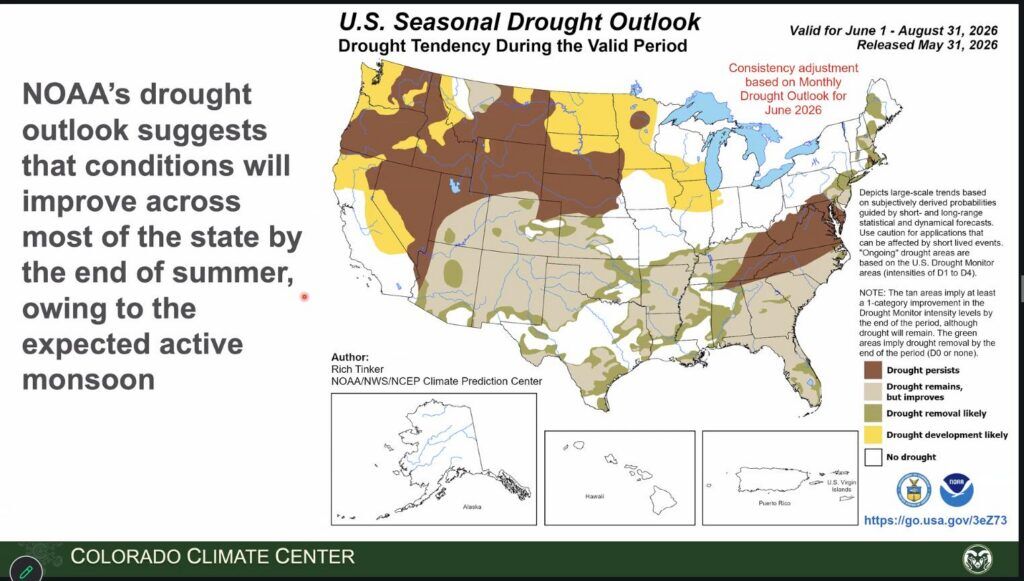
Colorado is headed into what could be one of its strongest El Niño summers on record, a shift expected to bring above‑average monsoon moisture, though not enough to erase the state’s long‑running drought.
That was the assessment on Tuesday from the Water Conditions Monitoring Committee, a group of state and federal water officials and local water managers.
Russ Schumacher, the state climatologist based at Colorado State University’s Colorado Climate Center, said the summer monsoon season, which could start as soon as the second week of July, will be wetter than average and possibly one of the strongest El Niños that Colorado has ever had.
That means Colorado is less likely to stay in long-term drought conditions.
“We’re happy to see it here, but a lot of places won’t be happy,” Schumacher said.
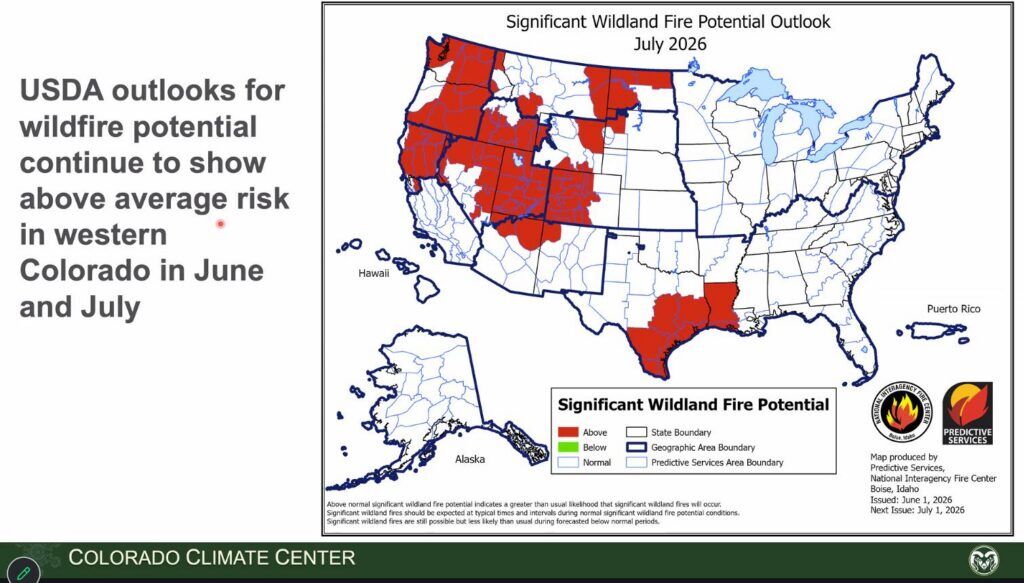
The moisture could bring record-high temperatures, too.
Part of the reason for a “Super El Niño” — and the high temperatures that come with it — is temperature change, according to Schumacher.
An El Niño occurs when temperatures in the equatorial Pacific are 0.5 degrees C above average for several consecutive months, according to the National Oceanic and Atmospheric Administration.
Its impact is felt most strongly during the winter months, but it can also cause coastal flooding, particularly on the West Coast.
As for temperatures, Schumacher said the current water year — Oct. 1 through this week — has been by far the warmest on record and among the top 10 driest in the state.
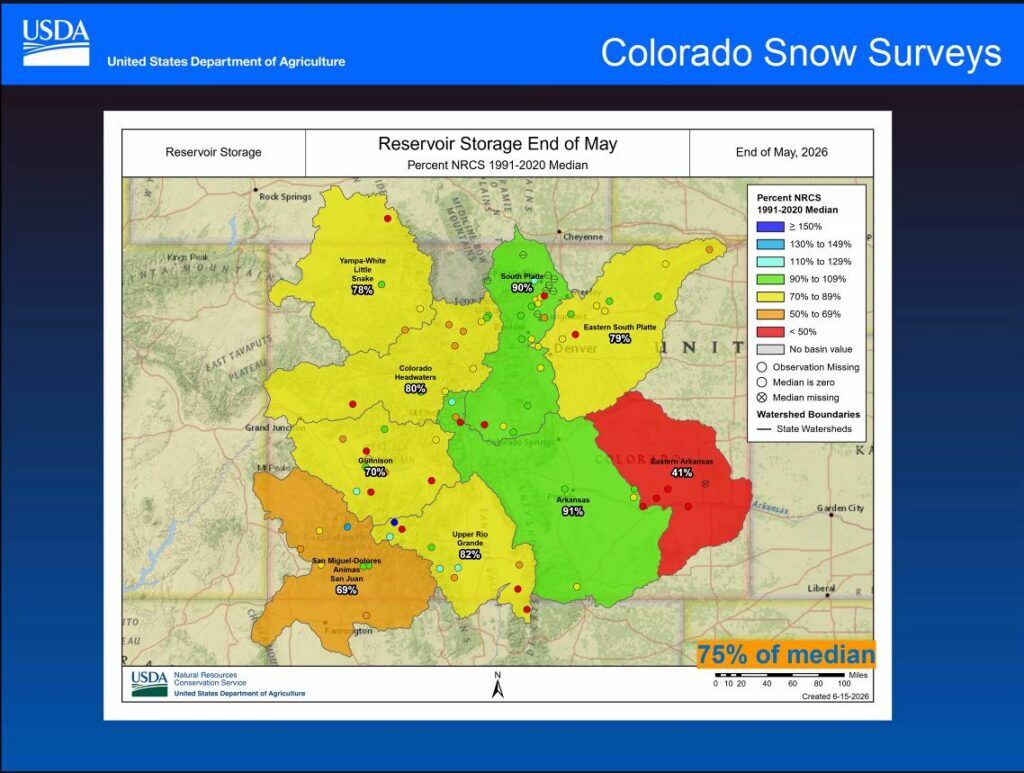
A report from Nagam Bell of the Natural Resources Conservation Service showed the state of Colorado’s reservoirs and soil conditions as the first storms from El Niño are on the horizon.
Colorado’s snowpack is gone, she said, about 36 days earlier than normal.
Reservoirs around the state are at 75% of median, Bell reported, but that’s higher, in part, due to the storms that hit southwestern Colorado last fall. Most Western Slope reservoirs are lower than usual, she added.
June’s precipitation to date is dismal, she indicated, showing the state has seen only 14% of the median precipitation it should expect for this time of year.
Experts who keep an eye on local reservoirs and water use are also optimistic about the El Niño forecast.
Denver Water’s Nathan Elder said the reservoirs they rely on are 81% full, about 2% above where they expected them to be in June.
Northern Water’s Emily Carbone said their storage, at 75%, is the lowest since 2014, and they expect the shortages to increase over the summer.
Drew Beckwith at the city of Westminster struck a more optimistic tone: With local storage at 96% of capacity, they’re keeping their fingers crossed for a strong El Niño summer.
Snowpack in Colorado had peaked at about 58% of normal — and weeks earlier than usual. An unusually warm March accelerated the melt, and parched soils will absorb much of that runoff before it ever reaches streams and reservoirs — leaving less water flowing downstream.
The snowpack doesn’t just feed the Colorado River. It supplies rivers across the region, including the South Platte, which provides water to much of the Denver metro area. But the already strained Colorado River is where the impact is most visible, experts have said.
The Colorado River has always cycled through wet and dry years. But over the past two decades, prolonged drought and rising temperatures have reduced the river’s overall flow — a trend water experts say is unlikely to reverse.
The stakes extend far beyond Colorado.
In Arizona, roughly 85% of residents live in cities that rely, at least in part, on the river.
“The snowpack was destroyed by the temperatures and lack of precipitation the likes of which have never occurred in the basin,” Brad Udall, senior water and climate research scholar at Colorado State University’s Colorado Water Center, earlier said.
Udall added, “The river basin was already in dire straits. This only makes it worse.”
In response, cities across the Denver metro region have imposed water restrictions — a strategy adopted so early in the year that it reflects how quickly conditions have deteriorated.
“By many measures, it’s the worst snowpack that we’ve seen,” Nathan Elder, manager of water supply with Denver Water, earlier said. “The numbers really are alarming.”
Denver Gazette’s Nico Brambila contributed to this article.


Colorado House ethics committee issues ‘stern letter’ to Democrat over caucus funds mismanagement
Marianne Goodland
marianne.goodland@coloradopolitics.com
Updated 1 hour ago
The Colorado House ethics committee on Friday voted unanimously to issue a “stern letter” to Rep. Mandy Lindsay, D-Aurora, regarding her mismanagement of House Democratic caucus funds. The committee further voted to request that Lindsay resign as Democratic Caucus co-chair...

State seeks $50K penalty against GOP candidate Victor Marx over alleged campaign finance violations
Deborah Grigsby
deborah.smith@denvergazette.com
Updated 5 hours ago
Republican gubernatorial candidate Victor Marx is looking at more than $50,000 in fines in what the Elections Division of the Office of the Secretary of State calls “unprecedented” campaign finance violations. The state has not imposed that fine yet, and...

Judge puts Colorado Libertarians’ secretary of state candidate on ballot after party’s 1st nominee drops out
Ernest Luning
ernest.luning@coloradopolitics.com
Updated 6 hours ago
A Denver judge ruled Friday that the Colorado Libertarian Party’s pick for secretary of state will appear on the November ballot after the party’s original nominee withdrew one day after the deadline to replace minor party candidates. Following a hearing...

Regulators knew this marijuana product was harming people. It stayed on shelves for more than a year
Christopher Osher
chris.osher@gazette.com
Updated 2 hours ago
Colorado’s Marijuana Enforcement Division can take months or even years to issue formal safety warnings about marijuana products even when it receives reports that the products are harming people’s health, The Denver Gazette and ProPublica found. This article was produced...

Douglas County commissioners reject challenge to ballot language for 3 to 5 petition
Nicholas Fogleman
nicholas.fogleman@denvergazette.com
Updated 3 hours ago
Douglas County commissioners denied a challenge Thursday to the language of a ballot initiative that would expand the board from three to five members. Following a contentious hearing that saw multiple audience members escorted out by police for disruptions, commissioners...
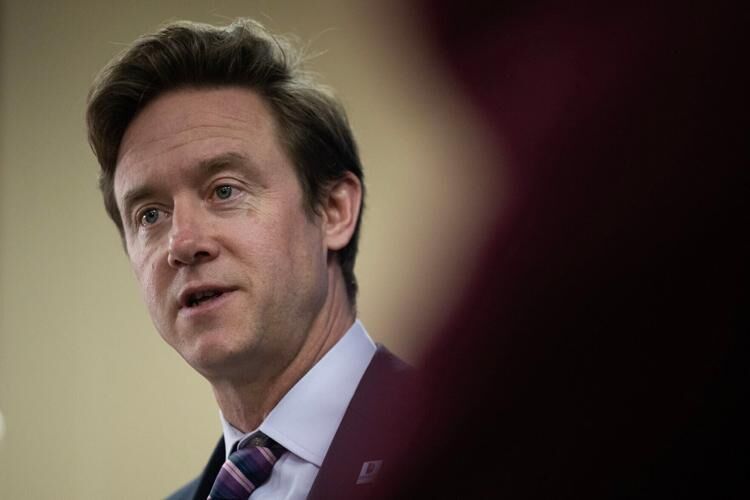
Favorability rating of Mayor Mike Johnston, Denver City Council slides
Nico Brambila
nico.brambila@denvergazette.com
Updated 5 hours ago
Denver Mayor Mike Johnston’s favorability rating fell 7 percentage points over the past year, while the City Council’s favorability rating dropped 3 percentage points, a new poll has found. A little more than a year after taking office, Johnston had...

Judge orders home confinement for Barry Morphew
Dennis Huspeni
dennis.huspeni@gazette.com
Updated 1 day ago
An Alamosa County district judge has ordered home confinement for Barry Morphew, who is accused of murdering his wife. Barry Morphew, 59, faces a first-degree murder charge in the death of his wife, Suzanne Morphew, who disappeared Mother’s Day weekend...

Ikon Pass company Alterra to move into former Denver Post building, create downtown ‘outdoor hub’
Bernadette Berdychowski
bernadette.berdychowski@denvergazette.com
Updated 1 day ago
What was once the home of two of Colorado’s longest-running daily newspapers could soon become a central location for the state’s ski resort and outdoor companies, city and state leaders said Thursday. Alterra Mountain Co. is moving its headquarters to...
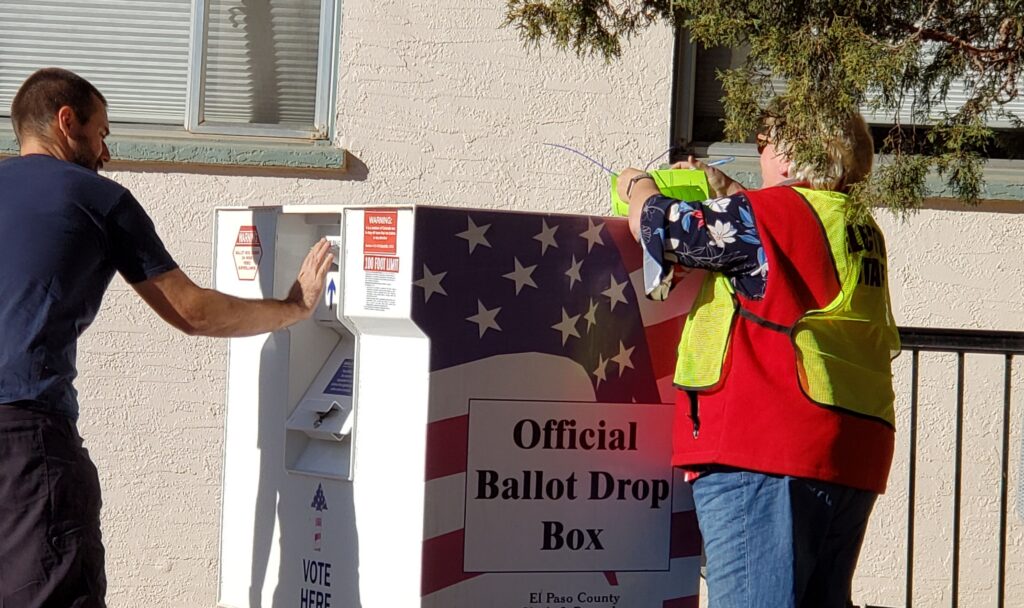
Fentanyl sentencing, tax overhauls and transgender‑related issues anchor Colorado’s 14 ballot measures
Marissa Ventrelli
marissa.ventrelli@coloradopolitics.com
Updated 1 day ago
Fourteen statewide ballot measures await Colorado voters this November, offering a mix of criminal justice crackdowns, tax overhauls, and constitutional tweaks that ensure no one will accuse the ballot of being boring this year. Colorado’s 14 statewide ballot measures match...
Colorado sues to stop Trump’s ban on Medicaid dollars paying for minors’ transgender transition
Thelma Grimes
thelma.grimes@coloradopolitics.com
Updated 1 day ago
Colorado on Wednesday filed yet another lawsuit against the Trump administration — this time to stop a new rule that prohibits Medicaid dollars from paying for transgender transition services for minors. The question of transgender services has increasingly become a...
PREV
PREVIOUS

Weld County judge wrongly denied bail to murder defendant in gap between law change
Colorado’s second-highest court ruled this month that a Weld County judge was wrong to deny bail to a murder defendant in the window between the state Supreme Court’s recognition of the right to bail and the voters’ subsequent overruling of that decision through a 2024 constitutional amendment. Moises Rodriguez-Nunez stands accused of first-degree murder for […]

Denver City Council committee delays vote to advance biennial budget
Members of the Denver City Council Governance and Intergovernmental Relations Committee delayed a vote that would advance a proposed ballot measure allowing the city to adopt an optional biennial budget cycle because three of the seven voting members were out of town. Committee members will now vote on the matter on June 30. The “Budget […]