

Denver City Council committee delays vote to advance biennial budget

Members of the Denver City Council Governance and Intergovernmental Relations Committee delayed a vote that would advance a proposed ballot measure allowing the city to adopt an optional biennial budget cycle because three of the seven voting members were out of town.
Committee members will now vote on the matter on June 30.
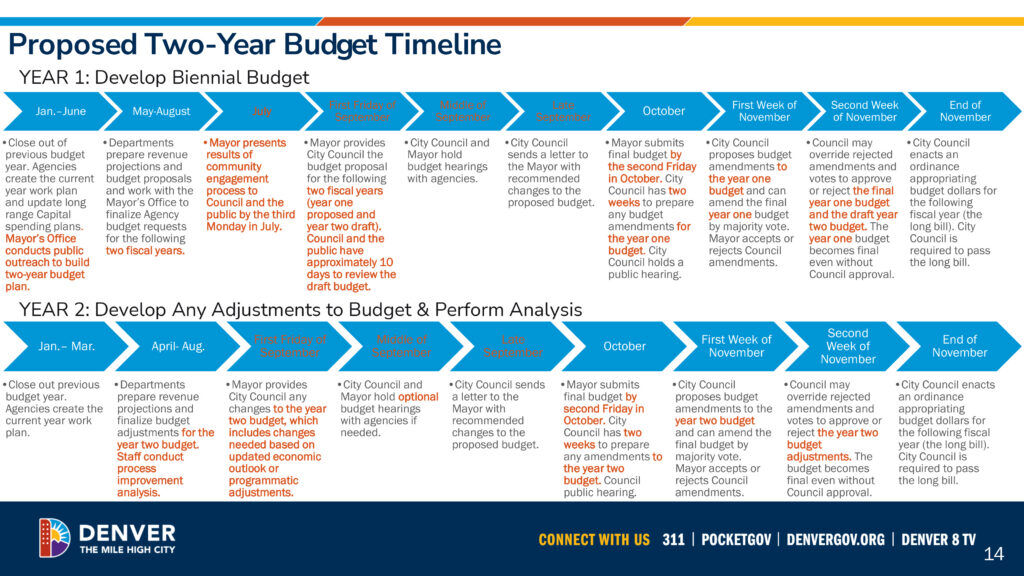
The “Budget Together Denver” initiative would allow Denver to use either a one- or two-year budget cycle, depending on the economic outlook and the city’s needs.
It would also require a public process to garner resident feedback.
In short, the shift would provide earlier and expanded opportunities for residents to directly influence how the city spends money.
Experts say a biennial budget allows for more long-range planning for capital and multi-year projects.
City budgets would still require annual approval per the Colorado State Constitution.
The second-year budget would be proposed in the first year as a draft and not finalized until the second year.
Annual audits of the city’s financials would remain unchanged.
If the proposed charter amendment is approved by the full City Council, it would go to voters in a special municipal election held in conjunction with the Nov. 3 general election.
The measure would also eliminate the required July 1 preliminary budget estimate, which officials note is not representative of the final budget and creates confusion and misinformation in the community.
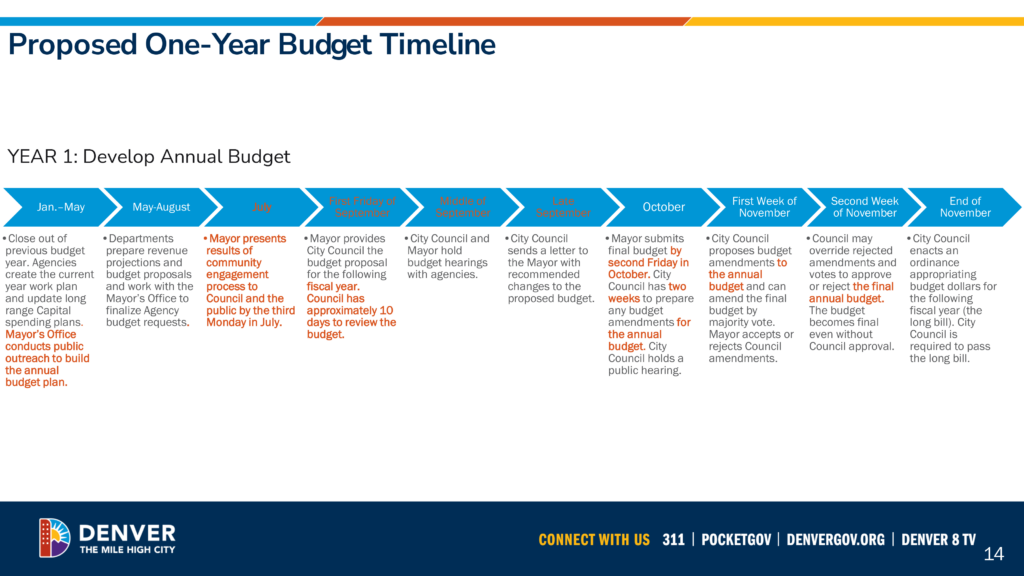
The Sept. 15 deadline for the Denver mayor to submit a budget proposal to the City Council would move to the first Friday of September. The final budget would be sent to the council on the second Friday in October, with a public hearing set for the fourth Monday in October.
Sponsors of the legislation argue that the changes will not only free up financial staff but also give council members more time to analyze the budget before hearings and proposing amendments.
Additionally, the proposed change better defines what happens when revenue does not meet projected levels.
If city finance experts determine that Denver is likely to spend at least 2% more than budgeted or collect at least 2% less in revenue than expected, the mayor would be required to alert the City Council and propose spending cuts.
Should the gap grow to 5% or more, the mayor and City Council would be required to formally reduce authorized spending through an ordinance to keep the budget balanced.
Denver finance officials have already warned that they expect little to no revenue growth through 2027, and “flat” growth is a “best-case scenario, ” anticipating next year’s revenue to remain around $1.66 billion.
But not all committee members are sold on the idea of a two-year budget cycle.
Councilmember Kevin Flynn has been a long-time skeptic of the concept, citing that “more jurisdictions have moved away from biennial (budgeting) than toward it.”
Specifically, Flynn points to concerns around forecasting accuracy.
“We would have to be projecting revenues and expenditures up to 32 months out, and no offense to Justin or the good people from the Department of Finance, but we don’t even get an annual budget right,” he said, adding that as budgets grow larger, accurately projecting them is difficult.
Denver would not be the first Colorado municipality to adopt a biennial budget process. Fort Collins, Centennial, Brighton, and Louisville operate under two-year budget cycles.


Democrat Jessica Killin’s internal poll shows dead heat with U.S. Rep. Jeff Crank in Colorado’s 5th CD
Ernest Luning
ernest.luning@coloradopolitics.com
Updated 3 days ago
Jessica Killin, the Democratic nominee in Colorado’s 5th Congressional District, is in a statistical tie with Republican U.S. Rep. Jeff Crank, according to an internal poll released this week by Killin’s campaign. The poll of likely general election voters, conducted...

Federal biotech commission examines Colorado’s role in critical minerals production
Scott Weiser
scott.weiser@gazette.com
Updated 3 days ago
China’s dominance over critical mineral supplies has left U.S. manufacturers vulnerable. Colorado’s biotech and research community is working to ease that dependence. Leaders from the National Security Commission on Emerging Biotechnology met last week at the Colorado School of Mines...

Violent and property crimes decreased in Colorado in 2025, according to new data
Marissa Ventrelli
marissa.ventrelli@coloradopolitics.com
Updated 4 days ago
Violent and property crime rates in Colorado decreased significantly in 2025, according to data from the state’s public safety agency. The violent crime rate decreased by 10.7% from 2024 to 2025, resulting in over 3,300 fewer crimes reported statewide, while...

Veo scooter clutter, sidewalk riders frustrate Denverites
Deborah Grigsby
deborah.smith@denvergazette.com
Updated 3 days ago
Denver resident Mike Miller was on a downtown sidewalk recently when a Veo scooter rider traveling at full speed passed him as the scooter blasted a “do not ride on sidewalks” warning. In a letter to Veo Policy and Partnerships...

Denver seeks to move more than $18 million to cover George Floyd protest claims
Deborah Grigsby
deborah.smith@denvergazette.com
Updated 4 days ago
City officials want to move millions from Denver’s General Fund contingency account to the City Attorney’s Liability Claims Fund to cover legal settlements and claims stemming from the 2020 George Floyd protests. The hefty shift of cash, proposed in Council...

Jeffco Public Schools sues Trump administration to protect funding after alleged transgender policies violation
Matt Kyle
matt.kyle@denvergazette.com
Updated 4 days ago
In the wake of several threats by the Trump administration to revoke federal funding, Jeffco Public Schools filed a lawsuit against the Department of Education seeking to protect that badly needed money. Jeffco has been under investigation by the DOE’s...

Denver labor acknowledgment proposal faces council committee questions
Deborah Grigsby
deborah.smith@denvergazette.com
Updated 5 days ago
A proposal to add a labor acknowledgment to Denver City Council proceedings has been delayed by the Finance and Business Committee after members raised questions about its wording, intentions and place in the council’s opening proceedings. The proposal, put forth...

Gov. Polis celebrates Colorado’s first-place education ranking by U.S. News
Marianne Goodland
marianne.goodland@coloradopolitics.com
Updated 5 days ago
Colorado officials said they have something to celebrate this week, in addition to the state’s sesquicentennial birthday on Saturday. U.S. News & World Report on Tuesday gave Colorado its top ranking for education efforts from pre-K to postsecondary, though it...

Denver City Council sends Xcel franchise deal to voters
Deborah Grigsby
deborah.smith@denvergazette.com
Updated 6 days ago
This November, Denver voters will decide whether to renew the city’s longstanding franchise agreement with Xcel Energy. Members of the Denver City Council approved on Monday sending a proposed 20-year franchise agreement with Xcel that would deliver more than $180...

Douglas County commissioners postpone meetings due to injury
Nicholas Fogleman
nicholas.fogleman@denvergazette.com
Updated 5 days ago
Douglas County officials have postponed Tuesday’s Business Meeting and Land Use/Public Hearing after a county commissioner sustained an injury, according to a statement from the county. County officials said the commissioner is “OK but may require surgery.” As a result,...
PREV
PREVIOUS

It won't end the drought, but 'Super El Niño' expected to boost Colorado moisture
Colorado is headed into what could be one of its strongest El Niño summers on record, a shift expected to bring above‑average monsoon moisture, though not enough to erase the state’s long‑running drought. That was the assessment on Tuesday from the Water Conditions Monitoring Committee, a group of state and federal water officials and local […]

A graduated tax plan could undercut Colorado's business competitiveness, analysis warns
A proposal to move Colorado to a graduated income tax — taxing individuals and businesses at different rates based on their earnings — could generate more than $2 billion in its first year, but it could also weaken the state’s business climate and cause corporations to flee, according to a new analysis from the Common […]