

Legislating at the speed of artificial intelligence | GUEST COLUMN
By Sean Camacho
Consumers in Colorado and across the country are demanding artificial intelligence companies be more transparent about how their systems work: how they’re built, how they learn, how they change over time. What we’ve learned as advocates for AI regulation is the process of building AI — iterative, adaptive and never fully finished — might actually have something to teach us about how to write the laws that govern it.
Twenty years into the social media era, the cost of waiting to address the clearly emerging dangers of rapidly advancing technology is overwhelming. Though platforms reshaped how we communicate, debate and understand the world, policymakers largely held back. Consumers eventually took matters into their own hands through legal action, but by the time they did, the harm had already been baked into the structure of ubiquitous platforms.
With AI, we have a chance to learn from those mistakes. But our window to act won’t stay open indefinitely. The risks aren’t hypothetical. We’ve already seen what happens when conversational AI operates without guardrails: real-world consequences for Coloradans of all ages, particularly our youth. Every legislative session we spend waiting for perfect answers is another year in which those consequences continue without any framework to address them.
But acting now doesn’t mean acting carelessly. It means being willing to legislate the way this technology actually develops: constantly, consistently and methodically, with the humility to treat the first version of a law as a beginning rather than a conclusion.
Part of what makes AI difficult to regulate is the sheer pace at which it continues to develop. What we’ve learned during the 2026 legislative session is in a fast-moving world, good policy can’t stand still. When the underlying technology is evolving in real time, policymaking doesn’t unfold in a straight line. It’s iterative. Assumptions change. New information forces reconsideration. One small change can make the difference between full-throated support or full-throttle opposition from the same stakeholder group.
This session is the first in Colorado where AI is truly ingrained in the everyday lives of nearly all of our constituents. Some voices of opposition have mistaken the complexity of developing good policy for inconsistency and suggested we should wait for clear answers before acting. But waiting has consequences, too. What we should demand of one another is a willingness to treat legislation the way this technology treats itself: always changing, always improving, open to revision and collaboration from all sides as the landscape evolves. That means we should never again treat a bill as one-and-done.
Stakeholder engagement is typically a phase: you gather input, negotiate changes and move forward. But legislating in a way that keeps pace with the world means engagement has to be more constant and transparent — and it means sitting with the core tension this kind of work creates: move too quickly and you risk getting it wrong; move too slowly and you allow real harm to take root without any guardrails at all. There is a meaningful difference between a process that ignores that tension and one that engages with it directly.
That approach won’t produce legislation that satisfies every perspective. In areas like this, the goal isn’t to arrive at a perfect, final answer — it’s to take a step that reflects what we know now, while leaving room to adjust as we learn more. That’s what HB26-1263 represents: months of engagement, iteration and compromise designed to establish clear guardrails around conversational AI while leaving room to adapt as the landscape continues to change. Some will argue it should go further. Others say that it goes too far or moves too soon. We’ve taken both seriously and worked diligently to thread the needle — building a bill with the best possible chance of passing with bipartisan support, earning the governor’s signature, and taking a meaningful step toward protecting Coloradans, especially youth.
That may not be the kind of certainty people are used to seeing from legislation. But it may be a more honest version of what transparency actually requires: not just clarity in outcomes, but openness about the process, the tradeoffs and the fact not everything is settled on day one.
AI isn’t going anywhere. Neither is our obligation to govern it responsibly. We started by demanding transparency from the systems shaping our lives, but transparency isn’t just something we should require of technology. It’s something we should require of ourselves. That means writing laws that are honest about their limits, open to revision and built with the understanding the work doesn’t end at passage. That’s not a concession. That’s the point.
Sean Camacho represents Denver in District 6. He serves as vice chair of the Business Affairs and Labor Committee. In addition to his work in the legislature, and after leaving active-duty Air Force service, he works as an attorney.

Sans seniors, what does Colorado’s uninterested early turnout say about our disengaged electorate? | Paula Noonan
Paula Noonan
paula-noonan@coloradopolitics.com
Updated 15 hours ago
This primary election is poorly attended. Evidence is in the numbers. About 10% of active registered voters are deciding this year’s primaries with seven days to go. If that number triples by June 30, only 30% of voters will decide...

Who gets to decide Colorado’s economic future? | GUEST COLUMN
Colorado Politics
colorado-politics@coloradopolitics.com
Updated 15 hours ago
By Sarah Blackhurst Colorado’s prosperity depends on industries that grow our food, build our future and power our homes. But today, these sectors face an invisible threat from 5,000 miles away: the European Union’s Corporate Sustainability Due Diligence Directive (CS3D)....
Colorado’s ‘right to natural gas’ measure submits signatures to qualify for November ballot
Marissa Ventrelli
marissa.ventrelli@coloradopolitics.com
Updated 18 hours ago
A natural-gas rights initiative backed by Advance Colorado is likely headed to the November ballot, triggering a parallel campaign by environmental groups seeking to impose new liabilities on oil and gas operators. Petitions for Initiative No. 177 were turned in...

Economists: Colorado budget improves slightly, but deficits still loom
Marianne Goodland
marianne.goodland@coloradopolitics.com
Updated 18 hours ago
State economists reported a stronger-than-expected bump in general fund revenue driven largely by higher individual income tax collections, yet warned that Colorado remains on track to begin the next fiscal year with a sizable shortfall. State economists upgraded “significantly” the...

Colorado law allowing lawsuits against ‘conversion therapy’ providers takes effect July 1
Marissa Ventrelli
marissa.ventrelli@coloradopolitics.com
Updated 18 hours ago
With a new law taking effect July 1, Colorado is creating a legal pathway for people to sue licensed providers of “conversion therapy,” even as debate over the practice’s constitutionality continues in the wake of a recent U.S. Supreme Court...
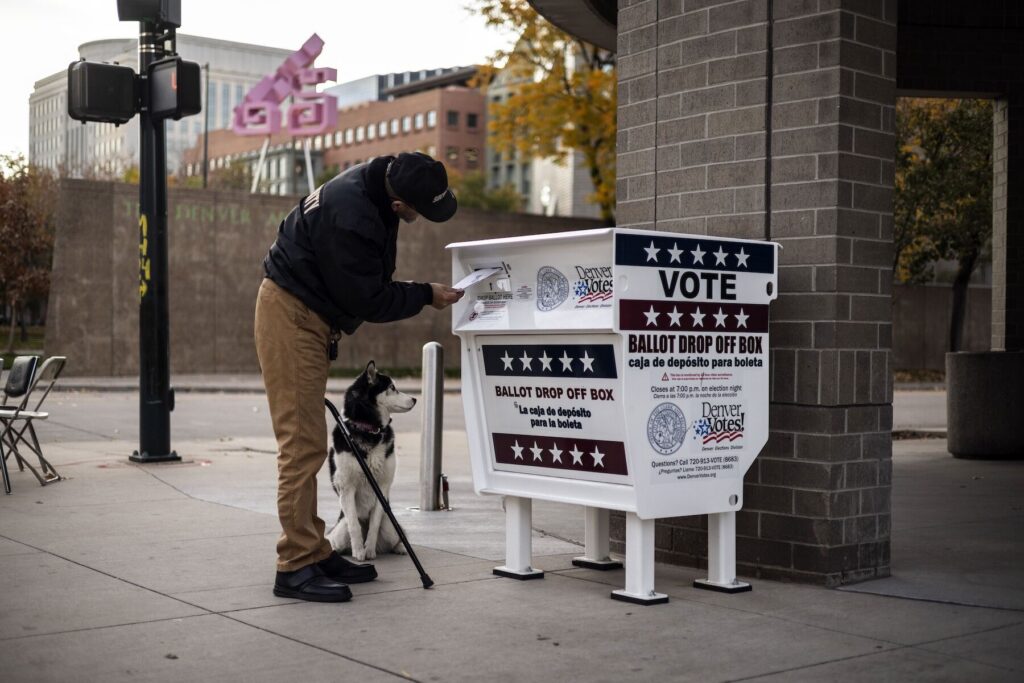
Colorado’s primary turnout tops 10% as election officials warn it’s too late to mail ballots
Ernest Luning
ernest.luning@coloradopolitics.com
Updated 13 hours ago
Colorado election officials cautioned on Tuesday that it’s too late to mail ballots for the June 30 primary and urged voters to use drop boxes and their county’s voting centers instead. Secretary of State Jena Griswold said in a release...

Road-funding initiative in Colorado qualifies for November ballot
Marissa Ventrelli
marissa.ventrelli@coloradopolitics.com
Updated 2 days ago
A measure that would dedicate all transportation-related revenue to Colorado’s roads and bridges has officially qualified for the November ballot after it cleared the state’s signature threshold, according to election officials. Backed by the coalition Restore Our Roads, Initiative No....

Judge blocks Colorado’s proposed ban on using SNAP benefits for soda
Marissa Ventrelli
marissa.ventrelli@coloradopolitics.com
Updated 2 days ago
A federal judge has temporarily blocked Colorado and several other states from enforcing a proposed “Healthy Choice Waiver” that would have barred Supplemental Nutrition Assistance Program (SNAP) recipients from using their benefits to buy soda and other sugary drinks. Under...

Colorado has a playbook for youth mental health — our next governor must use it | GUEST COLUMN
Colorado Politics
colorado-politics@coloradopolitics.com
Updated 2 days ago
By Karen Ron-Li Liaw From the rural communities on the western slope to the eastern plains, to the major urban regions on the Front Range, Colorado families are navigating an all-too-familiar crisis: kids are struggling, and Colorado’s mental health system...

Colorado chamber: 2026 legislative session marked ‘significant progress’ for business
Marissa Ventrelli
marissa.ventrelli@coloradopolitics.com
Updated 2 days ago
This year’s legislative session produced some big wins for the state’s business environment, according to the Colorado Chamber of Commerce’s annual report. The report measured the progress in the chamber’s legislative agenda across policy areas like labor and employment, technology...
PREV
PREVIOUS

Overtime for farms, school safety, public office rules: What’s new in Colorado law
Gov. Jared Polis signed 25 bills into law Monday, bringing changes that will affect workers, families, schools, and local governments across Colorado. The new laws deal with a range of issues – from overtime rules for farmworkers to limits on lawmakers holding multiple offices, along with school safety upgrades and new standards for dementia care […]

Can a law be neutral if it overrides faith-based beliefs? | GUEST COLUMN
By Joseph C. Stewart In what seems like a quintessential “Only in America” parody, there is a correlation between unemployment benefits, smoking peyote, and LGBTQ kids — or kids of LGBTQ couples — being allowed enrollment into Catholic Colorado preschools. Let’s connect the dots. Recently, the Supreme Court announced it will be taking the case […]