

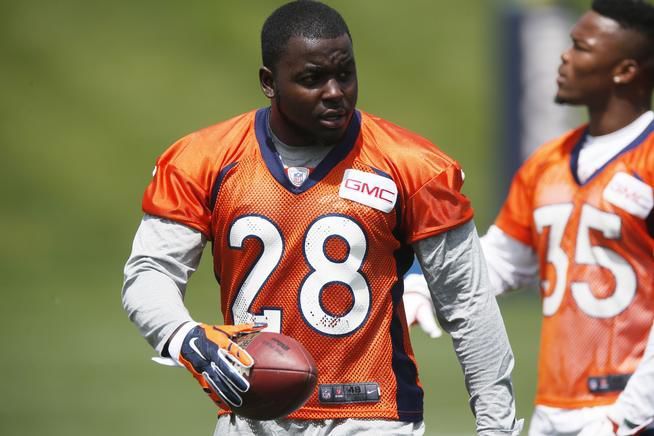
Ex‑Bronco Montee Ball backs push at Colorado Capitol for stronger concussion protocols

Amid rising worries about the long‑term effects of head injuries in youth sports, a Colorado committee began reviewing legislation that would tighten concussion protocols and expand mental health awareness among coaches.
Senate Bill 060 would require youth sports coaches to complete training on the mental health impacts of concussions. It would also require them to inform parents when an athlete sustains a concussion and advise them to have their child evaluated for potential physical, cognitive, or psychological effects.
The bill known as “Alyssa’s Act,” which has drawn support from Democrats and Republicans alike, is named for Alyssa Peterson, a 13-year-old from Arvada who committed suicide in 2019. Signing on as sponsors of the bipartisan bill are Sens. Rod Pelton, R‑Cheyenne Wells, and Lindsey Daugherty, D‑Arvada, along with Rep. Eliza Hamrick, D‑Centennial, and Assistant Minority Leader Ty Winter, R‑Trinidad.
Peterson’s mother, Stella, said Alyssa was a natural athlete who liked skiing and played soccer competitively. While her family knew Alyssa had sustained several concussions throughout her athletic career, they were not aware of the potential mental health impacts.
“After her death, our family began searching for answers,” Stella Peterson told the committee. “As I reviewed her medical history and reflected on her childhood, I began to wonder whether repeated concussions from years of youth sports had affected her brain and her mental health in ways we did not understand at the time.”
The family said it has since learned that concussions can affect mood, emotional regulation, and overall mental health — a message Stella Peterson, her daughter Emily, and her husband have been working to share widely in hopes of preventing tragedies like Alyssa’s.
“No law can bring Alyssa back, but this bill has the power to help other families recognize the signs earlier, start important conversations, and support youth athletes before it’s too late,” Stella Peterson said.
As a former Denver Broncos running back, Montee Ball said he suffered five concussions that he’s aware of, though he believes the actual number is much higher. He recalled developing constant headaches and unexplained personality changes.
“I became distant from the people who loved me most, my relationships suffered, and I struggled with emotional connection and intimacy,” he said. “I felt confused inside my own mind.”
Ball began drinking heavily, and his alcoholism eventually ended his football career and pushed him to seek intensive mental health treatment, he said. He believes his downward spiral was at least partly driven by concussions and the repeated head impacts he endured throughout his playing years, he added.
“Looking back, the hardest part is knowing my family watched me slowly change and had no roadmap for how to help,” he said. “That is why this bill matters.”
He added: “When coaches understand the mental health impact of brain injuries, they become the first people that can recognize that something deeper may be happening to a young athlete, and when we give coaches that knowledge, we’re not just protecting players, we’re protecting families from the fear and confusion my family lived through, but most importantly, that Alyssa’s family is living through.”
On an 11-2 vote, the concussion bill easily passed through the House Health and Human Services Committee. Reps. Brandi Bradley, R-Roxborough Park, and Ron Weinberg, R-Loveland, voted against it.


Courageous Colorado bucks Trump’s federal stupidity | Miller Hudson
Miller Hudson
miller-hudson@coloradopolitics.com
Updated 2 days ago
There are several theories regarding the rhythm of American politics. The most frequently cited is the pendulum hypothesis — positing that episodes of liberal dominance are then interrupted by spans of conservative control. Since Ronald Reagan’s presidential election in 1980,...

A historic moment during another major drought | Rachel Gabel
Rachel Gabel
rachel-gabel@coloradopolitics.com
Updated 2 days ago
Gustav Sumnick emigrated from Germany, traveled to Oklahoma and decided rather than be a Sooner, he wanted to be a farmer. He moved north to Nebraska and married an Irish immigrant farmer’s daughter. They farmed near Fremont, Nebraska, where the...

Colorado can’t forget the lessons of COVID | Jon Caldara
Jon Caldara
jon-caldara@coloradopolitics.com
Updated 3 days ago
We are finally getting a clearer picture of what happened during COVID. Not because the people who locked us up, masked our faces and forced unproven chemicals into our bodies have suddenly become transparent, but because Anthony Fauci’s COVID-era diary...
Historic preservation supporters organize to oppose Trump changes | Bob Loevy
Tom Cronin
tom-cronin@coloradopolitics.com
Updated 2 days ago
Historic preservation organizations in Colorado Springs, the remainder of Colorado and across the nation are organizing to resist a recent effort to relax and weaken historic preservation laws in the United States. In Washington, D.C., the Advisory Council on Historic...

At conservative summit, Colorado Republican leaders concede Democrats’ election edge
Marissa Ventrelli
marissa.ventrelli@coloradopolitics.com
Updated 2 days ago
Four Republican state lawmakers told attendees at a gathering of conservative leaders on Friday they doubt their party can win statewide races, noting that Colorado’s electorate has been shifting toward Democrats but adding they see an opening in several pockets....
Q&A with Mike Pence | Former vice president says GOP’s populist turn from conservatism isn’t permanent
Ernest Luning
ernest.luning@coloradopolitics.com
Updated 2 days ago
Former Vice President Mike Pence says he’s concerned that the Republican Party has taken a populist turn away from bedrock conservative principles during President Donald Trump’s second term, but he believes the party will return to its roots when Trump...

Republican Victor Marx taps George Markert as his lieutenant governor pick in Colorado’s gubernatorial race
Ernest Luning
ernest.luning@coloradopolitics.com
Updated 2 days ago
Colorado Republican gubernatorial nominee Victor Marx named George Markert, a retired Marine colonel, as his running mate for lieutenant governor Friday morning, saying the former U.S. Senate candidate will bring “exceptional character, proven leadership and a lifetime of serving others”...
Pueblo mayor, council concoct Trumpian Texas Two-Step | Dennis Maes
Dennis Maes
dennis-maes@coloradopolitics.com
Updated 3 days ago
Several weeks ago, an article was published positing Pueblo Mayor Heather Graham is a disciple of the calamitous Donald Trump school of governance — specifically as it related to questionable ethical practices and the misuse of public funds. Recently, Graham...

Colorado can’t afford to turn its back on proven public safety technology | GUEST COLUMN
Colorado Politics
colorado-politics@coloradopolitics.com
Updated 3 days ago
By Samuel G. Michael I recently saw a report that said Colorado is leading the way in artificial intelligence adoption for businesses. Across our state, more business owners and employees than ever before use AI for their everyday functions —...

Colorado lawmakers start crafting strategy to manage $200 million in federal rural health funds
Marissa Ventrelli
marissa.ventrelli@coloradopolitics.com
Updated 14 hours ago
Colorado officials have begun to strategize as the state is set to receive hundreds of millions of dollars from a federal program meant to boost rural health. Cristen Bates, deputy Medicaid director at the Department of Health Care Policy and...
PREV
PREVIOUS

Colorado drivers, mad about rising gas prices, may turn midterm election ire on Republicans
WELD COUNTY, Colorado — The touch-and-go race for House control in the Nov. 3 midterm elections could very well be decided in places like this wind-swept stretch of Interstate 25. Specifically, at gas stations in this rapidly growing area north of Denver, which is evolving from rural, agricultural roots into a key commuter region. In […]

Colorado Supreme Court appears OK with revised 'reasonable doubt' instruction
The Colorado Supreme Court appeared largely comfortable on Thursday with the recently revised definition of “reasonable doubt” that is now part of the template jury instructions for criminal cases. To date, multiple Court of Appeals decisions have endorsed the constitutionality of the new phrasing, which resembles the instruction given in Colorado’s federal trial court. U.S. […]