

Denver Water approves drought pricing, will apply to May usage

While this summer may be a hot one, it will most definitely be a more expensive one for some Denver Water customers.
The Denver Board of Water Commissioners on Wednesday approved temporary drought pricing on outdoor water use as part of its Stage 1 drought response, as Denver Water’s collection and service areas continue to face severe drought conditions, with a historically low snowpack and concerns about diminished spring runoff.
The drought pricing will apply to May water use (reflected in June bills) and remain in effect through April 30, 2027, or until further action by the board.
Tier 1 use, which covers essential indoor water use for bathing, cooking and flushing toilets, will be exempt from the temporary drought charge.
Officials said that under the temporary rate hike, residential customers will see a drought charge on Tier 2 water use of $1.10 per 1,000 gallons. Tier 3 will have a drought charge of $2.20 per 1,000 gallons.
The drought charges will be tacked onto the customer’s existing 2026 water rates.
Officials say an individual’s monthly residential water bill will vary depending on where they live within Denver Water’s service area and how much water they use.
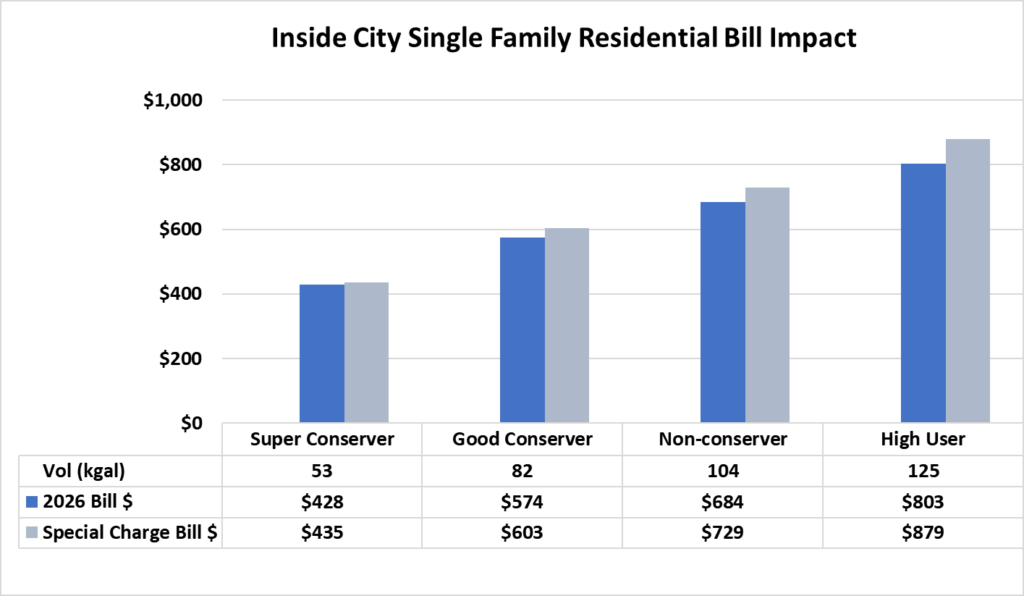
In these charts, the categories are:
- “Super conserver”: A customer who has very little outdoor water use, maybe only watering trees and shrubs throughout the year.
- “Good conserver”: An average customer who reduces their annual water use by 20%, from 104,000 gallons (the average use by residential customers in an average year) to 82,000 gallons.
- “Non-conserver”: An average Denver Water residential customer who uses 104,000 gallons of water over the course of the year (the average use by residential customers in an average year) and doesn’t respond to Denver Water’s call to reduce water use by 20%.
- “High user”: A customer in the top 25% of residential water users.

“Implementing temporary drought pricing is not a step we take lightly. It is one of many tools Denver Water has available — when needed — to respond to drought conditions, encourage customers to conserve our water supply, and ensure our ongoing ability to operate and maintain the system that delivers clean, safe water to 1.5 million people,” Alan Salazar, Denver Water chief executive officer, said.
“Drought charges signal to our customers the premium value of water in a drought, while exempting essential indoor water use. We haven’t needed to use this tool in more than 20 years — since the historic drought of 2002-04 — and conditions surrounding this year’s snowpack and potential runoff are shaping up to rival, and possibly be worse than, those years,” Salazar said.
The proposed 11-month tiered drought pricing, according to officials, is designed to incentivize water-use reductions by encouraging water consumption and ensuring “that higher-usage customers pay more.”
The price bump is expected to help Denver Water reinforce its recently implemented Stage 1 drought response, which targets a 20% reduction in water use.
Water restrictions are necessary to preserve reservoir storage until the levels can return to normal.
“Current conditions indicate that this is going to be an exceptionally challenging year for our water supply,” Nathan Elder, Denver Water’s manager of water supply, said in March after the drought restrictions were announced. “Snowpack levels are at historic lows, and they’re melting earlier and more rapidly than normal.”
The drought pricing covers several classes of customers, including residential, large irrigation, wholesale and raw water customers.


Democrat Jessica Killin’s internal poll shows dead heat with U.S. Rep. Jeff Crank in Colorado’s 5th CD
Ernest Luning
ernest.luning@coloradopolitics.com
Updated 2 days ago
Jessica Killin, the Democratic nominee in Colorado’s 5th Congressional District, is in a statistical tie with Republican U.S. Rep. Jeff Crank, according to an internal poll released this week by Killin’s campaign. The poll of likely general election voters, conducted...

Federal biotech commission examines Colorado’s role in critical minerals production
Scott Weiser
scott.weiser@gazette.com
Updated 2 days ago
China’s dominance over critical mineral supplies has left U.S. manufacturers vulnerable. Colorado’s biotech and research community is working to ease that dependence. Leaders from the National Security Commission on Emerging Biotechnology met last week at the Colorado School of Mines...

Violent and property crimes decreased in Colorado in 2025, according to new data
Marissa Ventrelli
marissa.ventrelli@coloradopolitics.com
Updated 2 days ago
Violent and property crime rates in Colorado decreased significantly in 2025, according to data from the state’s public safety agency. The violent crime rate decreased by 10.7% from 2024 to 2025, resulting in over 3,300 fewer crimes reported statewide, while...

Veo scooter clutter, sidewalk riders frustrate Denverites
Deborah Grigsby
deborah.smith@denvergazette.com
Updated 2 days ago
Denver resident Mike Miller was on a downtown sidewalk recently when a Veo scooter rider traveling at full speed passed him as the scooter blasted a “do not ride on sidewalks” warning. In a letter to Veo Policy and Partnerships...

Denver seeks to move more than $18 million to cover George Floyd protest claims
Deborah Grigsby
deborah.smith@denvergazette.com
Updated 3 days ago
City officials want to move millions from Denver’s General Fund contingency account to the City Attorney’s Liability Claims Fund to cover legal settlements and claims stemming from the 2020 George Floyd protests. The hefty shift of cash, proposed in Council...

Jeffco Public Schools sues Trump administration to protect funding after alleged transgender policies violation
Matt Kyle
matt.kyle@denvergazette.com
Updated 3 days ago
In the wake of several threats by the Trump administration to revoke federal funding, Jeffco Public Schools filed a lawsuit against the Department of Education seeking to protect that badly needed money. Jeffco has been under investigation by the DOE’s...
Denver labor acknowledgment proposal faces council committee questions
Deborah Grigsby
deborah.smith@denvergazette.com
Updated 4 days ago
A proposal to add a labor acknowledgment to Denver City Council proceedings has been delayed by the Finance and Business Committee after members raised questions about its wording, intentions and place in the council’s opening proceedings. The proposal, put forth...

Gov. Polis celebrates Colorado’s first-place education ranking by U.S. News
Marianne Goodland
marianne.goodland@coloradopolitics.com
Updated 3 days ago
Colorado officials said they have something to celebrate this week, in addition to the state’s sesquicentennial birthday on Saturday. U.S. News & World Report on Tuesday gave Colorado its top ranking for education efforts from pre-K to postsecondary, though it...

Denver City Council sends Xcel franchise deal to voters
Deborah Grigsby
deborah.smith@denvergazette.com
Updated 4 days ago
This November, Denver voters will decide whether to renew the city’s longstanding franchise agreement with Xcel Energy. Members of the Denver City Council approved on Monday sending a proposed 20-year franchise agreement with Xcel that would deliver more than $180...

Douglas County commissioners postpone meetings due to injury
Nicholas Fogleman
nicholas.fogleman@denvergazette.com
Updated 4 days ago
Douglas County officials have postponed Tuesday’s Business Meeting and Land Use/Public Hearing after a county commissioner sustained an injury, according to a statement from the county. County officials said the commissioner is “OK but may require surgery.” As a result,...
PREV
PREVIOUS

Federal judge partially allows second World Cup trafficking lawsuit to move forward
A federal judge allowed some claims to move forward last month against companies operating out of Colorado that allegedly participated in a human trafficking venture involving Filipino laborers who constructed facilities for the 2022 World Cup in Qatar. There are three lawsuits pending in Colorado, each brought by a group of workers under the federal […]

Colorado lawmakers propose changes to family court procedures | Bills in Brief
Colorado lawmakers introduce hundreds of bills each year. Bills in brief cuts through the noise by explaining which proposals matter, what’s at stake, and how decisions at the Capitol could affect everyday life across the state. Colorado lawmakers from both parties are seeking to make changes to various facets of the state’s family court system — from […]