

Democrats rebounding without learning necessary lessons | SONDERMANN
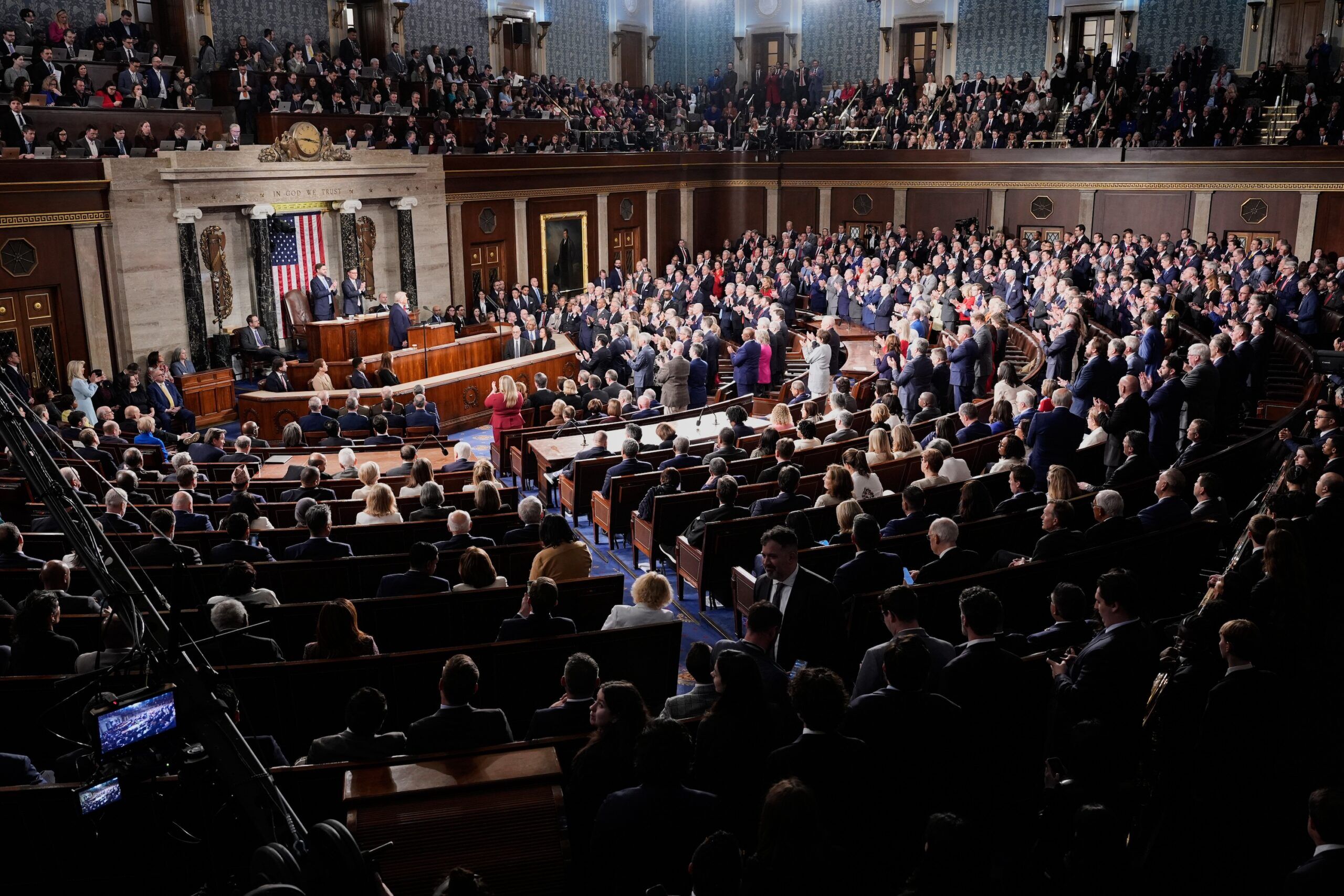
“When we fight, we win!”
That, reportedly, was the chant heard over and over again at the Colorado Democratic Assembly a week ago. It suggests that pugilism has been the piece missing from the Democratic toolkit.
Perhaps it was just me, but I seem to recall Democrats exhibiting plenty of fight back in 2024. The slugging went hand-in-hand with Kamala Harris’s faux “politics of joy,” an incompatibility if I’ve ever seen one.
What Democrats lacked two years ago was not spunk, spit, or boxing gloves. What was sorely absent was any sense of discernment around issues and a self-awareness of how much of the country saw them.
After a period of shock and grief following the party’s 2024 drubbing, 2026 has dawned with Democrats full of reborn vim and vigor. Donald Trump’s approval ratings, usually hovering within a small range between his low ceiling and high floor, are in the basement. Democrats handily won 2025’s two gubernatorial elections and are triumphing in special elections even in red locales.
All the trend lines are tilting in the Democrats’ direction. Capture of the U.S. House this fall is taken as a given, and even the Senate could be distantly in play if the projected electoral tsunami forms.
That should all be cause for elation. Cue FDR’s campaign music, “Happy Days Are Here Again.”
In the short term, it is ecstatic news for team-blue in a desperate search for a rebound and a political toehold. Just being “not Trump” may be good enough in an off-year election with the President mired in an unpopular war, gas prices breaking the pump and immigration enforcement turning into a parade of horror stories.
In the long term, it is a different story. 2024 exposed a critical leakage of Democratic support among multiple demographic groups. Moreover, as an increasingly coastal party with isolated inland enclaves like Colorado, Democrats are simply not competitive across vast swaths of America. Given institutions like the Electoral College and the Senate, writing off much of the heartland will not bring about sustained success.
As recently as 2010, Democrats held Senate seats in Alaska, Arkansas, Florida, Indiana, Iowa, Louisiana, Missouri, Montana, Nebraska, North Carolina, North Dakota, Ohio, South Dakota and West Virginia. In the intervening years, every one of those seats has flipped to Republican hands.
Certainly, 2026 is an opportunity year for Democrats. But let me suggest that it is also one of risk. The risk takes the shape of victory coming too easily.
If Democrats run the table this fall, it will constitute a major setback for Trump. Such a win will also give Democrats leverage for battles over the next two years.
But a win on the cheap, without forcing real introspection or recalibration among Democrats, could mask underlying problems that will continue to haunt the party for years to come.
In that vein and with an eye not on 2026, but on 2028, let’s address the presidential campaign boomlet that is California Gov. Gavin Newsom. Early frontrunners do not always go on to dominate the race. But often they do. Newsom has stepped into that position on the Democratic side.
Let me say it plainly: Any Democrat who regards Newsom as the answer completely misreads the question.
Yes, he is glib. He can access big dollars. He understands that attention has become society’s most precious commodity. And, oh, that perfect coiffure atop his head with not a hair out of place.
Was Kamala Harris’s defeat not enough to convince Democratic voters to shy away from another California candidate? Do they really want to spend the 2028 campaign defending California’s high taxes, lack of affordability, gaping wealth disparity, inability to build, highway gridlock, poor education metrics, out-migration of residents, and public pension system bordering on insolvency?
That hardly strikes me as a winning message.
Further, for much of America, California represents a culturally foreign land. That disconnect is the Democratic Party’s core dilemma. In the Golden State (and increasingly here in Colorado), it is a product of one-party rule and rarely having to worry about pushback from across the aisle.
For Harris, that disconnect took the shape of her support years ago for publicly-funded gender-change surgery for prisoners and detainees. That sells a whole lot better in San Francisco (Newsom’s home) and West Los Angeles than in Dayton, Greensboro, or Saginaw.
In Newsom’s case, prepare to hear plenty of the French Laundry, perhaps America’s fanciest restaurant, where he joined dinner festivities against his own protocols in the middle of the pandemic. Opponents will also be sure to bring up Newsom’s acknowledged affair with the wife of his own campaign manager. Such conduct might be forgiven more quickly in live-and-let-live Oakland than in Sioux City or Little Rock.
There will be no shortage of other candidates for the nomination. Without naming names, Democrats would be advised to pick someone who has, of necessity, had to attract unaffiliated and even Republican voters in building a political career instead of someone, a la Newsom, who has never had to reach beyond his party’s activist base.
Therein lies the path to long-term political rehabilitation.
Eric Sondermann is a Colorado-based independent political commentator. He writes regularly for Colorado Politics and The Gazette. Reach him at EWS@EricSondermann.com; follow him at @EricSondermann


Jena Griswold’s record: corruption, incompetence | Dick Wadhams
Dick Wadhams
dick-wadhams@coloradopolitics.com
Updated 3 days ago
There is no statewide elected official going back decades who is as breathtakingly corrupt and incompetent as Secretary of State Jena Griswold, who is now running for attorney general of all things. And compliant ruling Democrats know it. Their silence...

Kiros exudes why Colorado’s political times are a-changin’ at annual Denver Dems gala | Miller Hudson
Miller Hudson
miller-hudson@coloradopolitics.com
Updated 3 days ago
Among Colorado’s few remaining bipartisan rituals are county and state party dinners. I was particularly intrigued by last week’s Denver Democratic Party’s 2026 Annual Gala, a “New Deal for a New Era.” Their glossy program featured an artist’s Technicolor rendering...

Livestock grazing regulations need flexible updates | Rachel Gabel
Rachel Gabel
rachel-gabel@coloradopolitics.com
Updated 3 days ago
The Bureau of Land Management last updated their livestock grazing regulations the year I graduated from high school. I am 49. Assessing rangeland health can’t be done once and not revisited. This year is a prime example that managers must...

Taxpayers donate to tax increase campaign | Jon Caldara
Jon Caldara
jon-caldara@coloradopolitics.com
Updated 4 days ago
Give the man his due. President Donald Trump has undeniable talents. Colorado politicians are learning. Chief among The Don’s skills is taking the self-serving, ethically dubious behavior of previous politicians and putting it on steroids. Or, to borrow from the...
A summertime all-you-can-eat political buffet | SONDERMANN
Eric Sondermann
eric-sondermann@coloradopolitics.com
Updated 6 days ago
We find ourselves in the doldrums of August with a complete dearth of political news. Yeah, right. These days, that train never stops moving. It is a 24/7/365 express amplified by 24/7/365 media. Let me respond with one of my...
State money diversion scheme the unsurprising downfall of ERBOCES scam | Paula Noonan
Paula Noonan
paula-noonan@coloradopolitics.com
Updated 4 days ago
Falcon School District 49, aka El Paso County School District 49, has finally cut bait, thrown the fishing pole into the lake and sunk the canoe. The longtime enabler of the Education Reenvisioned BOCES’ (ERBOCES) schemes to fund private Christian...
Ain’t Polis’ Peters commutation a pity? | Hal Bidlack
Hal Bidlack
hal-bidlack@coloradopolitics.com
Updated 1 week ago
I am hoping that, yet again, my long-suffering and very forgiving editor will pardon my rambling thoughts today, as there are too many open tabs on my computer that deal with issues I want to talk about (Ed: pretty used...

Colorado lieutenant governor candidate Markert says early discipline and key mentors set his course
Marianne Goodland
marianne.goodland@coloradopolitics.com
Updated 1 week ago
Editor’s note: This is the first installment in a three-part series examining Colorado’s candidates for lieutenant governor. In this piece, Colorado Politics speaks with George Markert, the Republican running mate to gubernatorial candidate Victor Marx. Marx is competing against Democrat...
Colorado, like America, past due for generational change in politics | Miller Hudson
Miller Hudson
miller-hudson@coloradopolitics.com
Updated 5 days ago
I was 27 before I ever voted for president. At 19, in 1964, the Constitution had not yet been amended establishing 18-year-old voting eligibility. In 1968, I was serving overseas with the U.S. Navy at a time when there was...
Farmers and ranchers win on NIETC cancellation | Rachel Gabel
Rachel Gabel
rachel-gabel@coloradopolitics.com
Updated 1 week ago
The Department of Energy rolled into Lamar last week and Office of Electricity Assistant Secretary Katie Jereza stood in her neat, green suit in front of a room filled with farmers, ranchers and landowners. The crowd was filled with straw...
PREV
PREVIOUS

Colorado Politics Calendar Apr. 6-12
CoPo’s weekly political calendar will help you find political and public-policy events throughout Colorado. It includes candidate and issue campaign events, public policy meetings, court hearings, state and local party conventions, assemblies, debates, rallies, parades, speaking engagements, traveling dignitary appearances, water meetings, book signings, county commission hearings, city council meetings and more. As a subscriber, […]
An April Fool's Day to remember | Capitol M | Week of April 4, 2026
The lighter side of the Capitol, and if light were weight, the Capitol would have lifted off better than the Artemis II rocket on April Fool’s Day. There was a plethora of Fools at the Capitol for April Fool’s Day this year. It began with Gov. Jared Polis announcing Colorado would annex northern New Mexico […]