

Is work flex slowing downtown’s recovery? | ANALYSIS
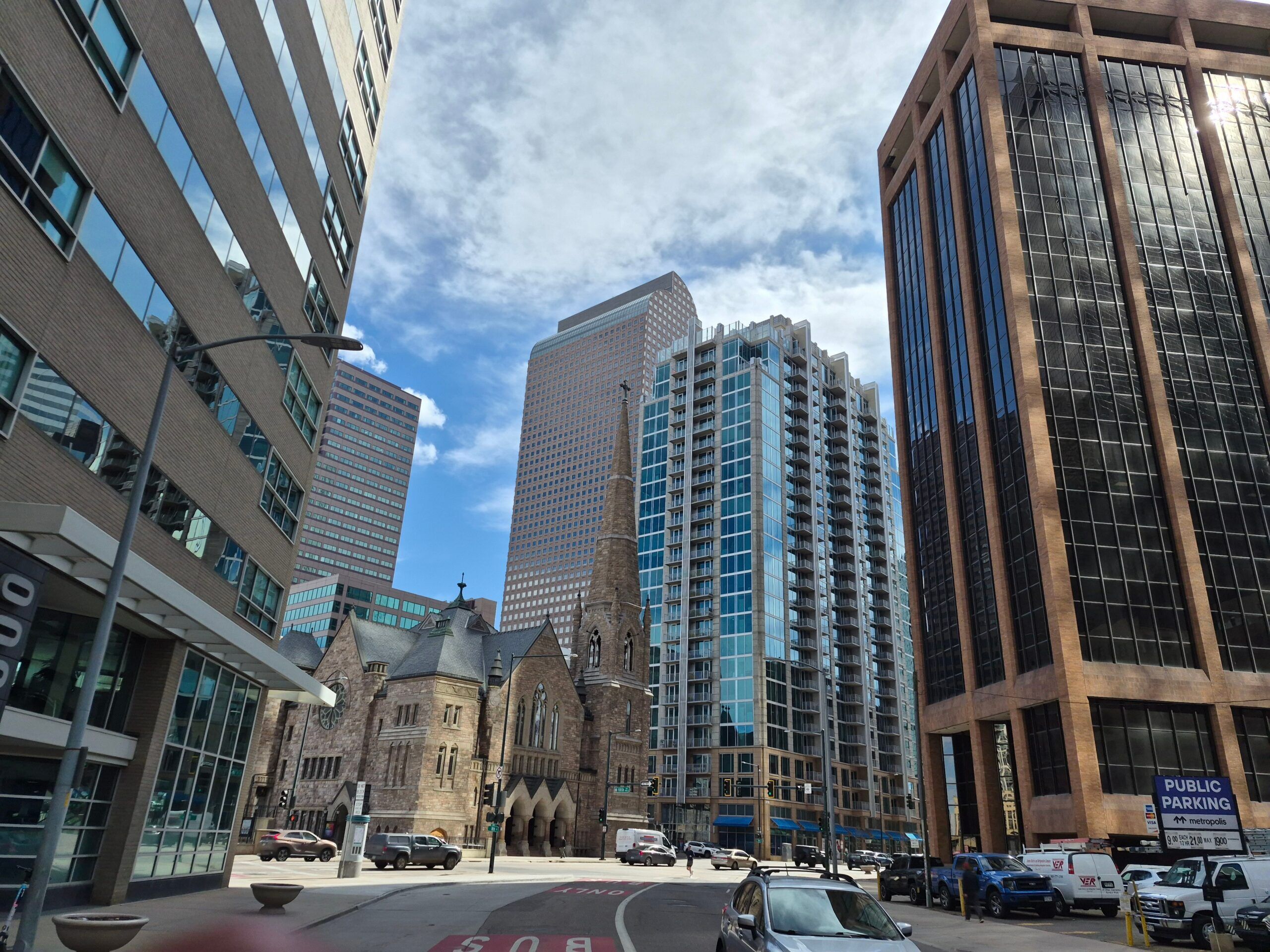
Work-from-home and “flex work” policies, widely adopted five years ago as a hedge against the spread of the COVID-19 pandemic, have lingered on — well after the virus retreated.
But flex work may be running counter to downtown Denver’s efforts to bring the core city back into full life, after its streets largely emptied from 2020 to 2022.
Now, tracking suggests that foot traffic is back up in parts of downtown — good news for restaurants and retailers that hung on through the pandemic, or that returned with the reopening of its 16th Street promenade linking upper and lower downtown.
But beyond the reach of 16th Street, other corridors of the city’s corporate and financial life remain starkly vacant, echoing with less vehicle traffic.
Pedestrians are few.
Bike lanes are empty for minutes at a time.
More evident, corners that were alive with the hottest restaurants and bars back when the city was a model of urban reinvestment appear colorless and quiet.
“We want to get 4,000 units into upper downtown to eliminate some static vacancies,” Denver’s Chief Projects Officer Bill Mosher told The Denver Gazette for a recent story. He had added that he views downtown’s growth as a neighborhood to be essential to its success.
Mosher, who presided over the Downtown Denver Partnership’s hugely successful campaign to create neighborhoods downtown in the 1990s, hopes to see another 1,000 to 1,500 units underway in the nearer term. Several developers have acquired older office towers, which they envision as residential conversions, that could work toward that goal.
But the pandemic was not the only factor slowing a full return now.
According to an analysis by strategic consultants at SB Friedman for a city project management meeting last year, the 3-square-mile area of downtown hosts around 156,000 jobs that represent around 30% of the city’s total workforce.
Some of those are hosted in 44 million square feet of office space downtown. However, most recent development has gone toward residential, which totals 9 million feet, half of which arrived after 2015.
That continues now, as prominent construction in downtown continues to be centered on apartment, including the mammoth Upton Residences, set for 461 new units, at 18th and Glenarm Streets.
Even though the number of jobs downtown has recovered from a 2021 low of around 134,000, office absorption was a negative 5 million feet from 2020 through 2023. Commercial real estate firm CBRE put recent vacancies at a whopping 38.2% at the end of 2025. (The figure includes space that doesn’t appear un-leased on landlords’ books but is nonetheless vacant.)
According to a CommercialCafe report, the wider city has another 604,000 feet under construction, adding more to overall inventory.
City, state and federal agencies that comprise a sizable piece of the downtown workforce keep no uniform records on the trend, according to administrative officers who spoke with The Denver Gazette. That’s in spite of an effort reportedly made during Mayor Michael Hancock’s term to encourage a return to the office.
However, the Downtown Denver Partnership has data showing that return to office (RTO) has largely stalled in downtown. Weekday RTO rates generally held at around 65% or 66% from 2023 through to early 2026.

The stall, agencies said, reflects the popularity of flexible schedules with employers and their managers. That includes state agencies, working to support a governor’s initiative adopted in 2019 to reduce the footprint of state government as a cost saving measure.
Work-from-home and flex-place policies also allow government to hire and hold onto talented employees who don’t want to deal with a daily commute into downtown or its limited parking, said Doug Platt, communications manager for the Colorado Division of Human Resources.
Platt, who told The Denver Gazette he works from home several days a week, said that the department doesn’t track how many people work remotely. However, he added that the majority of employees who apply the flex-place policy work a combination of hours onsite and remote.
“I’m working from home, but not a week goes by that I don’t spend time downtown,” Platt added.
At last count, Platt noted, 20,121 state employees worked in the metro area. Agencies vary, he added, by how important onsite work is to their function.
Meanwhile, the governor’s initiative has reduced the state government’s office and other footprint statewide by 660,766 square feet.
“Our responsibility is to the entire state of Colorado, to run more efficiently,” Platt said, adding that state employees, whether downtown or not, are economically supporting Colorado. “They may not be in downtown, but they’re spending money in their own communities.”
A Denver city employment official, who declined to be named, said that RTO is a challenge post-pandemic.
“I think it’s not unlike any large employer — it’s been tough since Covid,” the official said, adding that the downtown commute may have grown more difficult post-pandemic, as some RTD routes served before the outbreak were never reallocated.
“Parking is at a premium downtown,” the official added. “It’s made it more challenging to commute.
“The mayor could say, ‘I want all employees in three days a week,’” the official suggested, but added that the tracking such would be difficult.
However, even before the first warnings of a pandemic in late 2019, workers were trending away from occupying seats in leased space, according to SB Friedman. Even back then, in-person work accounted for only 60%-to-75% of total jobs. That number still stands at around 66%, according to estimates.
“Flex is here to stay, especially in a quality-of-life environment like Colorado,” Mosher told The Denver Gazette.
“I don’t think we ought to plan around five-day workweeks. COVID proved we can work in other places,” Mosher added. “That means businesses will continue to downsize, and when they do they move to quality.”
“Downtown needs to retain its tenants as they relocate and recruit new tenants to help fill space,” Mosher went on. “But if Colorado isn’t adding jobs, downtown isn’t going to add jobs.
“We need to focus as a region and as a state on creating jobs in metro Denver and then downtown will get its fair share,” he added.
Kourtny Garrett, president and CEO of the Downtown Denver Partnership, agrees that remote work has shifted space requirements, leading to higher vacancies downtown.
“However, in Q4 2025 and continuing into 2026 we are hearing from more and more of our members that in-office policies are shifting back toward an in-person preference,” she said in a statement to The Denver Gazette. She added that last year, downtown had retained over a million feet of tenants whose leases were expiring.
In addition to 16th’s reopening and the arrival of new ground-floor businesses, a new Downtown Area Plan has been adopted by City Council as a roadmap for downtown’s future, Garrett noted.
Meanwhile, as tech jobs grow in proportion to the total workforce, tech workers show the lowest rates of RTO. SB Friedman’s study showed them working on site around half the week on average, compared to closer to three days a week for financial service workers.
Analysts at CBRE and other observers have viewed the newer vacancy rates as “stabilizing” — but the Friedman study shows Denver occupancy trending 7% beneath other downtowns nationally.

Polis administration relaunches Colorado e-bike rebates with $3 million
Scott Weiser
scott.weiser@gazette.com
Updated 2 days ago
Gov. Jared Polis and the Colorado Energy Office announced Thursday the return of the state’s popular e-bike rebate program, with registration set to open later this month. The office plans to provide point-of-sale rebates totaling $3 million from the Community...

Right-to-natural-gas proposal in Colorado qualifies for ballot
Marissa Ventrelli
marissa.ventrelli@coloradopolitics.com
Updated 3 days ago
A citizen initiative that seeks to enshrine the right to natural gas has qualified for the November ballot, Colorado’s election office confirmed on Thursday. Petitions containing signatures for Initiative No. 177 were turned in to the Secretary of State’s Office for review...

Colorado AG urges Supreme Court to let Boulder climate lawsuit proceed
Marissa Ventrelli
marissa.ventrelli@coloradopolitics.com
Updated 3 days ago
Colorado Attorney General Phil Weiser has filed a court brief with the U.S. Supreme Court in a lawsuit brought by Boulder city officials seeking to hold oil companies liable for their environmental impact. The case began in 2018, when the...

New Colorado laws going into effect cover AI disclosures, medical marijuana access and gambling limits
Marissa Ventrelli
marissa.ventrelli@coloradopolitics.com
Updated 4 days ago
More than 100 new Colorado laws take effect Aug. 12, bringing changes to chatbot safety rules, psychedelic research, campus wellness checks and sports betting restrictions. Here is a look at some of those laws set to take effect. The law:...

Denver aerospace company Voyager sees rapid growth in latest earnings
Bernadette Berdychowski
bernadette.berdychowski@denvergazette.com
Updated 4 days ago
A fast-growing aerospace and defense company based in Denver saw record revenues and record bookings in the latest quarter. Voyager Technologies announced it generated $52.7 million in the second quarter, according to its latest earnings report released Monday. Revenues are...

Early bird pricing ends soon for Fill a Plate for Hunger fundraiser | NONPROFIT REGISTER
Joanne Davidson Special to Colorado Politics
joanne-davidson-special-to-colorado-politics@coloradopolitics.com
Updated 2 days ago
WE DON’T WASTE Denver News: Early bird pricing for Fill a Plate for Hunger, the signature fundraiser for We Don’t Waste, ends on Aug. 10 when the Foodie-level tickets jump in price from their current $225. The 15th edition of this popular event takes place Sept. 10...

Pickleball, anyone? It’s for a good cause | NONPROFIT REGISTER
Joanne Davidson Special to Colorado Politics
joanne-davidson-special-to-colorado-politics@coloradopolitics.com
Updated 2 days ago
ROCKY MOUNTAIN CHILDREN’S HEALTH FOUNDATION Arvada News: Pickleball is still quite the rage, and to capitalize on its popularity, the Rocky Mountain Children’s Health Foundation will host its first fundraising tournament on Aug. 23. It will be from 2-5 p.m. at Chicken & Pickle, 14225...

Colorado joins 2 lawsuits against Trump administration over TANF, tariffs authority
Marissa Ventrelli
marissa.ventrelli@coloradopolitics.com
Updated 6 days ago
Colorado has joined a coalition of states in filing two new lawsuits against the Trump administration. The first lawsuit alleges the Trump administration’s move to expand the U.S. health department’s oversight of the Temporary Assistance for Needy Families would illegally...

Colorado farmers, ranchers wrestle with hurdles amid extreme drought conditions
Shen Wu Tan (Special to The Denver Gazette)
shen-wu-tan@gazette.com
Updated 7 days ago
Some producers take drastic steps to adapt to dry climate, record-low snowpack This is the first time that Jim Magnuson, who operates a family farm in the rural town of Eaton, can ever recall planting only 75% of his acreage. ...
Federal biotech commission examines Colorado’s role in critical minerals production
Scott Weiser
scott.weiser@gazette.com
Updated 1 week ago
China’s dominance over critical mineral supplies has left U.S. manufacturers vulnerable. Colorado’s biotech and research community is working to ease that dependence. Leaders from the National Security Commission on Emerging Biotechnology met last week at the Colorado School of Mines...
PREV
PREVIOUS

Colorado health equity funder's redirection debated
A redirection in grantmaking that began two years ago for The Colorado Trust, a 40-year-old Denver-headquartered funder, has led some employees to now voice concerns, which has reportedly put their jobs in jeopardy. The vice president of communications for the private health equity foundation says the course has been set for years, with this being […]

Colorado Democrats pass union fee bill, even after Polis signals another veto
The Colorado House on Monday advanced along party lines legislation repealing a longstanding labor law governing a requirement before a unionized workplace can collect fees on all workers, regardless of whether they are union members. The House voted, 42-22, to send the proposal to repeal that second election requirement under the state’s current laws to […]